
普惠金融

Search documents
【铜川】让更多经营主体享受政策红利
Shan Xi Ri Bao· 2025-09-11 22:50
Group 1 - The successful implementation of ESG-linked loans has helped companies like Tongchuan Hengsheng Technology Materials Co., Ltd. overcome financial difficulties, showcasing the effectiveness of inclusive finance reforms in Tongchuan City [1] - Since the approval of the inclusive finance reform pilot zone in September 2022, the People's Bank of China Tongchuan Branch has focused on enhancing the business environment and developing a multi-layered inclusive finance system to support high-quality regional economic development [1][2] - By the end of June, the balance of medium and long-term loans in Tongchuan's manufacturing sector reached 5.496 billion yuan, with an increase of 389 million yuan since the beginning of the year, indicating a significant improvement in financing efficiency [1] Group 2 - Junmei Jingwei Circuit Co., Ltd. received 25 million yuan in credit funding from multiple banks to enhance its R&D capabilities and expand product applications, reinforcing its position as a key player in the regional electronic information industry [2] - The establishment of inclusive finance specialized departments in 14 banks and 6 insurance institutions in Tongchuan has improved the accessibility of financial services, with 722 rural payment points and 34 comprehensive service stations set up to serve local communities [2] - The People's Bank of China Tongchuan Branch has effectively utilized structural monetary policy tools to guide credit resources towards inclusive finance, resulting in a 16.04% year-on-year increase in total loans, surpassing 50 billion yuan for the first time [4] Group 3 - The inclusive finance reform pilot zone in Tongchuan has achieved significant progress in service innovation and ecological optimization, but there remains substantial room for improvement in data support, guarantee capabilities, and promoting higher-level innovation [3] - By the end of June, the average interest rate on corporate loans in Tongchuan dropped to 3.18%, with a cumulative reduction of 138 million yuan, alleviating the financing difficulties faced by small and micro enterprises [4] - Future plans include expanding service models along industrial chains and enhancing financial support for key projects and quality enterprises to further integrate financial and industrial chains [5]
金融赋能 绘就经济新图景
Sou Hu Cai Jing· 2025-09-11 21:21
Group 1 - The financial services section of the 2025 Service Trade Fair focuses on "Digital Intelligence Driving Open Win-Win," providing a platform for global financial institutions to collaborate and showcase new trends in finance [1] - A total of 97 companies participated in the financial services section, with 51 domestic and 46 foreign institutions, resulting in an internationalization rate of 47.4% [10] - The event highlighted the importance of financial technology in promoting inclusive finance, with innovations such as voiceprint technology for elderly clients to facilitate transactions [10] Group 2 - The digital RMB was prominently featured, with various banks offering promotional activities to encourage its use, including a "red envelope rain" event [11][12] - Innovative applications of digital RMB were showcased, such as the collaboration between Industrial and Commercial Bank of China and Meituan to develop a digital RMB prepaid card [12] - The event also emphasized the value of investment, with companies like Galaxy Securities and Jianxin Fund using the fair to engage with a wide audience and promote their services [13][14]






深耕科技金融 东兴证券做科创企业长期陪跑者
Zheng Quan Shi Bao· 2025-09-11 18:08
Core Viewpoint - Dongxing Securities is actively integrating national strategies and promoting high-quality development into its operational practices through deepening reforms, focusing on its main business, and collaborative development [1][2]. Group 1: Financial "Five Articles" - The implementation of the financial "Five Articles" series of policies provides fundamental guidance for securities companies to deepen their main business transformation and enhance service efficiency [2]. - Dongxing Securities plans to incorporate the financial "Five Articles" into its long-term strategic development, strengthening organizational management and internal reforms to enhance core competitiveness [1][2]. Group 2: Technology Finance and Competitive Advantage - Dongxing Securities is focusing on technology finance to create a distinctive competitive advantage, actively participating in the issuance of technology innovation bonds [2]. - In July, Dongxing Securities successfully issued "2025 Technology Innovation Company Bonds (First Phase)" with a scale of 1 billion yuan and a coupon rate of 1.80%, receiving a subscription multiple of 3.94 times [2][3]. Group 3: Support for High-tech Enterprises - Over the past five years, Dongxing Securities has served 35 real economy enterprises, helping them raise a total of 29 billion yuan through IPOs, ranking 17th in the industry [3]. - In the first half of 2025, Dongxing Securities ranked among the top three in the industry as a sponsor for four high-tech enterprises completing IPOs [3]. Group 4: Comprehensive Lifecycle Services - Dongxing Securities is enhancing its financial services for technology enterprises throughout their entire lifecycle, exemplified by its support for Xianhui Technology in various capital operations [4]. - The company assisted Xianhui Technology in its IPO in 2020 and subsequent financing efforts, helping it transition into a dual-driven product layout in smart manufacturing and new energy [4]. Group 5: Green and Inclusive Finance - Dongxing Securities has successfully issued green bonds and asset-backed securities, supporting enterprises in environmental protection and clean energy sectors [7]. - The company has issued a total of 1.344 billion yuan in rural revitalization bonds and corporate bonds to promote inclusive finance in underdeveloped regions [7]. Group 6: Digital Finance Strategy - Dongxing Securities has developed a digital finance strategy focusing on "strategic leadership, digital drive, platform empowerment, collaborative innovation, and building a smart Dongxing" [8].


【时代风口】中国RWA市场真正突破口在非金融资产
Zheng Quan Shi Bao· 2025-09-11 18:00
Core Insights - The discussion around Real World Assets (RWA) has become a central topic in the digital finance and blockchain industry, aiming to address liquidity and financing efficiency issues in the real economy [1] - The Chinese market has significant potential for RWA, particularly in non-financial assets, which face challenges such as unclear rights, difficult valuation, low liquidity, and high transaction costs [1] Group 1: Real Estate - China's real estate market is large, but traditional transaction and financing channels are rigid, leading to many quality assets being illiquid [2] - REITs reforms have shown potential for improving liquidity through structured tools, but blockchain technology can further enhance this by tokenizing real estate assets, lowering investment thresholds, and increasing transaction efficiency [2] Group 2: Commodities and Energy - As a major manufacturing and energy consumption country, China has a persistent demand for the financialization of commodities and energy assets [2] - Digitizing these assets through RWA can improve their circulation efficiency and support green transformation goals [2] Group 3: Data and Computing Power - Data and computing power are emerging as new production factors in the digital economy, with complex rights and circulation issues [2] - RWA can facilitate the tokenization of data assets, allowing for their rights to be clearly defined and traded, while computing power can be transformed into distributed resources for various users [2] Group 4: Art and Intangible Assets - The art market in China is large but suffers from transparency and valuation issues, making it difficult for investors to enter [3] - Tokenization can split ownership and usage rights of art, improving liquidity and expanding the market depth for art finance [3] - Intangible assets like intellectual property also face rights and circulation challenges, which RWA can address by providing transparent registration and trading mechanisms [3] Group 5: Market Innovation and Challenges - The innovation value of RWA in China lies in improving the liquidity of non-financial assets, allowing companies to convert various assets into digital rights for financing and trading [4] - Tokenization can lower investment barriers and promote inclusive finance, enabling more ordinary investors to participate [4] - RWA can enhance market transparency and transaction efficiency, reducing fraud risks and providing new investor protection methods [4] Group 6: Future Development and Recommendations - The development of non-financial assets on-chain faces challenges, particularly in rights clarification and valuation transparency [5] - To achieve healthy development in the RWA market, three breakthroughs are necessary: updating regulatory frameworks, accelerating standardization, and deepening scenario-based exploration [6] - RWA should align with national strategies for technological innovation, green transformation, and inclusive finance to address structural economic issues in China [6]
做好金融“五篇大文章”!江苏发力
Shang Hai Zheng Quan Bao· 2025-09-11 16:14
Core Viewpoint - The People's Bank of China Jiangsu Branch, along with various financial regulatory bodies, has drafted an action plan to enhance financial support for high-quality economic development in Jiangsu Province by focusing on five key financial areas [1][3]. Group 1: Action Plan Overview - The action plan consists of seven sections and 25 items, outlining development paths for technology finance, green finance, inclusive finance, pension finance, and digital finance [3]. - The core objective is to significantly improve financing accessibility in key strategic areas by 2027, optimizing the supply-demand match of financial products and services [3][4]. Group 2: Key Financial Areas - **Technology Finance**: The plan emphasizes increasing credit support for technology enterprises through a "stock-loan-bond guarantee" model, promoting investment-loan linkage, and establishing a technology finance alliance [3][6]. - **Green Finance**: It aims to enhance financing for green and low-carbon projects, expand the green financing subject library, and promote environmental information disclosure and ESG evaluation [3][4]. - **Inclusive Finance**: Focuses on expanding services for private enterprises, reducing costs for small and micro businesses, and supporting rural revitalization and poverty alleviation [4][5]. - **Pension Finance**: Plans to develop a collaborative system for pension financial products and services, establish a list of key enterprises in the silver economy, and promote financial education for the elderly [4][5]. - **Digital Finance**: Aims to advance the digital transformation of financial institutions, support the construction of digital economy pilot zones, and enhance data sharing and infrastructure [4][5]. Group 3: Implementation and Achievements - The Jiangsu Province has seen significant achievements in inclusive finance, with over 201 million registered users on its financial service platform, facilitating 6.49 trillion yuan in credit for small and micro enterprises [5]. - The regulatory body is implementing various policies to enhance technology finance, including pilot projects for equity investment and knowledge property finance [6][7]. - The transformation finance framework has been established, with over 2 billion yuan in loans allocated to incentivize enterprise transformation [7].
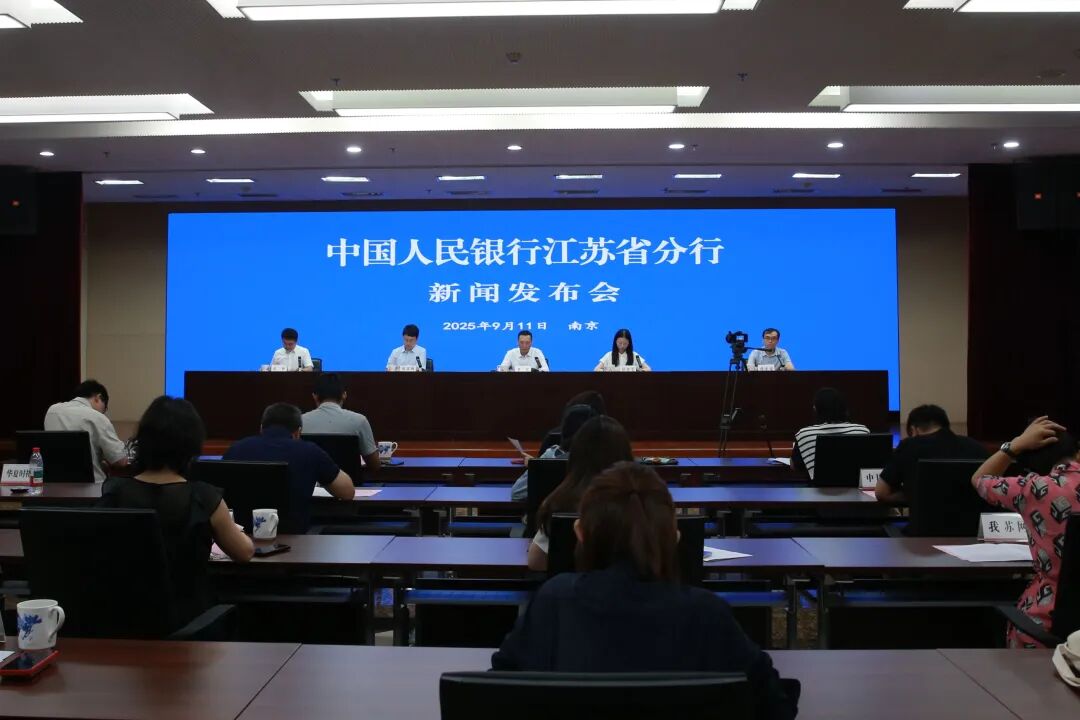
江苏晒出“一站式”综合金融服务“成绩单”:48.53万户中小微企业获得6.49万亿元授信
Yang Zi Wan Bao Wang· 2025-09-11 15:06
Core Insights - Jiangsu Province's financial office has made significant progress in promoting inclusive finance, with a comprehensive financial service platform aiding 485,300 small and micro enterprises in obtaining credit totaling 6.49 trillion yuan by the end of August [1][2]. Group 1: Financial Service Platform Development - The comprehensive financial service platform has developed multiple sub-sectors, including talent finance, green finance, blue finance, and rural revitalization finance, maximizing its one-stop service capabilities [2]. - As of the end of August, the platform has over 2.01 million registered users and 536 financial institutions, with 3,271 financial products published [2]. Group 2: Credit and Loan Statistics - The platform has facilitated credit for 485,300 small and micro enterprises, with credit loans amounting to 1.63 trillion yuan, accounting for 25.12% of the total [2]. - Among the beneficiaries, 152,700 are first-time borrowers, representing 31.47% of the total [2]. Group 3: Credit Data and Support Mechanisms - The provincial credit service platform has collected 7,916 enterprise credit data items and 2.04 billion records, covering approximately 1.63 million small and micro enterprises [2]. - A coordinated financing mechanism for small enterprises has been established, with 4.19 million enterprises visited and 320 billion yuan in credit granted to 610,400 enterprises by the end of August [2]. Group 4: Financial Consumer Protection and Governance - To enhance financial consumer protection, 100 financial dispute mediation service points have been established across the province, facilitating communication between consumers and financial institutions [3]. - The financial office has organized 62 special events this year to promote financial services to enterprises, addressing financing needs of approximately 6 billion yuan, with plans for over 100 events throughout the year [3].
普惠金融“期中考”交卷:农行四项指标居首 中小行份额继续下降
2 1 Shi Ji Jing Ji Bao Dao· 2025-09-11 13:09
Core Insights - The share of inclusive finance business by large commercial banks continues to increase, while the market share of rural financial institutions is declining [1][2] - The transition of inclusive finance development in China is moving from "incremental expansion" to "high-quality development" [2][3] Summary by Category Inclusive Finance Market Share - As of the end of Q2 2024, large commercial banks accounted for 45.11% of inclusive micro-enterprise loans, while rural financial institutions' share dropped to 25.86% from 27.38% in Q1 2023 [1] - The average growth rate of inclusive micro-enterprise loans has been slowing down, with growth rates of 30.9%, 24.9%, 23.6%, 23.3%, and 14.7% from 2020 to 2024 respectively [1] Regulatory Changes - Recent regulatory documents emphasize the shift towards high-quality development, moving away from rigid quantity targets [2][3] - The 2023 and 2024 notifications from the financial regulatory authority focus on maintaining volume, stabilizing prices, and improving structure, with an added emphasis on quality in 2025 [2] Performance of Major Banks - Agricultural Bank of China leads in inclusive micro-enterprise loans with a balance of 3.82 trillion yuan, followed closely by China Construction Bank at 3.74 trillion yuan [4] - Agricultural Bank's loan balance growth rate is 18.50%, the highest among major banks, with other banks like Industrial and Commercial Bank of China and China Construction Bank also showing strong growth rates [4][5] Customer Base and Service Innovations - Agricultural Bank has the highest number of inclusive micro-enterprise loan customers at 520.84 million, reflecting a significant increase [5] - The bank is innovating its service offerings by leveraging AI technology and enhancing its online service platforms [6] Asset Quality Focus - Several banks are prioritizing the improvement of asset quality in their inclusive micro-loan portfolios, with specific strategies tailored to their customer bases [8][9] - Agricultural Bank reported that its inclusive loan and credit card non-performing loan rates are among the best in the industry [10][11]

普惠金融“期中考“交卷:农行四项指标居首 中小行份额继续下降
2 1 Shi Ji Jing Ji Bao Dao· 2025-09-11 13:01
Core Insights - The share of inclusive finance business by large commercial banks continues to increase, while the market share of rural financial institutions is declining [1][2] - The transition of inclusive finance development in China is moving from "incremental expansion" to "high-quality development" [2][3] Summary by Sections Inclusive Finance Market Share - As of the end of Q2 2024, large commercial banks' inclusive micro-enterprise loans accounted for 45.11% of the total, while rural financial institutions' share dropped to 25.86% from 27.38% in Q1 2023 [1] - The average growth rate of inclusive micro-enterprise loans has been slowing down, with growth rates of 30.9%, 24.9%, 23.6%, 23.3%, and 14.7% from 2020 to 2024 respectively [1] Regulatory Changes - Recent regulatory documents emphasize the shift towards high-quality development, moving away from rigid quantity targets [2][3] - The 2023 and 2024 notifications from the financial regulatory authority focus on maintaining volume, stabilizing prices, and improving structure, with an added emphasis on quality in 2025 [2] Performance of Major Banks - Agricultural Bank of China leads in inclusive micro-enterprise loans with a balance of 3.82 trillion yuan, followed closely by China Construction Bank at 3.74 trillion yuan [4] - Agricultural Bank's loan balance growth rate is the highest among major banks at 18.50%, with other banks like Industrial and Commercial Bank of China and China Bank also showing strong growth [4][5] Client Base and Service Innovations - Agricultural Bank has the largest number of clients for inclusive micro-enterprise loans at 5.2084 million, reflecting a significant increase [5] - The bank is innovating its service offerings by leveraging AI technology and enhancing its online service platforms [6] Focus on Asset Quality - Many banks are prioritizing the improvement of asset quality for inclusive micro-loans, with specific strategies tailored to their client bases [8][9] - Agricultural Bank reported that its non-performing loan rates for inclusive loans are among the best in the industry, indicating effective risk management practices [11]
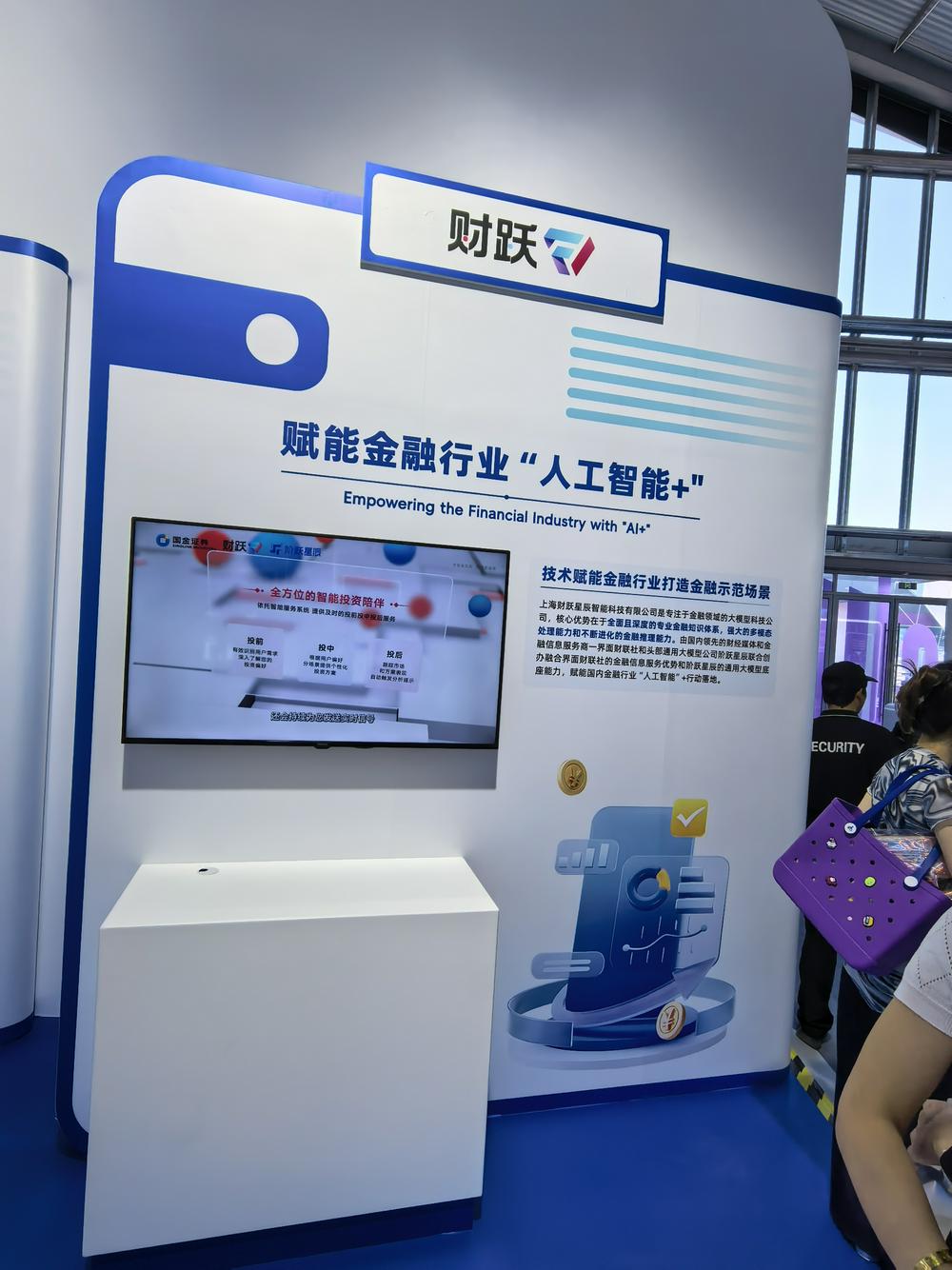
财跃星辰携四大成果亮相外滩大会,以AI创新重塑金融科技新图景
Xin Lang Cai Jing· 2025-09-11 12:45
Core Viewpoint - The "2025 Inclusion·Bund Conference" in Shanghai focuses on "reshaping innovative growth" and showcases advancements in financial AI technology, emphasizing the role of Shanghai in global financial innovation [1] Group 1: Financial AI Innovations - The conference highlighted four major financial AI achievements from Caiyue Xingchen, showcasing its breakthroughs in intelligent financial services [3] - The AI Xiaocaishen Pro product, known for its exceptional financial research capabilities, can generate professional financial reports in just half an hour, integrating exclusive data and analysis tools [3] - AI Xiaocaishen Pro ranked first in China and among the top three globally in the FinResearchBench evaluation for financial research report writing [3] Group 2: Collaborative Models - The Junhong Lingxi model, developed in collaboration with Guotai Junan, is the first multimodal large model with a scale of over 100 billion parameters, capable of processing text, images, and voice data [4] - This model enhances data perception and intelligent analysis, providing precise and efficient support in complex financial scenarios, thus creating a new paradigm in smart finance [4] Group 3: Inclusive Financial Services - The Shanghai Bank AI Mobile Banking, developed with Shanghai Bank, successfully addresses dialect recognition and synthesis, offering a seamless financial service experience for local elderly populations [5] - The Guojin AI Investment Advisory, created with Guojin Securities, merges strategy and service to lower the barriers for professional investment, making personalized advisory services accessible to a broader audience [5] - Caiyue Xingchen's innovations reflect the integration of cutting-edge technology with industry practices, contributing to the development of Shanghai as a global financial technology center [5]
普惠金融-小微指数显示:2025年二季度小微企业发展状况稳中向好
Zheng Quan Ri Bao Wang· 2025-09-11 09:50
Core Insights - The "Inclusive Finance - Micro and Small Enterprises Index" indicates a continuous improvement in the business environment for micro and small enterprises by Q2 2025, with stable funding supply and increased financial service accessibility and satisfaction [1][2] Group 1: Financing Conditions - The financing supply index for micro and small enterprises reached 205.10 points in Q2 2025, reflecting a month-on-month increase of 3.43% [1] - The financing demand index decreased to 111.86 points, showing a significant month-on-month decline of 24.81 points [1] - There was a notable increase in the demand for liquidity supplement funds of 100,000 yuan and below [1] Group 2: Business Development Indicators - The Inclusive Finance - Micro Development Index remained stable at 52.37 points in Q2 2025, with a month-on-month increase of 0.50%, surpassing the 50-point threshold [1] - The order index stood at 40.60 points, reflecting a month-on-month increase of 0.20% [1] - The micro business index was recorded at 57.84 points, with a month-on-month rise of 0.18%, and the policy environment index increased to 51.61 points, up by 0.87% [1] Group 3: Service Quality and Satisfaction - The service availability index was reported at 197.51 points, showing a month-on-month decrease of 0.57% [2] - The service quality index improved to 111.41 points, with a month-on-month increase of 0.94%, and the satisfaction index rose to 107.33 points, reflecting a month-on-month increase of 1.09% [2] - Overall, the quality of financial services for micro and small enterprises has improved, leading to enhanced satisfaction levels [2]