新型工业化

Search documents
李乐成:夯实基本盘培育新动能,奋力开创新型工业化新局面
Xin Hua She· 2026-01-12 06:05
Core Viewpoint - The article emphasizes the importance of implementing the "14th Five-Year Plan" to ensure stable growth in the industrial economy, focusing on innovation, expansion, and the integration of technology and industry [1][2]. Group 1: Industrial Economic Growth Measures - The industrial and information system aims to maintain stable growth by focusing on four key areas: "stability," "expansion," "innovation," and "increase" [2][3]. - In the first eleven months of 2025, the industrial added value above designated size grew by 6% year-on-year, with high-tech manufacturing and equipment manufacturing increasing by 9.2% and 9.3% respectively [2]. - The focus will be on stabilizing key industries and regions, which account for 80% of the total industrial output [2]. Group 2: Modern Industrial System Development - The development of a modern industrial system will prioritize advanced manufacturing, aiming for high-quality growth through intelligent, green, and integrated development [4][5]. - Traditional industries will undergo renewal through targeted improvement plans, while new industries will be supported to become new growth engines [4]. - Future industries will be strategically planned, focusing on breakthroughs in quantum technology, humanoid robots, and 6G [5]. Group 3: Technology and Industry Integration - The integration of technology and industry has seen significant advancements during the "14th Five-Year Plan," with a focus on enhancing the innovation capabilities of the manufacturing sector [6][7]. - The government plans to increase high-quality technological supply and strengthen the role of enterprises in innovation [6]. - Efforts will be made to streamline the conversion of technological achievements and optimize the innovation ecosystem [7]. Group 4: Digital Transformation in Manufacturing - The "14th Five-Year Plan" emphasizes the deep integration of information technology and industrialization, with a focus on accelerating the digital transformation of manufacturing [8][9]. - The establishment of high-quality industry data sets and the promotion of digital transformation for enterprises are key initiatives [8]. - The development of industrial internet platforms and the application of artificial intelligence in manufacturing are prioritized to enhance productivity [9].
李乐成接受新华社采访:夯实基本盘培育新动能 奋力开创新型工业化新局面
Xin Hua She· 2026-01-12 05:41
Core Viewpoint - The interview with Li Lecheng, Minister of the Ministry of Industry and Information Technology, emphasizes the importance of stabilizing and expanding industrial growth while fostering innovation and new momentum in the context of the "14th Five-Year Plan" and the upcoming "15th Five-Year Plan" [3][4]. Group 1: Industrial Economic Growth - The industrial economy has shown resilience and vitality, with a 6% year-on-year growth in industrial added value for large-scale industries in the first 11 months of 2025, and high-tech manufacturing and equipment manufacturing growing by 9.2% and 9.3% respectively [4]. - The focus for 2026 will be on four key areas: stability, expansion, innovation, and enhancement, with an emphasis on stabilizing growth in key industries and regions that account for 80% of total industrial output [4][5]. Group 2: Modern Industrial System - The construction of a modern industrial system will prioritize advanced manufacturing, aiming for high-quality development through intelligent, green, and integrated manufacturing [6][7]. - Traditional industries will undergo renewal through targeted improvement plans, while emerging industries will be supported to become new growth engines [7]. Group 3: Technology and Innovation - The integration of technology and industry has seen significant advancements during the "14th Five-Year Plan," with a focus on enhancing the capacity for technological innovation and achieving high-level self-reliance in technology [8][9]. - Future plans include increasing high-quality technological supply, strengthening the role of enterprises in innovation, and optimizing the ecosystem for integrated innovation [9][10]. Group 4: Digital Transformation - The push for deep integration of information technology and industrialization will continue, with a focus on digital transformation in manufacturing, supported by advancements in network technology and artificial intelligence [10][11]. - Key initiatives will include building high-quality industry data sets and promoting the digital transformation of enterprises, particularly in the manufacturing sector [11].
工信部部长李乐成:2026年将着重抓好“稳”“扩”“创”“增”四方面工作
Xin Hua She· 2026-01-12 05:39
权威访谈·开局"十五五"|夯实基本盘培育新动能 奋力开创新型工业化新局面——访工业和信息化部党组 书记、部长李乐成 "十五五"规划建议将"建设现代化产业体系,巩固壮大实体经济根基"摆在战略任务的首位。近期召开的 中央经济工作会议围绕推进新型工业化,作出一系列部署。 2026年是"十五五"开局之年。如何确保工业经济平稳增长?怎样加快推动科技创新和产业创新深度融 合?新华社记者采访了工业和信息化部党组书记、部长李乐成。 四方面发力,推动工业经济行稳致远 问:2026年将采取哪些措施保持工业经济平稳增长? 答:过去一年,工业和信息化系统坚持稳中求进工作总基调,推动工业经济顶压前行、向新向优发展, 实现质的有效提升和量的合理增长,展现强大韧性和活力。2025年前11个月,规模以上工业增加值同比 增长6%,规模以上高技术制造业、装备制造业增加值同比分别增长9.2%、9.3%,产业提质升级步伐明 显加快,新动能不断壮大。 2026年,我国工业经济发展韧性强、潜力大、活力足的优势条件没有改变,当然也面临一些风险挑战, 只要坚定信心、迎难而上,用创新的思路、改革的办法,用足用好优势条件,完全能够推动工业经济行 稳致远。我们将 ...
工信部:聚焦脑机接口、6G等领域,加强技术攻关、产品开发
Xin Hua She· 2026-01-12 05:11
Core Viewpoint - The Ministry of Industry and Information Technology emphasizes the need for a forward-looking layout and coordinated planning to accelerate the establishment of mechanisms for future industry investment growth and risk sharing, focusing on breakthroughs in fields such as quantum technology, humanoid robots, brain-computer interfaces, deep-sea polar exploration, and 6G technology [1] Group 1: Industrial Economic Stability - The industrial and information system aims to maintain stable growth in the industrial economy, achieving a year-on-year increase of 6% in industrial added value for large-scale industries in the first 11 months of 2025, with high-tech manufacturing and equipment manufacturing growing by 9.2% and 9.3% respectively [2] - The focus will be on four areas: "stability," "expansion," "innovation," and "growth" to ensure industrial economic resilience and vitality [2][3] Group 2: Modern Industrial System Development - The construction of a modern industrial system will prioritize advanced manufacturing, aiming for high-quality development through intelligent, green, and integrated manufacturing [4] - Traditional industries will undergo renewal through targeted improvement plans, while emerging industries will be supported to become new engines of growth [4][5] Group 3: Technology and Innovation Integration - The integration of technology and industry will be deepened, with a focus on enhancing the supply of high-quality technology and promoting the transformation of technological achievements [6][7] - The establishment of a national manufacturing innovation center and the implementation of major technology projects will be prioritized to boost industrial technological innovation capabilities [6][8] Group 4: Digital Transformation in Manufacturing - The push for deep integration of information technology and industrialization will continue, with significant advancements in digitalization, networking, and intelligence in manufacturing [9][10] - The focus will be on building a robust digital foundation and enhancing network connectivity to facilitate the transition to smart manufacturing [9][10]


工信部部长李乐成:推动未来制造、未来信息、未来材料等取得新突破
Xin Hua She· 2026-01-12 04:24
Core Viewpoint - The article emphasizes the importance of solidifying the foundation of the industrial economy and fostering new growth drivers to achieve a new phase of industrialization, as highlighted by the Ministry of Industry and Information Technology's strategic tasks for the 14th Five-Year Plan [1]. Group 1: Industrial Economic Stability - The industrial and information system aims to maintain stable growth in the industrial economy by focusing on four key areas: "stability," "expansion," "innovation," and "increase" [2]. - In the first 11 months of 2025, the industrial added value above designated size grew by 6% year-on-year, with high-tech manufacturing and equipment manufacturing increasing by 9.2% and 9.3% respectively [2]. - The focus will be on stabilizing key industries and regions, which account for 80% of the total industrial output [2]. Group 2: Expanding Effective Demand - Efforts will be made to enhance supply-demand matching, promote flexible manufacturing, and accelerate the application of new technologies such as artificial intelligence [3]. - The government plans to initiate major projects under the 14th Five-Year Plan and strengthen the coordination of industrial and trade policies [3]. Group 3: Promoting Value Creation - The strategy includes revitalizing traditional industries and fostering emerging industries to create new growth drivers [4]. - There will be a focus on major technological upgrades and enhancing standards, quality, and brand development [4]. Group 4: Enhancing Business Vitality - A system for nurturing high-quality enterprises will be established, with particular attention to improving cash flow for small and medium-sized enterprises [5]. - The government will monitor capacity in key industries and continue to address issues of overdue payments to businesses [5]. Group 5: Building a Modern Industrial System - The construction of a modern industrial system will be anchored by advanced manufacturing, with a focus on high-quality development [4]. - Traditional industries will undergo renewal, while emerging industries will be supported to become new pillars of economic growth [4]. Group 6: Deepening Integration of Technology and Industry - The integration of technology and industry will be accelerated, with significant advancements made during the 14th Five-Year Plan period [6]. - The government aims to enhance the supply of high-quality technology and strengthen the role of enterprises in innovation [6]. Group 7: Promoting Digital Transformation - The Ministry of Industry and Information Technology will focus on advancing the digital transformation of manufacturing, with 5G applications already integrated into 91 out of 97 major sectors of the economy [8]. - The plan includes building high-quality industry data sets and promoting digital transformation among enterprises [8]. Group 8: Enhancing Intelligent Manufacturing - The strategy will involve promoting artificial intelligence in manufacturing and developing intelligent manufacturing platforms [10]. - The government aims to create a multitude of application scenarios to drive high-quality development in the manufacturing sector [10].
权威访谈·开局“十五五”丨夯实基本盘培育新动能 奋力开创新型工业化新局面——访工业和信息化部党组书记、部长李乐成
Xin Hua Wang· 2026-01-12 03:31
Core Viewpoint - The "14th Five-Year Plan" emphasizes the construction of a modern industrial system and the strengthening of the real economy as a strategic priority, with a focus on promoting new industrialization and ensuring stable growth in the industrial economy by 2026 [1] Group 1: Measures for Industrial Economic Stability - The industrial and information systems will focus on four areas: "stability," "expansion," "innovation," and "growth" to ensure steady industrial economic growth [2] - In the first 11 months of 2025, the industrial added value above designated size grew by 6% year-on-year, with high-tech manufacturing and equipment manufacturing increasing by 9.2% and 9.3% respectively [2] - Key industries and regions account for 80% of the total industrial output, and targeted support will be provided to stabilize growth in these areas [2] Group 2: Enhancing Industrial Structure - The modern industrial system will be built around advanced manufacturing, focusing on high-quality development and the integration of intelligent, green, and collaborative manufacturing [4] - Traditional industries will undergo renewal through targeted improvement plans and the implementation of "Artificial Intelligence +" initiatives [4] - New industries will be developed as new engines for industrial upgrade, with the establishment of national demonstration bases for emerging industries [4] Group 3: Promoting Technological Innovation - The integration of technology and industry will be deepened, with a focus on enhancing the capacity for technological innovation in manufacturing [6] - A national manufacturing innovation center will be established to support high-quality technological supply and promote collaboration between enterprises and research institutions [6] - The government will implement policies to support small and medium-sized enterprises in enhancing their cash flow and innovation capabilities [6] Group 4: Digital Transformation in Manufacturing - The "14th Five-Year Plan" has made significant progress in promoting the digitalization, networking, and intelligence of manufacturing, with 5G applications integrated into 91 out of 97 major economic categories [8] - The focus will be on building a robust digital foundation and promoting the digital transformation of enterprises, especially in large-scale and small and medium-sized enterprises [8][9] - The development of industrial internet platforms and smart manufacturing solutions will be prioritized to enhance connectivity and application in key industries [9][10]
夯实基本盘培育新动能 奋力开创新型工业化新局面——访工业和信息化部党组书记、部长李乐成
智通财经网· 2026-01-12 03:28
Core Viewpoint - The "14th Five-Year Plan" emphasizes the construction of a modern industrial system and the consolidation of the real economy as a strategic priority, with a focus on promoting new industrialization and ensuring stable growth in the industrial economy by 2026 [1]. Group 1: Measures for Stable Industrial Growth - The industrial and information systems will focus on four areas: "stability," "expansion," "innovation," and "growth" to ensure steady industrial economic growth [2]. - "Stability" involves maintaining growth in key industries and regions, which account for 80% of total industrial output, by implementing growth support plans for major sectors like steel and petrochemicals [2]. - "Expansion" aims to enhance effective demand by promoting flexible manufacturing and accelerating the application of new technologies such as artificial intelligence [3]. - "Innovation" focuses on value creation and quality improvement through traditional industry renewal and the development of emerging industries [3]. - "Growth" seeks to enhance the vitality of business entities, particularly small and medium-sized enterprises, by improving cash flow and addressing overdue payments [3]. Group 2: Building a Modern Industrial System - The construction of a modern industrial system will prioritize advanced manufacturing, aiming for high-quality development through intelligent, green, and integrated manufacturing [4]. - Traditional industries will undergo renewal through targeted improvement plans and the implementation of "Artificial Intelligence+" initiatives [4]. - Emerging industries will be developed as new growth engines, with the establishment of national demonstration bases for emerging industries [4]. - Future industries will be strategically planned, focusing on breakthroughs in fields like quantum technology and 6G [4]. Group 3: Enhancing Technological Innovation - The integration of technology and industry will be deepened, with a focus on enhancing the capacity for technological innovation in manufacturing [6]. - The government will increase high-quality technological supply and support the establishment of innovation centers and platforms [6]. - Efforts will be made to strengthen the role of enterprises in technological innovation and improve policies supporting small and medium-sized enterprises [6]. - The transformation of technological achievements will be accelerated through the establishment of a national manufacturing pilot service network [7]. Group 4: Promoting Digital Transformation - The integration of information technology and industrialization will be advanced, with a focus on digital, networked, and intelligent transformation in manufacturing [8]. - The government will initiate actions to build high-quality industry data sets and promote digital transformation among enterprises [8]. - Network upgrades will be prioritized to enhance connectivity between digital and intelligent systems, with a focus on developing industrial internet platforms [9]. - The promotion of artificial intelligence in manufacturing will be emphasized to drive high-quality development [10].
工信部部长李乐成:2026年将着重抓好“稳”“扩”“创”“增”四方面工作 保持工业经济平稳增长
Xin Hua She· 2026-01-12 03:10
Core Viewpoint - The "14th Five-Year Plan" emphasizes the construction of a modern industrial system and the strengthening of the real economy as a strategic priority, with recent central economic meetings focusing on promoting new industrialization and a series of deployments for 2026 [1] Group 1: Measures for Industrial Economic Stability - The industrial and information systems will focus on four areas: "stability," "expansion," "innovation," and "growth" to ensure steady industrial economic growth [2] - In the first 11 months of 2025, the industrial added value above designated size grew by 6% year-on-year, with high-tech manufacturing and equipment manufacturing increasing by 9.2% and 9.3% respectively [2] - Key industries and regions account for 80% of the total industrial output, and targeted support will be provided to stabilize growth in these areas [2] Group 2: Enhancing Industrial Structure - The focus will be on revitalizing traditional industries and accelerating the development of emerging industries, with actions to implement AI and create zero-carbon factories [4] - A modern industrial system will be built with advanced manufacturing as the backbone, emphasizing intelligent, green, and integrated development [4] - Future industries will be prioritized, with investments in quantum technology, humanoid robots, and 6G technology [4] Group 3: Promoting Technological Innovation - The integration of technology and industry will be deepened, with a focus on enhancing the capacity for technological innovation in manufacturing [6] - A national manufacturing innovation center will be established to support high-quality technological supply and promote collaboration between enterprises and research institutions [6] - The government will implement policies to support small and medium-sized enterprises in improving cash flow and reducing overdue accounts [3][6] Group 4: Digital Transformation in Manufacturing - The "14th Five-Year Plan" aims to accelerate the digital, networked, and intelligent transformation of manufacturing, with significant achievements in integrating 5G applications across various sectors [8] - The plan includes building high-quality industry data sets and promoting digital transformation for large and small enterprises [8][9] - The focus will be on enhancing network technology and developing industrial internet platforms to facilitate the integration of digital and intelligent manufacturing [9][10]
专访思谋吕江波:“AI+”时代,工业智能体正在变成必选项
Nan Fang Du Shi Bao· 2026-01-12 02:20
Group 1 - The "14th Five-Year Plan" emphasizes the core role of technology and innovation, presenting opportunities for transforming cutting-edge technologies into stable and scalable productivity [5][6] - The shift in smart manufacturing from point automation to "system intelligence" is highlighted, with industrial intelligence becoming essential for enhancing production efficiency and resilience [6][7] - The integration of visual perception, multi-modal large models, and execution capabilities is crucial for creating autonomous industrial intelligence systems that can operate in real production environments [6][7] Group 2 - The development of new productive forces relies not only on technological leadership but also on the ability to reconstruct production methods and expand efficiency boundaries [7][8] - The company focuses on creating a "evolutionary and executable" industrial intelligence system, ensuring stable operation and continuous iteration in complex scenarios [7][8] - Global validation of industrial intelligence systems is essential, with the company serving over 300 leading manufacturing enterprises across various regions, demonstrating the adaptability and ongoing evolution of its solutions [8][9] Group 3 - The core goal for 2026 is to transition industrial intelligence from capability building to ecological scale deployment, emphasizing the standardization and platformization of technology [9][10] - The company aims to enhance the stability and generalization of its systems in complex production scenarios, facilitating efficient replication across industries [9][10] - The focus will shift from "usable" AI to "user-friendly and easy to use" AI, with a competitive edge gained through long-term integration into production and decision-making systems [10] Group 4 - The company's globalization strategy involves embedding industrial intelligence deeply into global manufacturing systems, facing challenges related to compliance and industry ecosystems [11][12] - Establishing "systemic trust" is critical, requiring a balance between global standards and local practices to ensure reliable and reproducible systems [11][12] - Future strategies will prioritize deep empowerment and ecosystem co-construction over mere market coverage, focusing on key industries and scenarios to create reusable standardized delivery systems [11][12]
【媒体解读】广州先进制造业强市蓝图出炉
Guang Zhou Ri Bao· 2026-01-12 01:44
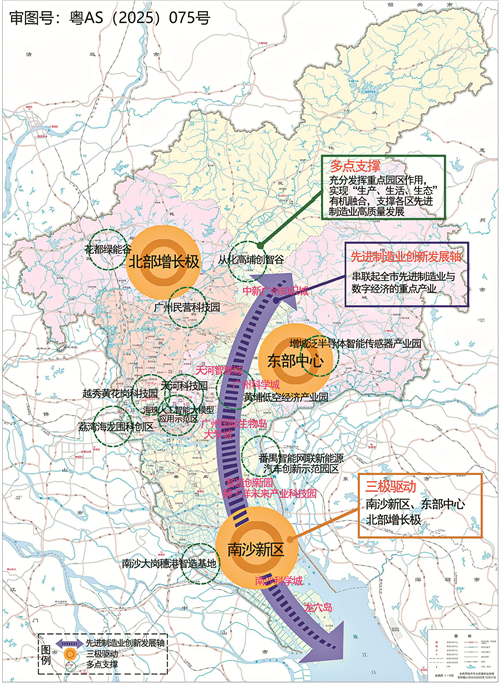
Core Viewpoint - Guangzhou aims to become a world-class advanced manufacturing hub by 2035, with a target to double its industrial added value [2][3]. Group 1: Strategic Goals - The plan outlines four strategic positions: a world-class advanced manufacturing base, a global innovation center for manufacturing, a benchmark city for digital and physical integration, and a model city for new-type industrialization [2][3]. - By 2030, significant progress is expected in building a modern industrial system, with a new structure characterized by trillion-yuan driving forces, hundred-billion-yuan leaps, and overall efficiency improvements [3]. Group 2: Industry Development Plans - The "12218" modern industrial system will be established, focusing on the integration of advanced manufacturing and modern services, as well as the digital and green transformation of industries [4]. - Key industry clusters will be developed, including six emerging pillar industries and five strategic leading industries, with a focus on creating a trillion-yuan "Smart Vehicle City" and achieving significant growth in biomedicine, smart construction, and rail transportation industries [4][10]. Group 3: Future Industries - Future industries driven by cutting-edge technologies will be prioritized, including embodied intelligence, smart unmanned systems, and quantum technology, with a goal of achieving exponential growth in these sectors within 5 to 10 years [5][6]. - High-energy innovation platforms will be established to accelerate the transformation and industrialization of technological innovations [6]. Group 4: Spatial Layout - The spatial layout for advanced manufacturing will be structured around an "axis, three poles, and multiple points" model, integrating key manufacturing resources and trends [7][8]. - The three poles will focus on the Nansha New Area, Eastern Center, and Northern Growth Pole, enhancing the resilience of the industrial chain and promoting high-end, intelligent, and green development [9]. Group 5: Industry Categories - Six emerging pillar industries include smart connected vehicles, ultra-high-definition and new display technologies, biomedicine and health, green petrochemicals and new materials, software and internet, and intelligent equipment and robotics [10]. - Five strategic leading industries encompass artificial intelligence, semiconductors and integrated circuits, new energy and storage, low-altitude economy and aerospace, and biomanufacturing [10]. - Four characteristic advantageous industries include fashion consumer goods, rail transportation, marine engineering, and smart construction [11].