
固态电池技术

Search documents
破尽密度千层障 筑实量产万里途——固态电池商业化破局开启全球竞速
Zhong Guo Zheng Quan Bao· 2025-11-25 22:30
Core Insights - The demand for longer range and higher safety in electric vehicles is driving the evolution of battery technology, with solid-state batteries seen as a promising breakthrough to overcome current energy density limitations [1][2] - Solid-state batteries are viewed as the ultimate solution for addressing range anxiety and safety concerns in electric vehicles, with significant advantages over traditional liquid lithium-ion batteries [3][4] Energy Density and Performance - Current lithium iron phosphate batteries achieve energy densities of 200 Wh/kg, while high-nickel ternary materials reach around 300 Wh/kg, nearing the limits of liquid lithium batteries [2] - Solid-state batteries can exceed 400 Wh/kg in laboratory settings, with some samples surpassing 500 Wh/kg, and theoretical limits reaching up to 900 Wh/kg [3] Safety and Longevity - Solid-state batteries offer higher safety due to the use of non-flammable solid electrolytes, which mitigate risks associated with liquid electrolytes [3] - The theoretical cycle life of solid-state batteries can exceed 10,000 cycles, significantly improving lifecycle cost compared to liquid lithium batteries, which typically last over 2,000 cycles [3] Commercialization Challenges - The path to large-scale commercialization of solid-state batteries is fraught with challenges, including technical hurdles, manufacturing processes, and cost considerations [5][6] - The first domestic large-capacity solid-state battery production line is expected to begin mass production between 2027 and 2030, but significant obstacles remain [5] Global Competition and Strategies - Countries like the EU, US, Japan, and South Korea are heavily investing in solid-state battery technology, with various strategic initiatives aimed at enhancing battery durability and reliability by 2030 [7][8] - Different countries are focusing on various technological routes, with Japan and South Korea leading in sulfide solid-state batteries, while the US and Europe are more focused on oxide and polymer routes [8][9] Material and Production Considerations - The production of solid-state batteries involves complex choices regarding materials and techniques, with a need for cost-effective and rapid industrialization pathways [6][9] - Composite electrolyte solutions are expected to become mainstream, as no single electrolyte can address all challenges faced by solid-state batteries [9] Collaborative Innovation - To capture the competitive edge in the global new energy market, there is a call for large enterprises to lead innovation consortia and for small to medium enterprises to engage in common technology research [10]
破尽密度千层障 筑实量产万里途
Zhong Guo Zheng Quan Bao· 2025-11-25 20:27
Core Viewpoint - The development of solid-state batteries is seen as a promising solution to enhance energy density and safety in electric vehicles, although significant challenges remain before large-scale commercialization can be achieved [1][2][3]. Industry Overview - The mainstream liquid lithium-ion battery technology is nearing its energy density limit, necessitating breakthroughs in battery technology [1]. - Solid-state batteries are viewed as the ultimate form of lithium batteries, addressing concerns related to range anxiety and safety [2][3]. Technical Advantages - Solid-state batteries can achieve energy densities exceeding 400Wh/kg in laboratory settings, with some samples surpassing 500Wh/kg, compared to the 160-300Wh/kg of current mainstream liquid lithium-ion batteries [3]. - They offer higher safety due to the use of non-flammable solid electrolytes, which mitigate issues like corrosion and leakage found in liquid electrolytes [3]. - The theoretical cycle life of solid-state batteries can exceed 10,000 cycles, significantly reducing the lifecycle costs compared to liquid lithium batteries, which typically last over 2,000 cycles [3]. Current Developments - Major automotive companies are actively researching new composite solid-state batteries to enhance performance metrics such as internal resistance and charging speed [4]. - The first domestic large-capacity solid-state battery production line has been established, with plans for gradual mass production between 2027 and 2030 [4]. Challenges to Commercialization - Solid-state batteries face multiple hurdles, including technological, manufacturing, and cost-related challenges that must be overcome before they can be commercially viable [1][4][6]. - The production process for solid-state batteries is complex, with significant investment required for specialized equipment and a need for automated production capabilities [6][8]. Global Competition - Countries like the EU, the US, Japan, and South Korea are heavily investing in solid-state battery technology, with various strategic initiatives aimed at accelerating development [7][8]. - Different regions are focusing on various technological routes, with Japan and South Korea leading in sulfide solid-state batteries, while the US and Europe are primarily exploring oxide and polymer routes [8]. Future Outlook - The solid-state battery industry is expected to grow significantly, driven by policy support and market demand for safer and more efficient energy storage solutions [1][7]. - Collaboration between large enterprises and small companies is encouraged to foster innovation and expedite the transition from research to practical applications [9][10].
“窄门”的胜利:恩力动力如何靠细分场景赢在“固态电池”当下?
高工锂电· 2025-11-25 11:32
Core Viewpoint - The solid-state battery industry is experiencing a divide between optimistic projections and delivery anxieties, with companies like Enli Power demonstrating actual production capabilities amidst market skepticism [2][4][5]. Group 1: Industry Trends - The capital market is showing renewed enthusiasm for solid-state batteries, with companies like QuantumScape and SolidPower seeing significant stock price rebounds due to technological advancements and partnerships [3]. - Major automotive manufacturers such as Toyota and Volkswagen are investing heavily in solid-state battery technology, aiming for mass production between 2027 and 2030 [3]. - Despite the optimism, there is a collective anxiety regarding the industry's ability to deliver on these promises, as evidenced by QuantumScape's lack of revenue and high short-selling rates [5]. Group 2: Enli Power's Achievements - Enli Power has successfully delivered millions of high-performance solid-state battery cells from its factory in Beijing, addressing market concerns about timely and quality delivery [6][7]. - The factory achieved full production shortly after its launch in December 2023, with over 200,000 cells produced by September 2025 [7]. - Enli's battery performance metrics include an energy density exceeding 300Wh/kg, with capabilities for rapid charging and discharging even in extreme temperatures [9]. Group 3: Strategic Choices - Enli Power's strategy diverges from the mainstream focus on electric vehicles, opting instead for niche markets such as drones and high-end electric motorcycles, which require high-performance batteries [10][11]. - The founder, Dr. Dai Xiang, emphasizes the importance of addressing real market needs rather than following popular trends, positioning Enli to fill gaps left by established battery manufacturers [13][15]. - Enli's collaboration with SoftBank for a high-density battery project demonstrates its ability to meet demanding specifications that traditional manufacturers could not fulfill [16][18]. Group 4: Technological Approach - Enli Power is pursuing a challenging but potentially rewarding technological path by focusing on sulfide solid electrolytes and lithium metal anodes, which are expected to yield superior performance [20]. - The company has developed a tiered product matrix to balance immediate revenue generation with long-term technological goals, including semi-solid and fully solid-state battery products [22]. Group 5: Manufacturing Capabilities - Enli's manufacturing facility boasts a high yield rate of over 95%, significantly outperforming industry standards [25]. - The company has rapidly established its production line, completing the setup in just over four months, showcasing its operational efficiency [27]. - Enli's business model emphasizes collaboration with existing supply chains rather than attempting to dominate them, positioning itself as a battery cell manufacturer and product solution provider [28]. Group 6: Financial Outlook - Enli Power's revenue projections indicate a strong growth trajectory, with sales expected to reach 1 billion in 2026, driven by its successful product offerings [29][31]. - The profits from niche markets are being reinvested into the development of fully solid-state battery technologies, ensuring a sustainable growth model [31][32]. Group 7: Market Positioning - Enli Power's pragmatic approach contrasts with the more speculative strategies of other companies, allowing it to thrive in a market that is increasingly valuing manufacturing capabilities [34][35]. - The shift in market sentiment towards valuing manufacturing strength provides Enli with a competitive advantage as it focuses on delivering tangible results rather than lofty promises [35].

当升科技(300073):当升科技2025三季报分析:三元出货积极增长,铁锂盈利改善显著
Changjiang Securities· 2025-11-25 10:42
Investment Rating - The investment rating for the company is "Buy" and is maintained [6]. Core Insights - The company reported a revenue of 2.967 billion yuan for Q3 2025, representing a year-on-year increase of 49.54% and a quarter-on-quarter increase of 17.52%. The net profit attributable to shareholders was 192 million yuan, up 8.02% year-on-year but down 4.43% quarter-on-quarter. The non-recurring net profit was 136 million yuan, showing a year-on-year growth of 29.36% but a quarter-on-quarter decline of 26.42% [2][4]. Summary by Sections Financial Performance - In Q3 2025, the company achieved a revenue of 29.67 billion yuan, with a year-on-year growth of 49.54% and a quarter-on-quarter growth of 17.52%. The net profit attributable to the parent company was 1.92 billion yuan, reflecting an 8.02% increase year-on-year but a 4.43% decrease quarter-on-quarter. The non-recurring net profit was 1.36 billion yuan, which is a 29.36% increase year-on-year but a 26.42% decrease quarter-on-quarter [2][4]. Product Performance - The company's ternary and cobalt acid lithium shipments continued to grow, indicating a positive industry demand. The iron-lithium business maintained steady growth, with profitability significantly improving. The report noted that the operating profit per ton for ternary and cobalt acid lithium was under pressure, primarily due to a decrease in sales to overseas customers [9]. Market Outlook - The company is expected to continue growing its ternary cathode shipments in 2025 and maintain growth above the industry average in 2026, driven by previously signed supply agreements with overseas customers. The iron-lithium business is anticipated to improve further with new capacity coming online in 2026, enhancing profitability and becoming a new growth point for performance [9]. Technological Advancements - The company is leading in solid-state battery technology, having developed stable and scalable production capabilities for lithium sulfide electrolytes. These advancements are expected to open new market opportunities in applications such as drones and humanoid robots, contributing to long-term growth [9]. Profit Forecast - The company forecasts net profits attributable to shareholders of 750 million yuan and 1.03 billion yuan for 2025 and 2026, respectively, and continues to recommend the stock [9].

新能源板块走势分化,储能电池ETF(159566)全天净申购达4000万份
Sou Hu Cai Jing· 2025-11-24 13:26
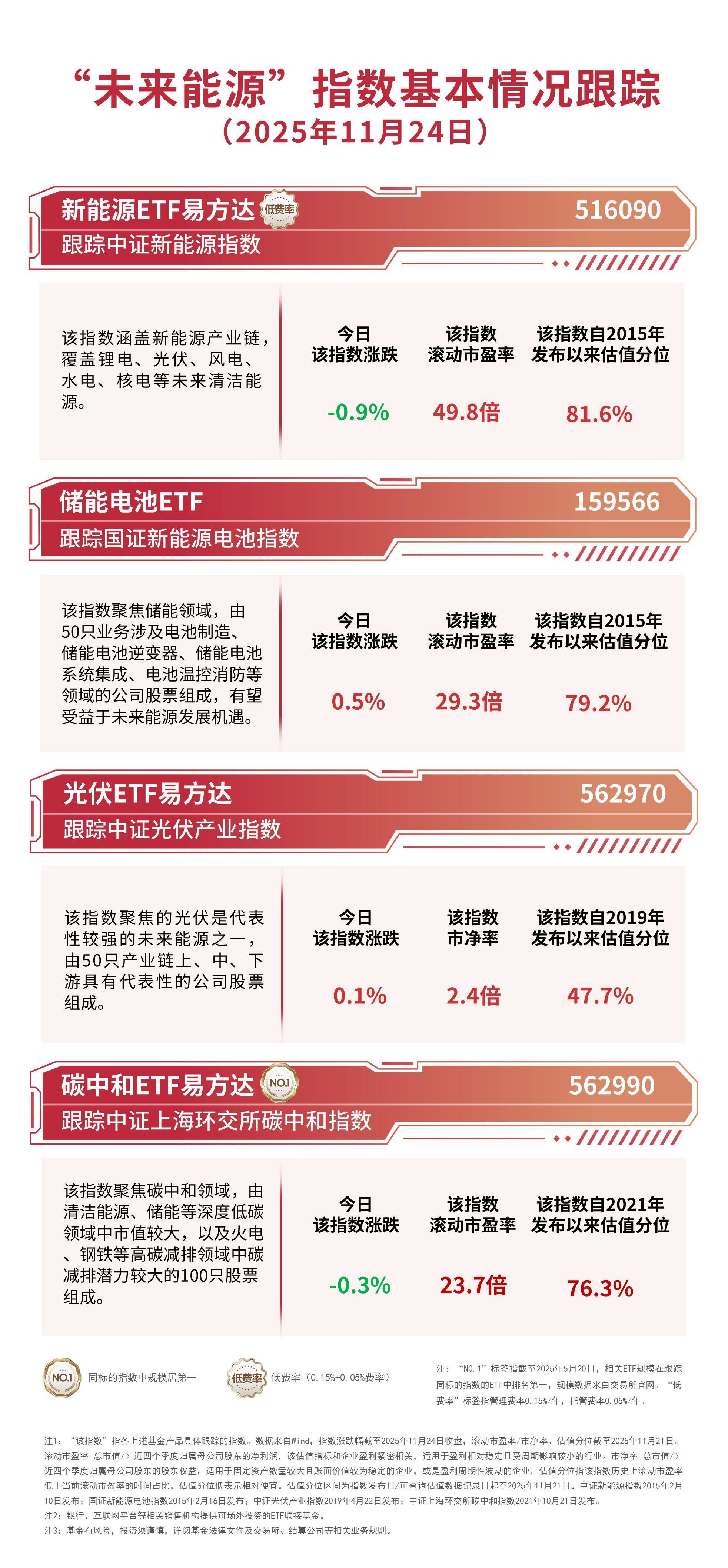
新能源板块今日走势分化,截至收盘,国证新能源电池指数上涨0.5%,中证光伏产业指数上涨0.1%,中证上海环交所碳中和指数下跌0.3%,中证新能源指 数下跌0.9%,储能电池ETF(159566)全天净申购达4000万份。根据Wind数据统计,该ETF月内合计"吸金"超11亿元。 中信建投证券表示,景气反转带动业绩修复,新技术催化推动估值提升。中国锂电设备行业在经历两年深度调整后,今年在营收端与利润端均呈现触底企稳 迹象,订单与合同负债也在逐季度改善;固态电池技术加速进化,催生锂电设备新增量。 国证新能源电池指数聚焦储能产业链,固态电池相关公司的权重超35%。储能电池ETF(159566)跟踪该指数,可助力投资者把握固态电池产业发展机遇。 眼球国让新能源电池指数 该指数聚焦储能领域,由 50只业务涉及电池制造、 储能电池逆变器、储能电池 系统集成、电池温控消防等 领域的公司股票组成,有望 受益于未来能源发展机遇。 �日 该指数涨跌 光伏ETF易方达 跟踪中证光伏产业指数 该指数聚焦的光伏是代表 性较强的未来能源之一, 由50只产业链上、中、下 游具有代表性的公司股票 组成。 �日 该指数涨跌 0.1% 碳中和E ...
广汽集团今日涨停,向华为学习能否带来转机?
Di Yi Cai Jing· 2025-11-24 12:33
相对于广汽旗下其他自主品牌,启境品牌已被视为广汽的重中之重。冯兴亚多次在公开场合提及,"公 司把启境置于最高优先级""广汽all in 启境"等。根据规划,启境首款新车将在明年上市,瞄准年轻人, 定位30万元级别。 除了启境,2026年,广汽集团还将推出9款改款及全新车型,其中传祺向往计划明年推出一款中型MPV 及一款中大型MPV;埃安将于明年一季度,推出一款针对年轻人开发的车型,以及MPV车型。但多位 车企高层和专家均认为,明年,汽车市场将迎来更为激烈的竞争,如何突出重围,仍是广汽的课题。 广汽集团平台技术研究院新能源动力研发负责人祁宏钟称,现在开发的全固态电池的能量密度比现有的 电池能量密度高了接近一倍,计划是2026年可以进行小批量装车试验,2027年到2030年期间,逐步进行 批量生产。 在固态电池之外,广汽集团仍在持续改革。今年前三季度,广汽集团营收约662.72亿元,归母净利润亏 损约43.12亿元。冯兴亚在2025广州车展上称:"一年前的今天,我们吹响了'番禺行动'号角。说实话, 这一年来汽车行业真的很卷。"他认为,在变革方面广汽已经找准了路子,见到了果子。 纵观广汽这一年,向华为学习是其变革的 ...

20cm速递|固态电池量产加速!创业板新能源ETF华夏(159368)成交额居首
Mei Ri Jing Ji Xin Wen· 2025-11-24 12:08
Group 1 - The A-share market opened high but closed low on November 24, with the ChiNext New Energy ETF (159368) rebounding by 0.5% after hitting a low [1] - Jinlei Co., Ltd. and Dike Co., Ltd. saw their shares rise over 4%, while Taisheng Wind Power, New Strong Link, and Haili Wind Power increased by over 2% [1] - The ChiNext New Energy ETF (159368) experienced a net inflow of over 30 million yuan in the past three days, with a trading volume exceeding 23.5 million yuan, ranking first among similar funds [1] Group 2 - The first large-capacity all-solid-state battery production line in China has been established and is currently undergoing small-batch testing [1] - All-solid-state batteries have significant advantages over traditional lithium-ion batteries, including increased safety and longer range for future electric vehicles [1] - CITIC Construction Investment predicts that the recovery in market conditions will drive performance recovery, with new technologies catalyzing valuation increases [1] Group 3 - The ChiNext New Energy ETF (159368) is the largest ETF fund tracking the ChiNext New Energy Index, covering various sectors including batteries and photovoltaics [2] - The fund has the highest elasticity, with a potential increase of up to 20%, and the lowest fee rate at a total of 0.2% for management and custody fees [2] - As of October 31, 2025, the fund's scale reached 829 million yuan, with an average daily trading volume of 90.05 million yuan over the past month [2]

3D打印新材料可与人体免疫系统兼容 有望推动人造器官移植和药物递送技术发展
Ke Ji Ri Bao· 2025-11-24 00:55
Group 1 - A new type of 3D printing material has been developed by a research team from the University of Virginia, which is compatible with the human immune system and has the potential to advance organ transplantation and drug delivery technologies [1][2] - The research team modified the properties of polyethylene glycol (PEG) to create a stretchable network structure, overcoming the limitations of traditional production methods that resulted in weak and crystalline structures [1] - The innovative "foldable bottle brush" structure allows the material to be both strong and highly elastic, enabling the production of 3D printable, highly stretchable PEG-based hydrogels and solvent-free elastomers [1] Group 2 - The team indicated that by altering the shape of the UV light, complex structures can be created, opening new possibilities for manufacturing artificial organs or drug delivery systems [2] - The stretchable 3D printed PEG material has been shown to be biocompatible, suitable for in-body applications such as organ scaffolds, as confirmed by cell culture tests [2] - The material may be combined with other substances to produce 3D printed products with varying chemical compositions, showcasing its potential as a high-performance solid electrolyte in advanced battery technologies [2]
超1000公里!全固态电池新突破
DT新材料· 2025-11-24 00:05
Group 1 - The core viewpoint of the article highlights significant advancements in solid-state battery technology, particularly by GAC Group, which has established the first domestic production line for high-capacity solid-state batteries capable of mass production [1][2] - The energy density of the newly developed solid-state batteries is nearly double that of existing batteries, enabling vehicles with a range of over 500 kilometers to achieve over 1000 kilometers [1][2] - GAC Group plans to conduct small-scale vehicle testing by 2026 and aims for gradual mass production between 2027 and 2030 [1][2] Group 2 - The article discusses the optimization of production processes and the shift to solid-state electrolytes, which significantly enhance the thermal stability and safety of the batteries [2] - Currently, no company globally has commercialized solid-state batteries, but several companies, including CATL and Changan Automobile, have set timelines for vehicle integration and mass production between 2025 and 2027 [2][3] - The industry is expected to reach a peak in pilot production lines by 2026, with small-scale commercialization anticipated by 2027, ultimately aiming for a market scale of over 100 GWh by 2030 [2][3]
订单排期到明年,鹏辉衢州储能产品热销本地、海外|新质衢州
2 1 Shi Ji Jing Ji Bao Dao· 2025-11-21 09:11
Core Insights - The cancellation of the "mandatory storage" policy and overcapacity in the energy storage market have led to intense price competition, prompting leading companies like Penghui Energy to accelerate their international expansion [1] Group 1: Market Demand and Supply - There has been a significant increase in orders for energy storage, with the company reporting that orders are scheduled until next year [1] - In October 2025, new bidding projects for energy storage reached a total of 12.7GW/38.7GWh, representing an 85% year-on-year increase, although a 11.24% decrease compared to the previous month [2] - The electrification transition is driving explosive growth in global energy storage demand, with domestic market needs and international factors such as power supply shortages in the U.S. and unstable grids in Europe contributing to this trend [2] Group 2: Production Capacity and Challenges - Penghui Energy's production lines for major energy storage products are currently at full capacity, leading to price increases for some products compared to earlier in the year [3] - The company’s production base in Quzhou has a capacity allocation of 30% for exports and 70% for domestic sales, with plans for further capacity expansion in 2024 [3] - The Quzhou base was established in October 2022 and achieved product rollout within 10 months, with ongoing plans for additional production lines to be operational by mid-next year [3] Group 3: Technological Innovations - Solid-state batteries represent a significant technological advancement in lithium batteries, with expectations for small-scale production by 2027 supported by government funding [4] - Penghui Energy has improved the energy density of its solid-state batteries from 280Wh/Kg to 320Wh/Kg, enhancing performance stability [4] - The development of AI technology is anticipated to optimize energy storage systems, particularly in adapting to the continuous power demands of AI computing centers [4][5]
