
服务消费

Search documents
国务院办公厅:加快入境签证全流程在线办理全球覆盖 提升境外人员出入境和入境居住便利度
Mei Ri Jing Ji Xin Wen· 2026-01-29 16:25
(文章来源:每日经济新闻) 每经AI快讯,1月29日,国务院办公厅日前印发《加快培育服务消费新增长点工作方案》,其中提到, 做好单方面免签国家试行期限延长相关工作,研究稳妥扩大单方面免签、过境免签、区域性免签政策适 用范围。加强入境政策和入境旅游海外宣传,加快入境签证全流程在线办理全球覆盖,提升境外人员出 入境和入境居住便利度。加强入境消费场景建设,创新中国消费名品场景化体验,培育高质量国际赛 事、演出、医疗、教育、旅居、康养品牌。打造"购在中国"品牌,推进国际化消费环境建设,培育国际 消费集聚区、入境消费友好型商圈,优化涉外支付服务,增加离境退税商店,提升公共场所多语种标识 覆盖率和国际化服务水平。 ...
服务消费支持政策落地,利好这些板块
Zhong Guo Zheng Quan Bao· 2026-01-29 15:18
Core Viewpoint - The Chinese government has issued a work plan to accelerate the cultivation of new growth points in service consumption, aiming to optimize and expand service supply, enhance service consumption quality, and support high-quality economic development [1] Group 1: Key Areas of Focus - The work plan targets key areas such as transportation services, housekeeping services, online audio-visual services, travel and accommodation services, automotive aftermarket services, and inbound consumption, focusing on optimizing service supply and innovating consumption scenarios [2] - It also emphasizes potential areas like performance services, sports event services, and experiential services, aiming to improve incentive mechanisms, optimize safety management, and cultivate quality brands [2] Group 2: Support Mechanisms - The plan includes strengthening support for cultivating new growth points in service consumption through the establishment of standard systems, enhancing credit construction, and reinforcing financial support [3] Group 3: Industry Impact - The work plan aligns with residents' demand for high-quality living, aiming to increase quality supply while benefiting people's livelihoods, thus promoting a positive interaction between consumption and investment [4] - It is expected to accelerate industrial integration and foster new productive forces, particularly in sectors like automotive aftermarket and digital consumption [4] - Digital empowerment is anticipated to reshape the consumption ecosystem, with new scenarios like smart housekeeping and immersive experiences driving enterprise transformation [4] Group 4: Investment Opportunities - Financial analysts suggest that sectors such as the silver economy (smart elderly care, health tourism), ice and snow economy, and sports events are likely to become new growth areas, driven by technology and emotional experience [5] - The service consumption sector is expected to benefit from policy support, with a focus on experience-oriented and service-oriented consumption trends [5] - The strategic positioning of service consumption is set to enhance its role as a core engine for driving domestic demand, with increased interest in popular travel routes and related industries [5]
A股晚间热点 | 停牌、限购、调整保证金 白银、石油、白酒基金批量提示风险
智通财经网· 2026-01-29 14:22
Group 1: China-UK Cooperation - Chinese Premier Li Qiang emphasized the need for China and the UK to deepen cooperation in emerging industries such as artificial intelligence, advanced manufacturing, clean energy, digital economy, and modern shipping services [1] Group 2: Service Consumption Growth - The State Council of China issued a work plan to accelerate the cultivation of new growth points in service consumption, aiming to optimize and expand service supply and enhance service consumption quality [2] - Specific measures include supporting real estate projects, promoting the automotive aftermarket, extending visa-free policies for tourism, and optimizing financial support for service sector enterprises [2] Group 3: Market Risks - Several funds, including Guotou Silver LOF and E Fund Gold Theme LOF, announced risk warnings, with Guotou Silver LOF halting trading and adjustments made to margin requirements for silver contracts [3] - The oil fund LOF will also suspend trading, while the liquor fund LOF warned investors about potential price premium risks [3] Group 4: Liquor Sector Performance - The liquor sector experienced a significant surge on January 29, attributed to its perceived undervaluation after a prolonged decline, attracting short-term capital [4] - Institutions like CITIC Securities predict stable sales for liquor during the 2026 Spring Festival, indicating a potential bottoming opportunity in the industry [4] Group 5: US-China Trade Relations - The Chinese Ministry of Commerce expressed willingness to maintain and implement important consensus reached by the leaders of China and the US, aiming for stable and sustainable development of bilateral trade relations [6] Group 6: Guizhou Moutai Clarification - Guizhou Moutai denied rumors regarding its participation in SpaceX's Series A funding, labeling the information as false [7] Group 7: AI and Robotics Developments - Beijing launched its first humanoid robot pilot verification platform, capable of producing 5,000 units annually, marking a significant step in the humanoid robot industry [13] - The industry is expected to enter a commercialization phase by 2026, with major investments anticipated in AI infrastructure and cloud computing [20] Group 8: Company Announcements - Jin Tian Co. plans to repurchase shares worth 200 million to 400 million yuan, while Hengyuan Coal Power intends to repurchase shares worth 200 million to 250 million yuan [21] - Several companies, including China Communications Construction and Shenghe Resources, reported significant projected net profit increases for 2025, indicating strong growth potential [21]



培育服务消费“路线图”出炉:打造多样化旅游专列产品,支持情绪式、体验式服务
Mei Ri Jing Ji Xin Wen· 2026-01-29 13:40
Core Viewpoint - The Chinese government has issued a "Work Plan" to accelerate the cultivation of new growth points in service consumption, focusing on stimulating key areas, nurturing potential sectors, and strengthening support measures [1] Group 1: Key Areas of Development - The "Work Plan" outlines 12 specific measures across various sectors, including transportation services, domestic services, tourism, and sports events [1] - There is a significant potential for service consumption in China, as it currently lags behind international standards where service consumption typically accounts for about 70% of personal consumption expenditure [3] Group 2: Specific Initiatives - The plan emphasizes the development of home-based elderly care services and encourages local governments to innovate service models and explore smart scenarios [4] - It also promotes the integration of railway and tourism, enhancing railway tourism services and creating themed trains for senior travelers [4] Group 3: Financial and Regulatory Support - The "Work Plan" calls for optimizing financial support for service consumption, including loan interest subsidies and encouraging financial institutions to increase credit for service sectors [9] - It highlights the need for a robust legal and regulatory framework to standardize service pricing and ensure compliance, which is crucial for the growth of service consumption [8][9] Group 4: Market Trends and Projections - By 2025, service retail sales in China are projected to grow by 5.5%, with per capita service consumption spending increasing by 4.5%, accounting for 46.1% of total per capita consumption [8] - The report indicates that sectors such as cultural, recreational, and transportation services are expected to see double-digit growth, with a notable increase in education and entertainment spending [8]
培育服务消费“路线图”出炉
Mei Ri Jing Ji Xin Wen· 2026-01-29 12:52
Core Viewpoint - The Chinese government has issued a "Work Plan" to accelerate the cultivation of new growth points in service consumption, focusing on stimulating key sectors, nurturing potential areas, and enhancing support measures [1] Group 1: Key Measures in the Work Plan - The Work Plan includes 12 specific measures targeting various sectors such as transportation services, domestic services, tourism, and sports events [1] - It emphasizes the development of railway and tourism integration, promoting themed trains and enhancing railway tourism services [4] - The plan supports innovation in cruise consumption and the development of diverse cruise products, as well as the promotion of night cruises and yacht consumption [4][5] Group 2: Potential Growth Areas - The Work Plan highlights the importance of developing performance services, sports event services, and emotional and experiential services [6] - It calls for innovative regulatory approaches for new business models and supports the inclusion of relevant occupations in the national classification system [6] Group 3: Standardization and Credit System - The Work Plan aims to optimize the standardization layout of the service industry and promote the development of a credit system in sectors like elderly care, domestic services, and tourism [8] - By 2025, service retail sales in China are projected to grow by 5.5%, with per capita service consumption expenditure increasing by 4.5%, accounting for 46.1% of total per capita consumption expenditure [8] Group 4: Financial Support - The Work Plan emphasizes the need for financial support, including optimizing loan interest policies and encouraging financial institutions to increase credit for service consumption sectors [9] - It supports the issuance of bonds by qualified companies in cultural, tourism, education, sports, and domestic service sectors, as well as the development of financial products tailored to service consumption [9]
新华鲜报 | 加快培育服务消费新增长点!国办出台12条政策举措
Xin Hua She· 2026-01-29 11:51
Core Viewpoint - The State Council of China has introduced a plan to accelerate the cultivation of new growth points in service consumption, focusing on optimizing service supply and enhancing consumer experience through 12 policy measures [1][5]. Group 1: Key Service Consumption Areas - The plan identifies key service consumption sectors including transportation, housekeeping, online audio-visual services, travel, automotive aftermarket, and inbound consumption [2]. - Specific measures include developing policies to promote the integration of railways and tourism, enhancing the tourism transformation of train stations and trains, and improving infrastructure for yacht services [2]. Group 2: Inbound Consumption Initiatives - The plan aims to boost inbound consumption by extending the trial period for unilateral visa-free countries, expanding the scope of visa policies, and increasing the number of tax refund shops for departing tourists [2]. - It anticipates that by 2025, the number of inbound and outbound travelers will reach a historical high, converting inbound flow into tangible consumption growth [2]. Group 3: Development of Service Sectors - The plan proposes actions such as specialized training for housekeeping services, support for private capital in online audio-visual services, and the development of travel destination cities [2]. - It emphasizes the importance of optimizing service supply, promoting pilot programs, innovating consumption scenarios, and enhancing talent cultivation [2]. Group 4: Entertainment and Experience Services - The plan addresses the potential of entertainment services, proposing measures to optimize performance management, set safety capacity limits, and combat ticket scalping [3]. - For sports events, it suggests improving safety management and encouraging the introduction of international sports events [3]. Group 5: Regulatory and Support Measures - The plan highlights the need for innovative regulatory approaches for emotional and experiential services, advocating for a gradual improvement of regulatory requirements [4]. - It also calls for the establishment of a standard system, strengthening credit construction, and enhancing financial support to foster service consumption growth [5].
刚刚!国办印发重要方案!
Jin Rong Shi Bao· 2026-01-29 11:37
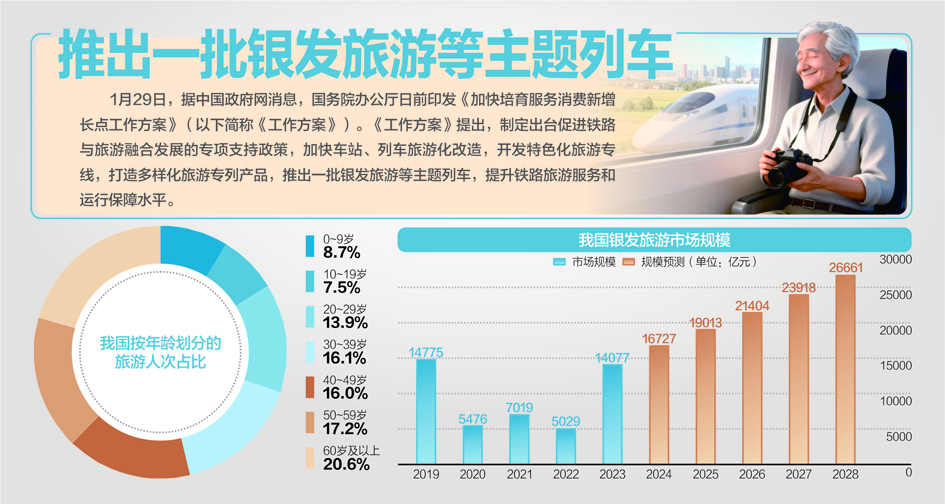
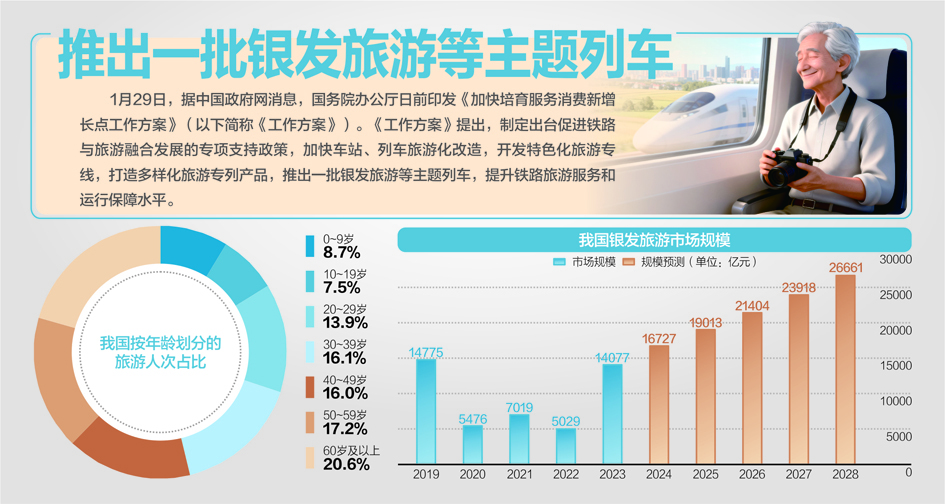
1月29日,为优化和扩大服务供给,聚焦重点领域、潜力领域,加快培育服务消费新增长点,促进服务 消费提质惠民,国务院办公厅印发《加快培育服务消费新增长点工作方案》(以下简称《方案》)。 服务消费是扩大内需的重要抓手,更是推动经济高质量发展的关键动力。当前我国居民消费正从商品消 费为主向商品和服务消费并重转变,服务消费市场活力持续释放,新产业(300832)、新业态、新模式 不断涌现,但同时也面临着标准体系不完善、部分领域信用建设滞后、经营主体融资难题突出等发展堵 点。此次出台的《方案》,直击服务消费发展的痛点难点,提出要健全标准体系、加强信用建设、强化 财政金融支持,为服务消费高质量发展划定清晰路径,让服务消费在规范中创新、在提质中惠民,真正 成为经济高质量发展的有力支撑。 一、《方案》明确了服务消费新增长点的重点领域: 包括: 交通服务。制定出台促进铁路与旅游融合发展的专项支持政策,加快车站、列车旅游化改造,开发特色 化旅游专线,打造多样化旅游专列产品,推出一批银发旅游等主题列车,提升铁路旅游服务和运行保障 水平等。 此次出台的《方案》,直击服务消费发展的痛点难点,提出要健全标准体系、加强信用建设、强化财政 ...
事关消费品以旧换新,扩大市场准入和开放领域……商务部最新发布
中汽协会数据· 2026-01-29 07:04
国务院新闻办公室于1月26日下午举行新闻发布会,商务部介绍2025年商务工作及运行情况,并答记者 问。一起关注—— 全年社会消费品零售总额首次突破50万亿元 全年社会消费品零售总额 首次突破50万亿元,达到50.1万亿元,增长3.7% ,消费对经济增长的贡献率 达到 52% ,提高了5个百分点。 优化实施消费品以旧换新,促进汽车、家电、数码和智能产品等大宗耐用商品消费。开展汽车流通消费 改革试点 ,进一步释放汽车消费潜力。开展好有奖发票试点工作。推动出台促进首发经济等一批务实 管用的政策举措。 加力培育服务消费新增长点 继续实施服务消费提质惠民行动,会同相关部门 推动提升文化娱乐、旅游休闲、餐饮住宿、体育赛 事、医疗健康等领域的供给水平 。 把握消费升级的趋势, 加力培育交通服务、家政服务、网络视听服务、旅居服务、汽车后市场服务、 入境消费等服务消费新的增长点 ,完善支持政策,推进先行先试,培育优质品牌,激发相关领域发展 活力,更好满足人民群众服务消费新需求。 以旧换新相关产品销售额2.61万亿元 扩围提质实施消费品以旧换新,汽车、家电、手机等相关产品销售额 2.61万亿元 ,惠及 3.66亿人次 。 限额以 ...
专访汇丰匡正:AI部分板块阶段性过热,中长期具备成长潜力
Sou Hu Cai Jing· 2026-01-29 03:52
Group 1: Consumer Sector Opportunities - The focus on expanding domestic demand will be a key policy priority in 2026, with consumption being reinforced as the main engine for economic growth [4] - Short-term measures like trade-in policies are expected, but long-term growth is anticipated to come from service consumption, which is seen as a critical growth source [4] - The government emphasizes new solutions to support the expansion of new consumption and service consumption, indicating a long-term trend [4] - Investors are advised to pay attention to segments with long-term growth potential, particularly in the context of low expectations and valuations in the consumer sector [4][5] Group 2: AI and Technological Integration - Artificial Intelligence (AI) is becoming a significant theme in the global market, with its applications expanding across various industries, particularly in finance, manufacturing, healthcare, and consumer sectors [6] - China's advantages in hardware manufacturing and a rapidly evolving AI ecosystem are driving the integration of AI into various sectors, enhancing economic resilience [6] - Despite some overheating in certain segments, industries like gaming, consumer electronics, and robotics are expected to maintain growth potential due to their alignment with existing market demands [6] Group 3: Investment Outlook for the Greater Bay Area - The Hong Kong stock market is viewed positively due to strong capital inflows and active IPO activities, with policy support for AI expected to attract further investments [7] - A barbell strategy is recommended for onshore and offshore Chinese stocks, balancing technology stocks with high-dividend quality state-owned enterprises for downside protection [7] Group 4: Global Economic Trends and Risks - Key macro factors influencing asset risks in 2026 include the monetary policy paths of the Federal Reserve and other major central banks, which could affect interest-sensitive assets [8] - Geopolitical events may cause market volatility, particularly impacting oil prices, but current oversupply in the oil market mitigates some risks [9] - The divergence in global growth, with strong performance in the US versus challenges in Europe, affects capital flows and asset performance across regions [9] - Increased correlation among asset classes necessitates diversified cross-asset, cross-industry, and cross-regional strategies to manage risks effectively [9]

未知机构:三峡旅游发布业绩预告后续关注省际游轮经营数据东财新消费事件-20260129
未知机构· 2026-01-29 02:00
三峡旅游发布业绩预告,后续关注省际游轮经营数据【东财新消费】 事件:公司发布25年报业绩预告:全年预计归母净利润0.56-0.72亿元,同比-38.77%~-52.38%;扣非归母净利润 0.67-0.87亿元,同比-9.65%~-30.42%。 Q4单季度预计归母净利润-0.30至-0.14亿元(24Q4为0.32亿);扣非归母净利润-0.26~-0.06亿元(24Q4为0.4亿 元),业绩略低于市场预期。 三峡旅游发布业绩预告,后续关注省际游轮经营数据【东财新消费】 事件:公司发布25年报业绩预告:全年预计归母净利润0.56-0.72亿元,同比-38.77%~-52.38%;扣非归母净利润 0.67-0.87亿元,同比-9.65%~-30.42%。 Q4单季度预计归母净利润-0.30至-0.14亿元(24Q4为0.32亿);扣非归母净利润-0.26~-0.06亿元(24Q4为0.4亿 元),业绩略低于市场预期。 除此前已经发生的补税因素外(对归母净利润影响为4433万元)。 除了此前所说的4亿利润*20X估值外。 未来打开进一步空间的可能在于:1)#单船盈利目前普遍按照5000万盈利,是否可以进一步提升; ...
