
物理AI

Search documents
21特写|一人公司,不止于天才的游戏
2 1 Shi Ji Jing Ji Bao Dao· 2026-01-19 08:36
Core Insights - The article discusses the emergence of One Person Companies (OPC) in the AI era, highlighting their ability to reduce startup costs and leverage AI for efficiency [1][2][10] - It emphasizes the shift from traditional large-scale operations to smaller, agile teams that utilize AI to enhance productivity and innovation [5][10] Group 1: OPC Model and Its Advantages - The OPC model allows for significant reductions in startup costs, enabling a small team to accomplish tasks that previously required larger teams [2][10] - Companies like "Natural Chenji" and "Shouyi Computer" exemplify the successful application of the OPC model, focusing on AI-driven products such as smart clothing and interactive devices [1][6] - The trend of "one-person unicorns" is on the rise, with a notable increase in startups founded by single individuals, accounting for 36.3% of new businesses in the U.S. as of 2025 [5][10] Group 2: AI's Role in Entrepreneurship - AI technologies are transforming the entrepreneurial landscape by simplifying complex tasks and reducing the need for extensive human resources [5][10] - Entrepreneurs are increasingly using AI as a tool for learning and decision-making, allowing them to manage various aspects of their businesses more effectively [6][10] - The integration of AI in startups is leading to a new paradigm where individual capabilities are enhanced, making it possible for smaller teams to compete in the market [5][10] Group 3: Market Trends and Future Outlook - The article notes a growing trend of policies supporting OPCs across various cities in China, aiming to create conducive environments for AI-driven startups [19][20] - The concept of "probability investment" is emerging, where cities focus on nurturing numerous small startups rather than just large enterprises, anticipating that some will grow into significant players [20][21] - The collaboration between large enterprises and OPCs is reshaping urban development, creating a dynamic ecosystem that fosters innovation and agility [23]


一人公司,不止于天才的游戏
2 1 Shi Ji Jing Ji Bao Dao· 2026-01-19 08:34
Group 1 - The core idea of the articles revolves around the emergence of innovative startups in the AI and technology sectors, particularly focusing on the OPC (One Person Company) model, which allows for rapid validation and iteration of ideas with minimal resources [2][9]. - Companies like Shouyi and Ziran Chanjing, both with Tsinghua University backgrounds, are exemplifying the potential of the OPC model, having quickly expanded their teams and secured significant funding for product development and market entry [1][6]. - The "Tsinghua system" startups are concentrated in AI and intelligent manufacturing, with a high funding success rate of 74%, indicating the strong market appeal of the Tsinghua brand [4]. Group 2 - The concept of "Physical AI" is introduced, emphasizing the integration of AI with physical entities like robots and sensors, which can significantly reduce the cost of executing complex tasks in the physical world [5]. - The trend of "vertical empowerment" in AI is noted, with various sectors such as government, finance, and healthcare increasingly adopting AI technologies, creating numerous startup opportunities [4]. - The establishment of specialized OPC communities in cities like Shenzhen aims to provide essential infrastructure and support for AI enterprises, fostering innovation and collaboration [6][7]. Group 3 - The articles highlight a shift in policy focus towards supporting small, agile startups rather than just large corporations, recognizing the potential of "probability investment" in nurturing a diverse range of innovative individuals [8][9]. - The collaboration between large enterprises and OPCs is seen as a complementary relationship, where OPCs can act as agile innovators that meet specific needs of larger companies, thus reshaping urban development logic [10].
机构:人工智能进入“物理AI”时代
Zheng Quan Shi Bao Wang· 2026-01-19 00:54
Group 1 - The Shanghai Municipal Committee has released suggestions for the 15th Five-Year Plan, emphasizing the promotion of full-stack innovation in artificial intelligence, development of high-performance intelligent computing chips, high-quality data, and efficient intelligent computing clusters [1] - Dongxing Securities believes that the AI industry is currently in a phase of policy, technology, and demand resonance, with the "AI+" initiative providing top-down policy support and potential funding, leading to improved performance validation for domestic chip and cloud computing leaders [1] - The AI industry's prosperity is expected to continue rising, maintaining its dominant position in technology investment [1] Group 2 - Bank of China Securities states that AI has entered the "Physical AI" era, which emphasizes the integration of real physical dynamics such as gravity and friction for precise execution of complex tasks, supported by core pillars like the Newton physics engine and GPU+LPU hybrid architecture [2] - Robotics and autonomous driving are identified as ideal carriers for "Physical AI" [2] - The core raw materials for AI are anticipated to reach a critical transition point from "0 to 1," indicating a shift towards commercialization in real-world applications [2] - "Physical AI" requires substantial computational power and data resources, raising the demands for AI infrastructure development [2]
物理AI:人工智能发展又一高光时刻
Ke Ji Ri Bao· 2026-01-19 00:54
Core Insights - The emergence of "Physical AI" is seen as a transformative phase in AI development, moving from generative AI to models that can understand and interact with the physical world [1][2] - Physical AI is expected to significantly impact various industries, including manufacturing, healthcare, and autonomous driving, by enabling machines to perform complex tasks in dynamic environments [3][5] Group 1: Definition and Evolution of Physical AI - Physical AI is defined as AI models that can perceive, understand, and execute tasks in the real world, integrating physical laws such as gravity and friction [2] - The evolution of AI is categorized into four stages: Perceptual AI, Generative AI, Agent AI, and Physical AI, with the latter focusing on the integration of AI with the physical world [2] Group 2: Applications in Industry - In manufacturing, Physical AI is advancing automation from fixed processes to dynamic adaptability, enhancing production efficiency and reducing energy consumption [3][4] - The integration of Physical AI in autonomous driving systems has improved capabilities in adverse weather conditions, with specific models showing a 30% enhancement in performance [4] - In healthcare, Physical AI is enhancing the precision of surgical robots, leading to significant reductions in surgical errors and improved patient outcomes [5] Group 3: Challenges and Considerations - The implementation of Physical AI faces challenges such as high costs associated with real-world data collection and the need for robust systems to handle unpredictable environments [6] - Ethical and legal considerations regarding accountability in the event of accidents involving AI-driven systems remain unresolved, necessitating the establishment of clear regulations [6] - Building trust in AI systems is crucial, as societal concerns about job displacement and decision-making transparency persist [6]

早报|欧盟多国考虑对930亿欧元美国商品加征关税;贾国龙再回应西蓝花争议;容百科技涉嫌误导性陈述被立案;包头爆炸已致2死8失联
虎嗅APP· 2026-01-18 23:55
大家早上好!这里是今天的早报,每天早上,我都会在这里跟你聊聊昨夜今晨发生了哪些大事儿。 昨夜今晨 【欧盟多国考虑对930亿欧元输欧美国商品加征关税】 据央视新闻报道,欧盟多国正考虑对价值930亿欧元的输欧美国商品加征关税,或限制美国企业进入欧盟市 场,以反制美国总统特朗普为得到格陵兰岛而对欧洲8国加征关税。 一名欧盟外交官当天透露称,如果欧盟与美国未能达成协议,报复性关税将从2月6日起自动生效。 特朗普17日在社交媒体上宣布,将从2月1日起对来自丹麦、挪威、瑞典、法国、德国、英国、荷兰和芬兰的输 美商品加征10%关税,并宣称加征关税的税率将从6月1日起提高至25%,直到相关方就美国"全面、彻底购买 格陵兰岛"达成协议。 近日,挪威、瑞典、法国、德国、英国、荷兰和芬兰等欧洲国家宣布向格陵兰岛派兵,参加由丹麦在该岛发起 的"北极耐力"军事演习。 【贾国龙:西贝冷冻西蓝花比市面普通市价高80%-120%,"从来不存在两岁的西蓝花"】 1月18日,西贝董事长贾国龙回应消费者热议的冷冻西蓝花问题,称选用的是市面最高品级的冷冻有机无农残 西蓝花,价格比普通的高80%至120%,采用超低温急冻技术,全程冷链运输。西贝高周转 ...

计算机行业事件点评:2026:具身智能与机器人关键一年
Guolian Minsheng Securities· 2026-01-18 12:37
Investment Rating - The report maintains a "Recommended" rating for the industry, indicating an expected stock price increase of over 15% relative to the benchmark index within the next 12 months [8]. Core Insights - The collaboration between Star Dynamics and SF Technology focuses on the development and application of embodied intelligent robotics in logistics, addressing labor shortages and automation flexibility issues [4]. - The report highlights the accelerating progress of embodied intelligence in logistics, with Star Dynamics leveraging its self-developed VLA model and humanoid robots to provide comprehensive solutions for warehousing and logistics [4]. - Major tech companies are investing in physical AI, with advancements in humanoid robots and their applications in autonomous driving and robotics [5][6]. - Tesla's Optimus robot is expected to achieve significant advancements, with plans for mass production and potential applications in space missions [7]. Summary by Sections Industry Collaboration - Star Dynamics and SF Technology have signed a deep cooperation agreement to develop embodied intelligent robotics for logistics, focusing on areas like warehousing and express delivery [4]. Technological Advancements - The CES 2026 showcased advancements in physical AI, with Nvidia introducing the Cosmos model for understanding and simulating real-world scenarios, enhancing humanoid robot capabilities [6]. - Nvidia's collaboration with Hugging Face aims to streamline the workflow from simulation training to real-world deployment of humanoid robots [6]. Market Potential - The report emphasizes the long-term potential of embodied intelligence, with key companies such as Slin Technology, Pinming Technology, and others identified as significant players in the market [11].

半导体设备ETF(159516)大涨3%,盘中流入超6亿份,存储在AI算力产业链中的重要性有望显著提升
Mei Ri Jing Ji Xin Wen· 2026-01-17 08:27
Group 1 - The semiconductor equipment ETF (159516) experienced a significant increase of 3% on January 16, with an inflow of 625 million shares, indicating strong market interest [1] - Huatai Securities highlighted that the super cycle driven by AI data center construction will remain the primary investment theme in the technology sector through 2026, with storage's importance in the AI computing power supply chain expected to rise significantly [1] - The development of AI systems is increasingly focused on system collaborative design to reduce token production costs, creating value enhancement opportunities in server assembly, heat dissipation, optical interconnects, and PCB segments [1] Group 2 - The semiconductor equipment ETF (159516) tracks the semiconductor materials and equipment index (931743), which focuses on the materials and equipment segments of the semiconductor industry, selecting listed companies involved in key upstream material supply and equipment manufacturing [2] - The index primarily includes companies with technological advantages and market positions in the semiconductor materials and equipment field, emphasizing high-tech manufacturing and growth-oriented styles [2]
导远科技港股IPO:营收倍增、亏损收窄,业务版图扩张
Jing Ji Wang· 2026-01-17 03:42
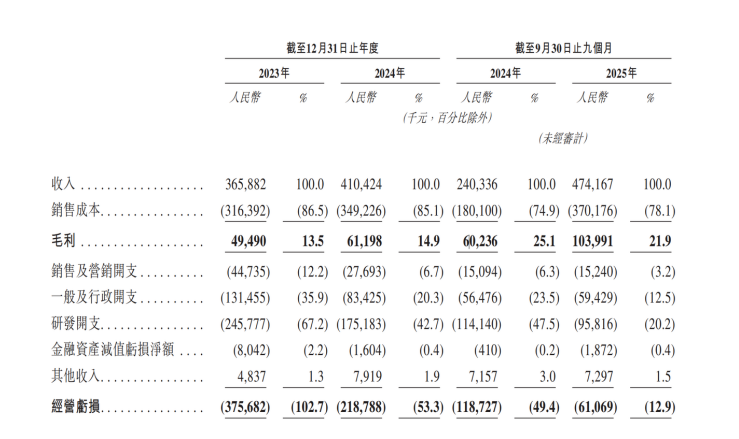
Core Viewpoint - Guangdong Daoyuan Technology Co., Ltd. has submitted an application for listing on the Hong Kong Stock Exchange, aiming for a main board listing with CICC and CITIC Securities as joint sponsors [1] Financial Performance - In the first three quarters of 2025, Daoyuan Technology's revenue reached 474.17 million RMB, a significant increase of 97.3% compared to 240.34 million RMB in the same period last year, surpassing the total revenue for the entire year of 2024 [2] - The gross profit margin improved from 13.5% in 2023 to 21.9% in the first three quarters of 2025, driven by cost optimization from vertical integration and scale effects [4] - Adjusted net loss decreased from 119 million RMB in the previous year to 50 million RMB, indicating an approaching profitability inflection point [4] Market Position - Daoyuan Technology holds a leading market share of 27.6% in global automotive spatial intelligence solutions for 2024, and a remarkable 59.75% in the domestic high-precision positioning system market for vehicles in the first ten months of 2025 [5] - The top five customers accounted for 84.4%, 85.3%, and 88.8% of revenue in 2023, 2024, and the first three quarters of 2025, respectively, indicating a high customer concentration [7] Growth Opportunities - The non-automotive business is emerging as a second growth curve, with potential revenue contributions from clients in electronic testing and measurement instruments [8] - The global potential market size for spatial intelligence solutions is expected to reach 270.2 billion RMB by 2035, indicating significant growth opportunities across various sectors [8] Operational Capabilities - Daoyuan Technology has a production capacity exceeding 3 million sets annually, ensuring a balance between performance, cost, and delivery for large-scale production [11] - The company is transitioning from scale expansion to structural optimization, with substantial contributions from non-automotive businesses beginning to materialize [11]
物理AI,联想先行
2 1 Shi Ji Jing Ji Bao Dao· 2026-01-16 14:32
Core Insights - The term "Physical AI" has become a hot topic in 2026, with significant discussions around the practical application of AI in real-world scenarios, particularly highlighted at CES where Huang Renxun mentioned it 17 times [1][2] - The challenge of implementing AI in practical settings, referred to as the "last mile," is being addressed more effectively in China compared to Silicon Valley, due to its rich application scenarios and mature AI infrastructure [2] Company Strategies - Lenovo has developed a "Human-Centric AI" strategy, focusing on personalized AI solutions for both individuals and enterprises, emphasizing that a one-size-fits-all approach is no longer viable [3][6] - The introduction of Lenovo's hybrid AI strategy aims to provide scalable AI solutions that can be industrially delivered, leveraging Lenovo's extensive computing device manufacturing capabilities [3][17] Product Innovations - Lenovo unveiled the personal AI super agent, Lenovo Qira, which connects various devices and learns user preferences to provide seamless task execution and privacy protection [6][9] - The Lenovo Personal AI Hub Concept Project Kubit allows users to run complex AI models locally, addressing concerns about computational power and data privacy [10] Industrial Applications - Lenovo's AI cloud super factory aims to streamline the deployment of AI infrastructure for enterprises, significantly reducing the time required for AI model implementation [17] - The company has developed liquid cooling technology to manage the energy consumption and heat generated by large AI models, positioning it as a potential industry standard [19] AI in Sports - Lenovo is collaborating with FIFA to introduce the Football AI Pro, an enterprise-level AI system that will provide data analysis and insights during the 2026 FIFA World Cup [20][21] - Various AI technologies, including 3D visualization and enhanced video systems, will be tested during the World Cup to improve decision-making and viewer experience [24][25] Conclusion - The ultimate goal of Physical AI is to enhance human experiences, making AI as accessible and essential as utilities like water and electricity, as emphasized by Lenovo's leadership [26]

21对话|解码“一人公司”:“人多力量大”在AI时代失灵了吗
2 1 Shi Ji Jing Ji Bao Dao· 2026-01-16 10:19
Core Insights - The rise of "One Person Company" (OPC) is driven by advancements in artificial intelligence (AI), enabling individuals to leverage diverse tools and technologies to operate businesses independently [1][3][4] - The traditional model of requiring large teams for business operations is being disrupted as AI reduces the complexity and cost of various tasks, allowing individuals to manage multiple roles [3][4][16] - The entrepreneurial landscape is evolving, with a diverse range of OPC founders, including recent graduates, seasoned entrepreneurs, and those with previous startup experience, all utilizing AI to innovate and create [6][7][10] Industry Trends - The OPC model is gaining traction as AI democratizes access to technology, allowing individuals to handle tasks that previously required larger teams or specialized service providers [4][10] - The operational efficiency of OPCs is enhanced by AI, which can participate in nearly all aspects of business processes, from ideation to marketing [4][16] - Different cities are witnessing varying focuses in OPC development, with Shenzhen emphasizing hardware products and global market outreach due to its strong supply chain advantages [14][15] Policy and Support - Recent policy shifts in major cities like Shenzhen reflect a growing recognition of the long-term value of OPCs, with support mechanisms transitioning from broad subsidies for large enterprises to targeted assistance for individual entrepreneurs [19][20] - The government is adopting a role as an "ecological gardener," fostering a conducive environment for innovation by providing tailored support to meet diverse entrepreneurial needs [19][20]
