HBM4e

Search documents
Rubin Ultra设计调整--价值量重新分配
傅里叶的猫· 2026-03-31 12:47
Core Viewpoint - The cancellation of the Rubin Ultra 4-die design highlights the challenges in manufacturing complex chips, but the engineering team's adjustments reflect a pragmatic approach to problem-solving rather than a rigid adherence to initial plans [1][3]. Design Configuration - GFHK suggests a potential shift from a native 4-die design to a 2+2 configuration, though this is still under development, making it difficult to finalize the solution [2]. - The specific design choice is less critical as cloud service providers purchase complete computing systems rather than individual chips, meaning the overall system specifications remain unchanged [2]. - If the 2+2 configuration can still deliver approximately 1TB of HBM4e memory per high-end unit, the overall memory capacity of the system will not be affected [2]. Industry Impact - Adjustments in the Rubin Ultra design will alter the value distribution within the hardware supply chain. A native 4-die solution centralizes complexity and pricing power in advanced packaging, while a 2-die module approach reduces pressure on the most advanced packaging layers [4]. - As die aggregation shifts upstream, more integration work will be required at the PCB and module design levels, increasing their importance [4]. - The focus will shift towards system integration and scalability at the tray and rack levels, rather than solely on the scale of individual packaging [4]. Hardware Demand - The demand for hardware remains robust, driven by the AI boom, which has led to shortages across various components, including CPUs and transformers [6]. - A report from Nomura indicates that AI hardware demand is expected to continue growing from 2026 to 2030, with a projected increase in new data center demand from 7 GW in 2025 to 27 GW in 2026 and 28 GW in 2027 [7][10]. - The construction of data centers in North America is ongoing, with numerous projects announced, indicating a strong infrastructure development trend [8]. Capacity Deployment - Incremental capacity deployment is forecasted to rise significantly, with projections of 26.67 GW in 2026 and 28.48 GW in 2027, driven by major players like OpenAI and top cloud service providers [10]. - The demand for CoWoS wafers is expected to increase, with an additional 450,000 wafers needed in 2026 and 600,000 in 2027 [7][10].

半导体设备ETF(159516)大涨3%,盘中流入超6亿份,存储在AI算力产业链中的重要性有望显著提升
Mei Ri Jing Ji Xin Wen· 2026-01-17 08:27
Group 1 - The semiconductor equipment ETF (159516) experienced a significant increase of 3% on January 16, with an inflow of 625 million shares, indicating strong market interest [1] - Huatai Securities highlighted that the super cycle driven by AI data center construction will remain the primary investment theme in the technology sector through 2026, with storage's importance in the AI computing power supply chain expected to rise significantly [1] - The development of AI systems is increasingly focused on system collaborative design to reduce token production costs, creating value enhancement opportunities in server assembly, heat dissipation, optical interconnects, and PCB segments [1] Group 2 - The semiconductor equipment ETF (159516) tracks the semiconductor materials and equipment index (931743), which focuses on the materials and equipment segments of the semiconductor industry, selecting listed companies involved in key upstream material supply and equipment manufacturing [2] - The index primarily includes companies with technological advantages and market positions in the semiconductor materials and equipment field, emphasizing high-tech manufacturing and growth-oriented styles [2]
信创ETF(159537)涨超1%,行业技术演进与需求复苏受关注
Mei Ri Jing Ji Xin Wen· 2026-01-16 06:49
Core Viewpoint - The main investment theme in the technology sector for 2026 is expected to be driven by AI data center construction, with high growth in AI computing power demand [1] Group 1: Industry Trends - The storage industry is entering a "super cycle" driven by AI, with significant growth in demand for HBM4e and new storage systems like Context Memory Storage System [1] - 2026 may be recognized as the "physical AI year," where humanoid robots are anticipated to surpass smart electric vehicles as the most notable hardware form, with China's electronic supply chain having a first-mover advantage in core robot components [1] Group 2: Technological Advancements - In smart hardware, significant progress has been made in core technologies such as micro-displays and optical waveguides, with market expectations for the launch of Android XR ecosystem products to drive a new cycle [1] - Cloud cameras have entered a popularization phase, becoming a new growth segment in the market [1] Group 3: ETF Overview - The Xinchang ETF (159537) tracks the Guozheng Xinchang Index (CN5075), which selects listed companies involved in software development and computer equipment to reflect the overall performance of securities related to information technology innovation [1]
消电ETF(561310)涨超2.2%,行业景气获市场关注
Mei Ri Jing Ji Xin Wen· 2026-01-16 06:44
Core Viewpoint - The consumer electronics ETF (561310) has risen over 2.2%, indicating increased market attention on industry prosperity driven by AI data center construction and a "super cycle" in the storage sector [1] Group 1: Industry Trends - The technology sector's main investment theme for 2026 is expected to be driven by AI data center construction, with strong demand for computing chips, storage, network equipment, and electricity [1] - The storage industry is entering a "super cycle" driven by AI, with significant growth in demand for HBM4e and new storage systems [1] - 2026 may be recognized as the "physical AI year," where humanoid robots will surpass smart electric vehicles as the most notable hardware form, with China's electronic supply chain having a first-mover advantage in core robot components [1] Group 2: ETF and Index Information - The consumer electronics ETF (561310) tracks the consumer electronics index (931494), which selects securities from companies involved in the design, manufacturing, and sales of consumer electronic products [1] - The index covers sectors such as smartphones, home appliances, and wearable devices, reflecting the overall performance of the consumer electronics industry characterized by technology-driven and consumption-upgrading features [1]
20cm速递|科创芯片ETF国泰(589100)涨超1.7%,行业需求复苏获关注
Mei Ri Jing Ji Xin Wen· 2026-01-16 06:24
Group 1 - The core viewpoint is that the technology sector is entering a "super cycle" driven by AI data center construction, with strong demand for computing chips, storage, network equipment, and power [1] - The storage industry is experiencing a surge in demand for HBM4e, with increasing manufacturing difficulties, while new storage systems like Context Memory Storage System aim to address the massive data storage needs of large models [1] - Advanced processes and packaging in semiconductor equipment are in continuous demand, with relevant equipment manufacturers playing a crucial role [1] Group 2 - The ETF Guotai (589100) tracks the semiconductor index (000685), which has a daily price fluctuation limit of 20%, focusing on companies across the entire semiconductor industry chain, including materials, equipment, design, manufacturing, and packaging [2] - The index selects no more than 50 large-cap securities in the relevant fields to reflect the overall performance of the semiconductor industry chain and its high growth and technological innovation characteristics [2]
赛道Hyper | 媲美CoWoS:英特尔突破先进封装技术
Hua Er Jie Jian Wen· 2025-06-02 13:52
Core Viewpoint - Intel has made significant advancements in chip packaging technology under the leadership of new CEO Chen Liwu, particularly with the introduction of the EMIB-T technology, which enhances chip packaging size and power delivery capabilities to support new technologies like HBM4/4e [1][9]. Group 1: EMIB-T Technology Advancements - EMIB-T integrates TSV (Through-Silicon Via) for vertical signal transmission between chips, reducing power transmission resistance by over 30%, which minimizes voltage drop and signal noise [2][6]. - The technology incorporates high-density MIM (Metal-Insulator-Metal) capacitors to suppress power noise, ensuring signal integrity, especially in high-performance applications like AI accelerators and data center processors [2][7]. - EMIB-T supports a maximum package size of 120x180 mm, allowing integration of over 38 bridges and 12 dies, with plans to reduce bump pitch from 45 microns to as low as 25 microns in the future [2][7]. Group 2: Strategic Importance and Market Position - Intel's foundry aims to leverage cutting-edge process node technologies to manufacture chips for both internal and external clients, enhancing performance, cost, and energy efficiency through complex heterogeneous designs [4][5]. - The EMIB-T technology is crucial for supporting HBM4 memory and UCIe interconnect requirements, making it an ideal packaging solution for AI accelerators, data center processors, and supercomputing chips [7][8]. - Intel plans to achieve mass production of EMIB-T packaging by the second half of 2025, with a vision to integrate over 24 HBM chips in a single package by 2028, significantly impacting global semiconductor packaging technology [9].

下一代HBM:三大技术,定生死!
半导体行业观察· 2025-04-03 01:23
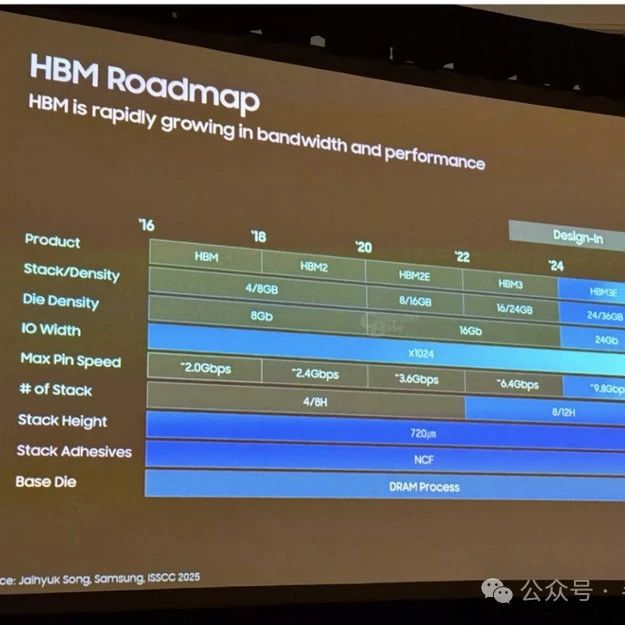
Core Viewpoint - SK Hynix emphasizes that the commercialization of the next generation of HBM (High Bandwidth Memory) requires technological advancements across various fields, particularly in power efficiency, and closer collaboration with major foundries is expected [1][3]. Group 1: Development Focus of HBM - SK Hynix's next generation HBM development focuses on three main tasks: bandwidth, power, and capacity [3]. - The bandwidth is a critical measure of data transfer speed, with the number of I/O ports for HBM4 expected to double compared to HBM3E, reaching 2,048 [3]. - Future HBM is anticipated to improve in power consumption and capacity, with the number of DRAM stacks expected to increase from a maximum of 12 to 16 or even 20 layers [3][4]. Group 2: Challenges in HBM Production - To stack more layers of the next generation HBM within a limited height specification of 775 micrometers, the spacing between each DRAM must be reduced [4]. - SK Hynix is advancing hybrid bonding technology, which connects DRAMs directly without bumps, thus reducing chip thickness and improving power efficiency [4][5]. - However, hybrid bonding faces challenges in commercialization due to high technical difficulty and issues with mass production and reliability [5]. Group 3: Competitive Landscape - Samsung has successfully produced 16-layer stacked HBM3 memory using hybrid bonding technology and plans to mass-produce HBM4 using this technology [6][8]. - Micron Technology is on track with its HBM4 development, expecting to start mass production in 2026, with HBM4E following shortly after [12]. - Micron's HBM4 will utilize 1β (5th generation 10nm class) DRAM technology, integrating up to 16 DRAM chips per stack, each providing 32 GB capacity, with a peak bandwidth of 1.64 TB/s [12][13]. Group 4: Future Projections - The HBM4 and HBM4E are seen as crucial for the ongoing expansion of AI performance, with expectations for significant improvements in density and bandwidth [22]. - Nvidia's upcoming AI accelerators are projected to utilize HBM4 technology, with the Rubin Ultra expected to feature up to 1TB of memory capacity [20][22]. - The competitive landscape is intensifying, with both Samsung and SK Hynix planning to adopt advanced foundry processes for HBM4 production, aiming for enhanced performance and efficiency [16][17].