
研发投入

Search documents
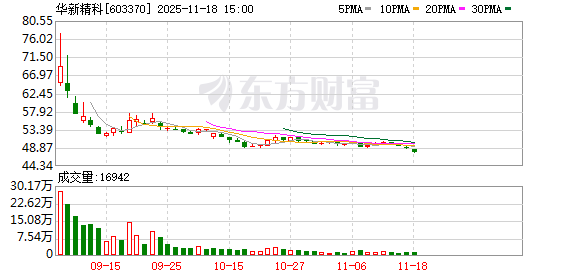
华新精科:公司高度重视技术创新和研发投入
Zheng Quan Ri Bao· 2025-11-18 13:38
Group 1 - The company emphasizes the importance of technological innovation and research and development investment [2] - The company is continuously optimizing its business strategy to ensure stable performance and create long-term value for shareholders [2] - The company strictly adheres to information disclosure standards, providing timely, accurate, and complete updates to the market [2]

北京“双榜”稳居全球前三背后的创新密码
Bei Jing Shang Bao· 2025-11-17 16:40
Core Insights - Beijing has maintained its position as the top global research city for nine consecutive years and ranks third in the International Science and Technology Innovation Center for four years [1] - The reports highlight Beijing's robust investment in research and development (R&D), with a consistent R&D intensity of around 6%, placing it among the leading innovation cities globally [2] R&D Investment - Beijing's R&D investment intensity remains at a high level of 6%, providing a solid foundation for original innovation and key technological breakthroughs [2] - The city has established four national laboratories and restructured national key laboratories, enhancing collaboration with national research forces [2] - The establishment of the "Original Innovation Fund" aims to optimize the investment structure, increasing the proportion of basic research from 18% to align with top global institutions [2] Innovation Ecosystem - Over 300 technology companies are established daily in Beijing, surpassing Silicon Valley, with 115 unicorns and 1,035 "little giant" enterprises by the end of 2024, leading the nation [4] - The innovation ecosystem is characterized by a collaborative framework involving universities, research institutions, and a supportive policy environment [4][5] - The unique combination of top talent, cutting-edge knowledge, and significant application scenarios creates a competitive advantage for Beijing's innovation landscape [5] Challenges and Strategic Responses - Despite its achievements, Beijing faces challenges such as reduced international cooperation, land resource constraints, and low patent conversion rates [6] - To address these challenges, Beijing aims to build an open innovation network and extend its industrial chain to surrounding areas [6] - The city must remain vigilant against potential declines in innovation vitality and strive for continuous self-reform to maintain its competitive edge [7]
广汽集团:今年1月-9月份研发费用为10.05亿元
Zheng Quan Ri Bao Wang· 2025-11-17 14:15
证券日报网讯广汽集团(601238)11月17日在互动平台回答投资者提问时表示,根据上市公司企业会计 准则,研发投入包括费用化支出和资本化支出两部分,其中资本化支出不计入当期损益,不直接影响当 年利润。公司2025年研发投入(包括费用化支出及资本化支出)预计突破100亿元,其中今年1月-9月份研 发费用(即费用化支出)为10.05亿元,已计入当期损益。当前公司财务结构良好,第三季度末公司资产负 债率为45.3%,整体负债率在整车行业中处于较低水平,现金与现金等价物余额为325亿元,具有充足 的资金储备和较强的融资能力。公司正推进三年"番禺行动",展开自主品牌一体化变革,降本增效已取 得一定成效,将在财务上逐步体现,同时自主品牌盈利状况也将逐步改善,实现健康、可持续发展。 ...

晨化股份:公司研发部门一直在加大研发投入,关注市场变化
Zheng Quan Ri Bao Wang· 2025-11-17 12:09
Core Viewpoint - The company, Chenhua Co., Ltd. (300610), emphasizes its commitment to safety and environmental standards in its production processes while increasing R&D investments to meet market demands [1] Group 1: Company Operations - The company's production base in Baoying is a key monitoring point for chemicals in Yangzhou and is not located within a chemical park [1] - New projects will need to consider safety, environmental protection, and compliance with regulations [1] Group 2: Research and Development - The R&D department is increasing its investment and focusing on market changes [1] - The company is developing new products based on market and customer needs, with plans to disclose information as it meets disclosure standards [1]
报告:中国高端制造业上市公司总资产规模持续增长
Zhong Guo Xin Wen Wang· 2025-11-14 13:20
报告还显示,过去5年,中国高端制造业上市公司不断开拓海外业务,海外收入持续增长。2020年至 2024年,高端制造业上市公司海外收入从20926亿元增长至43113亿元,过去5年复合增长率为19.81%, 明显高于同期全体A股上市公司海外收入的复合增长率;海外收入占A股上市公司海外总收入的比例从 32.53%增长至41.96%,体现出高端制造业正逐步发展成为中国企业出海的主力军。(完) 来源:中国新闻网 报告:中国高端制造业上市公司总资产规模持续增长 编辑:王永乐 中新社北京11月14日电 (记者 陈康亮)中国上市公司协会14日发布《中国上市公司高端制造业发展报告 (2025)》(下称报告)称,中国高端制造业上市公司家数由2020年的1661家增加至2024年的2503家,高端 制造业总体资产规模和收入水平持续增长。 广告等商务合作,请点击这里 报告显示,截至2024年底,高端制造业上市公司的总资产规模达到27.24万亿元(人民币,下同),占A股 上市公司总资产的6.07%,较2023年末增长6.13%,较2020年末增长68.79%,资产规模增速较快。 高端制造业上市公司的收入规模持续增长,由2020年的9 ...
奇瑞汽车新车销售不佳极限测试意外“翻车” 管理过于严苛屡遭员工强烈抵触
Xin Lang Zheng Quan· 2025-11-14 10:18
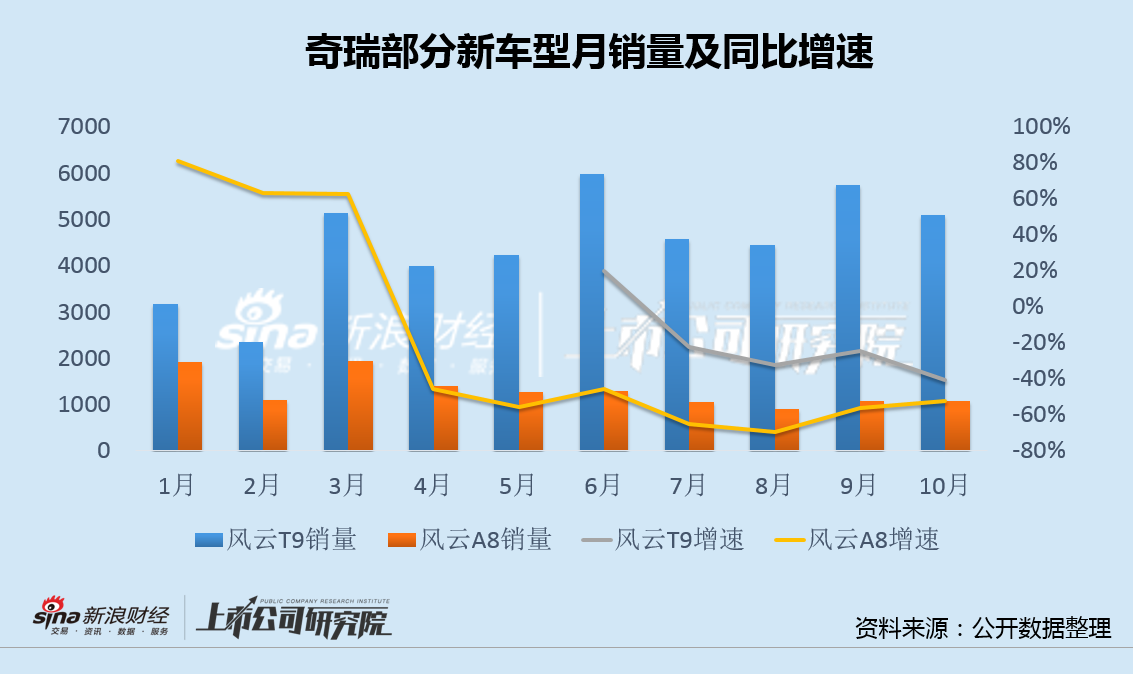
Core Viewpoint - Chery Automobile faces significant challenges with its new model, the Fengyun X3L, which has seen disappointing sales and a recent incident during a performance test that highlights internal management issues and safety concerns [1][3][10] Sales Performance - The Fengyun X3L has not met sales expectations since its launch, with overall sales growth for Chery slowing to just 2% in October compared to previous months [1][9] - Other models in the Fengyun series, such as the Fengyun T9 and A8, have also experienced poor sales performance, with the T9's monthly sales dropping from over 8,000 to below 5,000 and the A8's sales falling below 1,000 units [5][6][8] Incident Analysis - An incident during a performance test at Tianmen Mountain resulted in the vehicle sliding backward and breaking three sections of guardrail, attributed to a failure in the safety harness [3][4] - Chery's explanation for the incident points to a lack of risk assessment and detail management, raising concerns about the company's internal processes [10][15] Internal Management Issues - Reports indicate that Chery's strict management practices have led to employee dissatisfaction, with claims of excessive overtime and harsh working conditions [10][13] - A recent incident involving a refusal to attend a mandatory Saturday meeting by a new employee garnered significant internal support, highlighting employee morale issues [12][13] R&D Investment - Chery's research and development spending is notably lower than competitors like BYD and Geely, with R&D expenses constituting only 3.4% of revenue, which has contributed to lower profit margins and product competitiveness [10][13][15] Market Competition - The automotive industry is characterized by intense competition not only in product and technology but also in overall management efficiency, suggesting that Chery's current management approach may hinder its market position [15]
甘肃上市公司交出高质量三季报:营收登顶,盈利回归,科技+资源产业双线发力
Zheng Quan Shi Bao· 2025-11-14 05:29
Core Insights - Gansu listed companies reported robust growth in the first three quarters of 2025, achieving record-high revenues and total assets exceeding 900 billion yuan, showcasing the resilience and transformation of the regional industry [1] Revenue Performance - In the first three quarters of 2025, 34 A-share listed companies in Gansu achieved a total revenue of 1730.47 billion yuan, marking a historical high with a year-on-year increase of 2.69%, accounting for 17.36% of the local GDP [1] - Three companies surpassed 10 billion yuan in revenue, with Baiyin Nonferrous Metals leading at 726.43 billion yuan, followed by Jiugang Hongxing at 237.57 billion yuan and Huatian Technology at 123.80 billion yuan [2][3] Profitability - Gansu listed companies collectively reported a net profit of 52.65 billion yuan, a significant year-on-year increase of nearly 62%, ending a downward trend since 2022 [3] - 23 companies achieved profitability, with 13 companies reporting net profits exceeding 1 billion yuan, while only 5 companies incurred losses exceeding 1 billion yuan [3][4] Asset Growth - By the end of the third quarter, total assets of Gansu listed companies reached 9338.73 billion yuan, a historical high with a year-on-year growth of 8.57% [6] - The number of companies with total assets exceeding 100 billion yuan remained at 12, with Lanzhou Bank being the first in the region to surpass 500 billion yuan in total assets [6][7] Net Asset Increase - Total net assets of Gansu listed companies reached 2050.64 billion yuan, marking the first time exceeding 2000 billion yuan, with a year-on-year growth of 5.59% [9] - Eight companies reported net assets exceeding 100 billion yuan, with Lanzhou Bank being the first to exceed 400 billion yuan [9][11] Cash Flow - Operating cash flow for Gansu listed companies reached 251.86 billion yuan, a year-on-year increase of 492.09%, nearing the historical high of 254.33 billion yuan in 2021 [13] - Four companies reported cash inflows exceeding 20 billion yuan, with Lanzhou Bank being the first to exceed 100 billion yuan in operating cash flow [13][14] R&D Investment - Total R&D expenditure for Gansu listed companies was 3.173 billion yuan, maintaining a historical high despite a slight year-on-year decline [16] - Eight companies reported R&D expenses exceeding 1 billion yuan, with Huatian Technology leading the expenditure [16][17] Sector Performance - The technology sector, represented by Huatian Technology, showed strong growth with revenues reaching 123.8 billion yuan, a year-on-year increase of 17.55%, and net profit of 5.43 billion yuan, up 51.98% [20] - The resource sector, led by Baiyin Nonferrous Metals, showed recovery with revenue growth of 5.21% and a reduction in losses [22] - The power sector, represented by Gansu Energy, achieved revenue of 65.25 billion yuan, a year-on-year increase of 0.64%, and net profit of 15.82 billion yuan, up 14.16% [23][24]



腾讯Q3研发投入228亿,同比增长28%
Xin Lang Cai Jing· 2025-11-13 10:50
Core Insights - Tencent Holdings reported a record high R&D expenditure of 22.82 billion yuan in Q3, alongside capital expenditures of 12.98 billion yuan [1] - The company's international business showed positive progress, with international gaming revenue increasing by 43% year-on-year to 20.8 billion yuan, marking a quarterly record [1] Financial Performance - R&D expenditure reached 22.82 billion yuan, the highest in the company's history [1] - Capital expenditures amounted to 12.98 billion yuan [1] Business Development - International gaming revenue grew by 43% year-on-year, totaling 20.8 billion yuan, which is the highest quarterly figure to date [1]

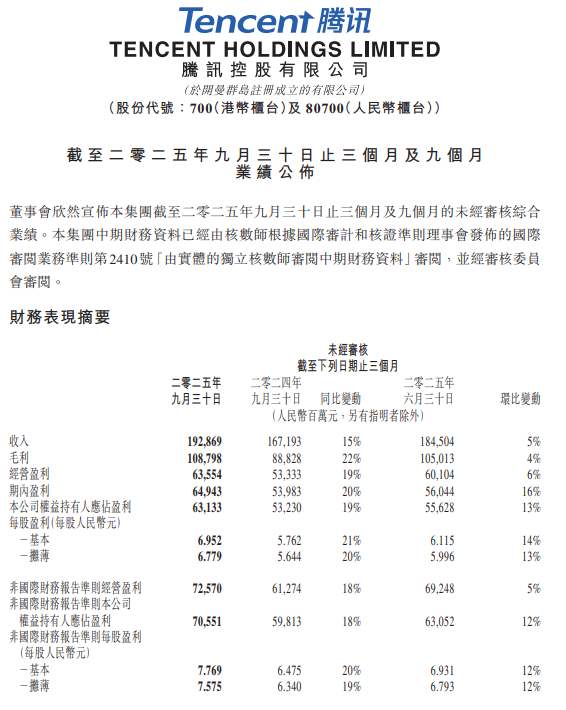
腾讯,最新财报公布
Di Yi Cai Jing· 2025-11-13 09:36
Core Insights - Tencent Holdings reported third-quarter revenue of RMB 192.87 billion, a year-on-year increase of 15% [1][2] - Non-IFRS operating profit reached RMB 72.57 billion, up 18% year-on-year [1][2] Financial Performance - Total revenue for the third quarter was RMB 192.87 billion, compared to RMB 167.19 billion in the same period last year, reflecting a 15% growth [2] - Gross profit increased to RMB 108.80 billion, a 22% rise from RMB 88.83 billion year-on-year [2] - Operating profit was RMB 63.55 billion, up 19% from RMB 53.33 billion year-on-year [2] - Net profit attributable to equity holders was RMB 63.13 billion, a 19% increase from RMB 53.23 billion year-on-year [2] - Basic earnings per share rose to RMB 6.95, a 21% increase from RMB 5.76 year-on-year [2] Business Segments - Online gaming revenue totaled RMB 63.6 billion, with international market game revenue growing 43% year-on-year, surpassing RMB 20.8 billion [2] - ToB (Technology and Business) segment, including fintech and enterprise services, showed strong performance with a 10% increase to RMB 58.2 billion [3] - Research and development expenditure reached a record high of RMB 22.8 billion, up 28% year-on-year [4] User Metrics - As of September 30, 2025, the combined monthly active accounts for WeChat and Weixin reached 1.414 billion, a 2% increase year-on-year [4] - Monthly active accounts for QQ on mobile terminals were 517 million, reflecting an 8% year-on-year decline [4] - The number of paid value-added service subscribers remained stable at 265 million [4]
佰仁医疗(688198):Q3收入端保持快速增长,期待新产品持续放量
Bank of China Securities· 2025-11-13 05:37
Investment Rating - The investment rating for the company is "Buy" with a market price of RMB 108.83 and a sector rating of "Outperform" [1][5]. Core Insights - The company reported a revenue of RMB 382 million for the first three quarters of the year, representing a year-on-year growth of 30.58%. The net profit attributable to the parent company was RMB 93 million, up 57.93% year-on-year [5]. - The third quarter revenue was RMB 134 million, showing a year-on-year increase of 31.54%, while the net profit decreased by 9.39% year-on-year [5]. - The company is expected to continue launching new products, which will contribute to future growth, maintaining a positive outlook for the company's development [5][7]. Financial Performance Summary - For the years 2023 to 2027, the company is projected to achieve the following: - Revenue growth rates of 25.6% in 2023, 35.4% in 2024, and 37.5% in 2025 [9]. - Net profit growth rates of 21.1% in 2023, 27.0% in 2024, and 60.8% in 2025 [9]. - The estimated earnings per share (EPS) are expected to rise from RMB 0.84 in 2023 to RMB 3.27 in 2027 [9]. - The company maintains a high R&D expense ratio, with R&D expenses accounting for 30.81% of revenue in the first three quarters [10]. Product Development and Market Position - The company is in the process of launching multiple new products, with 8 products currently in the registration review phase [10]. - The collagen product line, particularly Collagen-I, is nearing approval and is expected to provide significant revenue growth [10].
