
玄戒芯片

Search documents
大佬的2025 | | 雷军不服
Sou Hu Cai Jing· 2026-02-23 11:39
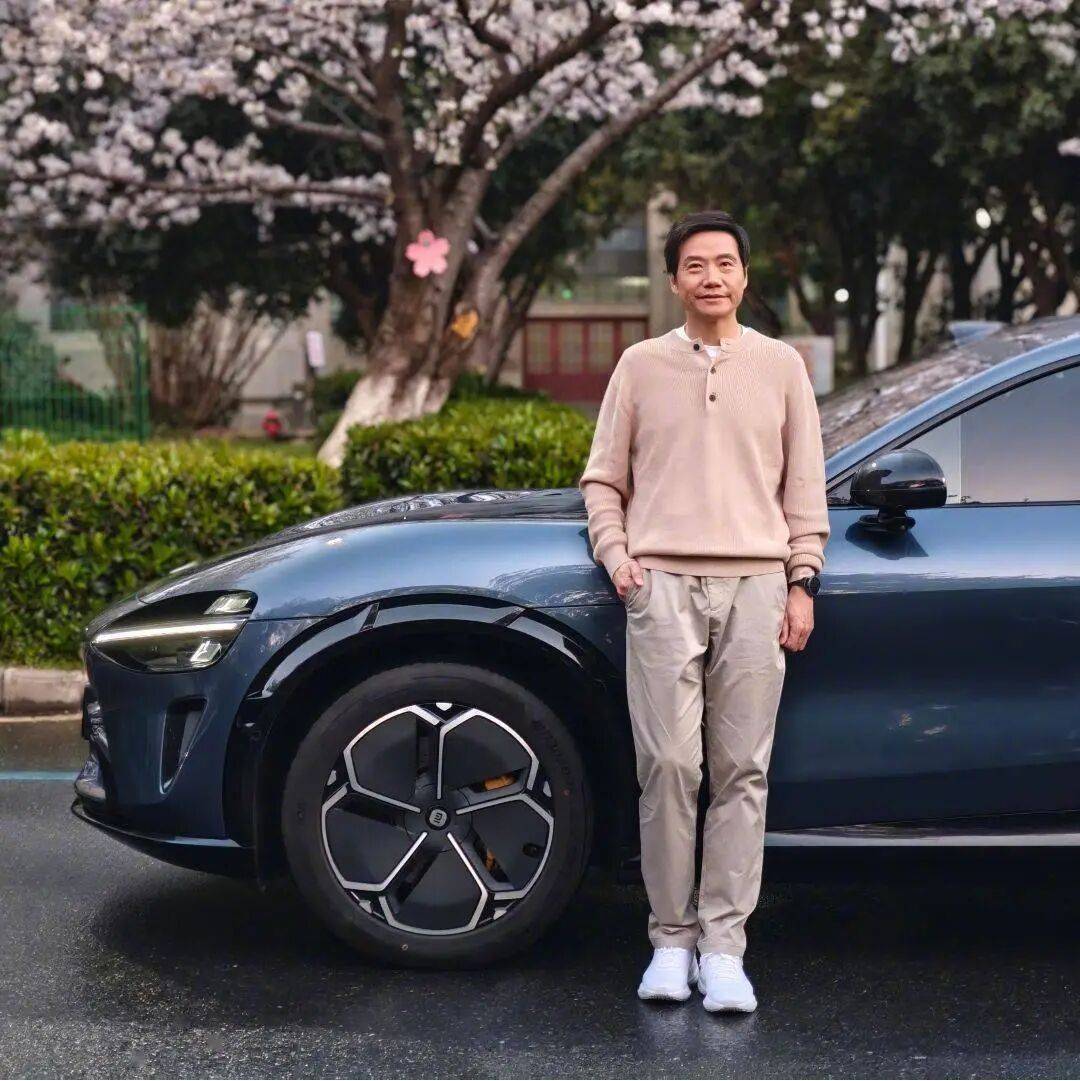
Core Viewpoint - The year 2025 presents significant challenges for major players in the tech and internet sectors, shifting from rapid growth to a more demanding environment that tests judgment and endurance [1][2]. Group 1: Company Performance and Challenges - Xiaomi's first-generation SU7 has delivered over 381,000 units in less than two years, showcasing a remarkable achievement in the automotive sector [3]. - Despite the impressive sales figures, 2025 has been marked by controversies and criticisms surrounding product safety and marketing practices, leading to a perception of a "downward spiral" for the company [4][5]. - The SU7 incident in March 2025, which resulted in a fatal accident, has raised serious concerns about the safety of Xiaomi's vehicles and has led to increased scrutiny from regulatory bodies [15]. Group 2: Leadership and Public Perception - Lei Jun, the founder of Xiaomi, has faced significant public backlash and criticism, feeling that many of the concerns raised about the company are misinterpretations or attacks from competitors [6][7]. - Despite the challenges, Lei Jun remains defiant, emphasizing that the criticisms do not reflect the true quality of Xiaomi's products and asserting that the company is a victim of misinformation [19][21]. - The company's stock price has seen a decline, dropping to approximately 900 billion HKD from a peak of 1.5 trillion HKD earlier in the year, reflecting the impact of negative public sentiment on market performance [21]. Group 3: Strategic Adjustments and Future Outlook - In response to the controversies, Xiaomi is making efforts to improve its marketing strategies and product safety measures, including recalling vehicles with safety issues and redesigning certain features [22][23]. - There is a growing expectation for Lei Jun to innovate beyond past practices and to lead Xiaomi into a new era of technological advancement, which could solidify the company's reputation as a trusted brand [24].


未知机构:小米业务经理访谈纪要260209GD家电家电业务-20260211
未知机构· 2026-02-11 01:55
Summary of Xiaomi's Business Conference Call Industry Overview - The conference call primarily discusses Xiaomi's home appliance and technology sectors, including air conditioning, Internet of Things (IoT), smartphones, and automotive business. Key Points Home Appliances - **Air Conditioning Shipment**: The target for 2025 is to ship 10 million units, with an actual completion of 9.2 million units in 2025 [1] - **Strategic Shift**: Starting from Q4 2025, the strategy will shift to focus on profitability in the home appliance sector [1] - **Air Conditioning Profit Margins**: The gross margin for air conditioning was 18% last year, with a net profit margin around 2%. The goal for 2026 is to increase the gross margin to over 23% [1] IoT and Internet - **IoT Revenue Structure**: Black and white appliances account for 43% of revenue with an overall gross margin of 15%, while other IoT products contribute 57% of revenue with a gross margin of 35% [1] - **Internet Revenue**: In 2025, the internet segment generated revenue of 36 billion yuan with a net profit margin of 58% [2] Television - **Global Shipment**: The global shipment of televisions remains stable at 12 million units, with hardware yielding zero net profit and internet services generating profit [3] Smartphones - **Profitability Levels**: The breakeven gross margin for smartphones is 12%. The gross margin reported for Q3 2025 was 11%, with expectations for Q4 2025 to drop below 9%. Pressure on margins is expected to continue into Q1 2026, with some relief anticipated in Q2 2026 [3] - **Shipment Volume**: For Q4 2025, the expected shipment is 37 million units, with a forecast of 35 million units for Q1 2026. The annual shipment target for 2026 has been revised down from 185 million to 155 million units, following an actual shipment of 166 million units in 2025, which fell short of the 175 million target [3] Automotive Business - **Order Status**: As of mid-January, there are 133,000 existing orders (equivalent to 3.5 months of production capacity), with an additional 13,000 new orders (only for the Yu7 model) [4] - **Production Capacity**: The Beijing factory has a full production capacity of 1.2 million units, while the Wuhan factory has a capacity of 450,000 units [4] - **Profit per Vehicle**: The net profit per vehicle in 2025 is approximately 35,000 yuan, with investments in AI and robotics affecting apparent profitability [4] New Industry Investments - **Robotics**: An estimated investment of 2.5 to 3 billion yuan is planned for 2026, focusing on model development and hardware research [4] - **Chip Development and OS**: An annual investment of 9 billion yuan is allocated, with 13.5 billion yuan invested over four years in the Xuanjie chip [4] - **Autonomous Driving**: An investment of 3.5 billion yuan is planned for 2026 [4] - **AI Large Models**: An investment of 8 billion yuan is required for 2026 [4] Offline Channel Adjustments - **Store Count Reduction**: The number of stores decreased from 18,000 in mid-2025 to 14,000 by the end of 2025, with plans to further reduce to 10,000 to 12,000 stores, focusing closures on lower-tier cities [4] - **Adjustment Logic**: The rapid expansion of stores and low commission rates for franchisees are cited as reasons for the adjustments [5] - **Major Appliance and Automotive Store Count**: Currently, there are over 400 stores selling cars and 2,000 stores selling major appliances, with a cap of 4,000 stores for major appliances [5]
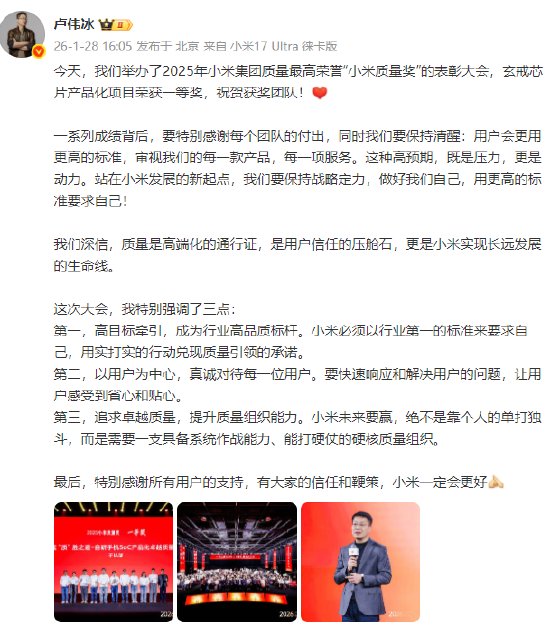
小米卢伟冰:必须以行业第一的标准来要求自己
Xin Lang Cai Jing· 2026-01-28 08:11
Core Viewpoint - Xiaomi Group emphasizes the importance of quality as a key driver for long-term development and user trust, as highlighted by the recent "Xiaomi Quality Award" ceremony where the玄戒 chip project won first prize [1][3]. Group 1: Quality Commitment - Xiaomi aims to set industry standards for high quality, committing to actions that reflect its promise of quality leadership [1][3]. - The company believes that quality is essential for high-end positioning and is crucial for gaining user trust [1][3]. Group 2: User-Centric Approach - Xiaomi stresses the importance of being user-centered, focusing on quickly addressing and resolving user issues to enhance user experience [1][3]. Group 3: Organizational Excellence - The company highlights the need for a robust quality organization capable of systematic operations and tackling challenges, rather than relying on individual efforts [1][3].
央视点名雷军!小米干成苹果没做到的事,五年野心藏不住了
Sou Hu Cai Jing· 2025-12-27 09:05
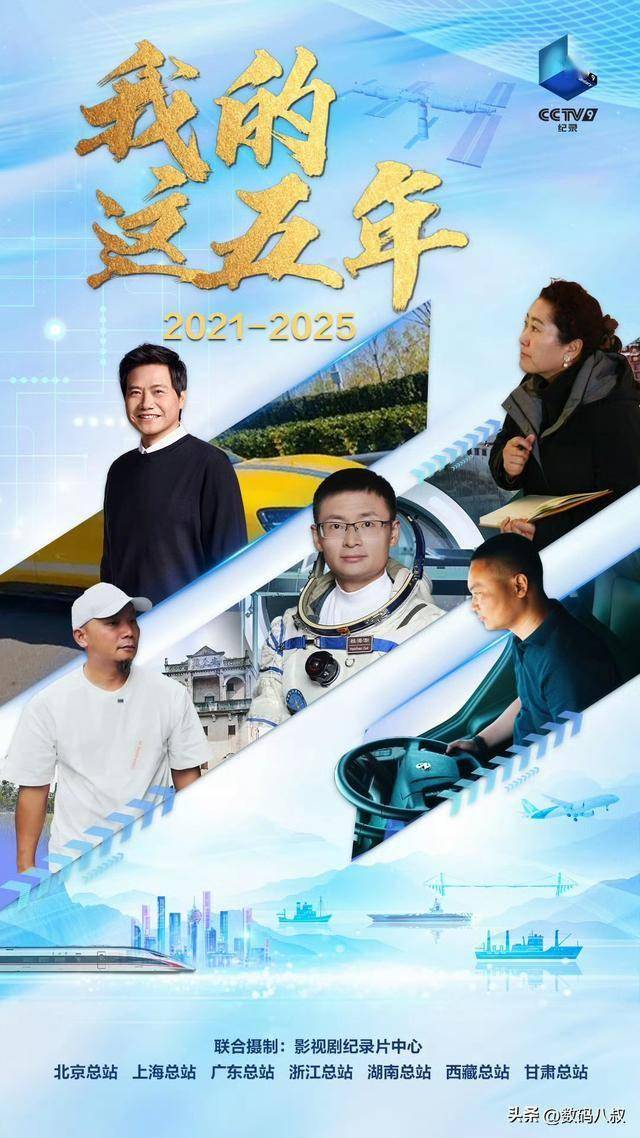
Core Viewpoint - Xiaomi has established itself as a leading global technology company through significant advancements in core technologies, including the development of its own chips, electric vehicles, and smart manufacturing capabilities, positioning itself beyond just a cost-effective brand [1][12]. Group 1: Chip Development - The development of the玄戒 chip, which took four years and an investment of 13.5 billion, features a 3nm architecture with 19 billion transistors, achieving energy efficiency comparable to Apple's A18 Pro [3]. - Xiaomi has become one of only four global smartphone manufacturers to possess self-developed flagship chips, marking a significant milestone in its journey to reduce reliance on external supply chains [3][9]. Group 2: Automotive Sector - Xiaomi's entry into the automotive market has been rapid, with over 200,000 units of the SU7 model delivered within two years, establishing itself as a major player in the new energy vehicle sector [5]. - The integration of 澎湃 OS allows seamless interaction between smartphones, cars, and home appliances, providing a user experience that surpasses Apple's CarPlay, thus creating a comprehensive ecosystem [5][12]. Group 3: Smart Manufacturing - Xiaomi's smart manufacturing capabilities are exemplified by its Wuhan factory, which produces an air conditioner every 6.5 seconds, with over 40% of its energy sourced from solar power [7]. - The establishment of three major smart production bases enables Xiaomi to control quality across high-end home appliances, flagship smartphones, and smart vehicles, reinforcing its position as a leader in intelligent manufacturing [7]. Group 4: Market Position and Future Outlook - Xiaomi's market share in the high-end smartphone segment has increased from 5.6% to 16.8%, with the 17 Ultra Leica version gaining significant traction in the ultra-high-end market [7]. - The company aims to deliver 350,000 vehicles annually, marking a second growth curve, while its ecosystem strategy connects various devices, enhancing the user experience across all scenarios [7][14]. - Xiaomi's ambition extends from high-end to ultra-high-end products, and from domestic to global markets, indicating a strong commitment to innovation and market expansion [14].
小米新征途:智能汽车、出海和高端化造想象空间
凤凰网财经· 2025-11-20 09:00
Core Viewpoint - Xiaomi Group reported a strong performance in Q3 2023, achieving revenue of 113.1 billion yuan, a year-on-year increase of 22.3%, and an adjusted net profit of 11.3 billion yuan, marking an 80.9% increase, the highest in its history [2][4]. Group 1: Core Business Growth and Innovation Acceleration - The revenue from Xiaomi's mobile and AIoT segments reached 84.1 billion yuan, with smartphone revenue at 46 billion yuan and IoT and lifestyle products at 27.6 billion yuan, showing a year-on-year growth of 5.6% [7][10]. - Xiaomi's smartphone shipments reached 43.3 million units in Q3, marking nine consecutive quarters of year-on-year growth, maintaining a top-three global ranking for 21 quarters [8][10]. - The innovative business segment, including smart electric vehicles and AI, generated 29 billion yuan in revenue, with a staggering year-on-year growth of over 199% [10][13]. Group 2: R&D Investment and Future Growth - Xiaomi's total revenue for the first three quarters of the year reached 340.4 billion yuan, nearing last year's total, with adjusted net profit exceeding last year's figure at 32.8 billion yuan [2][4]. - The company invested 23.5 billion yuan in R&D in the first three quarters, approaching the total planned investment for 2024, with expectations to exceed 30 billion yuan for the year [22][26]. - Xiaomi plans to invest 200 billion yuan in core technology R&D over the next five years, transitioning from an internet company to a hard-tech company [26][28]. Group 3: Market Position and Competitive Edge - Xiaomi's new flagship Xiaomi 17 series achieved over 1 million sales within five days of launch, indicating strong market acceptance and competitive positioning against rivals like Apple [14][16]. - The company has established a robust ecosystem with over 1 billion connected IoT devices, and the number of users with five or more connected devices reached 21.6 million, reflecting high user engagement [8][10]. - Xiaomi's smart electric vehicle business is positioned for significant growth, with plans to launch new models and expand into international markets, contributing to a projected 23% increase in vehicle shipments by 2027 [17][19].
雷军年度演讲透视:小米为何“干啥成啥”?
Sou Hu Cai Jing· 2025-10-16 12:54
Core Insights - Xiaomi's recent annual speech by Lei Jun emphasized the company's innovative journey and breakthroughs in chip and automotive sectors, marking its 15th anniversary [2][3] - The success of Xiaomi's innovations is attributed to a well-rooted methodology that combines user-centricity, technology, cost-effectiveness, efficiency, and leadership [2][21] Group 1: Reflection and Methodology - The breakthroughs in chips and automotive sectors stem from a deep internal reflection initiated five years ago, addressing critical questions about past successes and failures [3][4] - This reflection led to a strategic shift towards becoming a hard-tech company, with a commitment to invest 100 billion yuan in core technologies over five years [6][19] Group 2: Chip Business Insights - Xiaomi's chip business began with the establishment of Pinecone Electronics in 2014, but initial attempts faced challenges due to a focus on low-end products [8][9] - The rebranding of the chip initiative to "Xuanjie" in 2021 involved aligning the chip team closely with the smartphone team, fostering a shared risk and goal environment [9][11] - The successful launch of the Xuanjie chip, utilizing a 3nm process, is expected to position Xiaomi among the top players in the market [9][19] Group 3: Automotive Business Insights - Xiaomi's automotive venture, initiated in 2021, aims to create the world's strongest pure electric performance vehicle, reflecting a long-term investment philosophy [12][14] - The SU7 Ultra's development faced challenges but ultimately achieved record-breaking performance, while the YU7 model was designed based on user insights, leading to significant pre-orders [14][18] Group 4: Leadership and Organizational Evolution - Leadership and organizational capabilities are crucial for Xiaomi's success, with Lei Jun's direct involvement in the automotive sector being a key factor [36][37] - The evolution of Xiaomi's leadership structure, with new executives joining, signifies a maturation of the company's management philosophy [36][42] Group 5: Broader Industry Impact - Xiaomi's innovative methodology serves as a benchmark for the transformation of China's manufacturing industry, demonstrating that high-end products can be achieved without high prices [44][46] - The company's approach to user co-creation and efficiency optimization has implications for various sectors, providing a replicable model for other businesses [50][49]
喜娜AI速递:今日财经热点要闻回顾|2025年10月2日
Xin Lang Cai Jing· 2025-10-02 11:11
Group 1 - The U.S. government shutdown has led to market volatility, with gold prices rising and stock indices fluctuating, indicating increased investor risk aversion and expectations for Federal Reserve rate cuts [2] - Warren Buffett's Berkshire Hathaway plans to acquire Occidental Petroleum's chemical subsidiary OxyChem for $10 billion, marking its largest acquisition since 2022 [2] - Gold prices have reached new highs, driven by factors such as the Federal Reserve's potential rate cuts and the government shutdown, with September marking the largest monthly increase since August 2011 [2] Group 2 - Asian stock markets surged, led by semiconductor and technology sectors, attributed to heightened expectations of Federal Reserve rate cuts and advancements in AI technology [3] - Elon Musk's net worth surpassed $500 billion, making him the world's first "half-trillionaire," due to the rebound in Tesla's stock price and rising valuations of his startups [3] - In October, 13 brokerage firms released their top stock picks, favoring electronics and technology sectors, with expectations of a strong market performance driven by favorable policies and industry catalysts [3] Group 3 - The U.S. H-1B visa application fee has increased to $100,000, significantly impacting India's IT services sector, which relies heavily on the U.S. market [3] - Xibei has implemented significant price reductions of 20% to 40% across its menu in response to consumer backlash, but consumer trust remains unverified [4] - Xiaomi is facing challenges and opportunities in its automotive and chip development investments, with plans to invest a total of 3.05 billion in these sectors by 2025 [4] Group 4 - The financial industry is addressing "involution" competition, characterized by homogenized competition and excessive price cuts, which threaten profitability and risk management [5]
雷军“两个大学生学费账单”:造车1050亿+芯片135亿?
Sou Hu Cai Jing· 2025-09-29 23:07
Core Insights - Lei Jun, the founder of Xiaomi, expressed the significant financial pressure of supporting two university students, which metaphorically refers to the company's investments in electric vehicles and chip development [2][25] - As of April 2025, Lei Jun's net worth reached $43.5 billion, primarily due to the recovery of Xiaomi's stock price and the delivery of the SU7 model [3] - Xiaomi's total investment in its automotive venture has exceeded 105 billion yuan, with plans to invest an additional 30 billion yuan in 2025 alone [13][15] Investment in Automotive Sector - Xiaomi's automotive project has incurred a total investment of 105 billion yuan over five years, with a single-year plan for 2025 to invest 30 billion yuan [13][15] - The SU7 model's development costs alone surpassed 30 billion yuan, and the automotive division reported a quarterly loss of 1.8 billion yuan despite achieving a revenue of 20.6 billion yuan in Q2 2025 [15] - Xiaomi's automotive strategy aims for a sales target of 300,000 units annually, emphasizing the importance of substantial investment in technology and product quality [15][25] Investment in Chip Development - Xiaomi's chip development has seen an investment of over 13.5 billion yuan in 2023, with a projected budget of over 6 billion yuan for 2025 [22] - The cost of developing the 3nm flagship processor "Xuanjie O1" reached $1 billion per iteration, highlighting the high stakes involved in chip manufacturing [22] - The chip division's R&D expenses accounted for 18% of total R&D spending in 2023, with a team of over 2,500 engineers [22] Strategic Vision and Market Position - Lei Jun's annual speeches have become a significant platform for Xiaomi's strategic narrative, focusing on innovation and product launches [9][12] - The company aims to leverage its existing smartphone user base to drive growth in both the automotive and chip sectors, creating a synergistic effect [21] - Xiaomi's commitment to long-term investment in high-tech sectors reflects a broader trend in Chinese enterprises striving for technological advancement and industry upgrades [25]
小米集团-W逆市跌超3% 发布会后股价累计跌超一成
Zhi Tong Cai Jing· 2025-09-29 06:15
Core Viewpoint - Xiaomi Group's stock has seen a significant decline, dropping over 3% in a bearish market following an 8% drop in the previous trading day, indicating investor concerns about the company's recent product launch and future plans [1] Group 1: Stock Performance - As of the latest update, Xiaomi's stock is down 2.74%, trading at 53.15 HKD, with a trading volume of 12.477 billion HKD [1] Group 2: Product Launch and Market Reaction - On September 25, Xiaomi held a product launch event where it introduced the flagship Xiaomi 17 series smartphones, Xiaomi Pad 8 series tablets, and a range of high-end home appliances [1] - Nomura's report highlighted that CEO Lei Jun did not provide updates on the launch of the玄戒 chip or the timeline and capacity expansion plans for new electric vehicle models, suggesting a lack of excitement from the event [1] - The Xiaomi 17 series went on sale across all channels on September 27, with the company's public relations manager announcing that the series set a record for first-day sales and revenue for new smartphone series in the domestic market within 5 minutes of launch [1] Group 3: Marketing and Public Perception - Xiaomi's promotional materials for the new Xiaomi 17 Pro smartphone featured slogans that sparked online discussion, with some interpreting them as "wordplay" due to the small print clarifying the product's design goals [1] - The customer service team clarified that the term "逆光之王" (King of Backlight) refers to the phone's capability to perform well in backlight photography, emphasizing the technology and features of the device [1]
港股异动 | 小米集团-W(01810)逆市跌超3% 发布会后股价累计跌超一成
智通财经网· 2025-09-29 06:05
Group 1 - Xiaomi Group-W (01810) experienced a decline of over 3% in the market, following an 8% drop in the previous trading day, with the current price at 53.15 HKD and a trading volume of 12.477 billion HKD [1] - On September 25, Xiaomi held a product launch event where it introduced the flagship Xiaomi 17 series smartphones, Xiaomi Pad 8 series tablets, and a range of high-end home appliances. However, Nomura's report indicated that CEO Lei Jun did not provide updates on the launch of the玄戒 chip or the timeline and capacity expansion plans for new electric vehicle models, leading to a lack of highlights in the event [1] - On September 27 at 10 AM, the Xiaomi 17 series became available for sale across all channels, and within 5 minutes, it set a record for the highest sales volume and revenue for a new smartphone series in the domestic market for 2025, as stated by Wang Hua, the General Manager of Xiaomi Group's Public Relations Department [1] Group 2 - Xiaomi's promotional materials for the new Xiaomi 17 Pro smartphone featured slogans such as "King of Backlight," which sparked discussions among netizens regarding the use of small print that indicated these were design goals rather than definitive claims. Xiaomi's customer service clarified that "King of Backlight" refers to the phone's capability to perform well in backlight photography, emphasizing the technology and features of the device [1]