两融市场

Search documents
两融市场显著升温:新开户数创年内新高,投资者参与度持续提升
Huan Qiu Wang· 2025-10-18 03:53
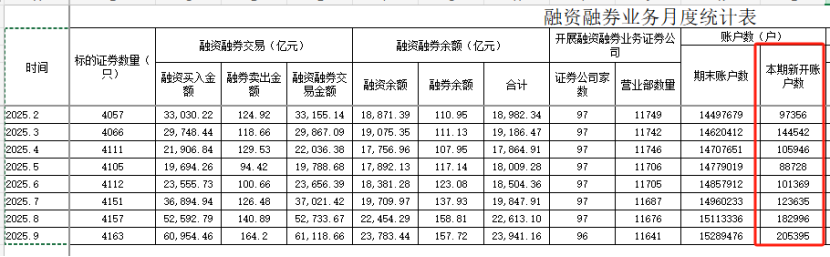
Core Insights - The financing and securities lending market in China is experiencing significant growth, with a notable increase in new account openings and overall market participation [1][3] - As of September 2025, the total number of financing and securities lending accounts reached 15.29 million, indicating a substantial expansion of the business [1] - The financing balance in the A-share market rose from 1.85 trillion yuan to 2.39 trillion yuan in the third quarter of 2025, reflecting a quarter-on-quarter increase of 29.19% [1] Summary by Category Market Activity - In September 2025, 205,400 new financing and securities lending accounts were opened, marking the highest monthly record for the year and a 12.24% increase from August [1] - Year-on-year, new account openings surged by 288% compared to September 2024, when only 52,900 accounts were opened [1] Investor Participation - The number of individual investors in the financing and securities lending market reached 7.72 million, while institutional investors totaled 50,204 [2] - The average maintenance margin ratio in the market stood at 279.01%, indicating a robust level of risk control [2] Industry Response - Securities firms are actively expanding their financing and securities lending business to meet the growing market demand while also implementing measures to control risks, such as adjusting financing margin ratios [3] - Analysts suggest that the recovery in financing and securities lending data is closely linked to increased market activity and enhanced investor confidence, which reflects the effective utilization of leverage in the capital market [3]

两融市场火热,券商密集“提额”
2 1 Shi Ji Jing Ji Bao Dao· 2025-09-25 12:08
Core Viewpoint - The recent increase in financing business limits by several securities firms, including Zheshang Securities, reflects the booming demand for margin trading in the A-share market, with the total margin trading balance reaching a historical high of 24,310.59 billion yuan as of September 24 [3][9]. Financing Business Expansion - Zheshang Securities announced an increase in its financing business limit from 40 billion yuan to 50 billion yuan to promote the development of credit business and manage financing business scale [5][6]. - Other securities firms, such as Huayin Securities and Xingye Securities, have also raised their financing business limits, indicating a trend among brokers to expand their credit business in response to market demand [7][9]. Market Dynamics - As of September 24, the A-share market's margin trading balance reached 24,310.59 billion yuan, with a financing balance of 24,140.84 billion yuan and a securities lending balance of 169.75 billion yuan, marking the third trading day this year where the financing balance exceeded 24 trillion yuan [3][9]. - The proportion of margin trading transactions to total A-share trading volume reached 12.25%, the highest since July 14, 2020, indicating increased investor participation [10]. Investor Engagement - In August, 180,000 new margin trading accounts were opened, a year-on-year increase of 381%, bringing the total number of margin trading accounts to 15.11 million by the end of August [4][11]. - The average maintenance guarantee ratio for clients with margin trading is 280.87%, suggesting a controlled risk environment despite the increased trading activity [6][11]. Future Outlook - Industry experts believe that the increase in financing business limits will not be a short-term trend but rather a regular occurrence driven by market demand and regulatory conditions, with expectations that 10 to 15 more securities firms may follow suit by the end of 2026 [12].


两融余额站稳2.4万亿元 资金偏好锚定高景气赛道
Cai Jing Wang· 2025-09-19 08:53
Group 1 - The balance of margin financing and securities lending (referred to as "two financing") has reached a historical high of 24.04 trillion yuan, reflecting increased market activity and investor sentiment [1][2] - As of September 17, the total margin balance was 23.89 trillion yuan, with a daily increase of 127.11 billion yuan, while the securities lending balance was 169.22 billion yuan, increasing by 0.81 billion yuan [2] - The two financing balance has shown a fluctuating upward trend, with significant increases from 16.4 trillion yuan in early 2021 to 24.04 trillion yuan in September 2023 [2] Group 2 - The current scale of two financing is considered reasonable, as it remains within historical averages since 2016, despite surpassing pre-2015 highs [3] - The number of individual investors in the two financing market has increased to 7.66 million, with 549,700 active participants, indicating heightened investor engagement [3] - Financing funds have shown a clear preference for high-growth sectors, with industries such as power equipment, electronics, and non-bank financials leading in net financing purchases [3] Group 3 - The continuous high balance of two financing has contributed to the securities industry's performance, with net interest income reaching 26.24 billion yuan in the first half of the year, accounting for 10.45% of total revenue [5] - Securities firms are actively optimizing service processes and adjusting credit business limits to enhance their capacity to capture market opportunities [5] - For instance, Huayin Securities has raised its credit business limit twice within six months, reflecting a strong focus on two financing and related credit services [5] Group 4 - The two financing market is entering a phase of fee competition, prompting firms to enhance service quality and professional capabilities rather than solely relying on fee reductions [6] - Leading securities firms dominate the two financing business due to their advantages in capital, clients, and channels, while smaller firms are focusing on differentiated competitive strategies [6] - For example, Guoyuan Securities aims to establish a tiered client service system to provide differentiated value-added services, while Changcheng Securities is enhancing customer service experience through refined operations [6]
2.3万亿元!A股两融余额再创新高,超越2015年牛市峰值
Mei Ri Jing Ji Xin Wen· 2025-09-10 11:36
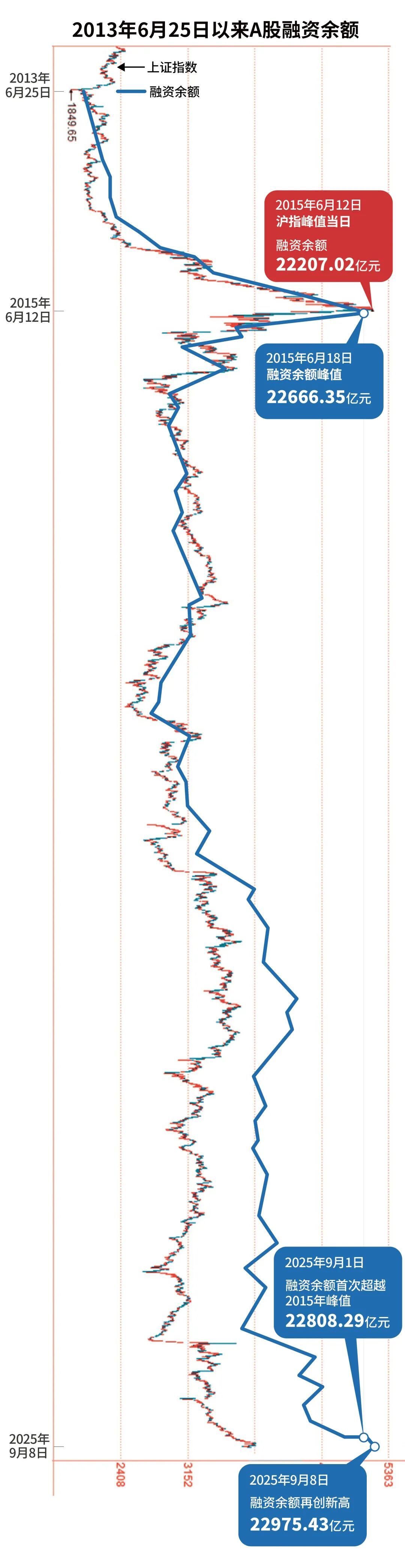
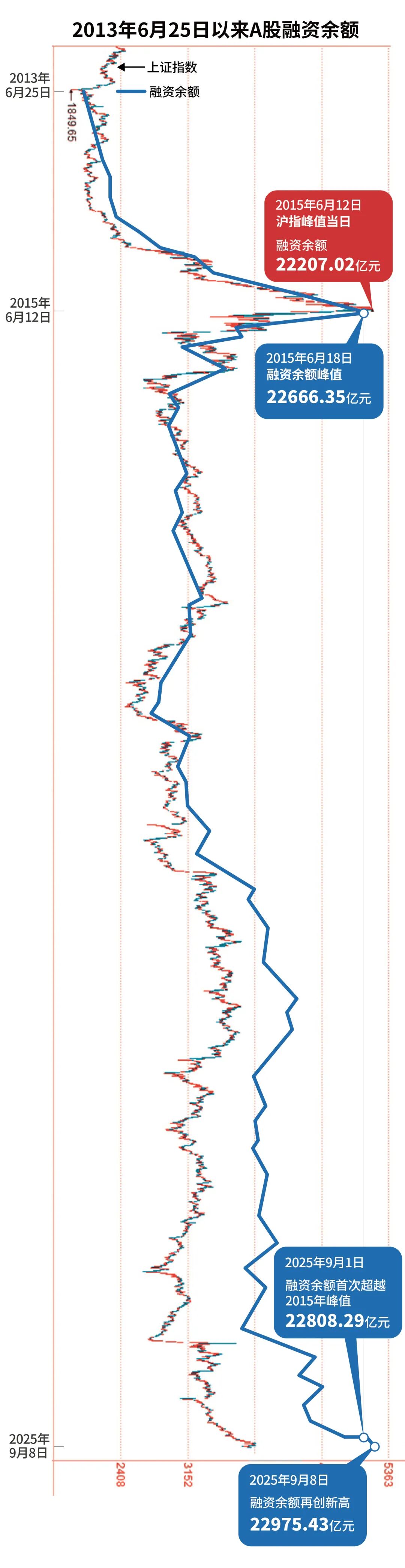
Core Viewpoint - The A-share margin trading balance has reached a historical high, surpassing the peak of 2015, indicating a significant increase in leverage in the market, but with different characteristics compared to the previous peak [1][5][30]. Margin Trading Data Comparison - The number of margin trading stocks has increased from 912 in 2015 to 4239 in 2025, reflecting a broader market participation [5]. - As of September 9, 2025, the margin trading balance accounted for 2.5% of the A-share market capitalization, which is significantly lower than the over 4% seen in 2015 [6][7]. - The absolute amount of margin trading is higher now, but its proportion of total trading volume is slightly lower than in 2015, indicating a more active market with a higher participation of self-funding [8][9]. Investor Participation and Debt Levels - The number of individual investors participating in margin trading has exceeded 7.6 million, with a notable increase in participation during certain trading days, although it has fluctuated recently [10][11]. - The average debt per margin trader has decreased from approximately 163.91 million in 2015 to 128.4 million in 2025, suggesting a reduction in individual leverage [12]. Sectoral Analysis of Margin Trading - The margin trading balance for the ChiNext board has significantly increased by 367% from 2015, while the balance for the CSI 300 has decreased by 39.8% [14][17]. - The current margin trading balance across various industries is notably lower than the peaks seen in 2015, with traditional sectors like finance and real estate experiencing substantial declines in margin trading balances [22][23]. Market Dynamics and Investment Logic - The current market shows a more diversified funding structure compared to 2015, with various funding sources including public and private funds, and foreign investments contributing to market dynamics [30]. - The investment logic has shifted towards a focus on performance and fundamentals, with margin funds being directed more towards growth sectors such as technology and innovation [30][31].
2.3万亿元!A股两融余额再创新高,超越2015年牛市峰值!十年数据对比,这几个风险点必须警惕
Mei Ri Jing Ji Xin Wen· 2025-09-10 11:34
Core Insights - The A-share margin trading market has reached a historic milestone, with the margin balance exceeding 22,969.91 billion yuan as of September 1, 2025, marking a new high since 2015 [1] - As of September 9, 2025, the margin balance further increased to 23,197.18 billion yuan, indicating sustained high levels of trading activity [1] Margin Trading Data Comparison - The number of margin trading stocks has increased significantly from 912 in June 2015 to 4,239 by September 2025 [5] - The margin balance as a percentage of A-share circulating market value is currently at 2.496%, which is significantly lower than the over 4% observed in June 2015 [6][7] Trading Activity and Investor Participation - The absolute amount of margin trading is higher now, but its proportion of total trading volume is slightly lower than in 2015, with recent trading volumes fluctuating between 2,600 billion and 3,000 billion yuan [8][9] - The number of individual investors participating in margin trading has increased to over 7.6 million, while the average debt per margin trader has decreased from approximately 163.91 million yuan in 2015 to 128.4 million yuan in 2025 [10][12] Sector-Specific Trends - The margin balance for the ChiNext index has surged to 4,845.23 billion yuan, a 367% increase from 1,038.30 billion yuan in June 2015, while the margin balance for the CSI 300 index has decreased by 39.8% [14][16][17] - The current margin balance across various industries is significantly lower than the peaks seen in 2015, with traditional sectors like finance and real estate experiencing substantial declines in margin trading activity [22][23] Market Dynamics and Investor Behavior - The current market shows a more rational approach to margin trading, with funds being directed towards sectors with solid performance and growth potential, such as technology and innovation [30] - The overall market structure has become more diversified, with various funding sources including public and private funds, as well as foreign investments, contributing to a more sustainable market environment compared to the reliance on margin trading in 2015 [30] Conclusion - The A-share margin trading landscape has evolved significantly over the past decade, with increased participation and a shift in focus towards growth-oriented sectors, while maintaining a lower overall leverage ratio compared to the previous peak in 2015 [24][30]
今年布局曝光,券商多维度“掘金”两融市场
Zheng Quan Shi Bao· 2025-09-04 09:56
Core Insights - The A-share market has seen increased trading activity in the first half of the year, leading to a significant rise in margin financing and securities lending (two-in-one) business, which has become a key battleground for brokerages [1][3] - Over 95% of listed brokerages reported year-on-year growth in two-in-one interest income, with notable increases among smaller firms [1][3] Revenue Performance - Three leading brokerages achieved over 3 billion yuan in two-in-one interest income in the first half of the year: Guotai Junan at 3.827 billion yuan, CITIC Securities at 3.686 billion yuan (up 7.04%), and Huatai Securities at 3.509 billion yuan (up 1.49%) [3] - Several other brokerages, including Galaxy Securities (2.747 billion yuan) and China Merchants Securities (2.338 billion yuan), also reported substantial two-in-one interest income [3] - Among 42 listed brokerages, only Changcheng Securities saw a slight decline in two-in-one interest income, down 1.85% year-on-year [3][4] Client Acquisition Strategies - Brokerages are focusing on expanding their two-in-one client base and market share through various strategies, including optimizing mechanisms, differentiated marketing, and technology empowerment [6] - Notable client acquisition results include Guotai Junan's net addition of 26,400 two-in-one clients (up 61%) and an increase in market share to 9.78% [6][7] - Other firms, such as CITIC Jiantou and Pacific Securities, also reported significant growth in the number of credit accounts [6] Competitive Landscape - The competition among brokerages has intensified, with a focus on both pricing and comprehensive service capabilities, including trading system optimization and innovative financial products [1][3][9] - Some brokerages are facing challenges due to aggressive pricing strategies, leading to concerns about profit margins approaching break-even points [7] Service and Operational Enhancements - Brokerages are enhancing their service and operational capabilities to improve client retention and business quality through system support, product innovation, and risk management [9] - Technological investments are being made to improve trading system experiences, with firms like Dongfang Securities and Guoxin Securities upgrading their systems and services [9] - Product innovation is also a key focus, with new tools and services being developed to enhance the trading experience and support client education [9]



杠杆资金离场!单日融资净流出近480亿元
券商中国· 2025-04-08 05:16
Core Viewpoint - The article discusses the significant outflow of leveraged funds from the A-share market, particularly in response to global market volatility caused by U.S. tariff policies, leading to a notable decline in stock indices and a record net outflow in margin trading [2][3][5]. Summary by Sections Market Performance - On April 7, the Shanghai Composite Index fell over 7%, with the Shenzhen Component down 9.66% and the ChiNext Index down 12.5% due to the impact of U.S. tariffs [3]. - The margin trading balance reached 1.84 trillion yuan on April 7, with a net outflow of 479.64 billion yuan, marking the highest single-day outflow since October 2015 [2][3]. Margin Trading Trends - The margin trading balance had previously peaked at 1.91 trillion yuan at the end of March, reflecting a recovery in market sentiment over the past six months [3]. - From March 21 to April 3, the margin market experienced a cumulative net outflow of 482 billion yuan, with the balance dropping below 1.9 trillion yuan by April 3 [5]. Sector-Specific Fund Flows - The electronic sector saw the largest net outflow of leveraged funds on April 7, totaling 103.24 billion yuan, followed by the computer sector with 65.09 billion yuan [6]. - Other sectors with significant outflows included telecommunications, machinery, power equipment, and non-ferrous metals, each exceeding 30 billion yuan [7]. Investment Sentiment and Future Outlook - Despite the current market volatility, analysts remain optimistic about Chinese assets, citing government interventions and support measures aimed at stabilizing the market [11][12]. - The People's Bank of China has expressed support for increasing stock market investments, indicating a commitment to maintaining market stability [13]. - Reports suggest that after significant market corrections, valuations in the Chinese stock market may become attractive, with potential for recovery driven by domestic consumption and innovation [14][15].