
京津冀交通一体化

Search documents
雄安R1线今年将具备与大兴机场线贯通运营调试条件
Xin Jing Bao· 2026-02-02 11:13
Core Insights - The 2026 Beijing Transportation Comprehensive Governance Action Plan emphasizes the integration of transportation in the Beijing-Tianjin-Hebei region, with specific projects aimed at enhancing connectivity and efficiency [1][2] Group 1: Transportation Projects - The plan includes the opening of the 22nd subway line (Hongmiao-Pinggu) in Beijing [1] - The construction and renovation of the Xiong'an R1 line, which connects Xiong'an New Area to Beijing Daxing International Airport, is a key project expected to facilitate a one-hour commute to major business districts in Beijing [1][2] - The Daxing Airport Line is undergoing an extension to Lize Business District, which will enhance connectivity to major transport hubs and business areas [2] Group 2: Connectivity Enhancements - The Daxing Airport Line will reduce travel time from Lize Financial Business District to Beijing Daxing International Airport to 25 minutes, improving access to key areas [2] - The plan includes new measures for convenient travel between Beijing and Tianjin, along with the introduction of customized bus routes extending to surrounding areas [2] - The integration of various subway lines and transport hubs will allow for seamless transfers to reach the airport and other significant locations in Beijing [2]
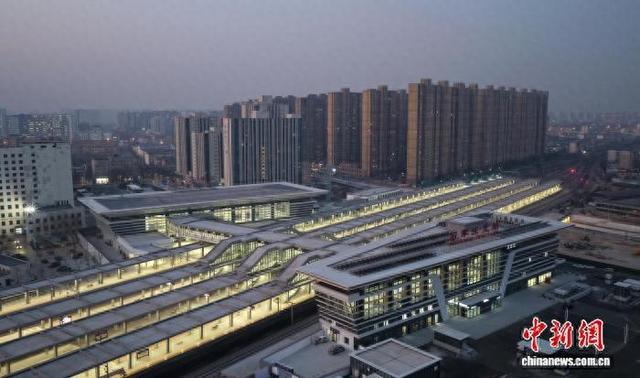
石家庄北站改造工程完成 恢复客运业务
Xin Lang Cai Jing· 2026-01-26 03:34
Group 1 - The core point of the article is the successful completion of the renovation of Shijiazhuang North Station, which has resumed passenger services, marking a significant upgrade in the station's facilities and capabilities [1][2]. Group 2 - The renovated Shijiazhuang North Station consists of two terminal buildings with a total area of 18,568 square meters, significantly enhancing waiting space for passengers [2]. - Four platforms have been extended to 550 meters to better accommodate long-haul passenger trains, improving passenger boarding and alighting efficiency [2]. - A new integrated service center has been established, consolidating functions such as inquiries, ticket sales, and special passenger reservations, while providing services like manual ticket sales and cash payments [2]. - The waiting area includes features such as accessible elevators, third restrooms, military waiting areas, special passenger waiting areas, mother-baby rooms, and child-friendly washbasins [2]. - The underground exit level has a parking lot for social vehicles and has reserved space for a transfer point to Shijiazhuang Metro Line 5, offering diverse travel options for passengers [2]. - After resuming passenger services, the station will handle 60 scheduled passenger trains daily, primarily heading to destinations like Beijing, Handan, Taiyuan, Hengshui, and Jinan [2]. - The station's renovation and resumption of services aim to better meet the diverse travel needs of the public, expand urban space, enhance urban functions, and improve urban quality, thereby supporting the integration of transportation in the Beijing-Tianjin-Hebei region and regional economic collaboration [2].

加快建设28个重大项目 增加津兴城际进京车次
Xin Lang Cai Jing· 2026-01-23 20:58
Core Viewpoint - The city aims to enhance its transportation system by focusing on development, public welfare, and safety, targeting a qualitative improvement and reasonable quantitative growth in transportation services [1]. Group 1: Infrastructure Development - The city plans to accelerate the construction of 28 major projects, including the Tianjin-Weifang High-speed Railway and the expansion of the Tianjin Port's 10,000-ton channel, to promote steady growth in road and waterway transportation [1]. - The integration of transportation in the Beijing-Tianjin-Hebei region will be emphasized, with initiatives to enhance commuting convenience and adjust transportation capacity based on demand [1]. Group 2: Port and Industry Integration - The strategy includes promoting the integration of ports, logistics, trade, and industry to establish a significant strategic support point for domestic and international dual circulation in northern China [1]. - The focus will be on enhancing port capabilities, implementing a "Port+" strategy, and fostering the development of industries near the port [1]. Group 3: Service Quality Improvement - The city will work on completing the construction of the Metro Line 8 and the Z4 Line's first phase to optimize public transportation supply and enhance service quality [2]. - Efforts will be made to reduce costs and improve efficiency in transportation logistics while deepening the integration of transportation and tourism [2].
北京今年拟开通首条跨省域城市轨道交通线路
Zhong Guo Xin Wen Wang· 2026-01-22 01:08
Core Insights - Beijing will continue to deepen the integration of transportation in the Beijing-Tianjin-Hebei region and expand the scale of "hard connectivity" by opening the Beijing Subway Line 22 (Pinggu Line) [1] Group 1: Transportation Development - The Beijing Subway Line 22 is the first inter-provincial urban rail transit line in Beijing and serves as a demonstration line for "railway connectivity in Beijing-Tianjin-Hebei" [1] - The line is approximately 81.82 kilometers long, passing through key areas such as Beijing Chaoyang, Beijing Tongzhou, Hebei Sanhe, and Beijing Pinggu, connecting major functional zones including Beijing CBD and Beijing Urban Sub-center [1] - After the line opens, the travel time from Hebei Yanjiao to Beijing CBD will be approximately 32 minutes, enhancing cross-regional commuting for residents of Beijing and Hebei [1] Group 2: Operational Plans - Following the opening of the Pinggu Line, there will be an exploration of a "passenger and freight dual-use" model, with dedicated freight trains operating on the line to reach logistics warehouses in downtown Beijing [1] - During peak hours, the line will primarily serve passenger transport, while during off-peak hours, it will accommodate freight transport using separate freight trains [1] Group 3: Additional Projects - In addition to the Pinggu Line, Beijing will also promote the integration of the Xiong'an R1 Line with the Daxing Airport Line and accelerate the construction of projects such as the west extension of the Jingqin Expressway and the Beijing section of National Road 335 [1]
京津冀跨省地铁22号线拟今年开通
Bei Jing Qing Nian Bao· 2026-01-21 18:59
Core Insights - The 2026 Beijing Transportation Work Conference emphasized the goal of achieving a 76.8% green travel ratio in the central urban area this year, aiming to alleviate traffic congestion [1] Group 1: Key Projects - The opening of Metro Line 22, which spans approximately 81.82 kilometers and includes 22 stations, is a significant focus, enhancing connectivity between key functional areas such as CBD, Tongzhou, and Pinggu [2][3] - The construction of Metro Line 22 is progressing steadily, with innovative features like dual-use for passenger and freight transport, aimed at reducing logistics costs and improving delivery efficiency for agricultural products [3] Group 2: Infrastructure Improvements - The renovation of the Apple Garden Station on Line 1 is part of a broader initiative to enhance transportation efficiency and integrate various transport modes [4] - The addition of 35,000 new parking spaces aims to address parking difficulties in the central urban area, alongside the implementation of 30 traffic decongestion projects [4] - Ongoing improvements to transportation infrastructure include the construction of new roads and enhancements to existing ones, focusing on better connectivity between the central urban area and key functional zones [5]
地铁新线、增加车位、拥堵治理,今年北京交通将干这些“大事”
Xin Jing Bao· 2026-01-21 06:17
Core Viewpoint - Beijing's transportation development plan for 2026 aims to enhance public transport, improve traffic conditions, and increase green travel options, with specific projects and targets outlined for the year [1][2][3]. Group 1: Transportation Infrastructure Development - The city plans to open the 22nd subway line (Hongmiao to Pinggu) and advance the construction of several other lines, including the 1st line branch and the connection between Yizhuang Line and Lines 5 and 10 [1][4]. - A total of 3.5 million new car parking spaces and 100,000 non-motorized vehicle parking spaces will be added to address parking challenges in urban areas [6]. - The construction of major road projects, including the Liangma River North Road and the new National Exhibition connection line, will be accelerated [5]. Group 2: Public Transport Enhancements - The goal is to increase the proportion of green travel in the central urban area to 76.8% in 2026, building on a 76.5% rate in 2025 [2][3]. - The public transport network will be expanded with the addition of new subway lines and stations, aiming for a total operational mileage of 909 kilometers [2]. - Integration of ground public transport with rail systems will be enhanced, with 91% of subway stations achieving bus connections within 50 meters [2][5]. Group 3: Traffic Management and Improvement - A total of 53 key congestion points will be addressed, with 30 traffic alleviation projects and 24 congestion point improvements planned [3][6]. - The average travel time for vehicles during peak hours at the Doujiakan area has been reduced by 19 minutes following improvements [3]. - The city aims to implement 30 traffic alleviation projects and improve over 50 congestion points to enhance overall road network efficiency [6]. Group 4: Safety and Smart Transportation - The plan includes enhancing traffic safety measures and emergency response capabilities, particularly for mountainous roads [7]. - Smart traffic systems will be upgraded, with 8,000 traffic lights connected for coordinated control and the establishment of 500 dynamic green wave roads [7]. - The goal is to create a closed-loop management system for traffic operations, improving the overall intelligence of the road network [7].
京津冀交通一体化纵深推进 北京“八站两场”格局成型
Bei Jing Shang Bao· 2026-01-21 03:39
Group 1 - The core viewpoint of the article highlights Beijing's transportation development strategy, aiming for deep integration in the Beijing-Tianjin-Hebei region by 2025, transitioning from "interconnectivity" to "deep integration" [1] - The opening of Tongzhou Station and the completion of the Beijing-Tangshan intercity railway enhance the transportation network, covering 32 provincial-level administrative regions and 266 cities, facilitating personnel movement and material flow [1] - The annual passenger throughput at the aviation hub reaches 124 million, reflecting a year-on-year growth of 6.5%, indicating an expanding network and accessibility [1] Group 2 - The transportation system is focused on public needs, addressing nearly 6,000 issues raised by citizens and businesses, demonstrating a commitment to service improvement [2] - Over 60,000 various signs and markings for subways, buses, and roads have been standardized and updated, enhancing user experience [2] - The construction of 300 kilometers of "beautiful countryside roads" and the resolution of over 1,300 road damage issues indicate ongoing infrastructure improvements [2]
河北高速公路突破九千公里 京雄两地1小时通达
Xin Lang Cai Jing· 2026-01-19 21:15
Core Viewpoint - The development of the Xiong'an New Area's transportation infrastructure is significantly enhancing connectivity with Beijing and Tianjin, promoting regional integration and economic growth [1] Group 1: Infrastructure Development - Hebei Province's total highway mileage is expected to exceed 9,000 kilometers during the 14th Five-Year Plan period [1] - There are 30 interfaces with the Beijing-Tianjin highway, facilitating better access [1] - The "four vertical and three horizontal" highway network in Xiong'an New Area is being further strengthened, ensuring direct highway connections with Beijing and Tianjin [1] Group 2: Regional Integration - The travel time between Xiong'an and Beijing is reduced to one hour, significantly improving accessibility [1] - The integration of transportation in the Beijing-Tianjin-Hebei region is accelerating, fostering economic collaboration [1]
跨省通勤更便捷:从“走得了”到“走得好”
Xin Lang Cai Jing· 2026-01-17 21:49
Core Insights - The integration of transportation networks in the Beijing-Tianjin-Hebei region is enhancing cross-province commuting, making it more efficient and comfortable for residents [1][2][3] Transportation Developments - The opening of the Beijing-Tanggu Intercity Railway has significantly reduced travel time for commuters from Yanjiao to Tongzhou, now taking only 12 minutes compared to previous bus journeys that could take up to two hours [2][3] - Customized express buses in the Jing-Tai region are set to launch in May 2024, providing door-to-door service and improving accessibility for commuters [4] Impact on Commuters - Commuters are experiencing a transformation in their daily travel routines, with many now able to manage their time more effectively due to reduced travel times [2][4] - The new transportation options are not only facilitating work commutes but also enhancing personal travel for family visits and tourism, as seen with residents carrying personal items for visits [3] Regional Connectivity - The completion of key roads, such as the Anshi Road connecting Xianghe County to Beijing, is improving regional connectivity and reducing travel times by at least 20 minutes [5] - Enhanced transportation infrastructure is fostering economic development and resource sharing between regions, benefiting local industries and public services [5]

城际铁路开通、定制快巴扩容……跨省通勤更便捷:从“走得了”到“走得好”
Xin Lang Cai Jing· 2026-01-17 21:49
Core Viewpoint - The integration of transportation networks in the Beijing-Tianjin-Hebei region is significantly enhancing the efficiency and convenience of cross-provincial commuting, transforming the experience from merely feasible to comfortable and efficient [1][2][3]. Group 1: High-Speed Rail Commute - The opening of the Beijing-Tangshan Intercity Railway has drastically reduced travel time for commuters from Yanjiao to Beijing, with a direct high-speed train taking only 12 minutes compared to previous bus commutes that could take up to two hours [2][3]. - Commuters are now able to manage their time better, with one individual noting that the new high-speed rail allows for an extra hour of sleep due to reduced travel time [2]. Group 2: Customized Bus Services - The introduction of customized buses in the Jing-Tang region is set to enhance commuting convenience, operating on a "door-to-door" service model that allows passengers to board near their homes and travel directly to key destinations in Beijing [4]. - The customized bus service has launched 12 main lines and over 50 branch lines, covering key areas such as Yanjiao, Zhuozhou, and Xiong'an New Area, thereby strengthening the transportation network for cross-provincial travel [4]. Group 3: Infrastructure Development - The completion of the Anshi Road, which connects Xianghe County directly to Beijing's urban sub-center, has reduced travel time by at least 20 minutes, facilitating easier access for residents commuting to the city [6]. - Improved infrastructure not only enhances transportation efficiency but also promotes economic development and resource sharing between regions, benefiting local industries and public services [6].