
低效用地再开发

Search documents
预计补偿100亿元!珠江新城压轴“宝地”马场补偿方案曝光
Nan Fang Du Shi Bao· 2025-11-18 04:15
Core Viewpoint - The Guangzhou Racecourse land plot is undergoing a significant compensation plan, with a total compensation amount of approximately 10 billion yuan, as the government plans to reclaim the land for redevelopment purposes [2][4]. Group 1: Compensation Plan Details - The compensation plan involves the Guangzhou Yuexiu Group being designated as the main entity for the redevelopment project of the low-efficiency land in the Tianhe District [4]. - The total area of the land to be reclaimed is 362,048 square meters, with the land rights currently held by Guangzhou Racecourse Operation Management Co., Ltd. [4]. - The compensation will be based on the assessed value of the land use rights, buildings, and other attached properties, with the total compensation amount estimated at around 10 billion yuan [4][5]. Group 2: Distribution of Compensation - After deducting taxes and necessary expenses, the expected net compensation for Guangzhou Racecourse Operation Management Co., Ltd. is approximately 6.64 billion yuan, which will be distributed among shareholders based on their ownership ratios [5]. - Shareholders will have the option to purchase properties within the redeveloped racecourse area after receiving their compensation dividends [5]. Group 3: Current Status of the Racecourse - The Guangzhou Racecourse, established in 1992, has transitioned from a racing venue to a low-efficiency commercial area, including automotive, home furnishings, and dining establishments [7]. - The racecourse is located in the highly valuable Zhujiang New Town area, often referred to as the "last treasure land" due to its potential for redevelopment [7]. - Recent planning documents indicate intentions to transform the racecourse area into a vibrant public cultural and commercial space [7].



自然资源部:开展低效用地再开发试点,允许试点城市优化存量商业土地利用
Mei Ri Jing Ji Xin Wen· 2025-10-29 08:13
Core Viewpoint - The Ministry of Commerce has announced a series of measures to support local revitalization of existing commercial properties and promote high-quality development of the real economy [1] Group 1: Policy Measures - Implementation of pilot projects for the redevelopment of inefficient land, allowing trial cities to optimize the use of existing commercial land [1] - Clear guidelines permitting self-reconstruction or joint reconstruction according to new planning purposes for existing commercial properties [1] - Support for the transformation of inefficient commercial land to enhance comprehensive land development and rational conversion of land use [1]
集约高效用地的“苏南实践”
Xin Hua Ri Bao· 2025-10-28 07:16
Core Insights - Suzhou is transforming low-efficiency land into productive industrial spaces, addressing the urgent need for new industry projects while enhancing economic development and ecological protection [1][7] Group 1: Industrial Development Strategies - The "Industrial Upward" initiative is breaking traditional industrial land use patterns by constructing high-rise factories, significantly increasing land utilization and providing more space for industrial enterprises [2][3] - Suzhou's industrial parks have over 60 "Industrial Upward" projects with a total investment of nearly 39 billion, covering over 5,000 acres and achieving an average floor area ratio increase from below 1.0 to over 2.4 [3][4] Group 2: Revitalization of Idle Land - The transformation of previously idle land, such as the Five Pines Innovation Park, has led to a dramatic increase in land efficiency, with tax revenue per acre rising from under 30,000 to over 600,000, marking a 20-fold improvement [4][5] - The Salt Iron Intelligent Manufacturing Industrial Park serves as a model for addressing fragmented land ownership, resulting in a unified redevelopment that increased tax revenue to over 40 million annually, achieving more than a tenfold increase in per-acre returns [6] Group 3: Ecological and Economic Benefits - The renovation of the Collaborative Innovation Industrial Park has led to a significant increase in land utilization, with a floor area ratio rising from 1.0 to 2.18, and a reduction in energy consumption by approximately 45% [7][8] - New industrial parks are being developed with a focus on sustainability, featuring integrated photovoltaic designs to minimize energy consumption and carbon emissions, thus contributing to the region's green development goals [7][8]

低效用地如何高效盘活?记者调研看各地如何“腾笼换鸟”
Zhong Guo Chan Ye Jing Ji Xin Xi Wang· 2025-08-28 23:44
Core Insights - The article highlights a significant transformation in land use in China, with a cumulative decrease of 15.97% in construction land per unit GDP from 2021 to 2024, achieving the "14th Five-Year Plan" target a year ahead of schedule [1] - The shift from incremental land use to optimizing existing land resources is emphasized, showcasing various pilot cities that have successfully redeveloped underutilized land [1] Group 1: Case Studies of Land Redevelopment - In Zhejiang's Hangzhou Xiaoshan District, the local government has initiated a comprehensive redevelopment of low-efficiency land, forming partnerships with state-owned enterprises, private enterprises, and village collectives to enhance land use efficiency [2] - The Xiangyang Village in Xiaoshan has transformed its old industrial buildings into rental housing, generating an additional income of over 1.3 million yuan annually for the village collective [2] - The Xiangyang Micro Industry Park saw its total building area increase from 20,000 square meters to 70,000 square meters, with an expected annual rental income exceeding 10 million yuan [3] Group 2: Industrial Upgrading and Ecosystem Development - In Fujian's Shishi City, the transformation of a low-efficiency industrial area into a smart manufacturing park has led to a new industrial ecosystem where businesses can easily connect with upstream and downstream partners [4][5] - The park has attracted numerous related enterprises, resulting in a significant increase in production efficiency by nearly 30% due to the implementation of intelligent production lines [5] - The park is projected to generate over 36.5 million yuan in tax revenue annually, demonstrating the economic benefits of such redevelopment initiatives [5] Group 3: Public Service Enhancement through Land Utilization - In Wuhan's Xiangyang Village, a previously idle collective industrial land has been developed into an education industry park, addressing local educational resource shortages and increasing village assets by 1.26 billion yuan [6][7] - The project will accommodate around 2,000 students, showcasing how underutilized land can be repurposed to meet community needs [6] - In Sichuan's Luzhou, the local government has effectively utilized idle land from urban renewal projects to create public facilities, enhancing community services and promoting urban-rural integration [7]
截至今年4月底相关试点城市累计实施再开发170.47万亩 低效用地如何高效盘活
Ren Min Ri Bao· 2025-08-26 01:51
Core Insights - The article highlights a significant transformation in land use in China, with a cumulative decrease of 15.97% in construction land per unit GDP from 2021 to 2024, achieving the "14th Five-Year Plan" target a year early [1] - The shift from incremental land use to optimizing existing land resources is emphasized, showcasing various pilot cities that have successfully redeveloped underutilized land [1] Group 1: Case Studies of Land Redevelopment - In Zhejiang's Hangzhou Xiaoshan District, the local government has initiated a comprehensive redevelopment of low-efficiency land, forming partnerships with state-owned enterprises, private enterprises, and village collectives to enhance land use efficiency [2] - The Xiangyang Village in Hangzhou has transformed its old industrial buildings into rental housing, generating an additional income of over 1.3 million yuan annually for the village collective [2] - The Xiangyang Micro Industry Park increased its total building area from 20,000 square meters to 70,000 square meters, with an expected annual rental income exceeding 10 million yuan [3] Group 2: Industrial Upgrading and Ecosystem Development - In Fujian's Shishi City, the transformation of a low-efficiency industrial area into a smart manufacturing park has led to the creation of a new industrial ecosystem, where businesses can easily connect with upstream and downstream partners [4][5] - The park has attracted numerous related enterprises, resulting in a significant increase in production efficiency by nearly 30% due to the implementation of intelligent production lines [5] - The park is projected to generate over 36.5 million yuan in tax revenue annually, demonstrating the economic benefits of such redevelopment initiatives [5] Group 3: Enhancing Public Services through Land Utilization - In Wuhan's Xiangyang Village, a previously idle piece of collective land has been transformed into an education industrial park, addressing local educational resource shortages and increasing the village's assets by 1.26 billion yuan [6][7] - The project will accommodate around 2,000 students, showcasing how underutilized land can be repurposed to meet community needs [6] - In Sichuan's Luzhou, the local government has effectively utilized idle land from urban renewal projects to build public facilities, enhancing community services and promoting urban-rural integration [7]
低效用地如何高效盘活(经济聚焦)
Ren Min Ri Bao· 2025-08-25 22:40
Core Insights - The article highlights a significant transformation in land use across China, with a cumulative decrease of 15.97% in construction land per unit GDP from 2021 to 2024, achieving the "14th Five-Year Plan" target a year early [1] - The shift from incremental land use to optimizing existing land resources is emphasized, showcasing various local initiatives aimed at revitalizing underutilized land for economic development [1] Group 1: Case Studies of Land Redevelopment - In Zhejiang's Hangzhou Xiaoshan District, the local government has initiated a comprehensive redevelopment of low-efficiency land, dividing the area into five industrial zones and seven redevelopment units, enhancing land use intensity and generating additional income for local communities [2] - The transformation of the Xiangyang Village in Hangzhou has led to the construction of rental housing on collective land, generating over 1.3 million yuan annually for the village [2] - The Xiangyang Micro Industry Park's renovation increased its total building area from 20,000 square meters to 70,000 square meters, with an expected annual rental income exceeding 10 million yuan [2] Group 2: Industrial Upgrades and Ecosystem Development - In Fujian's Shishi City, the Smart Manufacturing Park underwent a significant upgrade from a low-efficiency industrial area to a modern facility, addressing safety concerns and meeting the needs of the intelligent transformation of the local garment industry [3][4] - The park's new design facilitates a seamless integration of upstream and downstream production processes, enhancing operational efficiency by nearly 30% due to automation [4] - The park has attracted numerous related enterprises, creating a new industrial ecosystem that supports the entire supply chain [4] Group 3: Public Service Enhancements - In Wuhan's Xiangyang Village, a previously idle collective industrial site has been transformed into an educational park, addressing local educational resource shortages and increasing village assets by 1.26 billion yuan [5][6] - The project was made possible through a collaborative model involving government, banks, and enterprises, ensuring long-term rental income for the village while providing essential public services [5][6] - Similar initiatives in Sichuan's Luzhou have focused on revitalizing idle land for public amenities, enhancing community services and meeting residents' needs [6]
截至今年4月底,相关试点城市累计实施再开发170.47万亩 低效用地如何高效盘活(经济聚焦)
Ren Min Ri Bao· 2025-08-25 21:52
Core Insights - The article highlights a significant transformation in land use across China, with a cumulative decrease of 15.97% in construction land per unit GDP from 2021 to 2024, achieving the "14th Five-Year Plan" target a year early [1] - The shift from incremental land use to optimizing existing land resources is emphasized, showcasing various case studies of effective land redevelopment initiatives [1] Group 1: Land Redevelopment Initiatives - In Hangzhou's Yaqian Town, a comprehensive approach to redevelop low-efficiency land has been implemented, with the government and enterprises collaborating to enhance land use efficiency [2] - The Yaqian micro-industry park's renovation increased total building area from 20,000 square meters to 70,000 square meters, with an expected annual rental income exceeding 10 million yuan [3] - In Tangshan, the "HeTou Old Street Cultural District" was transformed into a new cultural landmark, demonstrating the potential of land redevelopment to stimulate urban growth [3] Group 2: Industrial Upgrades - The Shishi Intelligent Manufacturing Park in Fujian underwent a significant transformation from a low-efficiency industrial area to a modern industrial park, accommodating e-commerce and smart manufacturing needs [4] - The park's new design features large-span, high-load buildings, attracting numerous upstream and downstream enterprises, thus creating a new industrial ecosystem [5] - The park is expected to generate over 36.5 million yuan in tax revenue annually, showcasing the financial benefits of such industrial upgrades [5] Group 3: Public Service Enhancements - In Wuhan's Xiangyang Village, a previously idle collective industrial land was developed into an education industrial park, addressing local educational resource shortages and increasing village assets by 1.26 billion yuan [6] - The project exemplifies the effective use of idle land to enhance public services, with a focus on community needs [7] - In Luzhou, Sichuan, the redevelopment of idle land led to the establishment of public facilities, including parking lots and community service complexes, improving local living conditions [7]
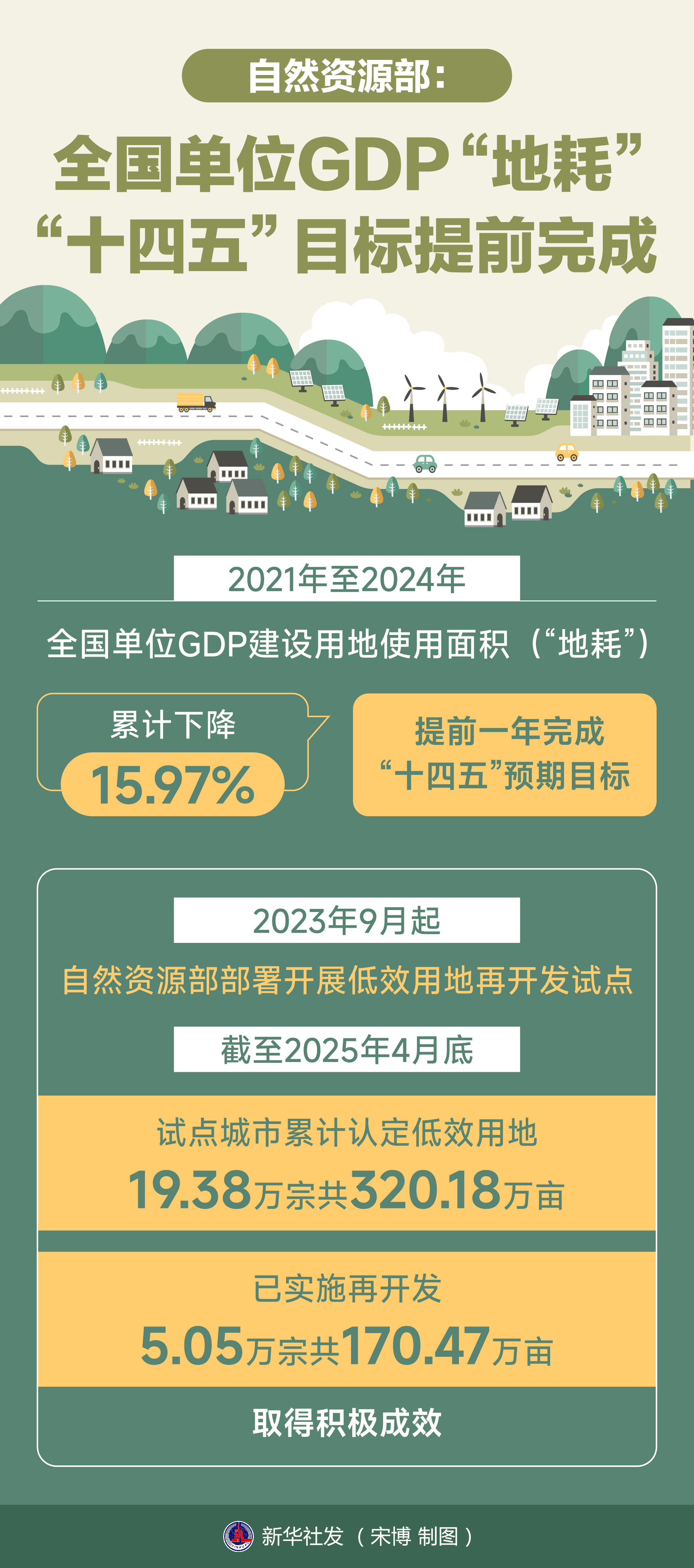
自然资源部:全国单位GDP“地耗”“十四五”目标提前完成
Xin Hua Wang· 2025-08-12 05:49
Core Insights - From 2021 to 2024, the national unit GDP construction land usage area (referred to as "land consumption") has decreased by 15.97%, achieving the "14th Five-Year Plan" target one year ahead of schedule [10] - Hubei Province has the highest reduction rate in unit GDP land consumption at 21.99% during the same period [10] - The Ministry of Natural Resources emphasizes the importance of revitalizing existing land and inefficient land use to enhance economic growth and meet public needs [10] Group 1 - The Ministry of Natural Resources has initiated a pilot program for the redevelopment of inefficient land starting from September 2023, with a goal to recognize 193,800 plots covering 3,201,800 acres by April 2025 [10] - As of now, 50,500 plots covering 1,704,700 acres have been successfully redeveloped, showing positive results [10] - Measures to address idle land include government acquisition, market transfer cooperation, and encouraging enterprises to optimize development [10] Group 2 - The next steps involve expanding and deepening the pilot program for inefficient land redevelopment, particularly in major economic provinces [10] - The Ministry aims to explore and establish a more favorable policy and regulatory framework to facilitate the revitalization of existing land [10]
广东省自然资源厅王功慧:在南沙开展低效用地再开发试点
2 1 Shi Ji Jing Ji Bao Dao· 2025-08-05 05:19
Core Viewpoint - The Guangdong Provincial Government is implementing policies to optimize land use efficiency in Nansha, aiming to support industrial development through targeted redevelopment of underutilized land [1] Group 1: Policy Initiatives - The government is launching pilot projects for the redevelopment of low-efficiency land, which includes optimizing urban development boundaries and simplifying planning approval processes [1] - Land that is not designated for residential use can be autonomously redeveloped and sold back to the original land users [1] - The pricing for land transfer will be based on market assessments, taking into account the costs of land consolidation [1] Group 2: Support for Industrial Development - Industrial land can have its costs calculated using a shared area approach, which may lower overall expenses [1] - The policies support the conversion of industrial, logistics, research and development, and commercial land types without changing the main land use or planning conditions [1] - These initiatives are designed to enhance land utilization efficiency and provide a solid foundation for the development of the manufacturing sector in Nansha [1]
福建省低效用地再开发典型案例公布,晋江三项入选
Zhong Guo Jing Ji Wang· 2025-07-08 15:37
Group 1 - Fujian Province's Natural Resources Department announced the third batch of typical cases for the redevelopment of inefficient land, including three projects: Fengshan Stone Material Exit Reconstruction, Jinjiang Hengxin Cloud Valley New Materials Manufacturing Park, and Jinjiang Green High-end Fabric Sorting Micro Industrial Park [1][2][3] - The Fengshan Stone Material project involves a land area of approximately 137 acres, primarily consisting of outdated stone and ceramic factories, with complex land ownership issues that hindered overall planning [1] - The project successfully utilized a land exchange policy to consolidate state-owned and collective land, enhancing land utilization efficiency and becoming the first case in the province to benefit from such a land exchange [1] Group 2 - The Jinjiang Hengxin Cloud Valley New Materials Manufacturing Park project covers an area of 112.59 acres, with 103.45 acres of existing construction land and 9.14 acres of non-construction land, significantly improving land use efficiency [2] - The project is the first in the province to convert rural inefficient land into construction land, with the total building area increasing from 36.73 acres to 61.62 acres and building density rising from 35.07% to 54.75% [2] - Upon completion, the project is expected to generate annual tax revenue exceeding 20 million yuan and create over 500 new jobs [2] Group 3 - The Jinjiang Green High-end Fabric Sorting Micro Industrial Park project spans 100 acres, addressing historical issues related to land reclamation and enabling effective planning and construction [3] - The project integrates the resolution of historical land reclamation issues with the necessary land use guarantees, exploring efficient land use and ecological restoration [3] - This initiative aims to alleviate land shortages and support industrial clustering in the park [3]