全球治理体系改革

Search documents
专访丨全球治理倡议是迈向建立更加公平国际体系的重要一步——访土耳其国际经济专家阿克布卢特
Xin Hua Wang· 2025-10-05 02:01
Core Insights - The global governance initiative proposed by China is seen as a significant step towards establishing a more equitable and balanced international system [1][2] - Emerging economies such as China, India, Brazil, and Turkey are now the core drivers of global growth, yet they still have limited representation in major international organizations [1] - There is a need for reforms in the global governance system to better address global challenges and balance the interests of developed and developing countries [1][2] Group 1 - The global governance initiative is closely linked to the Belt and Road Initiative, which provides the necessary infrastructure for connectivity, while the governance initiative establishes a framework for mutually beneficial relationships [1] - The post-World War II global governance structure must adapt to the current multipolar reality, and reforming this system is crucial for rebuilding confidence in multilateralism [2] - A more representative and responsive global governance system will enhance international cooperation and improve the ability to address urgent issues such as climate change, terrorism, and global health security [2] Group 2 - Recent protectionist measures by the United States have significant impacts on countries with close trade ties, potentially forcing them to reduce production or shift exports to other markets [2] - The ongoing changes in U.S. tariff policies create substantial uncertainty for producers, exporters, importers, and investors, undermining trust in institutions like the World Trade Organization [2] - Strengthening cooperation and reducing uncertainty in international trade are essential for ensuring sustainable global growth [2]
【环球财经】俄外长:俄方支持全球治理体系改革
Xin Hua She· 2025-10-01 04:27
Core Viewpoint - Russia supports the reform of the global governance system and aims to assist China and other countries in refining and implementing global governance initiatives [1] Group 1: Global Governance Initiatives - The global governance initiative proposed by China during the Shanghai Cooperation Organization summit in Tianjin is seen as a way to change the dominance of Western mechanisms in global governance [1] - Russia's Foreign Minister Lavrov criticized the U.S. for obstructing the International Monetary Fund from increasing the representation of Global South countries [1] - Lavrov highlighted the misuse of multilateral mechanisms by the West for unilateral geopolitical purposes, describing it as a disaster [1] Group 2: Need for Reform in International Organizations - The World Trade Organization (WTO) is identified as needing reform due to U.S. obstruction of the organization's ability to resolve trade disputes [1] - The U.S. has been blocking the WTO from reviewing China's complaints regarding discrimination and violations of trade regulations by Western countries [1]
俄外长:俄方支持全球治理体系改革
Xin Hua Wang· 2025-10-01 03:31
Core Viewpoint - Russia supports the reform of the global governance system and aims to assist China and other countries in refining and implementing global governance initiatives [1] Group 1: Global Governance Initiatives - The global governance initiative proposed by China during the Shanghai Cooperation Organization summit in Tianjin is seen as a way to change the dominance of Western mechanisms in global governance [1] - Russia's Foreign Minister Lavrov criticized the U.S. for obstructing the International Monetary Fund from increasing the representation of Global South countries [1] - Lavrov highlighted the misuse of multilateral mechanisms by the West for unilateral geopolitical purposes, describing it as a disaster [1] Group 2: Need for Reform in International Organizations - The World Trade Organization (WTO) is identified as needing reform due to U.S. obstruction of the organization's ability to resolve trade disputes [1] - The U.S. has been blocking the WTO from reviewing China's complaints regarding discrimination and violations of trade regulations by Western countries [1]
南非总统呼吁推动全球治理体系改革
Xin Hua Wang· 2025-09-25 00:54
Core Points - South African President Ramaphosa emphasized the need for international cooperation to address global challenges and defend multilateralism during the 80th UN General Assembly [1] - He called for reforms in international financial institutions to support developing countries with fairer lending rules and highlighted the importance of maintaining the World Trade Organization's core role in global trade [1] - Ramaphosa pointed out the severe impacts of climate change on African nations, urging UN member states to adhere to their commitments in combating climate change [1] Group 1 - Ramaphosa criticized unilateral military actions and trade protectionism as threats to multilateralism and international law [1] - He highlighted the heavy debt burden hindering sustainable development in many African countries [1] - The President condemned Israel's actions in Gaza as "genocide" and called for the international community to implement the "two-state solution" [2] Group 2 - Ramaphosa stressed the need for nuclear disarmament and mentioned South Africa's role in the 2026 review conference of the Treaty on the Non-Proliferation of Nuclear Weapons [2] - He urged countries to reaffirm their commitment to equality, dignity, and collective security in the context of the UN's 80th anniversary [2]
推动全球治理体系改革
Xin Hua Ri Bao· 2025-09-24 23:42
Core Points - South African President Ramaphosa emphasized the need for international cooperation to address global challenges and defend multilateralism during the 80th UN General Assembly [1] - He called for reforms in the UN Security Council to enhance its representativeness and effectiveness, citing its current inadequacies in maintaining international peace [1] - Ramaphosa highlighted the heavy debt burden hindering sustainable development in many African countries and urged for fairer lending rules from international financial institutions [1] - He stressed the importance of reforming the multilateral trading system to protect developing countries from unilateral trade policies that threaten global stability [1] - The impact of climate change on African nations was underscored, with Ramaphosa calling for adherence to the principle of "common but differentiated responsibilities" in addressing climate commitments [1] Peace and Security Issues - Ramaphosa condemned Israel's actions in Gaza as "genocide" and urged the international community to fully implement the "two-state solution" [2] - He advocated for advancing nuclear disarmament and announced that South Africa will host the 2026 review conference of the Treaty on the Non-Proliferation of Nuclear Weapons [2] - On the 80th anniversary of the UN, he called for countries to draw wisdom and build consensus to reaffirm commitments to equality, dignity, and collective security [2]
对外经济贸易大学:全球治理体系面临改革完善 对国家高层次会计人才培养提出前所未有新要求
Xin Hua Cai Jing· 2025-09-23 06:46
Core Insights - The global governance system is facing the need for reform and improvement, particularly due to the disruptive impact of technologies like big data and artificial intelligence on the accounting industry [1][2] - The establishment of the accounting doctoral program at the University of International Business and Economics (UIBE) is a significant step towards enhancing the training system for high-level accounting professionals, aligning with national strategic needs and industry demands [1][2] Group 1 - UIBE's accounting doctoral program aims to cultivate high-end accounting talents with international perspectives, research capabilities, and practical skills [2] - The program will focus on three training directions: "Accounting Information Disclosure and Corporate Value Analysis," "ESG and Audit Supervision," and "Capital Markets and Corporate Financial Management Decisions" [2] - The training model will combine internal and external mentorship to ensure comprehensive education [2] Group 2 - The importance of accounting as a support for economic decision-making and its role in modernizing national governance systems is emphasized [2] - The program is designed to respond to the high-quality development needs of the country and the acceleration of new productive forces [2] - UIBE's approach to accounting education is characterized by a strong emphasis on international vision while being rooted in China's economic practices [1][2]
王毅同巴西外长维埃拉通电话
Xin Hua Wang· 2025-08-28 21:40
Core Viewpoint - The relationship between China and Brazil has reached its historical best, with strong mutual trust and friendship established between the leaders of both countries, providing strategic guidance for building a China-Brazil community of shared destiny [1] Group 1: Bilateral Relations - Wang Yi emphasized the importance of strengthening strategic mutual trust and support between China and Brazil, and accelerating the implementation of key consensus reached by the leaders of both nations [1] - The Chinese side is willing to deepen practical cooperation across various fields with Brazil [1] Group 2: Multilateral Cooperation - Brazilian Foreign Minister Vieira expressed gratitude for the recent communication between the leaders of China and Brazil, highlighting the significance of close coordination among BRICS nations amid uncertainties in international trade and challenges to multilateralism [1] - Both sides aim to enhance communication and coordination to support the multilateral trading system and promote reforms in the World Trade Organization [1] Group 3: Global Governance - Wang Yi praised Brazil's role as the rotating presidency of BRICS, noting its successful hosting of the Rio Summit, which fostered cooperation among global South countries [1] - The Chinese side is committed to coordinating with Brazil and other BRICS nations to resist unilateralism and bullying, safeguard the legitimate rights of developing countries, and promote reforms in the global governance system [1]
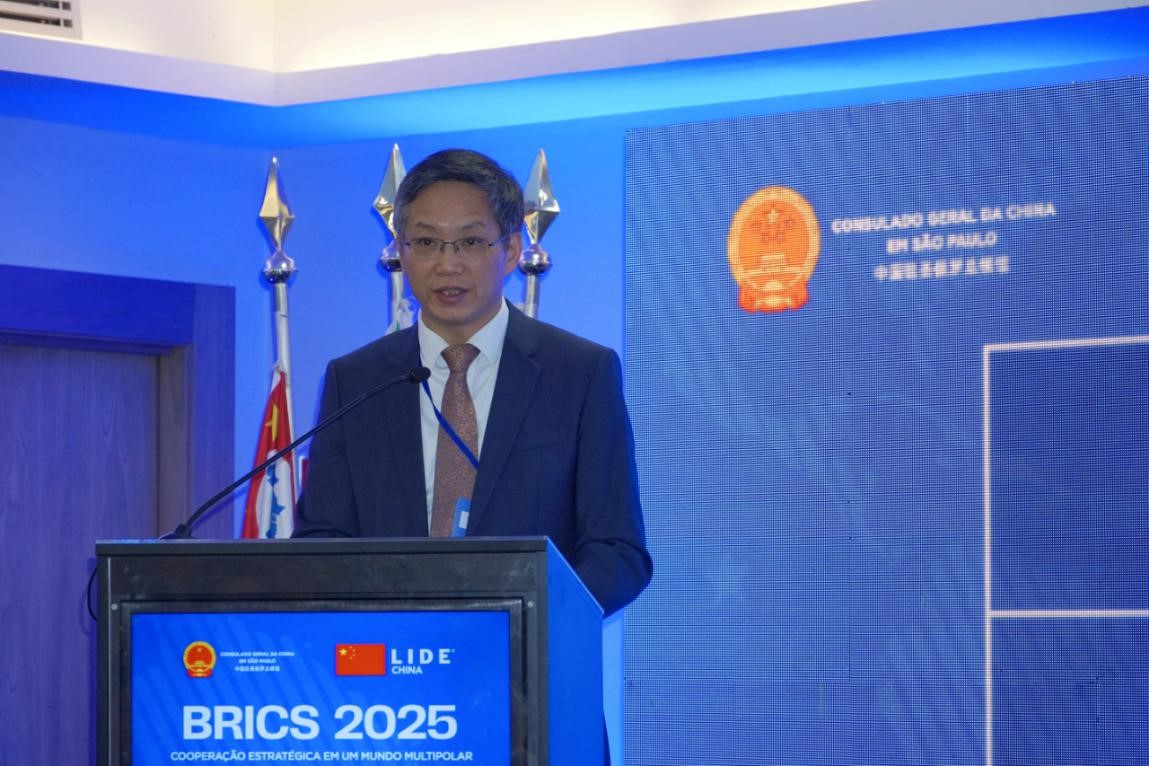
“金砖2025:多极世界中的战略合作”主题研讨会在巴西圣保罗举行
人民网-国际频道 原创稿· 2025-07-27 08:21
Group 1 - The seminar titled "BRICS 2025: Strategic Cooperation in a Multipolar World" was held in São Paulo, Brazil, with over 130 representatives from politics, business, and academia attending [1][3] - The Chinese Consul General in São Paulo, Yu Peng, emphasized that BRICS countries are becoming a leading force in promoting global governance reform and are willing to strengthen strategic cooperation with Brazil under the BRICS framework [1][3] - Former Brazilian Minister of Industry and Trade, Fernando, stated that the inclusion of more countries in BRICS enhances the mechanism's representativeness and influence, indicating a higher level of cooperation ahead [3] Group 2 - José Ricardo, Co-Chairman and CEO of the Brazil Business Leaders Organization, highlighted that Brazil-China relations are a crucial pillar of BRICS cooperation and that efforts will continue to promote business connections, policy communication, and cultural exchanges [3] - The seminar featured discussions on three main topics: "Southern Countries and Global Governance," "Economic and Financial Cooperation," and "Innovation and Sustainable Development," with participants noting the unprecedented leadership exhibited by BRICS cooperation [3] - Future collaboration between China and Brazil is expected to deepen in areas such as digital economy and green energy, contributing to global stability [3]

【高端访谈】金砖合作机制为全球治理改革注入“南方力量”——访英国学者马丁·雅克
Xin Hua She· 2025-07-17 07:35
Core Viewpoint - The BRICS cooperation mechanism is growing in strength and influence, providing a platform for the Global South to enhance unity and cooperation, while injecting "Southern power" into global governance reform [1][2]. Group 1: Significance of BRICS Cooperation - The development of the BRICS cooperation mechanism is significant as it addresses the long-standing bias of the international system towards the West, allowing emerging markets and developing countries to have their voices heard [1]. - The total population of BRICS countries exceeds half of the global population, enabling them to represent broader interests and voices in global governance [1]. - The recent expansion of BRICS reflects a major decision by member countries, enhancing the mechanism's representativeness and inclusivity, and creating greater space for collaboration among Global South countries [1]. Group 2: Diversity and Multilateralism - The diversity of the Global South is a key advantage for BRICS, necessitating the expansion of cooperation areas and innovative collaboration methods while maintaining unity and cohesion [2]. - Multilateralism relies on cooperation and trust among nations, emphasizing the importance of resolving differences through consultation to promote common development [2]. Group 3: China's Role in BRICS - China plays a crucial role in the development of the BRICS cooperation mechanism, providing solid support through its own development and promoting deeper and broader cooperation with independent strategic thinking [2]. - The consensus-building and collaborative efforts led by China have been essential for BRICS to reach its current level of achievement [2].
金砖国家联合声明不点名批评美国:单边关税扭曲了贸易,扰乱全球供应链
Guan Cha Zhe Wang· 2025-07-07 07:06
Group 1 - The 17th BRICS summit opened in Rio de Janeiro, Brazil, on July 6, 2025, focusing on global governance and economic cooperation among member states [1][9] - The joint statement expressed serious concerns over the unilateral tariffs imposed by the United States, criticizing them for distorting trade and potentially reducing global trade [1][4] - The summit highlighted the growing influence of BRICS nations, with their combined GDP surpassing that of the G7, reaching approximately $77 trillion based on purchasing power parity [9] Group 2 - The joint statement condemned recent attacks on Iran, emphasizing the need for international law adherence and calling for UN Security Council intervention [5][6] - The summit addressed the humanitarian situation in Gaza, urging the release of all detained individuals and reaffirming commitment to a two-state solution, although Iran expressed reservations about this approach [6] - A new declaration was adopted, calling for the UN to lead the establishment of global rules for artificial intelligence, aiming to prevent deepening inequalities between developed and developing countries [6]