
公募基金业绩比较基准改革

Search documents
重磅来了,又要见证历史
3 6 Ke· 2025-11-10 00:06
Core Viewpoint - The release of the "Guidelines for Performance Comparison Benchmarks of Publicly Raised Securities Investment Funds (Draft for Comments)" and "Operational Details for Performance Comparison Benchmarks of Publicly Raised Securities Investment Funds (Draft for Comments)" by the CSRC and the Fund Industry Association aims to enhance the constraints of performance benchmarks, address the issue of "style drift" in funds, and promote high-quality development in the public fund industry [1][2][15]. Group 1: Impact on Fund Industry - The guidelines clarify that benchmarks should reflect product positioning and investment style, aligning with the fund contract's investment goals and strategies [2][10]. - The new regulations are expected to address current industry issues such as style drift, misleading product descriptions, and significant performance fluctuations, improving investor understanding and experience [2][3][12]. - The establishment of a benchmark library will guide the selection of appropriate benchmarks for new funds, promoting standardized and transparent investment behavior [8][12][13]. Group 2: Key Features of the Guidelines - The guidelines introduce a comprehensive internal control and accountability mechanism, requiring fund managers to establish processes for benchmark selection, monitoring, evaluation, and correction [4][18]. - Performance assessments will now be closely tied to benchmarks, eliminating the previous focus on overall market rankings and encouraging long-term investment strategies [4][17]. - The guidelines emphasize that once a benchmark is selected, it cannot be changed arbitrarily, which aims to prevent frequent style drift and ensure consistency in fund management [4][10][19]. Group 3: Challenges and Recommendations - Fund managers may face challenges in aligning their investment strategies with the new benchmarks, particularly in balancing short-term performance with long-term goals [6][7]. - Recommendations include optimizing assessment systems, refining benchmark adaptation processes, and enhancing training for investment strategies to meet the new requirements [6][18]. - The focus should be on controlling style drift while achieving stable performance, ensuring that fund products align with investor expectations and risk profiles [19].
重磅来了!又要见证历史
中国基金报· 2025-11-09 12:06
Core Viewpoint - The introduction of the "Guidelines for Performance Comparison Benchmarks of Publicly Offered Securities Investment Funds" and "Operational Details for Performance Comparison Benchmarks" aims to enhance the constraint of performance benchmarks, curtail "style drift" in funds, and shift the industry focus from "scale competition" to "capability competition," thereby promoting high-quality development in the public fund industry [2][4][24]. Summary by Sections Performance Benchmark Guidelines - The guidelines emphasize that benchmarks should reflect product positioning and investment style, aligning with the fund contract's investment goals, scope, strategies, and restrictions [4][24]. - Fund managers are required to appoint experienced fund managers based on the performance benchmark, and once selected, the benchmark cannot be changed arbitrarily [4][24]. Industry Impact - The new regulations are expected to clarify product positioning, improve investment behavior stability, and transform the assessment mechanism from short-term relative performance to long-term excess return stability [5][24]. - The guidelines aim to address current industry issues such as product style drift and misleading fund representations, enhancing investor understanding and trust in fund products [4][5][24]. Breakthrough Provisions - Key breakthroughs in the guidelines include a comprehensive internal control and accountability mechanism, linking compensation assessments to performance benchmarks, and requiring independent monitoring of benchmark deviations [7][8][24]. - The guidelines aim to prevent arbitrary changes to benchmarks and ensure that fund managers focus on long-term value creation [8][24]. Challenges in Implementation - Fund managers may face challenges in aligning their investment strategies with the new benchmarks, managing short-term volatility, and ensuring effective multi-departmental collaboration [9][10][24]. - The transition to the new assessment and compensation mechanisms requires a thorough understanding of benchmarks and the establishment of robust risk control models [10][11][24]. Establishment of Benchmark Library - The China Fund Industry Association has released a benchmark element library to assist fund managers in selecting appropriate performance benchmarks for new products [13][14][24]. - The library includes 69 indices in the first category and 72 in the second, categorized into broad-based indices, industry-themed indices, and strategy indices [17][24]. Guiding Fund Product Style and Transparency - The establishment of the benchmark library is seen as a key measure to address issues of unclear investment styles and short-term performance focus in the industry [20][24]. - The new regulations are expected to enhance the clarity of fund product styles and improve the transparency of fund manager performance evaluations [21][24]. Fund Evaluation and Standardization - The new regulations provide a standardized and quantifiable basis for fund evaluation, enhancing the precision and objectivity of performance assessments [25][26][24]. - Fund evaluation will increasingly focus on the relationship between fund performance and benchmarks, moving away from short-term rankings [27][24]. Future Management of Performance Benchmarks - Future management of performance benchmarks will require more precise selection and adjustment processes, moving away from broad indices to more tailored benchmarks based on investment goals [29][24]. - The new regulations aim to transform performance benchmarks from vague references to core metrics for evaluating funds, allowing investors to better understand the risk and return characteristics of fund products [29][24].


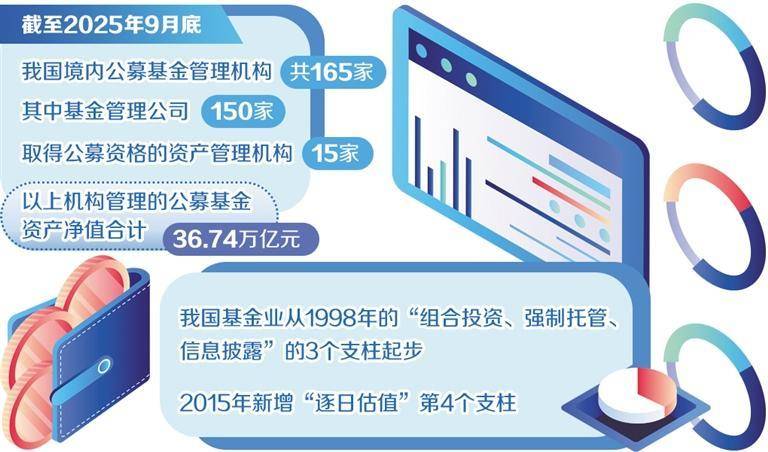
36.74万亿元迎来新“标尺”
Sou Hu Cai Jing· 2025-11-05 22:55
Core Viewpoint - The China Securities Regulatory Commission (CSRC) has released draft guidelines and operational details for performance benchmarks of publicly offered securities investment funds, aiming to enhance the regulatory framework and improve investor experience [2][10]. Group 1: Regulatory Framework - The new guidelines and operational details are part of a broader initiative to fill regulatory gaps and promote high-quality development in the public fund industry [3][10]. - Current issues in the performance benchmark system include a lack of specialized regulations and weak internal control mechanisms among fund managers [3][4]. - The guidelines emphasize the importance of performance benchmarks as a "anchor" and "yardstick" for fund managers, helping to clarify investment styles and assess performance against market standards [3][4]. Group 2: Impact on Fund Management - Fund managers are required to align their investment behaviors with the established performance benchmarks, ensuring that the benchmarks reflect the fund's investment goals and strategies [5][6]. - The guidelines mandate a comprehensive control mechanism covering the selection, disclosure, monitoring, evaluation, and accountability of performance benchmarks [6][7]. - Fund managers must enhance internal supervision and ensure that deviations from benchmarks are monitored and justified by an independent department [6][7]. Group 3: Investor Experience - The reforms aim to improve investor understanding of fund products by ensuring that performance benchmarks are clear and relevant to the fund's investment strategy [7][8]. - The guidelines also address the compensation structure for fund managers, linking their performance evaluations to the fund's investment returns relative to benchmarks [8][9]. - By establishing a more stable and clear investment style, the reforms are expected to enhance the value proposition of public funds and attract more long-term capital into the market [10][11]. Group 4: Implementation Strategy - The CSRC plans to guide industry institutions in transitioning to the new guidelines, ensuring that changes do not disrupt market stability [9]. - A benchmark library will be established to standardize the selection of performance benchmarks across the industry [9]. - The reforms will also include revising compensation assessment rules to strengthen the alignment of interests between fund managers and investors [9].
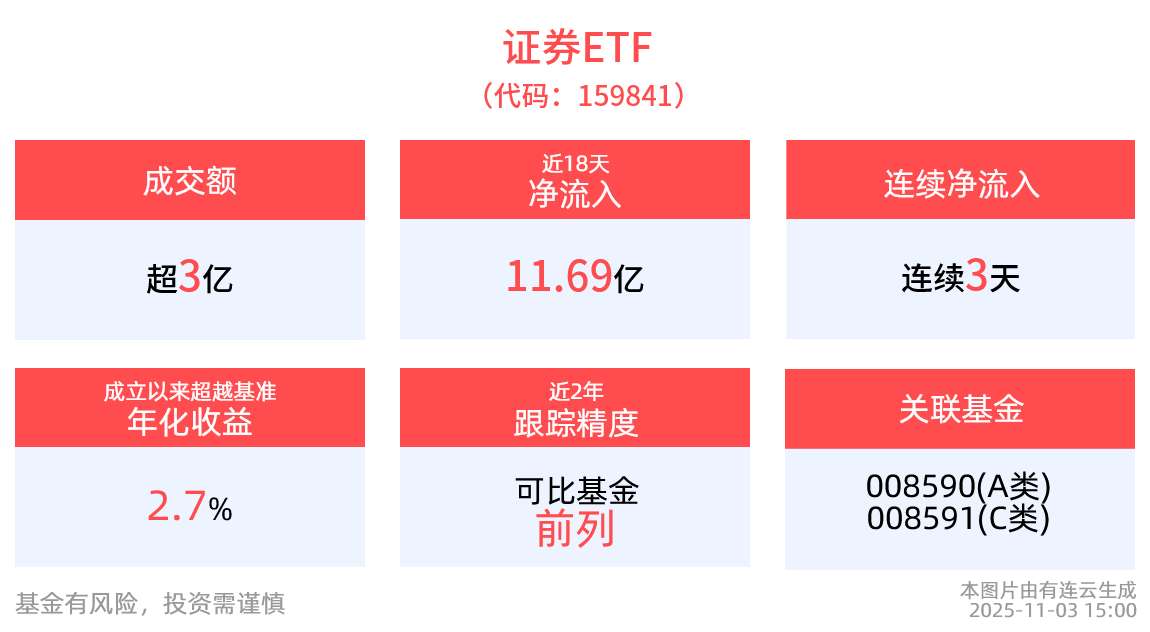
A股近3个月日均成交2.3万亿!深市规模最大的证券ETF(159841)连续3日净流入,昨日“吸金”超1亿元!
Xin Lang Cai Jing· 2025-11-04 01:58
Market Performance - The A-share market showed a strong rebound in the afternoon on November 3, 2025, with all three major indices closing in the green and total trading volume reaching 2.13 trillion yuan [3] - The average daily trading volume of the Wind All A index exceeded 2.3 trillion yuan over the past three months, indicating ample liquidity supporting market sentiment [3] ETF Performance - The Securities ETF (159841) had a turnover rate of 3.64% and a trading volume of 372 million yuan [3] - The Securities ETF's scale increased by 4.616 billion yuan over the past three months, with a monthly increase of 1.037 billion units, reflecting significant growth [3] - The latest single-day net inflow for the Securities ETF exceeded 100 million yuan, with a total net inflow of 274 million yuan over the past three days [3] Industry Insights - Data from the first three quarters indicated that the lending scale of 42 listed securities firms grew by 70% year-on-year, with net interest income increasing by 50%, highlighting credit business as a key driver of performance growth [4] - As of September 30, the cumulative lending scale of these firms surpassed 2 trillion yuan, marking a 34.9% increase from the end of the previous year and a 72.03% increase year-on-year [4] - Western Securities noted that the performance of listed securities firms in the third quarter met expectations, driven mainly by brokerage and proprietary trading businesses, with the industry showing an upward trend in profitability [4]
证券ETF(512880)连续两日净流入超27亿元,规模超610亿元居同类规模第一
Sou Hu Cai Jing· 2025-11-03 02:18
Group 1 - The core viewpoint is that the non-bank financial industry, particularly the securities sector, is expected to show a positive performance trend, driven by brokerage and proprietary trading businesses, with a focus on the upcoming reforms by the China Securities Regulatory Commission (CSRC) [1] - The performance of listed securities firms in the third quarter of 2025 is in line with expectations, indicating a recovery in earnings [1] - The securities industry is considered relatively undervalued with a high year-on-year growth in performance, making it an attractive investment segment in the current market environment [1] Group 2 - The CSRC is promoting reforms in the public fund performance benchmark, aiming to standardize the management of the entire industry [1] - The capital market's activity level is expected to remain high, suggesting ongoing investment opportunities in the securities sector [1] - The largest and most liquid securities ETF (512880) is recommended for investors to capitalize on opportunities within the securities sector, with its scale reaching 61.277 billion, ranking first among 21 similar products [1]

公募基金业绩比较基准改革落地 立标尺定锚点 告别“基金盲盒”
Zhong Guo Zheng Quan Bao· 2025-11-03 00:12
Core Viewpoint - The China Securities Regulatory Commission (CSRC) has released draft guidelines and operational rules aimed at standardizing performance benchmarks for publicly offered securities investment funds, addressing long-standing industry issues such as "style drift" and misleading product representations [1][2][9]. Group 1: Key Aspects of the Guidelines - The guidelines emphasize four main areas: the representation role of performance benchmarks, the enforcement of investment constraints, the evaluation role of benchmarks, and the establishment of a healthy interactive ecosystem [3][4]. - Performance benchmarks must accurately reflect the product's investment goals and strategies, and fund managers are required to appoint experienced fund managers based on these benchmarks [3][4]. - The operational rules provide detailed requirements for product design, benchmark display, and the matching of benchmarks with investment strategies [3][4]. Group 2: Impact on Fund Management - The guidelines aim to prevent issues like "style drift" by mandating a comprehensive control mechanism for benchmark selection, disclosure, monitoring, and accountability [4][5]. - Fund managers must establish a robust internal supervision system to monitor deviations from benchmarks, with independent departments responsible for assessing risks [4][5]. - The guidelines also stress the importance of linking fund performance to compensation structures, ensuring that fund managers' pay is tied to their ability to outperform benchmarks [4][8]. Group 3: Benefits for Investors - Clear performance benchmarks will serve as a "manual" for products, helping investors understand product characteristics and make informed decisions, ultimately leading to better investment experiences [2][10][11]. - The guidelines are expected to shift the industry focus from "scale" to "returns," allowing investors to benefit from long-term stable returns [2][9][12]. - By ensuring that benchmarks are aligned with the fund's investment strategies, investors can better assess fund managers' capabilities and avoid the pitfalls of unpredictable fund performance [11][12]. Group 4: Long-term Industry Implications - The introduction of these guidelines is anticipated to foster a more disciplined investment environment, encouraging fund companies to reassess their benchmark selections and align them with actual investment strategies [9][12]. - The shift from viewing performance benchmarks as mere "decorations" to essential "yardsticks" signifies a transformation in the public fund industry towards a more return-focused approach [9][12]. - Overall, the guidelines are expected to enhance the public fund industry's quality, ensuring clearer product positioning, more regulated investment operations, and better protection of investor rights [12].
公募基金业绩比较基准改革落地 立标尺定锚点告别“基金盲盒”
Zhong Guo Zheng Quan Bao· 2025-11-02 23:26
Core Viewpoint - The China Securities Regulatory Commission (CSRC) has released draft guidelines and operational details aimed at standardizing performance benchmarks for publicly offered securities investment funds, addressing long-standing industry issues such as "style drift" and misleading product representations [1][2][3] Group 1: Key Aspects of the Guidelines - The guidelines emphasize four main areas: the representation role of performance benchmarks, the enforcement role, the evaluation role, and the establishment of a positive ecosystem around benchmarks [3][4] - The guidelines require that benchmarks accurately reflect the product's investment goals and strategies, and once set, they cannot be changed arbitrarily [3][4][8] - The operational details further specify requirements for product design, benchmark display, and matching benchmarks with investment strategies [3][6] Group 2: Impact on Fund Managers and Products - Fund managers are now required to establish comprehensive control mechanisms for benchmark selection, disclosure, monitoring, and accountability [4][5] - The guidelines link fund managers' performance compensation directly to their ability to outperform benchmarks, promoting a focus on long-term investment returns [4][8] - The new regulations aim to eliminate "blind box" funds, ensuring that product risk-return characteristics are clear and stable [1][10] Group 3: Benefits for Investors - Clear benchmarks will serve as a "manual" for products, helping investors understand product characteristics and make informed decisions [2][10][11] - The shift from a focus on scale to a focus on returns will help investors escape the dilemma where funds perform well but investors do not [2][9] - The guidelines are expected to enhance investor experience by providing clearer expectations regarding risk and return, ultimately leading to better long-term investment outcomes [10][12] Group 4: Long-term Industry Implications - The guidelines are anticipated to reshape the industry by enforcing stricter adherence to benchmarks, thereby addressing issues like style drift and short-term performance chasing [7][9] - The reforms are seen as a move towards high-quality development in the public fund industry, promoting a more transparent and accountable investment environment [9][12] - The establishment of benchmarks as core metrics signifies a transition in the industry from prioritizing scale to prioritizing returns, enhancing the overall investment landscape [9][12]
金融行业周报(2025、11、02):公募业绩比较基准改革落地,各板块三季报披露完毕-20251102
Western Securities· 2025-11-02 13:31
Investment Rating - The report indicates a positive outlook for the insurance sector, suggesting it is the most growth-oriented direction in the financial industry during structural transformation [1][15] - The securities industry is viewed as relatively undervalued with high year-on-year growth in performance, making it a favorable investment opportunity [2][18] - The banking sector is recommended for selective investment in high-quality banks with strong fundamentals and improving performance [3][21] Core Views - The non-bank financial index decreased by 0.46%, underperforming the CSI 300 index by 0.03 percentage points, while the banking sector saw a decline of 2.16%, underperforming the CSI 300 by 1.74 percentage points [1][9] - The insurance sector experienced a notable increase in new business value (NBV) growth, with significant contributions from improved agent productivity and bancassurance efforts [12][13] - The securities sector's performance is driven by strong growth in brokerage and proprietary trading businesses, with overall earnings exceeding expectations [2][16] - The banking sector's earnings showed steady growth, with a slight improvement in net interest margins and a stable asset quality outlook [19][21] Summary by Sections Insurance Sector - The insurance sector's NBV growth for the first three quarters of 2025 showed significant increases, with notable performances from major companies [12][13] - The sector is expected to benefit from a supportive policy environment and increasing allocations to equity investments [15] - Recommended stocks include Xinhua Insurance A+H, China Ping An A+H, and China Life H [3][15] Securities Sector - The securities sector's PB valuation stands at 1.43x, indicating a favorable entry point for investors [2][18] - The report highlights the recovery in brokerage and proprietary trading as key drivers of performance, with a positive outlook for the sector [16][18] - Recommended stocks include Guotai Junan A+H, Huatai Securities A+H, and Oriental Securities A+H [3][18] Banking Sector - The banking sector's PB valuation is at 0.54x, with earnings growth expected to continue into the fourth quarter [19][21] - The report suggests focusing on banks with strong fundamentals and improving performance metrics, particularly those with low non-performing loan ratios [22][21] - Recommended stocks include Hangzhou Bank and a focus on other quality banks such as China Merchants Bank and Bank of Communications [3][22]
公募业绩比较基准改革征求意见,发挥业绩基准“锚”作用
ZHONGTAI SECURITIES· 2025-11-02 06:45
Investment Rating - The report maintains an "Overweight" rating for the industry [2] Core Insights - The reform aims to address two major issues in the public fund industry: investment style drift and significant performance fluctuations due to short-term ranking pursuits. The goal is to ensure that performance benchmarks serve as a true "anchor" and "yardstick," guiding the industry back to value investing and providing long-term stable returns for investors [3][4][8] Summary by Sections Industry Overview - The industry comprises 50 listed companies with a total market capitalization of 41,430.39 billion and a circulating market value of 38,805.86 billion [3] Regulatory Measures - Fund managers are required to establish a comprehensive control mechanism, with independent departments monitoring investment deviations. Fund manager performance compensation will be directly linked to their ability to outperform benchmarks, with significant penalties for long-term underperformance [4][5] - Custodians must fulfill supervisory responsibilities to ensure that fund investments do not deviate from their stated styles, and sales institutions must display benchmark performance alongside fund performance for investor comparison [5][6] Benchmarking Standards - The report emphasizes that performance benchmarks must be representative, continuous, and objective, with transparent calculation methods. The establishment of a benchmark element library is encouraged, although not mandatory [6][10] Investment Recommendations - The report suggests that the reform will enhance investment discipline and style stability in public funds, ultimately improving investor satisfaction and long-term returns. It recommends focusing on companies such as Huatai, GF Securities, CITIC, and others [8][10]
公募业绩比较基准改革落地!新规公开征意 公募改革又一关键举措
Zhong Jin Zai Xian· 2025-11-01 08:33
Core Viewpoint - The reform of performance benchmarks for public funds is set to be implemented, aiming to enhance the stability of investment behaviors, clarify product investment styles, and improve investor satisfaction through new guidelines and operational details released by the China Securities Regulatory Commission (CSRC) [1][2]. Group 1: Key Aspects of the Reform - The new regulations address issues in the public fund industry, such as style drift and misleading performance claims, by emphasizing the importance of performance benchmarks as a guiding "anchor" for fund managers [2][3]. - The guidelines and operational details aim to establish a comprehensive regulatory framework that includes internal controls for fund managers and external responsibilities for market institutions [2][5]. Group 2: Requirements for Fund Managers - Five key requirements are outlined for fund managers, including the establishment of a full-process control mechanism, decision-making at the management level for benchmark selection, independent monitoring departments, enhanced compliance management, and performance compensation linked to benchmark performance [3][4]. - The regulations encourage fund managers to improve their active research and investment capabilities while holding them accountable for their investment decisions [3][4]. Group 3: External Responsibilities of Market Institutions - The new rules also impose responsibilities on external market institutions, such as fund custodians and sales agencies, to ensure they actively supervise and disclose performance benchmarks alongside fund performance [5][6]. - Fund evaluation and award institutions are required to use performance benchmarks as a critical criterion for assessing fund management quality [5][6]. Group 4: Standards for Benchmark Usage - The guidelines specify that performance benchmarks must accurately reflect the product's investment style and strategy, remain consistent over time, and be based on transparent calculation methods [7][8]. - Information disclosure requirements are established to enhance transparency regarding the performance benchmarks used by funds [8]. Group 5: Supporting Measures for Benchmark Reform - A one-year transition period is set to allow fund managers to adjust existing benchmarks to align with their products without causing market instability [9]. - The establishment of a benchmark library is proposed to guide fund managers in selecting appropriate benchmarks, with an emphasis on flexibility rather than rigid requirements [9]. - Future regulations will link management fees and compensation to fund performance relative to benchmarks, reinforcing the alignment of interests between fund managers and investors [10].