
共享发展

Search documents
周文:遵循新发展理念做好经济工作
Jing Ji Ri Bao· 2025-10-23 00:04
Core Ideas - The new development concept is a concentrated reflection of China's development ideas, directions, and focal points in the new era, emphasizing its strategic, programmatic, and guiding role in the comprehensive construction of a modern socialist country [1][2] Group 1: Innovation - Innovation is highlighted as the primary driving force for development, essential for determining the speed, efficiency, and sustainability of economic growth [3] - China has made significant progress in technological innovation, particularly in 5G technology, which has laid a solid foundation for the digital economy [3] - There are still challenges in basic research and key core technologies compared to developed countries, necessitating increased investment in foundational research and reforms in the research evaluation system [3] Group 2: Coordination - Coordinated development is crucial for optimizing the economic development structure, addressing the imbalances between urban and rural areas, and among different regions [4] - Efforts have been made to improve rural infrastructure and diversify industrial development, yet disparities remain, indicating the need for further progress [4] - Future strategies should focus on promoting equal exchange and flow of resources between urban and rural areas to accelerate rural modernization [4] Group 3: Green Development - Green development is essential for sustainable growth, with significant achievements in environmental protection and the development of green industries [5] - China has become the largest producer and consumer of new energy vehicles, reflecting its commitment to ecological priorities [5] - The importance of ecological protection and restoration is emphasized, alongside the need for a green industrial transformation [5] Group 4: Openness - Openness is deemed necessary for national prosperity, with China actively promoting higher levels of openness in trade and investment [6][7] - The focus is on expanding the scope of open development and enhancing cooperation in global economic governance [7] - The establishment of free trade zones and other platforms is crucial for fostering international competitiveness [7] Group 5: Sharing - The sharing concept is central to socialism with Chinese characteristics, aiming for common prosperity and improved living standards [8] - Significant achievements have been made in poverty alleviation and employment stability, with ongoing efforts to enhance social security systems [8] - Future initiatives should focus on increasing the income of low-income groups and expanding the middle-income population [8] Group 6: Systematic Transformation - The transformation of the new development concept into practice requires a systematic approach, enhancing political capability, strategic vision, and professional skills [9][11] - A collaborative mechanism is necessary to integrate the five development concepts, ensuring they support and promote each other [10] - Policies should be aligned to create a cohesive framework that supports innovation, ecological protection, and social welfare [10][12] Group 7: Leadership and Governance - Leadership must shift from traditional performance metrics to a new performance view that aligns with the new development concept [13][14] - Emphasis is placed on long-term stability and sustainable development, avoiding short-termism and impulsive decision-making [14][15] - A focus on practical results and addressing real issues is essential for effective governance [15][16] Group 8: Local Adaptation - Policies must be tailored to local conditions, respecting objective laws and resource endowments to avoid blind imitation [16][17] - A comprehensive approach is needed to balance various development aspects, ensuring that local initiatives align with national goals [17][18] - The importance of breaking down regional barriers and fostering a unified national market is highlighted to prevent inefficient competition [18]
遵循新发展理念做好经济工作
Jing Ji Ri Bao· 2025-10-22 22:27
Core Viewpoint - The new development concept is a concentrated reflection of China's development ideas, directions, and focal points in the new era, emphasizing its strategic, programmatic, and guiding roles in economic work [1][2]. Group 1: Innovation - Innovation is highlighted as the primary driving force for development, essential for determining the speed, efficiency, and sustainability of economic growth [3]. - China has made significant progress in technological innovation, particularly in 5G technology, which has laid a solid foundation for the digital economy [3]. - There are still challenges in basic research and key core technologies compared to developed countries, necessitating increased investment and reform in the research evaluation system [3]. Group 2: Coordination - Coordinated development is crucial for optimizing the economic development structure, addressing the imbalances between urban and rural areas, and among different regions [4]. - Efforts have been made to improve rural infrastructure and diversify industrial development, yet disparities remain, indicating the need for further progress [4]. - Future strategies should focus on promoting equal exchange and flow of resources between urban and rural areas, enhancing regional cooperation, and achieving common development [4]. Group 3: Green Development - Green development is essential for sustainable growth, with significant achievements in environmental protection and the growth of green industries [5]. - China has become the largest producer and consumer of new energy vehicles, reflecting its commitment to ecological priorities [5]. - The importance of ecological protection and restoration is emphasized, alongside the need for a green transition in industries [5]. Group 4: Openness - Openness is deemed necessary for national prosperity, with a focus on adapting to the trends of economic globalization [6][7]. - China aims to expand its open development space, enhance trade and investment liberalization, and deepen bilateral and regional economic cooperation [6][7]. Group 5: Sharing - The concept of sharing is central to socialism with Chinese characteristics, focusing on achieving common prosperity and improving the well-being of the population [8]. - Significant progress has been made in poverty alleviation and employment stability, with ongoing efforts to enhance the social security system [8]. Group 6: Implementation of New Development Concepts - A complete and accurate implementation of the new development concept is crucial for a profound transformation in China's overall development [9]. - Systematic collaboration and a unified approach are necessary to integrate the five development concepts of innovation, coordination, green, openness, and sharing [10]. Group 7: Institutional Support - Institutional frameworks are essential for the realization of new development concepts, requiring reforms that support innovation, environmental quality, and social welfare [12]. - Establishing a robust indicator system and enhancing the role of the market in resource allocation are critical steps [12]. Group 8: Leadership and Governance - Leadership must shift towards a performance view that aligns with the new development concepts, prioritizing the well-being of the people [13]. - A long-term perspective is necessary to balance immediate results with sustainable development goals [14]. - A pragmatic approach is required to avoid formalism and ensure that economic policies are grounded in reality [15]. Group 9: Local Adaptation - Policies must be tailored to local conditions, respecting regional differences and avoiding one-size-fits-all approaches [16]. - Leaders should analyze local resources and capabilities to develop appropriate strategies that align with national goals [16]. Group 10: Systematic Thinking - A holistic approach is essential for economic and social development, ensuring that various aspects are considered in policy-making [17]. - Leaders should integrate the five development concepts into a cohesive strategy that addresses both immediate and long-term needs [17]. Group 11: National Unity - A unified national approach is necessary to eliminate local protectionism and promote collaborative development across regions [18]. - The focus should be on optimizing market competition and ensuring that local interests do not undermine national objectives [18].
以理念之变引领发展之变 ——从发展实践看新发展理念引领高质量发展的历史性成就
Ren Min Ri Bao· 2025-10-20 22:43
Economic Growth and Development - China's GDP growth for the first three quarters of this year is 5.2%, building on an average growth rate of 5.5% over the past four years, with projections indicating that the economy could reach approximately 140 trillion yuan by 2025 [1][2] - The new development philosophy proposed by Xi Jinping has guided China's economic transformation, emphasizing innovation, coordination, green development, openness, and sharing [3][5] New Energy Vehicles Industry - In November 2024, China will become the first country to produce over 10 million new energy vehicles annually, marking a significant milestone in the global automotive industry [4] - The adoption of advanced technologies such as artificial intelligence and digital twins in the production process has led to a reduction in production preparation time by at least 20%, a decrease in design costs by over 15%, and an improvement in product quality by over 10% [4] - China's new energy vehicle industry has maintained its position as the world's largest for ten consecutive years, with lithium-ion batteries holding the top international market share [4][5] Rural Development and Integration - The "Million Project" in Zhejiang has successfully promoted urban-rural integration, enhancing the modernization of rural production and living standards [8][10] - The implementation of the "Hundred-Thousand-Ten Thousand Project" in Guangdong aims to address regional disparities and improve rural economic conditions, resulting in significant increases in rural residents' disposable income [9][10] Open Market and Global Trade - The opening of the sixth-generation global trade center in Yiwu represents a shift from traditional trade to a digital trade ecosystem, enhancing China's role in global commerce [13] - China has established itself as a major trading partner for over 150 countries, maintaining the world's largest total trade volume for several consecutive years [14] Future Development Strategy - The upcoming "Fifteen Five" plan aims to provide strategic guidance for China's development over the next five years, focusing on high-quality growth and the implementation of the new development philosophy [15][16]
“十四五”:中国式现代化迈出坚实步伐——对话中国国际经济交流中心副理事长王一鸣
Jing Ji Ri Bao· 2025-10-14 22:25
Core Insights - The "14th Five-Year Plan" period has marked significant achievements in China's economic development, emphasizing high-quality growth and modernization [1][2] - The external environment has been complex, with challenges such as geopolitical tensions and the pandemic, yet China has managed to enhance its economic strength and global position [2][3] Economic Achievements - Economic scale has reached new heights, with GDP surpassing 130 trillion yuan, and projected to reach 140 trillion yuan by 2025, marking an increase of over 35 trillion yuan during this period [3] - The average annual GDP growth rate is around 5.5%, with per capita GDP exceeding the global average, placing China among upper-middle-income countries [3] Quality of Development - Significant improvements in development quality have been noted, with R&D expenditure intensity rising from 2.40% in 2020 to 2.69% in 2024, and global innovation index ranking improving from 14th to 10th [4] - The integration of advanced manufacturing and emerging industries has accelerated, with China leading in sectors like new energy vehicles and renewable energy installations [4] Structural Adjustments - Economic structure has been optimized, with the service sector's share increasing from 55.5% in 2020 to 56.7% in 2024, and significant contributions from domestic demand to economic growth [5] - Urbanization has progressed, with the urbanization rate rising from 63.89% in 2020 to 67.0% in 2024, and income disparity between urban and rural residents decreasing [5] Global Economic Impact - China's contribution to global economic growth has remained around 30%, with a record high in goods trade, reaching 43.8 trillion yuan in 2024 [6][7] - Exports of renewable energy products have significantly contributed to global carbon reduction efforts, with an estimated 4.1 billion tons of CO2 emissions reduced [7] Development Philosophy - The "14th Five-Year Plan" adhered to five key development principles: innovation, coordination, green development, openness, and sharing, which have been translated into practical actions across various regions and sectors [8][9] Future Outlook - The "15th Five-Year Plan" will focus on achieving socialist modernization, addressing challenges such as an aging population and the need for high-quality development [25][26] - Emphasis will be placed on technological innovation, industrial transformation, and sustainable development to maintain economic momentum and global competitiveness [25][26]
发展成果更多更公平惠及全民
Jing Ji Ri Bao· 2025-10-06 22:10
Core Insights - The article emphasizes the importance of shared development in China's economic and social progress during the "14th Five-Year Plan" period, highlighting the commitment to meet the people's needs for a better life [1][8] Social Security and Employment - The "14th Five-Year Plan" marks a significant period of reform in social security, transitioning from "broad coverage" to "high quality," with the basic pension insurance coverage reaching 1.072 billion people, an increase of over 73 million from the end of the "13th Five-Year Plan" [1] - Unemployment insurance and work injury insurance coverage reached 246 million and 302 million people, respectively, with increases of over 29 million and 34 million [1] - The new employment forms, such as delivery and ride-hailing services, have seen improved rights protection, with over 20 million workers covered under the occupational injury insurance pilot program [2] Healthcare Improvements - Basic medical insurance covers over 1.3 billion residents, maintaining a coverage rate of around 95%, with hospitalization reimbursement rates around 70% [2] - Medical assistance programs have benefited 670 million people since the start of the "14th Five-Year Plan," with annual assistance amounts reaching 30,000 to 50,000 yuan for low-income families [2] Elderly Care and Support - By the end of 2024, nearly 49.5 million elderly individuals will receive subsidies, with total expenditures on elderly welfare reaching 48.94 billion yuan [3] - Local initiatives, such as the "Sunshine Elderly Care Center," are addressing the diverse needs of the elderly population, particularly those who are isolated or have mobility issues [4] Education and Youth Development - The implementation of the "Compulsory Education Law" and the introduction of free education for one year of preschool have significantly increased enrollment rates, with preschool enrollment rising from 64.5% in 2012 to 92% [4] - Special education programs are being developed to cater to the needs of students with disabilities, ensuring inclusive physical education [5] Public Services and Cultural Development - The "14th Five-Year Plan" has led to optimized public service delivery, with social security cards now supporting 95 applications, including pension distribution and medical services [7] - Cultural reforms are being promoted, with initiatives to modernize marriage customs and enhance community engagement in cultural activities [6] Conclusion - The achievements of the "14th Five-Year Plan" reflect a commitment to shared development, with a focus on improving the quality of life for all citizens, setting a solid foundation for future growth [8]
“龟”途漫漫,共护这片蓝
Zhong Guo Zi Ran Zi Yuan Bao· 2025-09-24 05:47
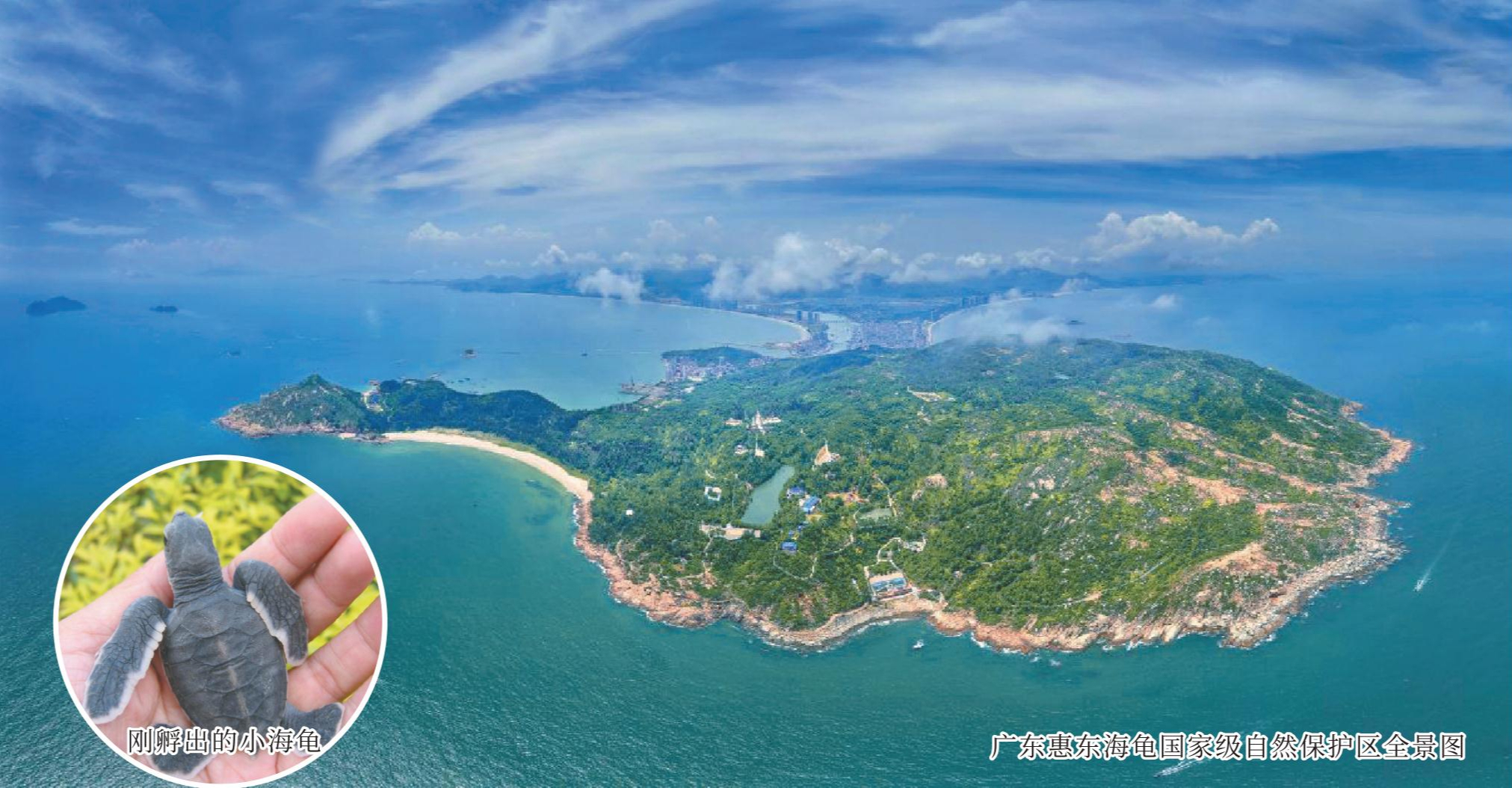
Core Viewpoint - The Guangdong Huidong Sea Turtle National Nature Reserve is a unique conservation area in China dedicated to the protection and breeding of sea turtles, particularly the green sea turtle, contributing significantly to ecological tourism and local economic development [2][3][5]. Group 1: Conservation Efforts - The reserve has successfully protected 745 nests and hatched 68,516 baby turtles since its establishment in 1985, with 65,304 turtles released back into the wild [3]. - A dedicated team has achieved a breakthrough in artificial breeding technology, resulting in over 16,000 new turtles bred, providing a model for global sea turtle resource recovery [3][4]. Group 2: Economic Impact - The ecological tourism initiatives have generated approximately 200 million yuan in local economic revenue, benefiting surrounding industries such as dining, accommodation, and retail [5][6]. - An ecological compensation mechanism has been established, distributing 30% of tourism ticket revenue to local communities, amounting to over 30 million yuan since 2013 [6][7]. Group 3: Public Engagement and Education - The reserve has developed a comprehensive public education program, reaching around 650,000 people annually, promoting awareness of sea turtle conservation and marine ecology [8][11]. - Special events, such as the World Turtle Day, engage the public in hands-on conservation activities, reinforcing the importance of community involvement in ecological protection [9][10]. Group 4: Sustainable Development Model - The reserve operates on a sustainable development model that integrates ecological protection with tourism, creating a cycle where tourism promotes conservation and vice versa [6][12].

韩文秀:完整准确全面贯彻新发展理念 | 宏观经济
清华金融评论· 2025-06-22 10:34
Core Viewpoint - The article emphasizes the necessity of fully implementing the new development concept as a key to achieving high-quality development and realizing Chinese-style modernization, amidst various new challenges and contradictions in the new journey ahead [2][3][20]. Group 1: New Development Concept - The new development concept is identified as the most important theoretical innovation in the political economy of socialism with Chinese characteristics, guiding the direction and focus of development in the new era [2][3]. - It is crucial for addressing external pressures and challenges, particularly in the context of rising unilateralism and protectionism from Western countries [4][5]. Group 2: High-Quality Development - High-quality development is deemed the primary task in building a modern socialist country, with the new development concept serving as the guiding principle [3][6]. - By 2035, it is projected that China's per capita GDP will reach the level of moderately developed countries, highlighting the need for significant advancements in economic strength and technological capabilities [3]. Group 3: Reform and Opening Up - The implementation of the new development concept is essential for deepening reforms and expanding high-level opening up, which involves adjusting various interest relationships and overcoming resistance [5][6]. - A comprehensive reform framework is necessary to support the new development concept, ensuring that it is integrated into the design of reform plans [5]. Group 4: Common Prosperity - The article stresses that shared development is a fundamental requirement of socialism, aiming to ensure that all people benefit from development and move towards common prosperity [6][14]. - The focus is on addressing disparities in wealth and ensuring that development outcomes are equitably distributed among the population [6]. Group 5: Risk Prevention - The need to prevent and mitigate major risks is highlighted, with the new development concept seen as a means to enhance economic stability and resilience against systemic risks [7][15]. - The article points out that risks often stem from low-quality development practices, underscoring the importance of high-quality development in risk management [7]. Group 6: Innovation and Coordination - Innovation is identified as the primary driving force for development, with a call for a modern industrial system supported by high-level technological independence [8][11]. - Coordinated development is emphasized as a strategy to address imbalances and promote sustainable growth across regions and sectors [11][12]. Group 7: Green Development - The article advocates for a comprehensive green transformation of economic and social development, aligning with ecological sustainability goals [12][13]. - It stresses the importance of integrating environmental considerations into economic planning and development strategies [12]. Group 8: Open Development - Open development is framed as a distinctive feature of Chinese-style modernization, with a focus on enhancing international cooperation and market access [13][14]. - The article calls for a balanced approach to utilizing both domestic and international resources to improve the quality of international circulation [13]. Group 9: Correct Performance View - The necessity of establishing a correct performance view is highlighted, advocating for a pragmatic approach to economic development that prioritizes stability and quality over speed [18][19]. - The article warns against superficial achievements and emphasizes the importance of addressing real economic conditions and needs [18][19].
安徽省能源局局长汪振宇解读“获得电力”新政
Zhong Guo Dian Li Bao· 2025-06-12 06:11
Core Viewpoint - The document outlines the joint issuance of the "Opinions on Deepening and Enhancing the 'Electricity Access' Service Level" by the National Development and Reform Commission and the National Energy Administration, aiming to create a modern electricity business environment that aligns with new economic and social development requirements [3][4]. Summary by Sections Overall Requirements - The "Opinions" emphasize the need for a modern electricity service system that supports high-quality economic development, with a framework summarized as "1+5+1," which includes overall requirements, five key tasks, and supporting measures [3][4]. Key Tasks - The document identifies five major tasks with 14 specific reform measures aimed at enhancing the electricity service level, focusing on user-centered public service, high-quality electricity supply, and equitable access to electricity [4][5]. Strategic Importance - The "Opinions" highlight three strategic roles: 1. Reshaping public service models through streamlined processes and data sharing [4]. 2. Supporting high-quality development by ensuring reliable electricity supply for high-end industries and promoting green energy consumption [5]. 3. Establishing a fair and inclusive electricity service network to enhance the quality of life for residents [5]. New Developments - The "Opinions" introduce a new framework for long-term development in electricity services, focusing on five key areas: convenience in electricity access, high-quality supply, green energy usage, inclusive services, and collaborative governance [7][8]. Implementation and Execution - The document emphasizes the importance of legal compliance, clear objectives, and task accountability to ensure effective implementation of the proposed reforms [10][12]. Regional Focus - Anhui Province has been actively developing the "Beautiful Electricity Service" brand, achieving a power supply reliability rate of 99.982% by the end of 2024, positioning itself as a leader in supporting economic and social development [11][12].
边塞牧歌的现代回响
Xin Hua Wang· 2025-05-21 05:15
Core Viewpoint - The article highlights the modernization and development of the border areas between China and Mongolia, showcasing how local residents are adapting to contemporary life while preserving their cultural heritage and contributing to the economy through innovative practices and community cooperation [2][3][11]. Group 1: Economic Development - The internet's penetration in Inner Mongolia has reached 100% in administrative villages, allowing local herders to engage in e-commerce and promote their products, such as the "wolf-proof lamp" [2][3]. - A cooperative named "Tao Ri Gen He Li," meaning "Abundant Border," was established by local herders to enhance the value of their livestock products, leading to increased income through direct sales of processed meat [3][4]. - The cooperative sells over 50,000 kilograms of lamb annually, generating additional income of over 300,000 yuan for the herders [3]. Group 2: Community and Environmental Protection - Local herders actively participate in fire prevention efforts, forming volunteer fire brigades to protect their pastures during critical fire seasons [5][6]. - Herders also provide assistance to wildlife, such as the endangered yellow sheep, by ensuring they have access to water and food during migration [7][8]. Group 3: Cultural Integration and Social Harmony - The article illustrates the blending of cultures in the border region, where individuals from different ethnic backgrounds live harmoniously, sharing languages and traditions [8][9]. - The narrative of Zhang Yongqing, a Han Chinese man married to a Mongolian woman, exemplifies the deep-rooted connections and mutual respect among different ethnic groups in the area [8][10]. Group 4: Infrastructure and Connectivity - The article notes the development of transportation infrastructure, including highways connecting remote areas, facilitating access to education and healthcare for local residents [2][3]. - Key border cities like Manzhouli and Erenhot serve as significant trade hubs, enhancing economic ties between China and Mongolia through various trade routes and rail connections [11][12].