
农业社会化服务

Search documents
联小农、强服务、促衔接——农业社会化服务体系不断完善
Zhong Guo Jing Ji Wang· 2026-01-22 05:49
对农业社会化服务的需求并不限于北京和超大城市。"大国小农"仍是现阶段我国的基本国情农情。伴随 城市化进展和老龄化问题的出现,"谁来种地、怎么种好地"成为迫切待解的现实问题。中国人民大学农 业与农村发展学院二级教授张利庠认为,小农户经营规模小,导致成本高、议价弱、抗风险能力 差。"春天种啥对,秋天卖啥贵?农资防假又该怎么办?"在张利庠看来,这些都是小农户经营面临的难 题。但是遇到困难不要慌,农业社会化服务可以来帮忙。 近年来,在政策护航和市场驱动的双重作用下,农业社会化服务行业快速崛起,服务主体多元化进展加 快,服务范围持续扩大,涉及环节不断延伸。农业农村部数据显示,目前,全国有111.1万个经营性主 体开展社会化服务,包括服务专业户(含对外提供服务的家庭农场)、农民合作社、农业服务公司、农 村集体经济组织等,服务小农户近9300万户,年服务面积超22.9亿亩次。越来越多的服务主体从提供单 一环节服务转向提供多环节、综合性服务,集成应用先进适用的品种、技术、装备,促进小农户和现代 农业发展有机衔接。 数九寒天,北京市平谷区马昌营镇气温跌破零下十度。"最近大降温,地里怎么防冻害?""如果发生了 冻害,小麦该怎样追 ...
“一埂之隔”变“一家亲”
Xin Lang Cai Jing· 2026-01-20 21:54
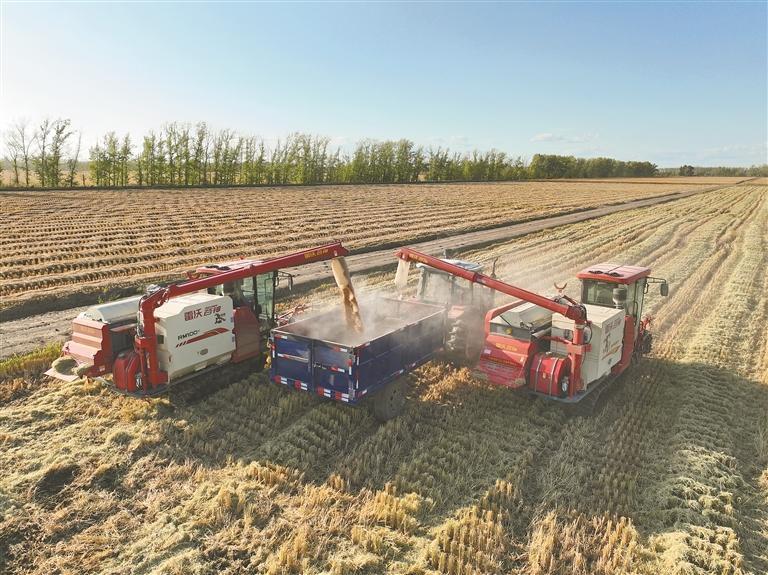
(来源:黑龙江日报) 转自:黑龙江日报 江川农场与桦川县"一乡两镇"开展垦地合作,机械化收割设备在田间高效作业的场景。李伟华摄 曙光农场与桦南县垦地合作秋收现场。张奥宇摄 □夏红英 黑土地还在深冬的白雪下深眠,而北大荒集团红兴隆分公司农业社会化服务的引擎已然轰鸣。回望2025年, 红兴隆分公司以农业社会化服务为强劲引擎,在推动区域农业现代化、助力乡村振兴的征程上迈出了坚实而 有力的步伐,交出了一份令人瞩目的亮眼答卷。 这一年,红兴隆分公司与属地三市深度融合,战略合作硕果累累。成功打造16处示范点,创新推出 的"1133"农服发展模式如星星之火,迅速燎原,累计覆盖面积达460万亩,带动地方粮食增产1700万斤。与双 鸭山市携手出台的《双鸭山市垦地合作结对联动实施方案》,更是成为垦地融合发展的典范。 从"各干各"到"一起干" 曾几何时,农场与农村虽"一埂之隔",却似两重天地。农场机械化、标准化,农村则地块零散、技术滞后。 如何打破这道"无形的墙"? 红兴隆的答案是主动融入、携手同行。 面对农户对新技术接纳度不高的难题,红兴隆分公司始终坚信:授人以鱼不如授人以渔,启动了"敲百家门、 入百家户、见百千人"破冰行动,直 ...

新农机新服务新活力
Xin Lang Cai Jing· 2026-01-19 22:17
Core Insights - The agricultural development in Zhijiang, Hubei is leveraging technology and socialized service systems to enhance efficiency and reduce costs in farming practices [1][2][3] Group 1: Technological Advancements - The use of agricultural drones equipped with BeiDou navigation systems has significantly improved operational efficiency, completing tasks in 1 hour for 100 acres, a 5-fold increase compared to 3 years ago, while production costs have decreased by 20% [1] - The integration of automated seedling production lines and intelligent environmental control systems in modern nurseries allows for precise management of seedling growth [2] Group 2: Socialized Service System - The "1+3+N" socialized service system, which includes government guidance and the integration of service companies, cooperatives, and family farms, aims to consolidate resources and enhance agricultural productivity [2] - By 2025, the city plans to cultivate 652 socialized service organizations, covering 1.9813 million acres and serving 100,400 households [2] Group 3: Infrastructure and Mechanization - Over the past five years, 278,900 acres of high-standard farmland have been established, achieving a comprehensive mechanization rate of 92.84% for major crops [2] - The focus is on comprehensive governance of land, water, and infrastructure to facilitate efficient agricultural practices [2] Group 4: Future Development Plans - The "14th Five-Year Plan" emphasizes enhancing agricultural production capacity and quality, aiming for a seamless integration of smallholders with modern agriculture [3] - Future initiatives will include customized agricultural machinery services for specific crops and livestock, promoting high-quality farmland construction and advanced agricultural technologies [3]
“联小农、强服务、促链接” 农业社会化服务高质量发展交流会在北京平谷召开
Huan Qiu Wang· 2026-01-19 06:59
Core Viewpoint - The conference focused on advancing high-quality agricultural social services, emphasizing the integration of small farmers with modern agricultural practices and the development of a comprehensive service system [1][2]. Group 1: Conference Overview - The Agricultural Social Service High-Quality Development Exchange Conference was held in Pinggu District, Beijing, attracting experts and entrepreneurs from across the country [1]. - The conference aimed to implement the spirit of the 20th Central Committee and promote rural revitalization and modernization of agriculture [1]. - Key discussions included the construction of a technology-enabled, efficient agricultural service system and the integration of small farmers into modern agricultural development [1]. Group 2: Key Presentations and Agreements - Notable presentations were made by leaders and researchers on topics such as agricultural social services and their role in modern agricultural development [1][2]. - A strategic cooperation agreement was signed for the establishment of the Agricultural Social Service Professional Committee in Pinggu, which will serve as a think tank for the region's agricultural transformation [2]. Group 3: Pinggu District's Initiatives - Pinggu District is leveraging its strengths in high-tech agriculture, logistics, and leisure to create a comprehensive agricultural service model [3]. - The district is developing a "Pinggu Plan" that integrates high-tech solutions into agricultural services, enhancing efficiency and value [3]. - Pinggu is positioned as a logistics hub, facilitating the efficient distribution of agricultural products and connecting to major markets [3]. Group 4: Systematic Development and Collaboration - The district is constructing a systematic agricultural social service network characterized by a full-chain empowerment approach [4]. - Collaborations among companies for digital platform development, smart machinery sharing, and agricultural production management were highlighted, showcasing the potential for practical implementation of agricultural social services [5]. - The conference marked a significant step towards transforming agricultural social service concepts into tangible operations and projects [5].
滨州市委书记宋永祥调研冬季农业生产情况
Xin Lang Cai Jing· 2026-01-07 14:04
Core Insights - The article emphasizes the importance of enhancing agricultural production capacity and quality to ensure a bountiful harvest in 2023, following directives from Xi Jinping regarding rural work [1] Group 1: Agricultural Production - The local government is focusing on monitoring weather changes and crop conditions to ensure the safe overwintering of wheat [1] - Early planning for spring wheat field management is highlighted, including scientific pest and disease control measures to achieve grain yield [1] Group 2: Agricultural Services - There is a push to strengthen the construction of modern agricultural service centers to provide integrated, one-stop services for smallholders and other production entities [1] - Increased emphasis on technical training and collaboration with research institutions is aimed at improving agricultural resource utilization and technology promotion [1]
天水市推进农业社会化服务走深走实
Xin Lang Cai Jing· 2026-01-05 09:30
2094.52万元资金赋能 18.52万亩农田提质 天水市推进农业社会化服务走深走实 每日甘肃网1月5日讯 据天水日报报道【天水融媒记者王琴】我市坚持把农业社会化服务作为实现小农 户和现代农业有机衔接、推进农业现代化的重要抓手,紧紧围绕保障粮食生产和粮油作物大面积单产提 升两项重点任务,扎实开展农业社会化服务扩面提质行动,2025年落实项目资金2094.52万元,完成生 产托管服务面积18.52万亩。 坚持高位推动农业社会化服务工作,市级层面将其纳入农业农村工作重点,制定印发工作要点,明确项 目实施、主体培育、领域拓展等重点任务;指导各项目县区以政府名义出台《农业社会化服务项目实施 方案》,细化目标任务、压实主体责任,构建起"市级牵头抓总、县区负总责、乡镇抓落实"的高效推进 机制。同时,严格落实信息公开制度,督促各县区通过政府门户网站及时公开项目实施方案、遴选结果 等关键信息,让群众全程参与监督,有效提升项目实施透明度。 紧紧围绕保障粮食生产、聚焦服务小农户,我市充分发挥村级党组织战斗堡垒作用和农村集体经济组 织"统"的优势,探索推广"村集体、合作社、撂荒地复耕复种、生产托管"模式。由村集体经济组织牵 头,一 ...
农业现代化水平不断提高
Ren Min Ri Bao Hai Wai Ban· 2025-12-31 02:01
Core Insights - The agricultural sector in China is experiencing significant growth, with the value of agriculture and related industries reaching 20.6173 trillion yuan in 2024, accounting for 15.29% of GDP [2] - The seed industry revitalization initiative has led to a stable grain production of over 1.3 trillion jin for several years, with a record high of 1.4298 trillion jin achieved this year [3] - The modernization of agricultural production and seed safety assurance levels are improving, with seed quality compliance rates remaining above 98% [4] Group 1: Agricultural Development and Modernization - Hebei Province is advancing agricultural structural adjustments by developing specialty facility agriculture and high-quality vegetable cultivation to increase farmers' income and support rural revitalization [2] - The agricultural modernization level is continuously improving, with major grain crops achieving full mechanization in planting and harvesting [2] - The national seed supply guarantee rate has reached 80%, an increase of 10 percentage points since 2020 [4] Group 2: Seed Industry and Technological Innovation - The proportion of domestically bred crop varieties has exceeded 95%, with domestic seed sources for livestock, aquatic products, and vegetables holding market shares of over 80%, 85%, and 91% respectively [3] - The establishment of national livestock and poultry genetic resource banks has positioned China as the world leader in the preservation of agricultural genetic resources [3] - The investment in research and development by crop seed companies has doubled since 2020, indicating a robust innovation ecosystem [3] Group 3: Agricultural Social Services - The coverage and quality of agricultural social services are expanding, with a target to enhance service capabilities across the entire production chain by 2025 [5] - There are currently 1.111 million operational entities providing social services, serving nearly 93 million smallholder farmers [6] - The shift towards comprehensive service models is promoting the integration of advanced varieties, technologies, and equipment to support smallholder and modern agricultural development [6] Group 4: Policy and Strategic Initiatives - The Central Rural Work Conference emphasized the need to accelerate the construction of an agricultural powerhouse, focusing on improving grain quality and diversifying food supply capabilities [7] - The Ministry of Agriculture and Rural Affairs is implementing a new round of initiatives to enhance grain production capacity and ensure food security [8] - The promotion of smart agriculture and the application of new technologies such as big data and AI in agriculture are key components of the modernization strategy [8]
农业农村部:推动农业社会化服务向产前和产后环节延伸
Ren Min Wang· 2025-12-24 08:25
Core Viewpoint - The Ministry of Agriculture and Rural Affairs is focused on enhancing the agricultural social service system to improve the production service capabilities of grain and important agricultural products, utilizing modern comprehensive agricultural service centers as a key approach [1] Group 1: Service System Development - The Ministry is promoting various organizational forms such as "service entities + rural collective economic organizations + farmers" and "service entities + new agricultural management entities + farmers" to develop single and multi-link entrusted services tailored to local conditions [1] - The initiative aims to expand service coverage while consolidating and expanding the service scale for grain, cotton, oil, and sugar [1] Group 2: Service Expansion - Services are being extended to pre-production and post-production stages, as well as to economic crops, livestock, aquaculture, and facility agriculture [1] - In Inner Mongolia, socialized services in livestock are being implemented in three counties, supporting small farmers with services like mechanical shearing, medicinal baths, and entrusted breeding [1] Group 3: Future Goals - By 2024, the plan includes the establishment of 375 large and medium-sized forage storage facilities, the mowing of 1.16 million acres, and the transportation of 120,000 tons of forage, effectively exploring new models for agricultural social services in the livestock sector [1]
农业农村部:全国有111.1万个经营性主体开展社会化服务
Ren Min Wang· 2025-12-24 08:25
当前,越来越多的服务主体从提供单一环节服务转向提供多环节、综合性服务,集成应用先进适用的品 种、技术、装备,促进小农户和现代农业发展有机衔接。目前,全国有111.1万个经营性主体开展社会 化服务,服务小农户近9300万户,年服务面积超过22.9亿亩次,其中服务粮油作物面积17.8亿亩次。 2025年9月,在总结地方经验的基础上,农业农村部会同有关部门印发《关于加强现代农事综合服务中 心建设的指导意见》,指导各地坚持市场导向、因地制宜,积极探索、循序渐进建设一批现代农事综合 服务中心,推动农业社会化服务迭代升级。 (文章来源:人民网) 人民网北京12月24日电 (记者方经纶)据农业农村部官网消息,目前,全国有111.1万个经营性主体开 展社会化服务。 据介绍,农业农村部以完善便捷高效的农业社会化服务体系为导向,以提升粮食和重要农产品生产全链 条服务能力为重点,以建设现代农事综合服务中心为抓手,创新服务模式,拓展服务领域,推动农业社 会化服务迭代升级。 ...
我国农业社会化服务体系不断完善
Xin Hua She· 2025-12-23 12:04
Core Viewpoint - The Ministry of Agriculture and Rural Affairs plans to continuously innovate service models and expand service areas to promote the iterative upgrade of agricultural social services by 2025 [1] Group 1 - The Ministry of Agriculture and Rural Affairs is focused on innovation in service models [1] - There is an emphasis on expanding the scope of services provided [1] - The goal is to enhance the quality and efficiency of agricultural social services [1]