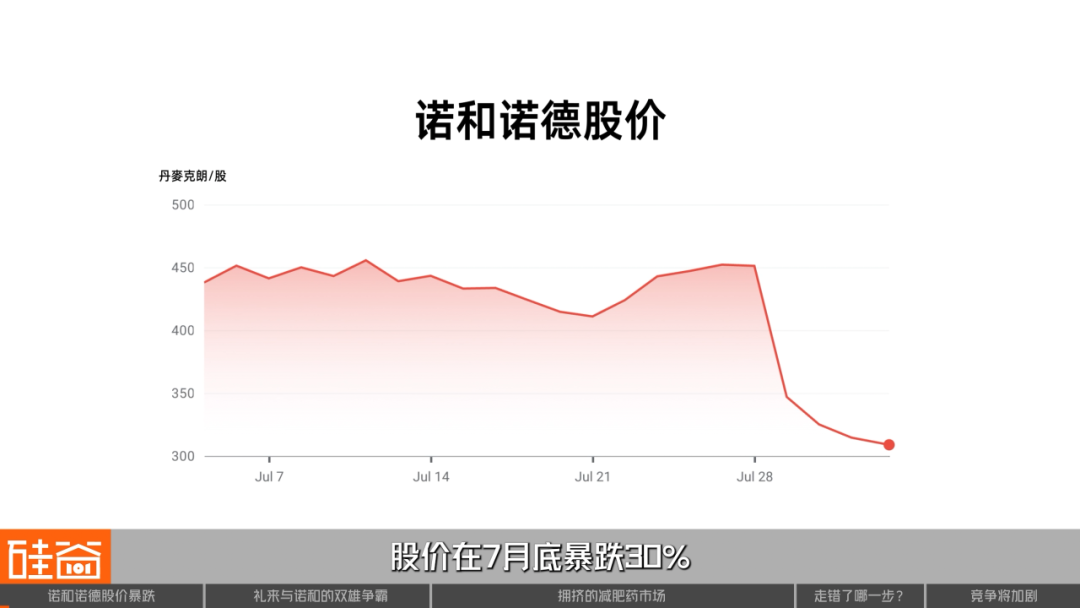
减肥药市场竞争

Search documents
诺和诺德(NVO.US)口服减肥药片获FDA批准 与礼来“减肥药之战”进入新回合
智通财经网· 2025-12-23 11:27
Group 1 - Novo Nordisk's stock price rose by 7.5% following FDA approval of its oral weight loss medication, positioning the company advantageously in the evolving obesity treatment market [1] - The approval allows Novo Nordisk to regain market share lost to Eli Lilly, which has been competing with its product [1] - CEO Lars Fruergaard Jørgensen stated that the company is better prepared for the launch this time, having sufficient supply of the oral medication [1] Group 2 - Eli Lilly's product Zepbound has gained a leading position in the injection weight loss drug market, capitalizing on Novo Nordisk's initial supply challenges [2] - Analysts suggest that oral weight loss medications may expand the market rather than cannibalize the injection segment, as a significant portion of adults may hesitate to self-inject [2] - Demand for Wegovy tablets is expected to be strong, with a projected global peak sales of approximately 37.9 billion USD, which is crucial for offsetting anticipated challenges in 2026 [2]


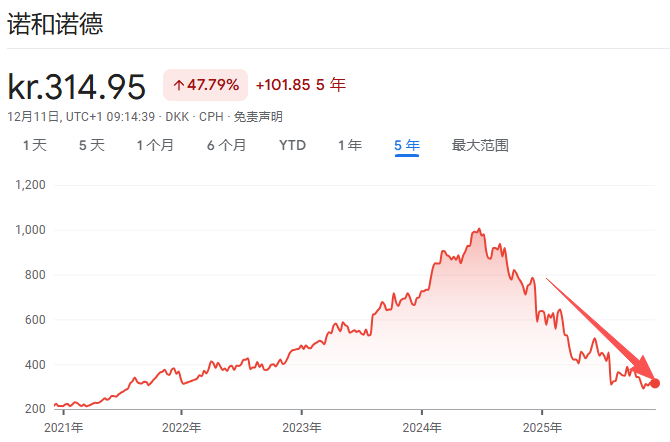
2025年暴跌50%!诺和诺德遭遇史上最差一年,“减肥药狂潮”仿佛从未发生
Hua Er Jie Jian Wen· 2025-12-11 08:32
Core Viewpoint - Novo Nordisk has faced its worst performance year ever due to poor clinical trial results, multiple profit warnings, and intense market competition, leading to a stock price drop of over 50% in 2023, erasing gains since the approval of Wegovy in 2021 [1][3]. Group 1: Financial Performance - The stock price of Novo Nordisk has fallen more than 50% this year, nearly negating the significant increase since Wegovy's approval for weight loss treatment in 2021 [1]. - Analysts predict that Novo Nordisk's sales may decline by 2026, contrasting sharply with the previous growth rates of 25%-30% during its prosperous period [3]. - The current trading price of the stock is approximately 14 times expected earnings, which is half of the average valuation over the past five years and over 10% cheaper than the MSCI World Pharmaceuticals Index [3][10]. Group 2: Competitive Landscape - The main threat to Novo Nordisk comes from Eli Lilly, whose stock has surged over 28% this year, contrasting with Novo Nordisk's decline [4]. - Novo Nordisk's weight loss drugs are reportedly less effective than those from Eli Lilly, which has enhanced Eli Lilly's market communication capabilities [7]. - The market sentiment has shifted, with investors favoring Eli Lilly as the primary beneficiary of the significant growth in the market, indicating a strong preference for Eli Lilly over Novo Nordisk [7]. Group 3: Future Prospects - Novo Nordisk is banking on new product launches to recover from its current challenges, including a more potent version of Wegovy and an oral version expected to launch early next year [8]. - The new CEO, Mike Doustdar, has indicated that the company has "sufficient" pills for targeted release and is in preliminary talks with Hims & Hers Health Inc. for remote sales of obesity pills [8]. - Analysts remain optimistic about Novo Nordisk, with 17 out of 33 institutions maintaining a buy rating, suggesting that the stock price drop may have been overdone and that a higher valuation is justified based on the company's strong R&D track record [10].

利空突袭!暴跌!超级巨头,重大宣布
券商中国· 2025-11-25 09:53
Core Viewpoint - Novo Nordisk's stock faced a significant decline due to the failure of its Alzheimer's drug trial, which has raised concerns about its future in the obesity treatment market and led to a year-to-date stock drop of over 46% [1][2][5]. Group 1: Stock Performance and Market Reaction - On November 24, Novo Nordisk's stock plummeted over 9% in the U.S. and over 12% in Denmark, reaching its lowest level since July 2021 [1][2]. - Following the announcement of the trial results, Novo Nordisk's market capitalization fell to $199.6 billion [2]. - The company's stock has decreased nearly 70% from its peak in 2024, reflecting investor concerns about its long-term competitive position in the obesity treatment market [5]. Group 2: Drug Trial Results - The clinical trials for the oral version of semaglutide (Rybelsus) did not show significant improvement in Alzheimer's patients, leading to the termination of the planned one-year study extension [2][3]. - The trials involved nearly 4,000 patients, and the results indicated that while some physiological markers improved, there was no significant slowing of disease progression [3][4]. Group 3: Competitive Landscape - Eli Lilly, a key competitor, has seen its stock rise significantly, becoming the first pharmaceutical company to surpass a $1 trillion market cap, driven by strong demand for its obesity and diabetes drugs [7]. - Eli Lilly's Zepbound has outperformed Novo Nordisk's Wegovy in the obesity drug market, capturing a substantial share of new prescriptions [7][8]. - Analysts estimate that if Novo Nordisk's Alzheimer's trial had succeeded, it could have generated up to $5 billion in annual revenue, highlighting the potential impact of the trial's failure on the company's financial outlook [3][4].

减肥药战场延烧:西维斯健康(CVS.US)扶植诺和诺德(NVO.US) 礼来(LLY.US)反手更换员工福利商
Zhi Tong Cai Jing· 2025-11-12 06:58
Core Insights - CVS Health has stopped covering Eli Lilly's weight loss drug, Zepbound, and is now supporting its competitor Novo Nordisk's Wegovy, prompting Eli Lilly to terminate its drug benefit plan with CVS Health [1] - Starting January 1, employees participating in Eli Lilly's health insurance plan will automatically transition to Rightway's drug benefit system, affecting approximately 50,000 employees [1] - CVS Health maintains a client retention rate of over 90% and claims that its decision to prioritize Wegovy over Zepbound was made to save costs for clients [1][2] Group 1 - Eli Lilly's decision to switch drug benefit providers is a direct response to CVS Health's prioritization of Wegovy over Zepbound [1] - Rightway is positioned as a more innovative and cost-effective option for Eli Lilly's employees, aligning with the company's goal of providing high-quality benefits [1] - CVS Health's Caremark removed Zepbound from its preferred drug list earlier this year, which Eli Lilly warned could negatively impact Zepbound's sales performance [1] Group 2 - The competition between Novo Nordisk and Eli Lilly in the weight loss drug market is intensifying, with the market expected to reach $100 billion by the end of the decade [2] - CVS Health's partnership with Novo Nordisk allows Wegovy to be sold at $499 to cash-paying customers across over 9,000 pharmacies nationwide [2] - Eli Lilly's CEO has indicated a shift towards a more technology-driven and fintech-oriented pharmacy benefit management approach [2]

堪比商战大片!“减肥药新贵”遭巨头争抢,最新进展来了
凤凰网财经· 2025-11-08 12:18
Core Viewpoint - The ongoing acquisition battle for Metsera between Pfizer and Novo Nordisk has intensified, with Pfizer recently amending its merger agreement to offer up to $86.25 per share, which includes $65.60 in cash and a contingent value right (CVR) of up to $20.65 per share [1][3][4]. Group 1: Acquisition Details - Pfizer's revised offer represents a significant increase from its initial proposal of $47.50 per share, which valued the total deal at approximately $7.3 billion [9]. - Novo Nordisk entered the competition with a higher bid, initially offering $8.5 billion and later increasing it to a maximum of $10 billion, which includes $7.2 billion in equity value and $2.8 billion in cash contingent value rights [10]. - Metsera's board has unanimously recommended that shareholders approve the revised merger agreement with Pfizer, citing the deal's ability to provide immediate and tangible value to shareholders [3][4]. Group 2: Market Context - Metsera, founded in 2022 and based in New York, focuses on developing treatments for obesity and related metabolic diseases, leveraging technology from Imperial College London's research team [5]. - The company's stock price surged from approximately $36 per share in September to $83.18 per share as of November 7, reflecting investor interest amid the acquisition bids [10]. - The competition for Metsera underscores the growing potential and long-term viability of the obesity treatment market, particularly in the context of GLP-1 therapies, where major pharmaceutical companies are vying for market share [10].


辉瑞49亿美元收购成立三年的减肥药企,赌一个“弯道超车”的可能
Guan Cha Zhe Wang· 2025-09-25 09:34
Core Insights - Pfizer's acquisition of Metsera for $4.9 billion marks a significant entry into the $100 billion weight loss drug market, indicating a shift in the competitive landscape as traditional pharmaceutical giants join the fray [1][2] - The deal includes a contingent value right (CVR) that could increase the total transaction value to $7 billion, linking payments to Metsera's clinical and regulatory milestones [2] - Metsera's key assets include four clinical-stage projects, notably MET-097i, which supports both weekly and monthly dosing, enhancing patient compliance and treatment convenience [3] Strategic Considerations - The acquisition aligns with Pfizer's strategy to focus on impactful opportunities, leveraging its expertise in cardiovascular metabolic diseases and strong commercialization infrastructure to accelerate product development [5] - The timing of the acquisition is strategic, as the weight loss drug market is experiencing rapid growth but faces supply shortages, allowing Pfizer to quickly enter the market without lengthy development cycles [5] Market Dynamics - The global weight loss drug market is characterized by a duopoly, primarily dominated by Novo Nordisk and Eli Lilly, creating high entry barriers for new competitors [6] - Novo Nordisk's products, including Ozempic and Wegovy, generated significant revenues, with Wegovy alone achieving $5.458 billion in sales, reflecting a 78% year-over-year increase [6][9] - Eli Lilly's Mounjaro and Zepbound also performed well, with combined sales reaching $14.734 billion in the first half of 2025, indicating strong market demand [6] Supply and Demand Challenges - The current supply-demand imbalance in the market has led to shortages, with some regions experiencing months-long stockouts, highlighting the vulnerabilities of the existing duopoly [9] - High treatment costs, exceeding $13,000 annually for Wegovy in the U.S., pose significant barriers to market accessibility, further complicating the competitive landscape [9] Innovation and Future Trends - The weight loss drug sector is witnessing a wave of innovation, with hundreds of companies conducting clinical trials across various mechanisms, including GLP-1/GIP dual agonists and amylin analogs [11] - Key innovation areas include improved safety and tolerability, enhanced weight loss efficacy, oral dosing options, and muscle-sparing therapies, which could redefine market competition [12][15] - The future of weight loss drugs is expected to focus on personalized and precision medicine, moving towards comprehensive metabolic health management rather than solely weight reduction [15]

减肥药巨头,全球裁员9000人
财联社· 2025-09-10 10:31
Core Viewpoint - Novo Nordisk is undergoing a major internal restructuring, including the layoff of 9,000 employees, to save 8 billion Danish kroner (approximately $1.26 billion) annually, amid increasing competition from Eli Lilly in the diabetes and obesity treatment market [1][3]. Group 1: Restructuring and Cost-Saving Measures - The company announced a comprehensive reform to simplify its organizational structure, accelerate decision-making, and reallocate resources to growth opportunities in diabetes and obesity [1]. - A global hiring freeze was implemented earlier, retaining only essential positions [2]. - The layoffs will affect approximately 5,000 positions in Denmark, with a total of 78,400 jobs worldwide [3]. Group 2: Market Challenges and Performance - Novo Nordisk's market share for its weight loss drug Wegovy is declining, leading to a slowdown in sales growth, particularly in the U.S. market [3]. - The company's market capitalization has dropped significantly, from a peak of $650 billion to $185 billion this year [3][4]. - The company has issued profit warnings, citing increased competition from generic drug manufacturers allowed to produce similar formulations of Wegovy [3].

减肥药竞争激烈,诺和诺德全球裁9000人,年内三次下调利润预测
Hua Er Jie Jian Wen· 2025-09-10 07:19
Group 1 - The core viewpoint is that Novo Nordisk is facing significant pressure in the weight loss drug market, leading to drastic restructuring measures including a global layoff of 9,000 employees and a third downward revision of profit growth expectations for the year [1][2] - The layoff plan will affect 11% of Novo Nordisk's global workforce, including 5,000 employees in Denmark, aiming to save 8 billion Danish kroner (approximately 1.3 billion USD) by the end of 2026 [1] - The company has significantly lowered its financial guidance, now expecting a 4% to 10% increase in operating profit for the year, a stark decline from the 27% growth forecast made in February [1] Group 2 - The restructuring is a response to losing market leadership in the critical U.S. weight loss drug market to competitors like Eli Lilly, compounded by threats from cheaper alternatives from U.S. compound pharmacies [2] - The aggressive measures are led by newly appointed CEO Mike Doustdar, who has emphasized the need for stricter spending discipline and has initiated hiring freezes and rescinded job offers [3] - The layoffs are part of a broader transformation plan aimed at simplifying the organizational structure, improving decision-making speed, and reallocating resources to core growth areas such as diabetes and obesity [3]
减肥药竞争激烈,诺和诺德Q2盈利未达预期,重申下调全年业绩展望
美股IPO· 2025-08-06 07:34
Core Viewpoint - Novo Nordisk's Q2 sales growth of 13% fell short of expectations, but the sales performance of its flagship weight loss drug Wegovy exceeded market predictions. The company is lowering its full-year outlook for the GLP-1 drug segment due to anticipated slower growth in the second half of the year [1][3][7]. Financial Performance - In Q2, Novo Nordisk reported sales of 76.86 billion Danish Krone, a 13% year-on-year increase, slightly below the market estimate of 76.99 billion Danish Krone [5]. - The company's EBIT was 33.45 billion Danish Krone, lower than the analyst forecast of 34.45 billion Danish Krone, while net profit was 26.50 billion Danish Krone, also below the expected 27.01 billion Danish Krone [5][9]. - The total sales of GLP-1 drugs, including Ozempic and Wegovy, reached 38.37 billion Danish Krone, missing the forecast of 39.45 billion Danish Krone [9]. Business Segment Performance - Wegovy's sales reached 19.53 billion Danish Krone, surpassing the market expectation of 19.20 billion Danish Krone, while the overall diabetes and obesity care segment generated total sales of 71.94 billion Danish Krone, below the expected 73.04 billion Danish Krone [9]. - The company experienced a 67% increase in Wegovy sales compared to the previous year, indicating strong demand despite challenges [6][10]. Management Changes and Strategic Outlook - Following a profit warning, CEO Lars Fruergaard Jørgensen announced his departure, with Maziar Mike Doustdar taking over as CEO, reflecting the company's response to current challenges [4][8]. - The company has revised its full-year sales growth forecast from 13%-21% to 8%-14%, and operating profit growth from 16%-24% to 10%-16%, primarily due to lower-than-expected sales of Wegovy in cash payment channels [8][10]. - Novo Nordisk is committed to investing in its product pipeline, with plans for capital expenditures of approximately 65 billion Danish Krone in 2025, maintaining a low double-digit ratio of capital expenditure to sales in the coming years [10].
股价腰斩,跌落神坛的诺和诺德错在哪一步?
Hu Xiu· 2025-08-05 05:52
Core Viewpoint - Novo Nordisk, once a leader in the weight loss drug market, is facing significant challenges due to increased competition and has drastically lowered its sales and profit forecasts, nearly halving its expectations [5][9][60]. Group 1: Market Dynamics - The weight loss drug market, estimated to be worth hundreds of billions, is becoming increasingly competitive, with new players entering and existing competitors like Eli Lilly gaining market share [4][12]. - Novo Nordisk has reduced its sales growth forecast from 13%-21% to 8%-14% and its operating profit growth from 16%-24% to 10%-16%, indicating a severe downturn [5][60]. - The emergence of compounding pharmacies has allowed for the sale of cheaper alternatives to Novo Nordisk's products, capturing a significant market share estimated between 5% to 20% [45][48]. Group 2: Competitive Landscape - Eli Lilly's dual-target drug, tirzepatide, has shown superior clinical results compared to Novo Nordisk's semaglutide, leading to a shift in physician preference towards Lilly's products [8][30]. - The prescription volume for Lilly's Mounjaro has surpassed that of Novo Nordisk's Ozempic, indicating a loss of market share for Novo Nordisk [25][30]. - Analysts note that Novo Nordisk is losing market share to Eli Lilly, with some physicians completely switching to prescribing Mounjaro instead of Wegovy [30]. Group 3: Strategic Missteps - Novo Nordisk underestimated market demand for Wegovy, leading to supply shortages and a subsequent inability to meet the growing demand, which allowed competitors to capitalize on the situation [54][57]. - The company faced a public fallout with Hims & Hers, a telehealth company, which resulted in a failed partnership aimed at promoting Wegovy, further complicating its market position [52][60]. - The appointment of a new CEO, who lacks direct experience in the competitive U.S. market, raises questions about Novo Nordisk's ability to navigate its current challenges [68].