
eloralintide

Search documents
Jim Cramer Stock Portfolio: Top 10 Stock Picks
Insider Monkey· 2026-03-23 19:23
Market Overview - Markets rebounded sharply following President Trump's announcement of a pause in strikes against Iran and engagement in talks with Tehran, reversing a period of negative investor sentiment [1] - Jim Cramer indicated that the markets were in oversold territory and poised for a bounce back, suggesting that extreme bearish sentiment often creates buying opportunities [2][3] Jim Cramer's Investment Insights - Cramer emphasized the importance of historical trends in market sentiment, noting that extreme readings can signal a reversal, leading to increased buying activity on positive news [3] - He actively bought stocks during the downturn, indicating a strategy of capitalizing on oversold conditions [4] Top Stock Picks from Jim Cramer's Charitable Trust - The article highlights 10 stocks from Cramer's Charitable Trust portfolio, selected based on their popularity among hedge fund investors, with a strategy that has outperformed the market significantly since May 2014 [5] Stock Analysis 1. **Advanced Micro Devices Inc. (NASDAQ:AMD)** - Cramer acknowledges AMD's strong position in the market under CEO Lisa Su, who has transformed the company from a $2.5 billion valuation in 2014 to $400 billion today, despite competition from Nvidia [7][8] - AMD is well-positioned to grow in the AI market and has been gaining market share from Intel, with projected earnings per share (EPS) of approximately $10 for FY2027 and over $20 by 2030, suggesting a potential stock price of $400+ [9] 2. **Eli Lilly and Company (NYSE:LLY)** - Cramer believes Eli Lilly is on track to reach a $1 trillion market cap, driven by its upcoming oral obesity drug, orforglipron, pending FDA approval [10][11] - The company has shown strong performance supported by favorable drug pricing policies and robust demand for its incretin portfolio, contributing to a positive outlook for long-term growth [12][13][14]



iBio (NYSEAM:IBIO) FY Conference Transcript
2026-02-26 20:02
iBio Conference Call Summary Company Overview - **Company**: iBio (NYSEAM:IBIO) - **Event**: FY Conference on February 26, 2026 - **Speakers**: Martin Brenner (CEO and CSO), Felipe Duran (CFO) Industry Insights - **Focus Area**: Obesity treatment and related therapies - **Key Drug Class**: GLP-1 (Glucagon-like peptide-1) drugs have shown significant efficacy in obesity treatment, previously achievable only through invasive surgery [3][4] - **Market Need**: There is a growing need for therapies that address the shortcomings of GLP-1 drugs, particularly in preventing lean mass loss and maintaining weight loss [7][9] Core Strategies and Products - **Portfolio Strategy**: iBio is focusing on second-generation drugs that address unmet patient needs beyond GLP-1s, including: - **IBIO-600**: A myostatin molecule aimed at preventing lean mass loss during weight loss [7] - **Activin E**: A long-acting molecule that targets fat-specific weight loss while preserving muscle [14][19] - **Bispecific Molecule**: Targeting myostatin and activin A for conditions like HFpEF (Heart Failure with preserved Ejection Fraction) and obesity [11][30] Clinical Development and Milestones - **Upcoming Data**: Non-human primate data for IBIO-610 expected in the next 30 to 60 days, with presentations planned at ADA ObesityWeek and the European Diabetic Association meeting [10][40] - **IND Filings**: Plans to file for IND equivalent in Australia by the second half of 2026, with first patient dosing anticipated in early 2027 [10][11] - **Clinical Trials**: Emphasis on Phase 1 studies for IBIO-610, leveraging insights from competitors like Arrowhead and Wave [42][44] Market Potential - **Obesity Statistics**: Approximately 1 billion obese individuals worldwide, with a treatable population estimated at 100 to 200 million [19][20] - **Antibody Modality**: iBio's approach to using antibodies for obesity treatment is expected to allow for scalable production and flexibility in market entry [20] Competitive Landscape - **Differentiation**: iBio aims to differentiate its products from existing therapies by focusing on mechanisms that reduce adverse effects associated with GLP-1s and other treatments [8][32] - **Market Position**: The company is positioned as a potential leader in the obesity treatment space, particularly with its unique antibody approaches [52] Financial Overview - **Market Capitalization**: iBio has a market cap of approximately $500 million, with a low float of 34.5 million shares outstanding [36] - **Funding**: The company is well-capitalized, with cash reserves expected to last until the first quarter of 2028, allowing for continued development of its assets [36] Additional Insights - **Patient Journey**: Highlighted the challenges patients face with GLP-1 treatments, including muscle loss and rapid weight regain after discontinuation [5][6] - **Regulatory Considerations**: Acknowledgment of the lack of a regulatory path for weight maintenance drugs, but optimism that high unmet medical needs will drive future decisions [9] Conclusion - iBio is strategically positioned to address significant unmet needs in obesity treatment through innovative drug development and a focus on maintaining muscle mass during weight loss. The upcoming clinical data and regulatory filings will be critical in establishing its market presence and therapeutic efficacy.

利空突袭!暴跌!超级巨头,重大宣布
券商中国· 2025-11-25 09:53
Core Viewpoint - Novo Nordisk's stock faced a significant decline due to the failure of its Alzheimer's drug trial, which has raised concerns about its future in the obesity treatment market and led to a year-to-date stock drop of over 46% [1][2][5]. Group 1: Stock Performance and Market Reaction - On November 24, Novo Nordisk's stock plummeted over 9% in the U.S. and over 12% in Denmark, reaching its lowest level since July 2021 [1][2]. - Following the announcement of the trial results, Novo Nordisk's market capitalization fell to $199.6 billion [2]. - The company's stock has decreased nearly 70% from its peak in 2024, reflecting investor concerns about its long-term competitive position in the obesity treatment market [5]. Group 2: Drug Trial Results - The clinical trials for the oral version of semaglutide (Rybelsus) did not show significant improvement in Alzheimer's patients, leading to the termination of the planned one-year study extension [2][3]. - The trials involved nearly 4,000 patients, and the results indicated that while some physiological markers improved, there was no significant slowing of disease progression [3][4]. Group 3: Competitive Landscape - Eli Lilly, a key competitor, has seen its stock rise significantly, becoming the first pharmaceutical company to surpass a $1 trillion market cap, driven by strong demand for its obesity and diabetes drugs [7]. - Eli Lilly's Zepbound has outperformed Novo Nordisk's Wegovy in the obesity drug market, capturing a substantial share of new prescriptions [7][8]. - Analysts estimate that if Novo Nordisk's Alzheimer's trial had succeeded, it could have generated up to $5 billion in annual revenue, highlighting the potential impact of the trial's failure on the company's financial outlook [3][4].

礼来--第一家“10000亿美元”医药公司!
华尔街见闻· 2025-11-22 11:25
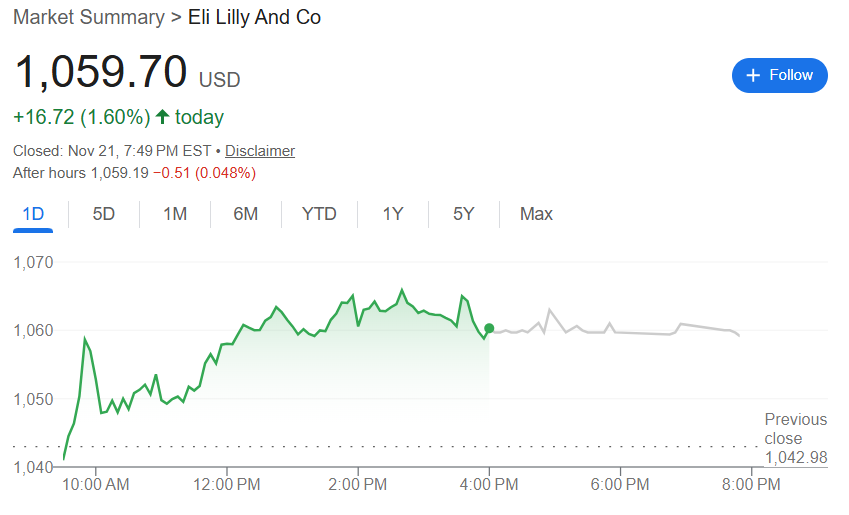
Core Viewpoint - Eli Lilly has become the first pharmaceutical company to reach a market capitalization of $1 trillion, driven by strong demand for weight loss and diabetes medications, with its stock price rising nearly 40% this year [2][18]. Group 1: Market Performance - Eli Lilly's stock rose by 1.60% on Friday, contributing to a year-to-date increase of nearly 40% [2][3]. - The healthcare ETF in the U.S. has seen a rise of over 2% on Friday and a cumulative increase of 12% this year, reflecting growing investor enthusiasm for the pharmaceutical sector [5][6]. Group 2: Competitive Advantage - Eli Lilly is rapidly distancing itself from competitors due to the overwhelming advantage of its GLP-1 class drugs, with its weight loss drug Zepbound expected to dominate the market despite only launching at the end of 2023 [4][9]. - The company is on the brink of a significant new product cycle in biopharmaceuticals, with its oral weight loss candidate orforglipron being highlighted as one of the most important new product cycles in the industry [9][10]. Group 3: Future Prospects - Eli Lilly's management has indicated that global regulatory submissions for orforglipron are imminent, with expectations for a U.S. market launch next year [10]. - The company is also advancing in next-generation obesity compounds, with promising data from the second phase of the selective incretin agonist eloralintide, which showed a weight loss of 20.1% [11][12]. Group 4: Financial Considerations - Eli Lilly's largest shareholder, the Lilly Foundation, has been selling shares, with a record $2.4 billion in stock sold in Q4 2025, raising concerns about valuation [16][17]. - The company’s forward P/E ratio for 2026 is projected at 41 times, significantly higher than the pharmaceutical industry average of 16 times, leading to debates about its valuation [19]. - Forecasts suggest that Eli Lilly's two flagship drugs could generate annual sales exceeding $40 billion by 2026, potentially justifying the high valuation [20].
礼来--第一家“10000亿美元”医药公司!
美股IPO· 2025-11-22 10:19
Core Viewpoint - Eli Lilly has become the first pharmaceutical company to reach a market capitalization of $1 trillion, driven by strong demand for weight loss and diabetes medications, as well as a sector rotation of funds from technology to healthcare [1][12]. Group 1: Market Performance - Eli Lilly's stock rose by 1.60% on Friday, with a cumulative increase of nearly 40% this year, leading to a market capitalization surpassing $1 trillion [1][2]. - The healthcare ETF in the U.S. has increased by over 2% on Friday and has risen 12% year-to-date, reflecting growing investor enthusiasm for the pharmaceutical sector [4]. Group 2: Product Development and Sales - Eli Lilly's weight loss drug sales more than doubled year-over-year in Q3, generating $10.1 billion in revenue from diabetes treatment Mounjaro and weight loss drug Zepbound [5]. - The company is on the verge of launching its oral weight loss candidate orforglipron in the U.S. market next year, which is expected to significantly expand the target market due to its convenience [8]. - Eli Lilly's next-generation obesity compounds, such as eloralintide and retatrutide, are showing promising results, with eloralintide demonstrating a weight loss of 20.1% in Phase II trials [9][10]. Group 3: Valuation and Investor Sentiment - The largest shareholder, the Lilly Foundation, has been selling shares, with a record $2.4 billion in stock sold in Q4 2025, raising concerns about valuation as the company's forward P/E ratio is 41 times, significantly higher than the industry average of 16 times [11][12]. - Despite valuation concerns, projections indicate that Eli Lilly's two flagship drugs could generate over $40 billion in annual sales by 2026 and approach $60 billion by 2030, potentially justifying the high valuation [12]. Group 4: Competitive Landscape - Eli Lilly's GLP-1 drugs are gaining a significant market share, surpassing competitors like Novo Nordisk's Wegovy in new obesity prescriptions [3]. - The company faces potential competition from other pharmaceutical giants like Amgen and Pfizer as it approaches a significant patent cliff, which could impact future revenue [13].
礼来--第一家“10000亿美元”医药公司!
Hua Er Jie Jian Wen· 2025-11-22 02:20
Core Insights - Eli Lilly has become the first pharmaceutical company to reach a market capitalization of $1 trillion, driven by strong demand for weight loss and diabetes medications [1][10] - The company's stock has risen nearly 40% this year, with a 1.60% increase on the last trading day [1][2] Market Performance - Eli Lilly's GLP-1 class drugs have established a significant competitive advantage, with its weight loss drug Zepbound expected to dominate the obesity drug prescription market despite its late 2023 launch [3][6] - The healthcare sector is experiencing renewed investor enthusiasm, as evidenced by a 12% increase in healthcare ETFs this year [4][3] Sales Growth - In Q3, Eli Lilly's weight loss drug sales exceeded $10.1 billion, more than doubling from the previous year, thanks to expansion into new markets [6][10] - The company is expected to maintain strong sales momentum, with projections indicating that its two leading drugs could generate over $40 billion in annual sales by 2026 [10] Product Pipeline - Eli Lilly is on the verge of a significant new product cycle, with its oral weight loss candidate orforglipron anticipated to launch in the U.S. market next year [7][8] - The company is also advancing other promising compounds, including eloralintide and retatrutide, which are expected to enter late-stage trials soon [8][9] Shareholder Activity - The largest shareholder, the Lilly Foundation, has been selling shares, with a record $2.4 billion in stock sold in Q4 2025 [10] - Concerns regarding the company's valuation are rising, with a forward P/E ratio of 41, significantly higher than the industry average of 16 [10] Long-term Considerations - The pharmaceutical industry faces inherent risks related to patent expirations, which could impact Eli Lilly's future revenue streams [11]
Pfizer's CEO Sends a Warning to Eli Lilly. Is the Stock a Buy?
The Motley Fool· 2025-11-18 02:10
Core Insights - Pfizer is making significant moves in the weight management market, which is expected to grow rapidly in the next decade, potentially rewarding leading companies handsomely [1][2] - The acquisition of Metsera for $7 billion, with potential milestone payments bringing the total to $10 billion, positions Pfizer as a strong contender in the weight management space [3][4] - Pfizer's CEO, Albert Bourla, expressed confidence in the company's ability to succeed in the obesity market, drawing parallels to past successes with drugs like Lipitor and COVID products [7] Company Developments - Pfizer's acquisition of Metsera indicates its commitment to entering the weight management market, especially after competing with Novo Nordisk for the deal [3][4] - Metsera's leading candidate, MET-097i, has shown promising results in clinical trials, indicating potential for substantial weight loss and good tolerability [6] - Pfizer plans to launch its first anti-obesity drug by the end of 2028, although Eli Lilly currently holds a significant lead with existing products on the market [8] Competitive Landscape - Eli Lilly is currently the leader in the weight management market with its product Zepbound, which has seen exceptional sales growth [8][11] - Eli Lilly has several promising candidates in its pipeline, including orforglipron and retatrutide, which are expected to enhance its competitive position [9][10][11] - Despite Pfizer's efforts, Eli Lilly's established presence and upcoming product launches may allow it to maintain its leadership in the anti-obesity market for the foreseeable future [11] Financial Outlook - Pfizer's recent financial performance has been underwhelming, with concerns about the impending patent cliff for its top growth driver, Eliquis [13] - However, the acquisition of Metsera and the potential success in the weight management sector could help Pfizer rebound [14] - The company also has a strong dividend program, which may attract investors despite current challenges [15]


国元香港晨报-20251113
Guoyuan International· 2025-11-13 02:50
Bond Market - The 2-year U.S. Treasury yield increased by 1.67 basis points to 3.568%[2] - The 5-year U.S. Treasury yield rose by 1.04 basis points to 3.672%[4] - The 10-year U.S. Treasury yield remained unchanged at 4.067%[4] Economic Data - The Baltic Dry Index closed at 2072.00, down 0.58%[5] - The Nasdaq Index closed at 23406.46, down 0.26%[5] - The Dow Jones Industrial Average closed at 48254.82, up 0.68%[5] - The ICE Brent Crude Oil price was $62.68, down 3.81%[5] - The London Gold price was $4194.61, up 1.68%[5] - The USD/CNY exchange rate (CFETS) was 7.12, down 0.05%[5] - The Hang Seng Index closed at 26922.73, up 0.85%[5] - The Shanghai Composite Index closed at 4000.14, down 0.07%[5]
美股异动丨礼来涨超3%创新高,公布实验性减肥药物2期临床研究的积极结果
Ge Long Hui· 2025-11-12 14:57
Core Viewpoint - Eli Lilly (LLY.US) shares rose over 3%, reaching a record high of $1019.98, following positive results from the Phase 2 clinical trial of the experimental weight loss drug eloralintide [1] Group 1: Clinical Trial Results - The Phase 2 clinical trial of eloralintide showed that all dosage groups achieved the primary endpoint at week 48, with an average weight reduction ranging from 9.5% to 20.1% [1] - The average weight reduction in the placebo group was only 0.4%, indicating a significant efficacy of eloralintide compared to the placebo [1] Group 2: Future Developments - Based on the positive trial results, the company plans to initiate enrollment for the Phase 3 clinical trial of eloralintide for obesity treatment next month [1]
美股盘前要点 | 美国众议院将就临时拨款法案投票!AMD发布积极展望,盘前涨超5%
Ge Long Hui· 2025-11-12 12:36
Market Overview - US stock index futures are all up, with Nasdaq futures rising by 0.61%, S&P 500 futures up by 0.38%, and Dow futures increasing by 0.31% [1] - European stock indices show mixed results, with Germany's DAX index up by 1.22%, UK's FTSE 100 down by 0.1%, France's CAC index up by 1.29%, and the Euro Stoxx 50 index rising by 1.25% [1] Company Developments - Wells Fargo indicates a reverse buy signal in the market, raising the S&P 500 index year-end target to 7100 points [3] - AMD anticipates that the data center chip and system market will grow to $1 trillion by 2030 [3] - Samsung Electronics, SK Hynix, and Kioxia plan to increase NAND prices and cut production [3] - Barclays warns that Oracle may run out of cash by November next year, downgrading the company's debt rating to "underweight" [3] - Netflix opens the "Netflix House" theme park in suburban Philadelphia, allowing free public access [3] - Morgan Stanley launches deposit tokens for institutional clients, enabling round-the-clock trading and instant payments [3] - Eli Lilly will start Phase 3 clinical trial enrollment for eloralintide, a treatment for obesity, next month [3] - Sony launches a low-cost version of the PS5 in Japan, set to be released on November 21 [3] - FedEx reports adjusted EPS of $4.05 for Q2, exceeding expectations and alleviating market concerns [3] - Tencent Music reports Q3 total revenue growth of 20.6% to 8.46 billion yuan, with net profit increasing by 36% to 2.15 billion yuan [3] - Oklo, a nuclear power company, reports a Q3 net loss widening to $29.7 million, which is worse than expected [3]