制造业中试平台

Search documents
新华解码 | 加快建设制造业中试平台 实施路径明确
Xin Hua She· 2025-11-12 12:28
Core Viewpoint - The article emphasizes the importance of establishing a systematic and high-level construction of manufacturing pilot platforms in China to facilitate the transition of innovative products from the laboratory to the market, addressing the challenges faced in this critical phase of development [1][2]. Group 1: Implementation Pathways - The Ministry of Industry and Information Technology has released a notice focusing on the construction of manufacturing pilot platforms, proposing targeted, systematic, and actionable implementation pathways [1][2]. - The notice aims to enhance the efficiency of converting major technological achievements into practical applications and outlines the development logic of what to build, who will build it, and how to build it [2][3]. Group 2: Current Status and Challenges - Currently, over 2,400 pilot platforms have been established across the country, with 241 selected as key cultivation platforms, which have undertaken 25,000 pilot service projects [2]. - Despite progress, some pilot platforms face issues such as unclear functional positioning, low service levels, and weak effectiveness, which hinder the transition from following to leading in manufacturing innovation [2][3]. Group 3: Construction Guidelines - The construction guidelines define the functional positioning of pilot platforms, emphasizing their role in providing services for samples transitioning from the trial production stage to the manufacturing process [3]. - The guidelines propose the establishment of pilot platforms in six key areas and 37 industry directions, addressing urgent needs for industrial development [3]. Group 4: Investment and Support Mechanisms - The guidelines suggest a multi-faceted support mechanism for pilot platform development, focusing on investment, operation, and support to address challenges such as high construction costs and funding shortages [4]. - Financial support from the government is emphasized to attract financial and social capital to empower the development of pilot platforms [4]. Group 5: Avoiding Redundancy and Competition - The notice addresses issues of redundant construction and homogeneous competition among pilot platforms, advocating for a resource-based approach to ensure complementary functions, resource sharing, and mutual promotion of services [5].
进一步推进制造业中试平台建设
Ren Min Ri Bao· 2025-11-11 23:22
Core Viewpoint - The Ministry of Industry and Information Technology of China has issued a notice to enhance the systematic layout of pilot testing platforms in the manufacturing sector, aiming to strengthen high-level pilot testing platform construction by the end of 2027 [1][2] Group 1: Pilot Testing Platforms - Pilot testing is a crucial link connecting the innovation chain, technology chain, and industrial chain, serving as an important support for the transformation of scientific and technological achievements into productive forces [1] - The notice outlines a plan to develop a modern pilot testing platform system, with a nationwide manufacturing pilot testing service network that features multi-entity participation, multi-field layout, and multi-level services [1] Group 2: Development Strategy - The strategy focuses on "strengthening a batch, activating a batch, and supplementing a batch" to guide pilot testing platforms towards higher levels [1] - Key industry sectors such as artificial intelligence and humanoid robots, which are critical for future development and industrial security, will be prioritized for pilot testing platform construction [1]
利好!工信部,最新发文!
Zheng Quan Shi Bao· 2025-11-11 15:34
Core Viewpoint - The Ministry of Industry and Information Technology has issued a notification aimed at accelerating the systematic layout and high-level construction of pilot test platforms in the manufacturing sector by the end of 2027, enhancing the connection between laboratory innovation and industrial production [4]. Group 1: Key Tasks and Objectives - The notification emphasizes the importance of pilot test platforms in bridging the gap between technological innovation and industrialization, with a reported success rate of over 80% for technology that undergoes pilot testing compared to only 30% for those that do not [4]. - Three main tasks are outlined: strengthening existing platforms, activating underperforming platforms, and filling gaps in key industries such as artificial intelligence, quantum technology, and biomedicine [5]. Group 2: Implementation Strategies - The strategy for strengthening platforms includes a tiered approach to cultivate and elevate pilot test platforms, creating a national service network with varying levels of capability [4]. - The activation of platforms will involve targeted support to enhance their public service attributes and overall effectiveness, focusing on those with potential but currently limited capabilities [5]. - The notification also provides guidelines for the construction of pilot test platforms, detailing six key areas and 37 industry directions for development [5].


工信部:到2027年底全国制造业中试服务网络初步形成
Zhong Guo Xin Wen Wang· 2025-11-11 13:51
Core Insights - The Ministry of Industry and Information Technology of China aims to establish a preliminary national manufacturing pilot service network by the end of 2027, focusing on high-level pilot platforms and a modernized system [1][2] Group 1: Development Strategy - The notification emphasizes a core strategy of "strengthening a batch, activating a batch, and supplementing a batch" to enhance the pilot platform's capabilities and effectiveness [1] - The approach includes a tiered advancement strategy, guiding pilot platforms to progress from "reserve pilot platforms" to "key cultivated pilot platforms" and finally to "national-level manufacturing pilot platforms" [1] Group 2: Activation and Support - The strategy includes targeted support for pilot platforms that have public service attributes but require enhancement in capabilities and effectiveness, utilizing methods like intelligent diagnostics and targeted improvements [2] - The focus is on demand-driven, industry-specific, and localized strategies to identify and fill gaps in key sectors such as artificial intelligence, humanoid robots, quantum technology, clean low-carbon hydrogen, biomedicine, industrial mother machines, and instruments [2]
利好!工业和信息化部发文
Shang Hai Zheng Quan Bao· 2025-11-11 13:03
Core Viewpoint - The Ministry of Industry and Information Technology (MIIT) of China has issued a notice to accelerate the systematic layout and high-level construction of manufacturing pilot platforms, emphasizing the importance of these platforms in connecting the innovation chain, technology chain, and industrial chain, and supporting the integration of technological and industrial innovation by 2027 [1][3]. Summary by Sections Overall Requirements - The initiative is guided by Xi Jinping's thoughts and aims to implement the spirit of the 20th National Congress of the Communist Party of China, focusing on new industrialization tasks with principles of scientific layout, local adaptation, standard guidance, and gradient cultivation [3]. Main Tasks - The plan includes three main strategies: strengthening a batch of pilot platforms, activating another batch, and supplementing a batch of pilot platforms [4][5]. - **Strengthening a Batch**: This involves guiding pilot platforms to develop based on strategic positioning, foundational capabilities, technological advantages, operational mechanisms, service effectiveness, and future potential [4]. - **Activating a Batch**: This focuses on enhancing the internal development dynamics and competitiveness of pilot platforms through targeted support and improvement activities [5]. - **Supplementing a Batch**: This aims to establish new pilot platforms in key industries such as artificial intelligence, quantum technology, and biomedicine, addressing supply shortages in critical sectors [5][6]. Work Arrangement - Local industrial and information departments are required to mobilize eligible pilot platforms to submit applications by specific deadlines, ensuring a structured approach to the development of these platforms [7]. Work Requirements - Emphasis is placed on establishing a stable investment mechanism, a scientific operational mechanism, and an efficient support mechanism to enhance the effectiveness of pilot platforms [8]. - The initiative encourages collaboration between pilot platform construction and existing technological innovation platforms to create synergistic effects [8].
利好!工信部发布
中国基金报· 2025-11-11 08:53
Core Viewpoint - The Ministry of Industry and Information Technology (MIIT) of China has issued a notification to accelerate the systematic layout and high-level construction of manufacturing pilot platforms, aiming to establish a modern pilot platform system by the end of 2027 [2][3]. Summary by Sections Overall Requirements - The notification emphasizes the importance of promoting new industrialization and aims to strengthen the role of pilot platforms as key nodes connecting the innovation chain, technology chain, and industrial chain [7]. Main Tasks - The notification outlines three main tasks for the development of pilot platforms: 1. **Strengthening a Batch of Pilot Platforms**: Focus on strategic positioning, basic capabilities, technological advantages, operational mechanisms, service effectiveness, and future potential to elevate pilot platforms to higher levels [8]. 2. **Activating a Batch of Pilot Platforms**: Implement targeted support and enhance the internal development dynamics and competitiveness of pilot platforms [9]. 3. **Supplementing a Batch of Pilot Platforms**: Focus on key industries such as artificial intelligence, humanoid robots, quantum technology, clean low-carbon hydrogen, biomedicine, and new materials to address supply shortages in critical areas [9]. Construction Goals - The construction goal of the pilot platforms is to create a comprehensive public service system that enhances pilot capabilities and service effectiveness, accelerates the engineering breakthroughs of innovative achievements, and promotes the deep integration of technological and industrial innovation [5]. Work Arrangements - Local industrial and information departments are required to mobilize eligible pilot platforms to apply for inclusion in the reserve list by specific deadlines, ensuring a systematic approach to the development of pilot platforms [10]. Work Requirements - Emphasis is placed on establishing a stable investment mechanism, a scientific operational mechanism, and an efficient support mechanism to enhance the overall development effectiveness of pilot platforms [12].

汇聚澎湃力量 高质量发展蹄疾步稳 | 透视重磅数据 深度看中国经济“答卷”
Yang Shi Wang· 2025-07-19 03:37
Core Viewpoint - The industrial and information technology sectors in China are expected to see steady growth in key economic indicators by the first half of 2025, with significant advancements in manufacturing and digital technologies [1][13]. Industrial Growth - In the first half of 2025, the industrial added value above designated size increased by 6.4% year-on-year, demonstrating strong resilience following a good start in the first quarter [3][14]. - The manufacturing value added accounted for 25.7% of GDP, remaining stable [3][14]. - Manufacturing investment grew by 7.5% year-on-year, supported by major engineering projects under the 14th Five-Year Plan [14]. Equipment Manufacturing - The equipment manufacturing sector continued to show robust growth, contributing 35.5% to the total industrial added value [16]. - The added value of the equipment manufacturing industry increased by 10.2% year-on-year, driving a 3.4 percentage point increase in overall industrial growth [18]. - Key products in the equipment manufacturing sector saw significant production and sales increases, with shipbuilding metrics indicating a global market share of 51.7% for completed orders, 68.3% for new orders, and 64.9% for hand-held orders [20]. Digital Technology Development - Digital technologies, including 5G and AI, are rapidly advancing, with the digital industry achieving a business revenue growth of 9.3% year-on-year, an increase of 3.4 percentage points compared to the previous year [11][16]. - The number of mobile internet users has shown double-digit growth for six consecutive months, with 5G applications integrated into 86 out of 97 major categories of the national economy [45]. Green Transformation - The deep green transformation of traditional industries is a primary task for low-carbon industrial development, focusing on steel, non-ferrous metals, petrochemicals, and building materials [24]. - The goal is to increase the proportion of recycled materials in raw materials by 2027, targeting 22% for scrap steel, 30% for scrap copper, and 25% for scrap aluminum [26]. Financial Support for Manufacturing - The national financial cooperation platform has facilitated over 1.2 trillion yuan in financing for manufacturing enterprises, with an average of nearly 34 million yuan in support per company [37]. - The A-share market raised 148.8 billion yuan for industrial enterprises through various financial instruments, marking a year-on-year increase of 51.6% [41]. Telecommunications Sector - The telecommunications sector maintained stable operations, with a 9.3% year-on-year growth in total telecom business volume, reaching 905.5 billion yuan in revenue [40][44]. - By the end of June, the number of 5G base stations reached 4.55 million, with 5G mobile phone users totaling 1.118 billion, achieving a penetration rate of over 79% [44].
工信部答每经问:聚焦装备制造、新兴和未来产业等6个领域,加快打造制造业中试服务网络
Mei Ri Jing Ji Xin Wen· 2025-07-18 14:47
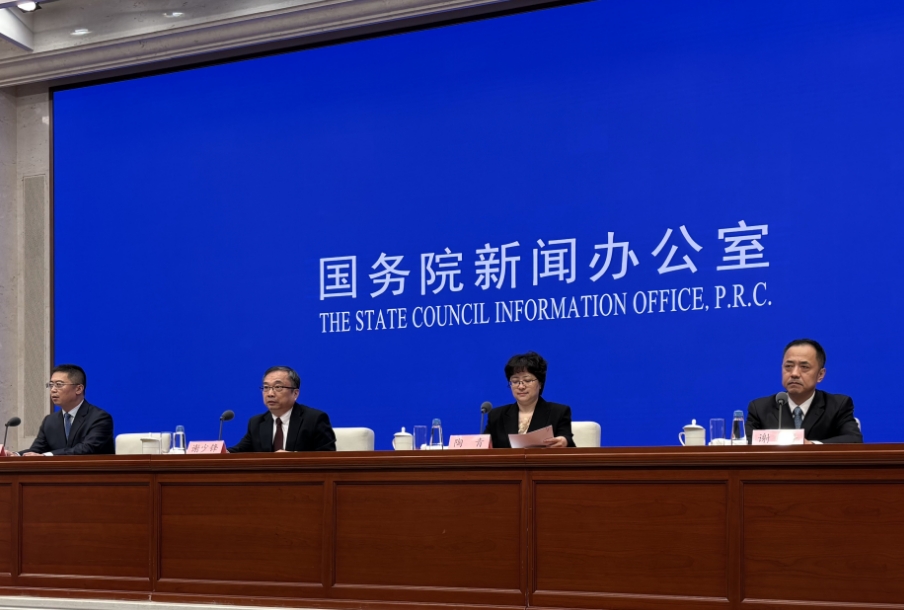
Core Viewpoint - The press conference highlighted the progress and future plans for China's manufacturing innovation centers and pilot testing platforms, emphasizing their role in bridging technology innovation and market application [1][4]. Group 1: Manufacturing Innovation Centers - As of June 30, China has established 33 national-level manufacturing innovation centers and 241 pilot testing platforms [1]. - The focus is on six key areas: raw materials, equipment manufacturing, consumer goods, information technology, emerging industries, and common technologies [1][4]. Group 2: Policy and Standards - The government has introduced policies such as the "Implementation Opinions on the Innovation and Development of Manufacturing Pilot Testing" and guidelines for building pilot testing platforms [4]. - A standardization committee has been formed to develop a standard system for pilot testing platforms [4]. Group 3: Future Goals - The goal is to cultivate more than five national-level manufacturing pilot testing platforms by the end of the year [4]. - The strategy includes enhancing regional characteristics, improving service capabilities, and accelerating the transformation of technological achievements into industrial applications [5]. Group 4: Equipment Manufacturing Sector - In the first half of the year, the equipment manufacturing sector accounted for 35.5% of the total industrial added value, indicating a stable growth trend [7]. - Key achievements include the certification of the AG600 amphibious aircraft and significant growth in the automotive sector, with production and sales of 15.62 million and 15.65 million vehicles, respectively, marking year-on-year increases of 12.5% and 11.4% [7][8]. Group 5: Future Actions - Upcoming actions include implementing a new round of growth stabilization initiatives across various sectors, including machinery and automotive [8]. - There will also be a focus on digital transformation and green development in the manufacturing industry [8].
工信部:今年培育5个以上国家级制造业中试平台
news flash· 2025-07-18 07:39
Core Viewpoint - The Ministry of Industry and Information Technology (MIIT) aims to cultivate over five national-level manufacturing pilot platforms by the end of 2025 to enhance the integration of technological and industrial innovation [1] Group 1: Development of Pilot Platforms - The MIIT is accelerating the establishment of a tiered cultivation system for manufacturing pilot platforms to empower the deep integration of technological and industrial innovation [1] - The current focus of pilot platform construction is on six key areas: raw materials, equipment manufacturing, consumer goods, information technology, emerging and future industries, and common demand [1] - More than 2,400 pilot platforms have been included in the reserve database, from which 241 key pilot platforms have been selected for initial cultivation by the MIIT [1]
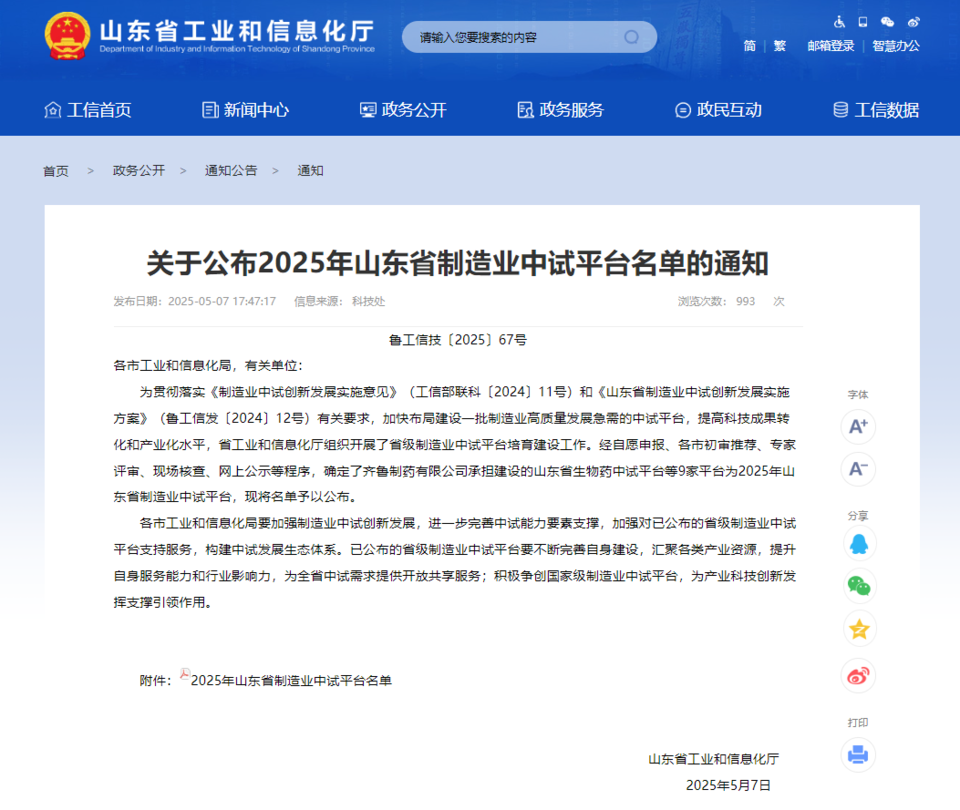
济南4家企业入选山东省首批制造业中试平台名单
Qi Lu Wan Bao Wang· 2025-05-13 10:29
Core Viewpoint - The Shandong Provincial Department of Industry and Information Technology has released the list of manufacturing pilot platforms for 2025, with nine platforms selected, including the Shandong Biopharmaceutical Pilot Platform led by Qilu Pharmaceutical Co., Ltd. [1] Group 1: Overview of Pilot Platforms - The establishment of manufacturing pilot platforms is a new initiative in Shandong Province aimed at supporting the transition of new products from trial production to mass production [1] - The pilot platforms are collaborative entities formed by enterprises, professional institutions, universities, and research institutes, driven by market mechanisms [1] Group 2: Selected Platforms in Jinan - Jinan City has four selected pilot platforms, ranking first in the province, which include: - Shandong Biopharmaceutical Pilot Platform by Qilu Pharmaceutical Co., Ltd. - Shandong Medical Equipment Pilot Platform by Boke Holdings Group Co., Ltd. - Shandong Functional Special Resin Pilot Platform by Shandong Shengquan New Materials Co., Ltd. - Shandong Integrated Circuit Pilot Platform by Jinan Jinggu Research Institute [4] - These platforms focus on key areas such as biomedicine, medical equipment, advanced materials, and integrated circuits, addressing the innovation needs of Shandong's manufacturing sector [4] Group 3: Future Development Plans - The Jinan Municipal Bureau of Industry and Information Technology plans to enhance support services for technological innovation platforms, leveraging pilot platforms and innovation centers to drive technology research and development, achievement transformation, and industry-academia-research collaboration [4] - The goal is to create a more systematic and ecological pilot service network, promoting sustainable development of pilot services and facilitating breakthroughs in traditional, emerging, and future industries [4]