
半导体投资

Search documents
ST晨鸣(000488.SZ):暂无参股脑机接口领域企业的相关计划
Ge Long Hui· 2026-01-14 13:25
Group 1 - The company is currently focused on the development of its main business in pulp and paper production, with no plans to invest in brain-computer interface companies [1] - In terms of semiconductor investments, the company has a minor stake in Shanghai Hengzheng Fund, which holds a small amount of related assets, and this investment has a limited impact on the company's overall business [1]
富森美:通过合伙企业投资天数智芯
Xin Lang Cai Jing· 2026-01-06 08:13
Core Viewpoint - The company, Fusenmei, has made an investment in Shanghai Tianshu Zhixin Semiconductor Co., Ltd. through a partnership fund, indicating a strategic move into the semiconductor industry [1] Group 1 - In May 2022, Fusenmei announced its investment in Shanghai Tianshu Zhixin Semiconductor Co., Ltd. through Ningbo Dingyinxin Equity Investment Partnership (Limited Partnership) [1] - The company plans to invest 21.2 million yuan in the equity investment fund specifically for the investment in Tianshu Zhixin [1]

万亿资金,涌入!
Zhong Guo Zheng Quan Bao· 2026-01-05 14:56
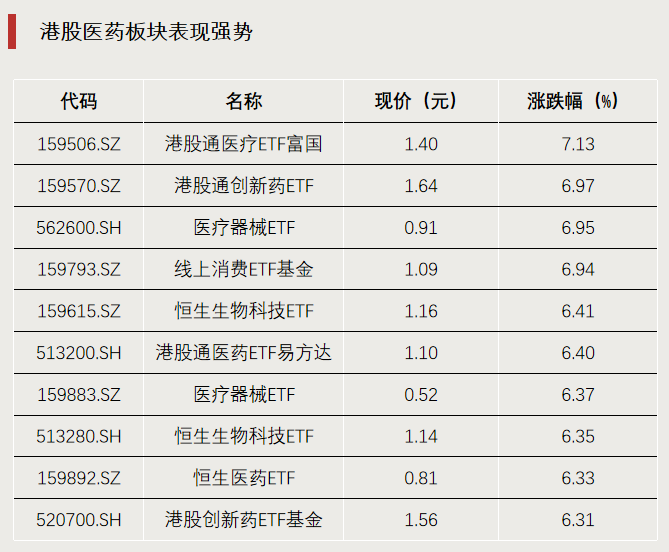
Group 1 - The A-share market showed strong growth in growth style, with notable performances in the pharmaceutical and semiconductor sectors, where multiple related ETFs rose over 5% in a single day [1] - In December 2025, the A500 and Sci-Tech bonds became significant directions for capital inflow, with several related ETFs seeing net inflows exceeding 10 billion yuan [2][8] - The Hong Kong pharmaceutical sector performed strongly, with multiple ETFs in innovative drugs and medical devices rising over 6%, indicating a robust market for innovative pharmaceuticals [4][5] Group 2 - The semiconductor sector experienced a hot market, with multiple ETFs related to semiconductor chips, big data, AI, and cloud computing showing significant gains, with some ETFs rising over 5% [6][7] - In December 2025, the net inflow for A500-related ETFs exceeded 20 billion yuan, with specific ETFs like the Southern CSI A500 ETF and Huatai-PB CSI A500 ETF seeing net inflows over 20 billion yuan each [9] - The outlook for the Hong Kong market in 2026 suggests a potential recovery in corporate earnings, particularly in sectors benefiting from overseas demand and competitive industry leaders, with AI, new consumption, pharmaceuticals, and dividends highlighted as key focus areas [12]

茅台旗下基金为何看中老鹰半导体?
Sou Hu Cai Jing· 2026-01-05 06:36
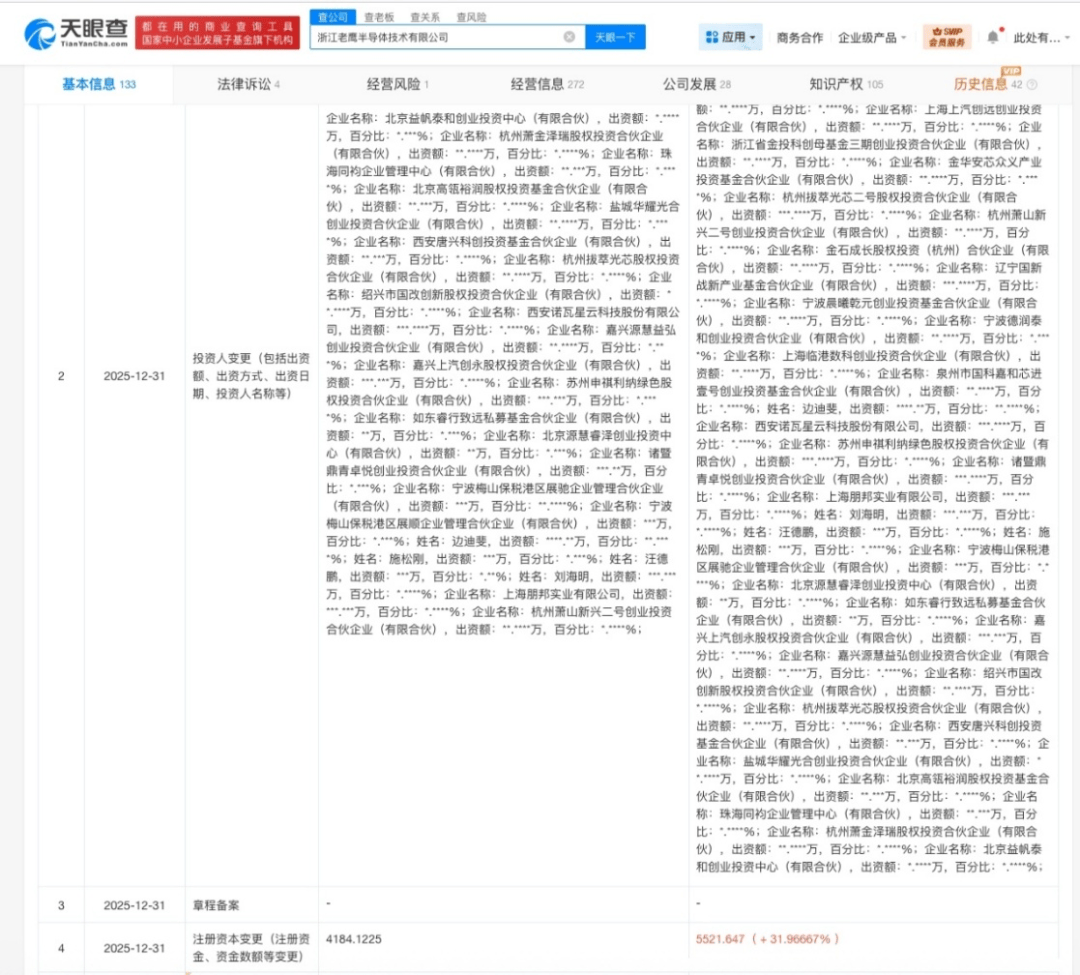
Group 1 - Zhejiang Eagle Semiconductor Technology Co., Ltd. focuses on the design of new semiconductor materials, VCSEL chip research and development, and packaging, with applications in optical interconnects, autonomous driving, and consumer electronics [1] - The company recently underwent a business change, adding new shareholders including Moutai Jinshi (Guizhou) Industrial Development Fund Partnership and Shanghai SAIC Chuangyuan Venture Capital Partnership, increasing its registered capital from approximately 41.84 million RMB to about 55.22 million RMB, a change of approximately 31.97% [1][2] - Established in April 2018, the company is recognized as a national high-tech enterprise, with its legal representative being Wang Depeng [1] Group 2 - The company's business scope includes research and development of electronic special materials, engineering and technical research, semiconductor discrete device manufacturing, integrated circuit chip design and services, and sales of integrated circuits [1] - Current shareholders include Bian Difei, Ningbo Meishan Bonded Port Area Zhanchi Enterprise Management Partnership, and Xi'an Nova Star Cloud Technology Co., Ltd., along with the newly added shareholders [1]
国家大基金,大比例增持中芯国际H股
财联社· 2026-01-02 09:38
香港交易所信息显示 ,国家集 成电路产业投资基金股份有限公司在中芯国际H股的持股比例于12月29日 从4.79%升至9.25%。 ...
陈立武的无限战争
3 6 Ke· 2025-12-31 03:00
Group 1 - Chen Liwu is a significant figure in the semiconductor industry, comparable to leaders like Jensen Huang and Lisa Su, having led Cadence, one of the top three EDA companies globally, and received the Robert N. Noyce Award in 2022 [1] - Under Chen's leadership, Walden International has been a highly active investment fund in the semiconductor sector, investing in over 100 companies since its inception in 1987, including notable firms like SMIC and Zhaoyi Innovation [1] - Chen's entry into China in 1993 marked a pivotal moment in the country's venture capital landscape, particularly in the semiconductor field [1] Group 2 - Before 2018, the primary investors in Chinese chip companies were mainly state-backed institutions and market-oriented funds like Walden International [2] - Intel appointed Chen as CEO in March 2023, recognizing his extensive network as crucial for seizing upcoming industry opportunities [2] - Chen successfully facilitated significant investments into Intel, including a $2 billion investment from SoftBank and a $5 billion investment from Nvidia [2] Group 3 - Intel faced a record quarterly loss of $16.6 billion before Chen's appointment, and his leadership led to a 25% increase in Intel's stock price on the day he took over [3] - Despite initial optimism, Chen's extensive investment network has raised internal trust issues at Intel, leading to employee departures due to perceived conflicts of interest [2][3] Group 4 - Meta's attempt to acquire Rivos, a chip design company valued at $2 billion, has been complicated by Intel's interest in the same company, driving its valuation up to $4 billion [4] - Rivos was incubated by Chen, who played a key role in its establishment and has been involved in its strategic direction [5][6] Group 5 - Chen's involvement in Rivos has led to concerns about potential conflicts of interest, as he is both a board member and an early investor in the company [8] - Intel's board previously rejected a proposal for Rivos' acquisition due to these conflicts, but Chen's team has since been working on a new AI business plan to justify the acquisition [8] Group 6 - Chen is also linked to other companies like SambaNova, which Intel is considering acquiring for $1.6 billion, despite its financial struggles [9] - Since 2019, Intel's venture capital division has collaborated with Chen or his associated firms on 12 investment occasions, raising internal concerns about conflicts of interest [10] Group 7 - Internal dissent at Intel has emerged regarding Chen's dual role as an investor and CEO, with some employees calling for him to divest from his investment portfolio to eliminate potential conflicts [10][11] - The semiconductor industry is characterized by high R&D costs, with companies needing to leverage both internal capabilities and external investments to succeed [12][13] Group 8 - Intel's strategy under Chen appears to focus on mergers and acquisitions to regain its competitive edge in the semiconductor market, particularly in the context of the AI boom [13][14] - Chen's public discussions about his investment achievements and the halting of Intel Capital's divestment plans indicate a strategic pivot towards leveraging existing investments for growth [14]

紫光同芯成立汽车域控芯片子公司,宁德时代入股
Guan Cha Zhe Wang· 2025-12-29 02:35
Group 1 - The core announcement is that Unisoc plans to establish a new subsidiary, Unisoc Tongxin Microelectronics Technology Co., Ltd., to enhance its market competitiveness in the automotive domain control chip business [1][3] - The registered capital of the new company is RMB 300 million, with Unisoc Tongxin contributing RMB 153 million, representing a 51% stake [1] - The new subsidiary will focus on the research, production, and sales of automotive domain control chips [1] Group 2 - After the transaction, Unisoc Tongxin Microelectronics will be included in Unisoc's consolidated financial statements [3] - Unisoc plans to acquire its evaluated automotive domain control chip business assets for RMB 193 million, reflecting an impressive valuation increase of 3723.15% [3] - Unisoc has reported a revenue of RMB 4.9 billion for the first three quarters of the year, marking a 15% year-on-year growth, and a net profit of RMB 1.26 billion, which is a 25% increase compared to the previous year [3]


开勒股份:拟参与设立合伙企业
Ge Long Hui· 2025-12-26 14:00
格隆汇12月26日丨开勒股份(301070.SZ)公布,根据公司长期发展战略规划需要,开勒环境科技(上海)股 份有限公司与杭州溯元企业管理合伙企业(有限合伙)(简称"杭州溯元")签署了《杭州勒泽企业管理 合伙企业(有限合伙)合伙协议》,双方拟共同投资设立杭州勒泽企业管理合伙企业(有限合伙),围绕半 导体相关产业链进行投资。其中,公司作为有限合伙人以自有资金出资7,000万元,占合伙企业出资额 的58.33%,杭州溯元作为普通合伙人出资5,000万元,占合伙企业出资额的41.67%。 ...
华源晨会精粹20251218-20251218
Hua Yuan Zheng Quan· 2025-12-18 12:31
Group 1: New Consumption Insights - The total retail sales of consumer goods in November 2025 reached 43,898 billion yuan, with a year-on-year growth of 1.3%. Excluding automobiles, the retail sales amounted to 39,444 billion yuan, growing by 2.5% year-on-year [2][5] - Urban and rural retail sales in November were 37,684 billion yuan and 6,214 billion yuan respectively, with year-on-year growth rates of 1.0% and 2.8% [2][5] - Restaurant retail sales outpaced goods sales, with a year-on-year increase of 3.2% compared to a 1.0% increase in goods retail sales [2][5][6] Group 2: Real Estate Market Analysis - The real estate sector saw a decline of 2.6% this week, with new home transactions in 42 key cities totaling 1.89 million square meters, a decrease of 2.4% week-on-week [8][9] - The Central Economic Work Conference emphasized risk mitigation and stabilizing the real estate market, implementing measures such as city-specific policies to control increments, reduce inventory, and encourage the acquisition of existing homes for affordable housing [10][12] - New policies include online processing for land use rights and housing ownership registration in Beijing, and home purchase subsidies in Ningxia [10][12] Group 3: Cement Industry Overview - The company, Shangfeng Cement, ranks third in comprehensive competitive strength among key cement enterprises, with a gross profit of 67 yuan per ton of cement clinker in the first half of 2025 [13][14] - The company is transitioning towards semiconductor investments, having established a full industry chain investment model covering design, manufacturing, packaging, and materials, indicating a significant transformation in its business model [13][15] - The cement industry is experiencing a "de-involution" trend, which is expected to enhance the company's performance elasticity as policies to control overproduction are implemented [14][15]

大摩闭门会-人形机器人AlphaWise调查反馈
2025-12-08 00:41
Summary of Human-Robot Interaction Conference Call Industry Overview - The conference focused on the human-robot interaction industry, specifically humanoid robots, highlighting their current applications and future potential [1][2]. Key Insights and Arguments - **Current Adoption**: 90% of surveyed companies have implemented various types of robots, with 10% currently testing humanoid robots. 62% are willing to try humanoid robots within the next three years [1][4]. - **Application Scenarios**: The primary application areas for humanoid robots include warehousing (80%), manufacturing (79%), and customer service/retail (70%) [1][4][5]. - **Work Replacement Potential**: It is estimated that humanoid robots could replace 11% of jobs in the next five years and 28% in the next ten years [1][5]. - **Investment in Robotics**: 90% of respondents plan to increase their robot spending in the next three years, but only 23% are satisfied with current products, indicating a significant demand for improvements [1][6]. - **Selection Criteria**: Key factors for choosing humanoid robots include reliability, safety, functionality, cost, and integration with existing workflows. Customization services are also important, while brand and supplier ecosystems are less critical [1][7]. Pricing and Market Dynamics - **Price Sensitivity**: 92% of respondents believe that humanoid robots need to be priced below 200,000 RMB for widespread adoption. Currently, most robots are priced above 500,000 RMB, which is a major barrier to market penetration [1][8][9]. - **Brand Preferences**: The most preferred brand is Yusu (60%), followed by Yun Shen Chu (28%) and UBTECH (23%). Brands need to improve product quality to capture market share [1][10]. Short-term and Long-term Projections - **Short-term Growth**: The industry is not expected to see explosive growth in the short term, with a conservative forecast of around 20,000 units to be applied next year [2][11]. - **Long-term Optimism**: Morgan Stanley maintains a long-term optimistic outlook for the humanoid robot industry, anticipating advancements in product iterations and technology [3][11]. Semiconductor Industry Impact - **Market Potential**: The development of humanoid robots is expected to significantly boost the semiconductor industry, with the related market projected to reach $305 billion by 2045. The cost of materials is expected to rise by 15% from 2025 to 2030 and by an additional 40% by 2045 [14]. - **Investment Opportunities**: Key investment areas in the semiconductor sector include AI processing, high-resolution sensing, and analog chips, with several companies identified as potential investment opportunities across different regions [16][17]. Return on Investment - **Payback Period**: The current payback period for commercial robots is approximately 3 to 5 years, expected to shorten to 2 years by 2030 due to decreasing costs and increasing efficiency [15]. Conclusion - The humanoid robot industry presents significant investment potential, particularly in AI processing, high-resolution sensing, and analog chip development. Companies establishing competitive advantages through innovation or acquisitions are likely to thrive in this evolving market [17].
