协同办公

Search documents
30天变7天,WPS 365助力小米芯片突破效率“围城”
Yang Zi Wan Bao Wang· 2025-09-26 03:02
Core Insights - Xiaomi's collaboration with Kingsoft Office has significantly improved the efficiency of its chip design team's document management and technical review processes, achieving a 77% reduction in review time from 30 days to 7 days [2][3] Group 1: Document Management and Efficiency - The Xiaomi chip team manages over a million research and development documents, utilizing WPS 365 for enhanced document security and efficiency [2] - WPS 365 employs a single-file permission management system, allowing for fine-grained and automated version control, which is crucial for high-sensitivity chip design documents [2] - The integration of real-time document review tools within WPS 365 allows experts to provide feedback directly on documents, increasing transparency and collaboration among project members [2] Group 2: Industry Leadership and Collaboration - The partnership between Xiaomi and Kingsoft Office represents a significant advancement in private network collaboration tools tailored for high-end manufacturing sectors, particularly in chip design [3] - The full-stack private deployment of WPS 365 covers document storage, collaborative editing, and instant messaging, setting a new standard for efficiency in the industry [3] - The ongoing exploration of integrating private AI into the development network aims to further enhance collaborative efficiency within the Xiaomi chip team [3]


亿万人的工作流程,正被AI重塑
第一财经· 2025-08-30 00:36
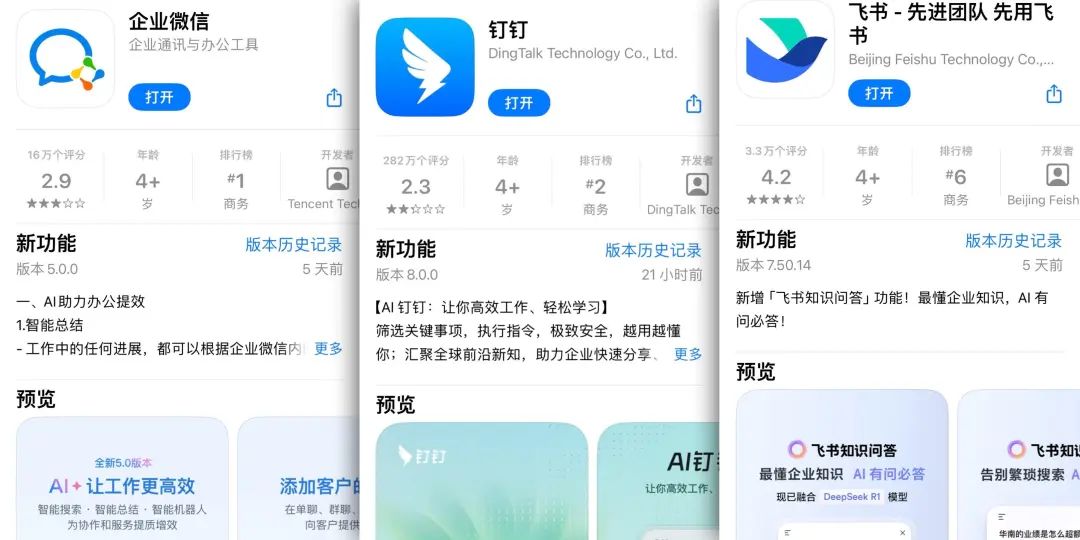
Core Viewpoint - The article discusses the recent government initiative to integrate artificial intelligence (AI) into various industries, aiming for over 70% application penetration of new intelligent terminals and agents by 2027, and a transition to an intelligent economy by 2035 [3][4]. Group 1: AI Reshaping Workflows - By 2027, intelligent agents are expected to revolutionize task allocation and execution in enterprises, impacting at least 40% of knowledge work in the G2000 companies [5]. - Companies like DingTalk, Feishu, and WeChat Work are rapidly adopting AI to reshape workflows, with DingTalk launching AI table functions and other AI products to enhance operational efficiency [6][8]. - The competition among these platforms is intense, with each striving to establish a strong AI presence and demonstrate capabilities in AI tables, intelligent search, and automated summaries [8][9]. Group 2: Future of AI in Office Work - Chinese enterprises are increasingly exploring innovative models for AI integration, focusing on identifying high-frequency, high-value application scenarios before deepening their AI usage [11]. - Different strategies are being employed by DingTalk, Feishu, and WeChat Work, with DingTalk emphasizing a complete workflow overhaul, while Feishu focuses on functional efficiency and WeChat Work aims to lower the barriers for AI integration [12][13]. - The smart office market in China reached 135.34 billion yuan in 2023, with projections of 176.82 billion yuan by 2025, indicating a robust annual growth rate of approximately 35% [14].



腾讯、字节、阿里开启协同办公“三国杀”
3 6 Ke· 2025-08-27 02:30
Group 1 - The core competition in the collaborative office sector is shifting from user scale to AI capabilities, with ByteDance's Feishu, Tencent's WeChat Work, and Alibaba's DingTalk all launching new AI features [1][4] - Feishu introduced an "AI Product Maturity Model" to categorize its AI functionalities, with recent products achieving M3 maturity, indicating stable performance in common scenarios [4][6] - WeChat Work focuses on integrating AI capabilities within the WeChat ecosystem, launching features like intelligent search and summaries to address common business pain points [4][5] Group 2 - DingTalk's recent updates reflect Alibaba's commitment to restructuring its ecosystem, introducing over 10 AI products, including DingTalk One and AI transcription tools [5][6] - The competitive landscape is characterized by increasing feature homogeneity among the three platforms, with a shift from "having what others lack" to "having superior offerings" [6][7] - All three platforms are facing profitability challenges, with WeChat Work aiming to achieve profitability before DingTalk and Feishu, despite significant user engagement [6][8][9] Group 3 - Feishu reported an ARR of $200 million in 2023, with expectations to exceed $300 million in 2024, although it remains in a loss position [9][10] - DingTalk announced an ARR of $200 million for the first half of the 2025 fiscal year, with plans to reach breakeven by 2025 [8][10] - The collaborative office sector is entering a new AI-driven phase, with all three platforms needing to convert technological investments into sustainable business models [10]

无招回归钉钉145天,想用表格卷「死」对手
3 6 Ke· 2025-08-26 10:27
Core Insights - The return of founder Wu Zhao (Chen Hang) to DingTalk marks a significant shift in the company's direction, aiming to rejuvenate its entrepreneurial spirit after a decade of operation [1][5][8] - DingTalk is undergoing a radical transformation, focusing on AI integration and competitive positioning against rivals like Feishu and WeChat Work [3][4][12] Group 1: Company Strategy and Leadership - Wu Zhao's previous entrepreneurial experience contrasts with his return to DingTalk, where he aims to implement a "start-up" mentality to drive innovation and growth [1][5] - DingTalk's recent changes include a restructuring of its product offerings, with a focus on user feedback and optimization of existing services [9][11] - The company is also emphasizing the development of new AI products, including DingTalk One and an AI search engine, to enhance its competitive edge [9][12] Group 2: Market Competition - The competitive landscape in the collaborative office software sector is intensifying, with DingTalk, Feishu, and WeChat Work vying for market share [4][13] - Both DingTalk and Feishu are focusing on AI-driven features, particularly in the realm of data management and collaborative tools, such as AI tables [15][18] - The "table war" between DingTalk and Feishu highlights the strategic importance of lightweight, user-friendly tools that can integrate with broader enterprise systems [15][17] Group 3: Organizational Changes - DingTalk is implementing a "top-down, from big to small" approach to internal restructuring, aiming to foster innovation and agility within the organization [8][12] - The company is forming small innovation teams to tackle specific challenges and enhance its product development speed [12][18] - Recent personnel changes indicate a shift towards a more dynamic and responsive organizational culture, aligning with Wu Zhao's vision for DingTalk [12][18]
钉钉十周年,新版本能否打破“大同小异”
Bei Jing Shang Bao· 2025-08-25 13:37
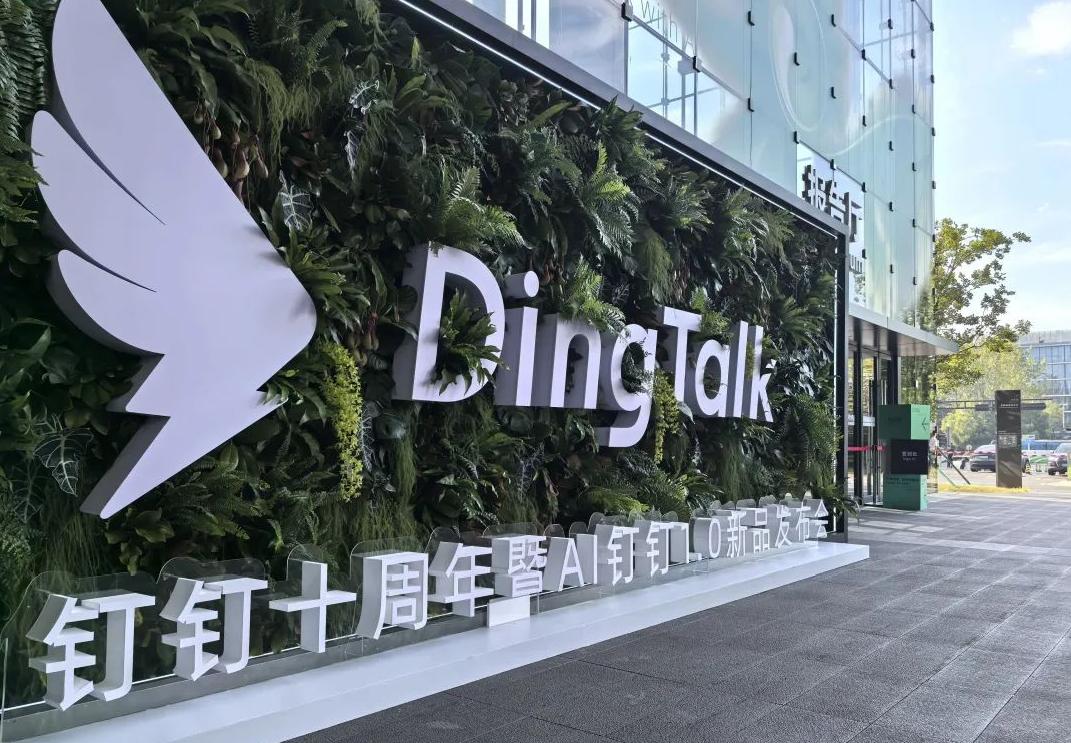
Core Viewpoint - DingTalk's CEO Chen Hang has returned and launched DingTalk 8.0, introducing new features such as DingTalk One, an AI search engine "AI Souwen," and smart hardware, aiming to transform the platform and enhance user experience [1][3]. Group 1: Product Features and Upgrades - DingTalk 8.0 emphasizes simplicity, efficiency, and user-centric design, addressing previous criticisms of outdated design and complex functionality [3][4]. - DingTalk One serves as a personal assistant, consolidating work-related information and tasks into a prioritized format, shifting from "people finding tasks" to "tasks finding people" [3][4]. - The AI search engine "AI Souwen" allows users to search for people, tasks, and knowledge based on their permissions, enhancing information retrieval in a corporate environment [7][10]. Group 2: Market Context and Competition - By 2025, the market for collaborative office platforms in China is projected to grow from 117 billion yuan to 139 billion yuan, with DingTalk and WeChat Work each holding a market share of 7.1% [10]. - DingTalk faces competition from traditional OA vendors and other specialized software providers, with early entrants like Lanling and Fanwei capturing a combined market share of 45.5% [10]. - The competitive landscape necessitates rapid innovation and adaptation, as indicated by industry insiders who believe DingTalk needs to "burn some fire" to stay relevant [10].
钉钉发布下一代办公应用形态 阿里又一APP走向AI原生
Zheng Quan Ri Bao Wang· 2025-08-25 10:48
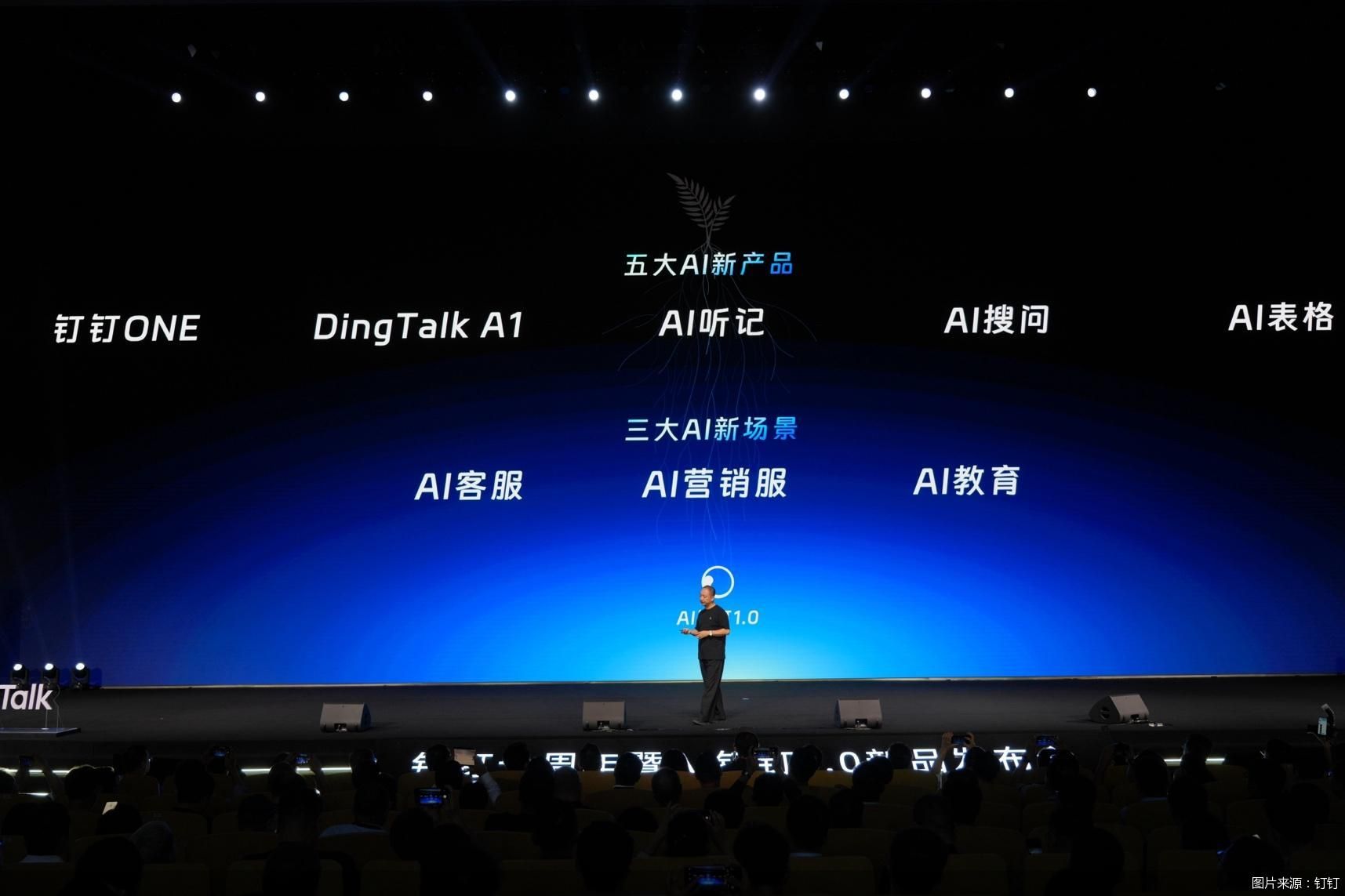
Core Insights - Alibaba's DingTalk officially launched version 8.0, marking its transition to an AI-native platform, with a commitment to redefine work interactions in the AI era [1][3] - The new version introduces over 10 AI products, including DingTalk One, an AI-driven work information flow, and an AI search engine called "AI Search" [1][2] Group 1: Product Innovations - DingTalk One serves as a unified entry point for users to interact with AI through natural language, significantly enhancing information processing efficiency [2] - The AI search engine "AI Search" allows precise retrieval of fragmented information within enterprise settings, featuring a model fusion engine that supports over 50 mainstream models [2] - The upgraded AI forms a platform for application creation, enabling users to quickly build business applications and automation processes through dialogue [2] Group 2: Hardware Integration - DingTalk introduced its first AI hardware, DingTalk A1, which features a slim design, advanced audio technology, and offers extensive voice transcription and cloud storage capabilities [3] - The device is designed to enhance meeting experiences by automatically generating minutes and integrating with core applications [3] Group 3: Industry Impact - The launch of version 8.0 signifies a transformative shift towards AI-native solutions in the collaborative office sector, positioning DingTalk to lead innovation and user-centric development [3]
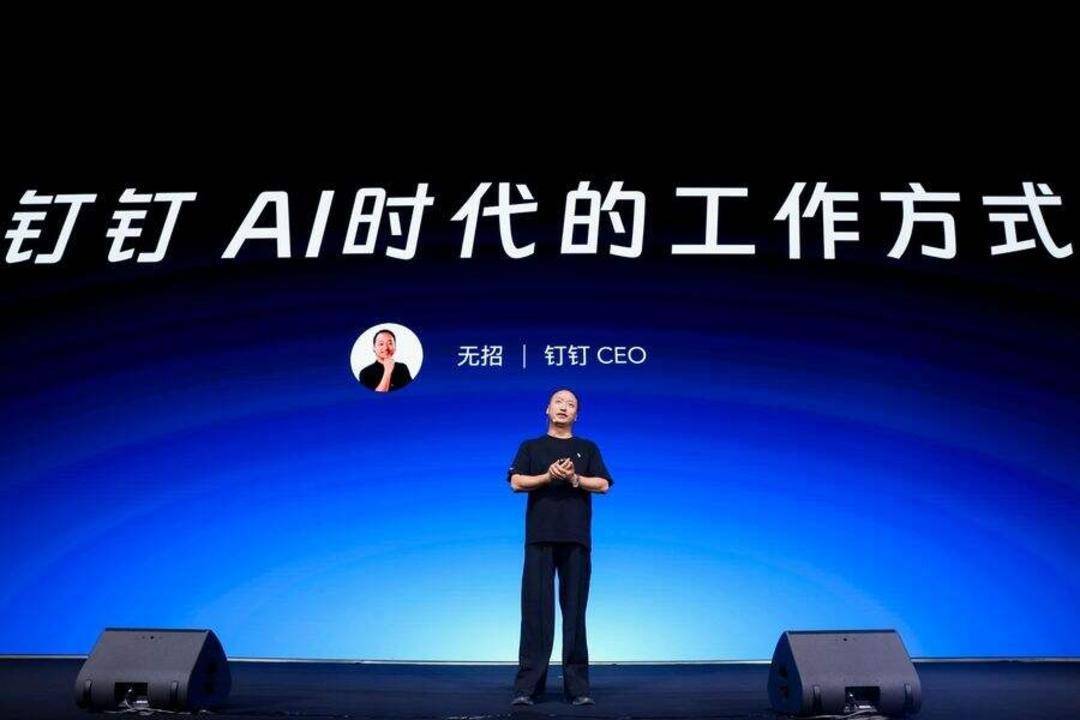
迎接AI时代的工作方式 钉钉CEO无招:协同办公APP应走向AI原生
Sou Hu Cai Jing· 2025-08-25 06:14
Group 1 - The core viewpoint is that DingTalk aims to innovate and redefine its collaboration tools for the AI era, emphasizing a return to entrepreneurship and user-centric development [2] - DingTalk CEO Wu Zhao announced the launch of DingTalk 8.0 and 10 AI products, marking the transition from mobile internet to AI-native solutions [2] - The next generation of work applications should be driven by AI assistants, transforming how information is accessed and collaboration occurs, making work processes smoother and more efficient [2] Group 2 - As of now, DingTalk has over 26 million enterprise organizations on its platform, with more than 190,000 paid organizations, and 79% of A-share listed companies in China are using DingTalk [3] - The number of AI applications on the DingTalk platform has reached 1.41 million, indicating significant adoption of AI capabilities [3] - Wu Zhao highlighted that the interaction between humans and AI through natural language will replace traditional methods of information flow in enterprises, enabling better collection and dissemination of industry-related insights [3]
5.0版上线 企业微信“抢风头”
Bei Jing Shang Bao· 2025-08-21 01:39
Core Insights - Tencent's WeChat Work has integrated over 14 million real enterprises and organizations, serving more than 750 million WeChat users daily [1] - The launch of WeChat Work 5.0 on August 20 introduced three core AI features: intelligent search, intelligent summary, and intelligent robot [2] AI Features - Intelligent search addresses common office needs by allowing users to ask questions in natural language, enabling AI to link various data sources like chats, documents, and emails for precise information retrieval [2] - Intelligent summary automates the consolidation of group chats, documents, and meeting notes into project progress reports, enhancing objectivity without requiring manual input from users [2] - The intelligent robot feature acts as an "AI colleague," allowing businesses to integrate their standard operating procedures and other resources for automated Q&A, with an open API for system integration [2][3] Integration with Other Tools - The intelligent table feature can track task progress, send overdue reminders, and generate visual data dashboards, with applications in various industries such as e-commerce and manufacturing [4] - The email function integrates with WeChat Work, allowing for automatic generation of emails from chat and meeting records, and includes grammar correction features [5] International Expansion - The WeCom version for overseas markets was launched, offering real-time translation and timezone adjustments, compliant with international standards like GDPR [6] - Companies like BYD and Luxshare Precision are utilizing WeCom for communication across multiple countries, indicating its growing adoption [7] Market Dynamics - The collaborative office platform market in China is projected to grow from 11.7 billion yuan in 2024 to 13.9 billion yuan in 2025, with various players including traditional OA vendors and internet companies [7] - WeChat Work, DingTalk, and Feishu are categorized as internet vendors, with the first entrants in the market holding a significant share [8]
独家专访飞书 CEO 谢欣:Office 是一个伟大的产品,而我们想做新时代的 Office
晚点LatePost· 2025-07-10 12:30
Core Viewpoint - The article discusses the evolution and strategic positioning of Feishu, a collaboration tool developed by ByteDance, emphasizing its long-term vision and the challenges it faces in a competitive market. Group 1: Company Background and Development - Feishu, originally known as Lark, was initiated in 2016 as an internal efficiency tool within ByteDance and officially launched to the public in 2020 after four years of development [1][2] - The platform has evolved from having only 1/10 of DingTalk's daily active users to becoming a representative collaboration software chosen by many enterprises [2] Group 2: Product Innovations and AI Integration - On July 9, Feishu launched a series of AI-driven products, including Knowledge Q&A, AI Meeting Minutes, and Aily Smart Assistant, focusing on real organizational use cases [3] - The Knowledge Q&A tool is designed to leverage internal company data, requiring substantial prior information accumulation, which is a characteristic of Feishu's client base [3][59] - Feishu's AI Meeting Minutes can automatically summarize meeting content and identify speakers, transforming each meeting into a digital asset for the company [3] Group 3: Strategic Goals and Market Positioning - The CEO of Feishu, Xie Xin, emphasizes that the company's goals differ from competitors like DingTalk, focusing on creating a next-generation office tool rather than merely achieving high user numbers [5][15] - Feishu's growth is described as steady rather than explosive, with a focus on long-term objectives rather than immediate profitability or return on investment [5][13] - The company aims to redefine work methods and improve organizational efficiency, viewing its mission as more significant than short-term financial metrics [13][39] Group 4: Competitive Landscape and Challenges - Feishu faces challenges in acquiring large clients, with notable companies like JD and NIO still using competitors' tools [19][28] - The article highlights the difficulty of competing against established players like Microsoft Office and Google Workspace, which dominate the global market [24][35] - The CEO acknowledges that the office software sector is inherently challenging and not particularly lucrative, making it difficult for new entrants to achieve profitability [12][37] Group 5: Future Outlook and AI's Role - The company is focused on leveraging AI to enhance its product offerings, with a belief that AI can significantly improve internal information retrieval and processing [49][70] - Feishu's AI capabilities are seen as a way to accelerate organizational change, although the company recognizes the need for a cultural shift within organizations to fully realize these benefits [64][73] - The CEO expresses a cautious optimism about the future of AI in the workplace, emphasizing the importance of realistic expectations regarding its capabilities [68][69]

协同办公近400亿市场规模竞技场内,头部厂商对决表格产品
Di Yi Cai Jing· 2025-07-09 12:10
Market Overview - The Chinese collaborative office market reached a scale of 33.01 billion yuan in 2023 and is expected to grow to 41.48 billion yuan by 2025, indicating a significant growth trajectory [5]. Product Development - ByteDance's collaborative office platform, Feishu, has launched a series of AI products, including knowledge Q&A, AI meetings, Aily, and Feishu Miaoduo, aimed at enhancing workplace efficiency [2][3]. - The knowledge Q&A feature provides businesses with tailored AI responses based on database resources, while AI meetings can generate playback videos, transcripts, and meeting minutes [3]. - Aily and Miaoduo are designed for B2B applications, allowing developers to configure work instructions and quickly build system prototypes using natural language [3]. Competitive Landscape - Feishu's multi-dimensional table product, which supports up to 10 million rows, has been highlighted as a key feature, contrasting with DingTalk's AI table that supports approximately 100,000 rows [4]. - User interest in collaborative office tools is driven by factors such as massive file management capabilities (51.88%), multi-user online editing (49.83%), and multi-device compatibility (48.81%) [4]. Industry Trends - The rise of the smart economy has positioned office scenarios as prime candidates for the application of large language models, given their extensive user base and high payment rates [5].