飞书多维表格

Search documents
一家GMV超30亿的公司,如何用AI实现“组织自动驾驶”?
Sou Hu Cai Jing· 2026-02-17 02:49
Core Idea - The article emphasizes the need for companies to leverage AI to restructure their organizations for "automated management" and improve efficiency in the e-commerce sector [7][8]. Group 1: AI Implementation and Organizational Restructuring - The founder of the company, Chi Shuai, transformed a company with a GMV of 30-40 billion into an "automated organization" using a multi-dimensional table and AI, streamlining management processes such as payroll, recruitment, and operational reviews [3][7]. - In the highly competitive e-commerce landscape, the first company to successfully implement AI-driven organizational restructuring will gain a significant competitive advantage [4][8]. Group 2: AI's Role in Business Processes - The implementation of AI is structured into three levels: value delivery, value transmission, and value creation, focusing on automating time-consuming tasks like performance evaluations [11][12][13]. - The organization relies on a unified data platform, referred to as "one table," to eliminate data silos and ensure seamless management across all functions [14][15]. Group 3: Automation in HR and Finance - The company has automated its HR processes, eliminating the need for dedicated HR personnel, with recruitment and onboarding now conducted online [18][19]. - Payroll processes have been streamlined, allowing for fair and transparent salary calculations through a system that automatically computes salaries based on defined criteria [20][21][22]. Group 4: AI in Training and Quality Control - AI is utilized for training and quality assessment, with an online training system that includes automated scoring for employee assessments [24][25]. - A "weekly report quality inspection" robot has been introduced to evaluate the quality of weekly reports, significantly improving the quality of submissions [27]. Group 5: Intelligent Business Operations - The company has developed intelligent systems for marketing and supply chain management, using AI to automate the creation of marketing materials and optimize production and procurement plans [28][30]. - Data-driven decision-making processes have been established, enabling real-time monitoring of profit margins and automatic alerts for data anomalies [36][39]. Group 6: Key Factors for Successful AI Transformation - The company identifies key personnel as essential for driving AI transformation, emphasizing the need for experienced individuals who understand the business and can navigate organizational changes [41][42]. - A talent emergence model is proposed, focusing on individuals who are passionate, skilled, and meet the company's needs, facilitating the successful implementation of AI initiatives [46][50]. Group 7: Recommendations for Management - Management is advised to prioritize reducing unnecessary tasks and to engage personally in understanding AI's potential and outcomes [53][55].


真正威胁你的竞品,往往不在你的分析名单里
3 6 Ke· 2026-01-26 06:21
Core Insights - The article emphasizes the importance of correctly identifying competitors before conducting detailed analysis, as selecting the wrong competitors can render the entire report useless [1][2]. Group 1: Definition and Classification of Competitors - Competitors are defined as products that can divert user attention, time, or budget, not just those that offer similar products [2]. - Three categories of competitors are identified: direct competitors, indirect competitors, and potential competitors [2]. Group 2: Direct Competitors - Direct competitors are characterized by operating in the same market, targeting the same user base, and offering similar core functionalities, leading users to choose between them [3][4]. - An example provided is the competition between Doubao and Kimi, both AI dialogue assistants targeting C-end users [4][5]. Group 3: Indirect Competitors - Indirect competitors address similar problems but differ in product form, core functionality, or usage scenarios, potentially diverting users in specific contexts [6][7]. - Midjourney is cited as an indirect competitor to AI dialogue products, as it serves the broader need for AI-assisted creation but through different means [8][9]. Group 4: Potential Competitors - Potential competitors currently differ significantly in product form and functionality but may compete for the same user resources in the future [10]. - Douyin is mentioned as a potential competitor due to its large user base and capability to introduce AI features, which could disrupt the market [11][12]. Group 5: Analysis Directions - When selecting competitors, companies should consider the analysis direction, which can include business strategy, specific functionalities, and user overlap [13]. - Business direction focuses on the competitor's commercial logic and revenue models, while functional direction examines specific features and technical paths [14][15]. - User direction analyzes user overlap and migration costs, which can inform operational strategies [16][17]. Group 6: Sources for Finding Competitors - Companies can identify competitors through various channels, including app stores, industry reports, social media, and direct user feedback [18][19][20][21][22]. - App stores provide a direct source for similar products, while industry reports offer insights into market dynamics and player rankings [19][20]. Group 7: Practical Example - A practical example is provided for selecting competitors for the Deep Research feature, categorizing them into direct, indirect, and potential competitors based on their functionalities and market positioning [23][24]. Group 8: Summary Principle - The core principle for selecting competitors is to first understand who is competing for the same users, which informs the focus of the analysis [25].
提效千万、降本百万:飞书安徽峰会解码奇瑞、蔚来们“AI成绩单”
Sou Hu Cai Jing· 2026-01-22 07:08
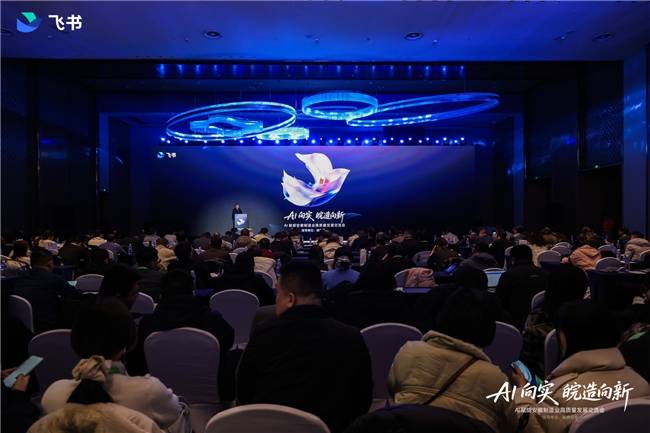
Group 1 - The summit in Hefei focused on the integration of AI technology in manufacturing, highlighting Hefei's position as a significant center for technological innovation and its strategic industrial layout of "chip, display, automobile, and integration" [1][2] - The event attracted over 200 executives, government leaders, and industry experts from sectors such as new energy vehicles, high-end equipment, and semiconductors to discuss how AI can drive high-quality development in Anhui's manufacturing [1][2] Group 2 - The summit served as an important platform for discussing practical paths for organizational transformation and technology implementation, with emphasis on the need for AI to move beyond strategic presentations to real business applications [5] - The launch of the "Anhui Feichanghao Efficiency Acceleration Plan" marked a significant step in making AI a widespread productivity tool in Anhui, aiming to help local enterprises transition from merely hearing about AI to effectively utilizing it [5][14] Group 3 - Four representative Anhui companies shared their successful experiences in integrating AI and digital tools in complex business scenarios, showcasing practical results and efficiency improvements [6] - Chery Jietu utilized AI and Feishu's multi-dimensional tables to enhance international collaboration, achieving significant cost savings and efficiency gains through innovative solutions [6] - NIO adopted a modular approach to business system development using Feishu's capabilities, significantly reducing development time and improving operational efficiency [8] Group 4 - Huafu Technology emphasized the importance of AI in strengthening midstream enterprises, successfully creating a smart closed-loop for safety management that drastically reduced manpower and response times [10] - Anhui Ruineng Technology shared lessons learned about execution gaps and how integrating Feishu helped ensure strategic alignment and improved data flow across systems [12]

飞书史上第一次硬件合作,和安克创新做了一款「AI录音豆」
36氪· 2026-01-19 00:07
Core Viewpoint - The article discusses the emergence of AI hardware, specifically focusing on the launch of the "AI Recording Bean" by Feishu in collaboration with Anker Innovation, highlighting its innovative design and features aimed at enhancing user experience in daily scenarios [4][5][6]. Product Overview - The "AI Recording Bean" is a lightweight device weighing only 10 grams, designed for seamless wear and recording, with a total weight of approximately 48 grams when combined with its charging case [4]. - It supports both Bluetooth and Wi-Fi transmission modes, emphasizing a user-friendly experience for recording in various situations without the need to interact with a smartphone app [7][9]. Market Context - Since 2025, there has been a surge in AI hardware innovations, including recording cards and AI cameras, as companies seek to create more accessible AI interaction points for users [6][11]. - Feishu's choice of a "bean" shape differentiates it from the more common card form factor, which, while convenient for attachment to smartphones, is bulkier and limits usage scenarios [7]. Functional Features - The device offers real-time summary capabilities, allowing users to view subtitles and AI-generated summaries during recordings, which enhances the efficiency of information capture [9]. - It boasts a total battery life of over 32 hours and an 8GB storage capacity, enabling the storage of approximately 250 hours of audio, with fast charging capabilities [9]. Competitive Landscape - The AI recording device market is characterized by a consensus that while hardware can be replicated quickly, the differentiation in user experience stems from ongoing engineering refinements and insights into various office scenarios [14][15]. - Feishu's integration of its self-developed Doubao model, known for its leading multimodal understanding capabilities, provides a competitive edge in transcription accuracy and intelligent summary generation [15]. User-Centric Design - The design of the AI Recording Bean aligns with the needs of knowledge-intensive industries, where meetings and documentation are prevalent, making it a logical extension of Feishu's existing product ecosystem [13]. - The device is tailored to address common user pain points, such as differentiating speakers in meeting minutes and automatically extracting action items, which are critical for effective collaboration [13].


书亦烧仙草携手飞书,打造新茶饮行业AI管理新范式
Sou Hu Wang· 2026-01-13 10:05
Core Insights - The partnership between the tea brand Shuyi Shao Xian Cao and Feishu aims to create an agile organization suitable for global chain operations, leveraging AI to enhance efficiency across thousands of stores worldwide [1][3] Group 1: Company Overview - Shuyi Shao Xian Cao was founded in 2007 and has grown into a well-known chain tea brand in China, expanding to nine countries including Vietnam, Indonesia, Thailand, Malaysia, the Philippines, the USA, Spain, Italy, and Canada [3] - The founder, Wang Bin, emphasizes the need for a more open, transparent, and agile management approach to meet new challenges in the industry [3] Group 2: Management Enhancement - The collaboration with Feishu is seen as a way to refine management granularity and improve cross-departmental collaboration through AI tools such as AI inspections and AI store assistants [3][4] - The company aims to strengthen real-time connections between headquarters and frontline stores globally, enhancing responsiveness [3] Group 3: Implementation and Innovation - Shuyi Shao Xian Cao will establish a "Feishu Efficiency Pioneer" team to encourage frontline staff to utilize Feishu tools for creating lightweight applications that address business pain points [4] - The company plans to share successful case studies and host themed activities to inspire innovation and practical application among employees [4] - Management is expected to lead by example as deep users of Feishu, facilitating resource coordination and knowledge transfer to enhance team collaboration [4] Group 4: Future Vision - The company aims to leverage the Feishu platform to deeply reshape management concepts and business processes, aligning with its mission to deliver joy through every beverage [4]

伊泰集团举办首届飞书效率先锋大赛 以数字化创新赋能高质量发展
Zhong Guo Neng Yuan Wang· 2026-01-09 01:27
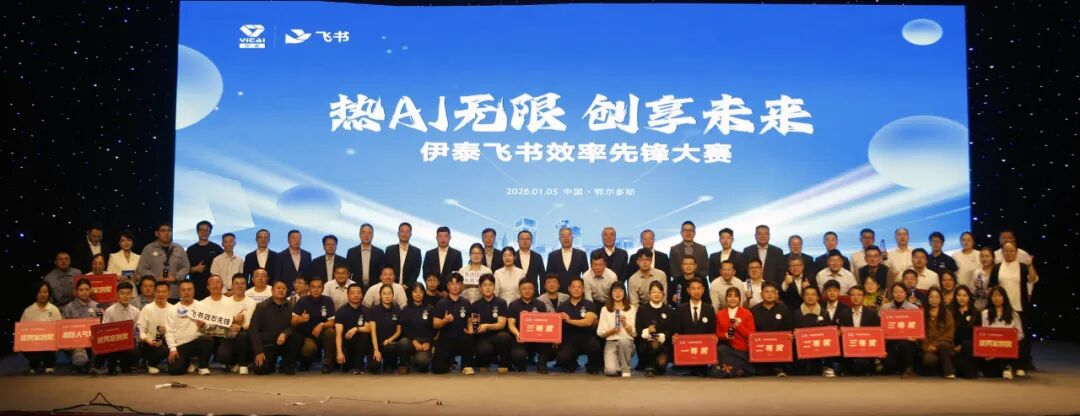
Core Insights - The event held by Yitai Group on January 5 aimed to deepen the integration of the Feishu office platform with business scenarios and stimulate digital innovation potential among all employees [2] - The competition showcased successful practices in digital transformation and highlighted the importance of digital tools in enhancing organizational efficiency and innovation [10] Group 1: Event Overview - The Feishu platform has been fully implemented at Yitai Group, achieving significant results with over 5,000 activated users and an activation rate of 98%, maintaining a stable activity level of 85% [4] - The competition featured 16 teams from various business areas, demonstrating the practical value of Feishu tools in improving efficiency, optimizing processes, and assisting decision-making [4] Group 2: Awards and Recognition - The "Yiluchangxing" team won first place for outstanding digital innovation, while "Yiqi Guanpeisheng. Xiaoyong Qixianfeng" and "Hua'an Xianfengdui" received second place [4] - An award ceremony recognized the establishment of the "Yitai-Feishu Efficiency Pioneer Official Alliance Enterprise," emphasizing the collaboration's achievements and future expectations [8] Group 3: Future Directions - Yitai Group's leadership expressed the need for a strategic collaboration mechanism, joint talent development, and the use of AI tools to enhance operational efficiency and management [8] - The company aims to integrate digital application results into performance evaluation systems to foster a culture of participation and excellence among all employees [10]
“AI不应该是用来淘汰老师傅的”
Sou Hu Cai Jing· 2026-01-08 05:16
Core Insights - The article highlights the transformative impact of AI on various industries, emphasizing that AI should enhance human capabilities rather than replace them. It showcases the story of a young accountant, Wang Zai, who implemented an AI system in a factory, significantly improving efficiency and reducing costs [4][9][22]. Group 1: AI Implementation in Factories - Wang Zai, an accountant with no technical background, developed an AI system called "Xiao Liu Classmate" to manage material alerts and information, which previously took weeks to process manually. This system saved the factory 1,000 hours annually [7][9]. - The factory experienced a 0.15% reduction in waste and a 6% decrease in costs, leading to an estimated annual savings of over 1 million yuan [9]. - The article emphasizes that the changes seen in Wang Zai's factory are indicative of a broader AI efficiency revolution across various industries in China [9][11]. Group 2: Broader Impact of AI Across Industries - Other industries are also witnessing similar transformations. For instance, a maintenance worker at a chemical plant developed an AI system that improved safety and reduced inspection time, saving the company 580,000 yuan in setup costs and generating an additional 2.4 million yuan [13][14]. - In the automotive sector, an AI auditing system was created to streamline compliance processes, reducing the time required for audits from weeks to minutes, saving an average of 300 hours per audit [14]. - A biotechnology company restructured its reporting system using AI, allowing for faster and more accurate information flow from frontline employees to management, significantly improving operational efficiency [15][18]. Group 3: The Role of "Efficiency Pioneers" - The article introduces the concept of "Efficiency Pioneers," ordinary employees who leverage AI tools to enhance organizational efficiency. These individuals are seen as key players in the AI transformation [24][27]. - The "Feishu AI Efficiency Pioneer Competition" highlighted the contributions of over 900 frontline workers from 130 companies, showcasing their innovative solutions to business challenges [27][28]. - The emergence of these pioneers is supported by a conducive environment for innovation, with companies like Feishu providing tools and incentives for employees to adopt AI [29][30]. Group 4: Future of AI in Business - The article concludes that AI is an irreversible trend that will redefine human capabilities in the workplace. It emphasizes the importance of integrating AI into frontline operations to improve the quality of work for ordinary people [34][36]. - Companies are increasingly recognizing the need to identify and cultivate "Efficiency Pioneers" as a critical aspect of their AI strategies [30][31]. - A report indicates that 52% of organizations using generative AI have deployed AI agents, with 88% of early adopters achieving positive ROI, underscoring the potential value of AI in enhancing business operations [33].
“AI不应该是用来淘汰老师傅的”
吴晓波频道· 2026-01-08 00:29
Core Viewpoint - The article emphasizes that in today's China, there are no sunset industries, only sunset individuals. Those who adopt AI tools early will become the new protagonists in the era of artificial intelligence [3][12]. Group 1: AI Implementation in Factories - A young accountant named Wang Zai implemented an AI system called "Xiao Liu Classmate" in a factory, which significantly improved material management and communication, allowing for real-time monitoring and alerts [10][11]. - The deployment of AI systems in the factory led to a reduction in waste rate by 0.15% and a cost decrease of 6%, with an estimated annual savings exceeding one million yuan [12]. - Wang Zai's factory is one of 6 million in China, illustrating that the AI efficiency revolution is not limited to exceptional cases but is a widespread trend [12]. Group 2: Broader Applications of AI - Various industries are witnessing similar transformations, such as a maintenance worker at a chemical plant who developed an AI operation system that improved safety and saved significant costs [19]. - In the automotive sector, an AI auditing system was created to streamline compliance processes, reducing the time required for audits from weeks to minutes [20]. - A biotechnology company restructured its reporting system using AI, allowing for faster and more accurate information flow from frontline employees to management [21]. Group 3: The Role of "Efficiency Pioneers" - The article introduces the concept of "Efficiency Pioneers," ordinary individuals who leverage AI tools to enhance organizational efficiency [36][38]. - These pioneers are emerging across various sectors, demonstrating that the most significant changes often come from those directly engaged in the work [39]. - The article highlights the importance of providing tools and fostering an environment that encourages innovation among frontline employees [40][41]. Group 4: Future of AI in China - The article predicts that China will build the world's most advanced AI factory clusters in the next decade, following its role as a testing ground for industrial intelligence [47]. - It emphasizes that AI is an irreversible trend, and the integration of technology into frontline work will continue to improve the quality of work for ordinary people [49]. - The contributions of Efficiency Pioneers are crucial in embedding human experience and professionalism into AI systems, redefining human value in the digital age [50][51].

罗振宇2026“时间的朋友”跨年演讲20条金句
Sou Hu Cai Jing· 2026-01-02 09:22
Group 1 - The core theme of the discussion is about how to navigate the world 1000 days from now, emphasizing the importance of practical actions today to shape the future [11][14][17] - The concept of "purple-collar" workers is introduced, referring to those who understand business logic and can leverage AI tools to solve complex problems, with an estimated 31 million such positions expected in China by 2035 [22][24] - The essence of AI is described as uplifting rather than replacing human workers, enabling individuals to focus on tasks that require emotional intelligence, creativity, and complex communication [20][21] Group 2 - Education in the AI era should focus on helping children escape uniformity, encouraging them to engage with diverse experiences and develop unique skills that AI cannot replicate [24][25] - The future of work will prioritize problem-solving abilities over traditional qualifications, with a shift towards valuing skills and outcomes rather than degrees [35][37] - A three-tier model for interacting with AI is proposed: walking alongside AI, sitting beneath it, and running above it, highlighting the importance of collaboration with AI to enhance productivity [28][30] Group 3 - The discussion emphasizes that the true value of the upcoming 1000 days lies in personal growth and actionable steps taken today, rather than merely predicting the future [19][35][37] - The potential for AI to create unprecedented new demands and expand human civilization is highlighted, suggesting that those who optimize workflows with AI will gain new skills essential for the future [29][32] - The importance of starting small and integrating AI tools into daily work practices is encouraged, fostering a habit of collaboration with technology [33][37]

2025 ToB 产品:消失的边界
3 6 Ke· 2025-12-30 00:47
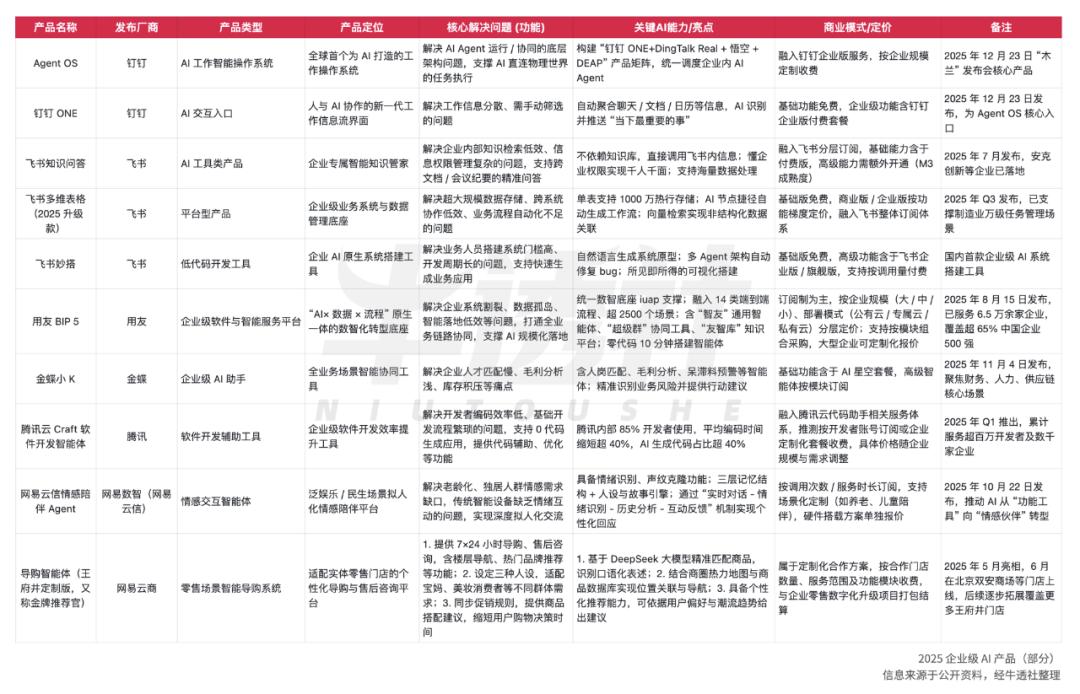
Core Insights - The enterprise AI product market is expected to experience explosive growth by 2025, with SaaS companies and AI-native firms reshaping the industry landscape. The focus has shifted from trial use to large-scale implementation, integrating AI into core business processes such as finance, sales, supply chain, and customer service [4][13][41] - The boundaries of enterprise software are becoming increasingly blurred, as traditional classifications like CRM, OA, and ERP fail to accurately describe the emerging products and their functionalities [2][13][42] - AI is transitioning from a supportive role to a more active role in executing tasks, with products allowing AI to directly participate in business processes and decision-making [20][22][24] Group 1: Product Types and Features - Four core types of enterprise AI products have emerged, covering the entire application ecosystem from foundational capabilities to vertical scenarios [5][6] - AI Agent platforms serve as the foundation for developing, deploying, and operating enterprise AI agents, addressing challenges such as high development barriers and poor system integration [6][7] - Vertical AI products focus on specific job functions, providing ready-to-use tools that enhance efficiency by automating repetitive tasks [8][10] Group 2: Changes in Business and Responsibility Boundaries - The traditional business boundaries of enterprise software are diminishing, with companies increasingly organizing work around tasks rather than systems [13][17][18] - The responsibility of AI in products is shifting forward, with AI now taking on execution roles and being held accountable for outcomes, which raises questions about risk management and accountability [19][20][22] - The convergence of AI-native companies and traditional SaaS firms is leading to similar product paths, as both seek to integrate AI deeply into their core workflows [24][25] Group 3: Business Models and Market Dynamics - The commercial model for enterprise AI products is shifting from selling tools to delivering value, with a focus on measurable outcomes and task completion [26][27] - AI products are increasingly being designed for private and controllable deployment, addressing concerns about data sovereignty and transparency [28][29][30] - The role of product managers is evolving to focus on creating collaborative frameworks among humans, AI, and existing systems, rather than merely optimizing tool functionalities [31][32][34] Group 4: Unresolved Issues and Challenges - Trust barriers remain as enterprises are hesitant to allow AI to autonomously execute core tasks, often preferring a model of AI assistance with human oversight [36] - The cost of AI errors is a significant concern, as companies currently bear the full responsibility for any mistakes made by AI systems [37][38] - The risk of over-platformization in AI products could lead to complexity and inefficiency, potentially alienating users who require simpler solutions [39][40]