
南向资金

Search documents
2月12日南向资金追踪:腾讯控股、小米集团-W、美团-W净买入额居前,分别为14.29亿港元、10.20亿港元、9.85亿港元
Jin Rong Jie· 2026-02-12 15:01
Market Overview - The Hang Seng Index fell by 0.86%, closing at 27,032.54 points, with a total market turnover of 238.705 billion HKD [1] Southbound Trading Data - Tencent Holdings, Xiaomi Group-W, and Meituan-W saw net purchases of 1.429 billion HKD, 1.020 billion HKD, and 0.985 billion HKD respectively [1][2] - WuXi Biologics, Zijin Mining, and Pop Mart experienced net sales of 0.392 billion HKD, 0.346 billion HKD, and 0.301 billion HKD respectively [1][2] Individual Stock Performance - Tencent Holdings had a trading volume of 12.026 billion HKD, with a net buy of 1.429 billion HKD, closing at 535.50 HKD, down by 2.28% [2] - Xiaomi Group-W recorded a trading volume of 27.46 billion HKD, with a net buy of 1.020 billion HKD, closing at 36.52 HKD, down by 1.56% [2] - Meituan-W had a trading volume of 38.31 billion HKD, with a net buy of 0.985 billion HKD, closing at 84.85 HKD, down by 4.50% [2] - Pop Mart had a trading volume of 21.899 billion HKD, with a net sell of 0.301 billion HKD, closing at 252.20 HKD, down by 1.10% [2] - WuXi Biologics had a trading volume of 6.99 billion HKD, with a net sell of 0.392 billion HKD, closing at 41.34 HKD, down by 0.14% [2] - Zijin Mining had a trading volume of 9.64 billion HKD, with a net sell of 0.346 billion HKD, closing at 45.02 HKD, up by 3.45% [2]




跌9.39%VS买636亿!南向资金节前逆势扫货|中环观察
2 1 Shi Ji Jing Ji Bao Dao· 2026-02-12 09:28
Core Viewpoint - The Hong Kong stock market is experiencing a significant influx of southbound capital despite recent declines in the Hang Seng Index and Hang Seng Tech Index, indicating a potential investment opportunity as valuations reach attractive levels [1][2]. Group 1: Market Performance and Capital Inflow - From January 29 to February 6, the Hang Seng Index fell by 4.55%, while the Hang Seng Tech Index dropped by 9.39%, yet southbound capital net bought HKD 636.64 billion during this period [1]. - On February 5, a record single-day net purchase of HKD 249.77 billion was noted, the highest since August 2025 [1]. - The increase in southbound capital is attributed to the perceived undervaluation of Hong Kong stocks, which have adjusted from 28,000 points to 26,200 points [1][2]. Group 2: Investment Strategies and Preferences - Southbound capital is focusing on two main types of stocks: technology leaders that are scarce in the A-share market and high-dividend stocks that offer better yields than their A-share counterparts [2][3]. - In 2025, the banking sector saw a net inflow of nearly HKD 210 billion, while tech giants Alibaba and Meituan attracted over HKD 250 billion combined, highlighting a preference for high-growth and dividend-paying stocks [2]. Group 3: Future Market Outlook - Analysts predict that the Hong Kong market has room for valuation recovery, with expectations of a slow bull market supported by increased southbound capital inflow and foreign investment [7][8]. - DBS Bank has raised its 12-month target for the Hang Seng Index to 30,000 points, while HSBC anticipates a target of 31,000 points by the end of 2026, driven by strong earnings growth and structural opportunities [8]. - Investment strategies for 2026 emphasize sectors such as technology, consumer goods, and essential retail, while cautioning against potential risks from geopolitical tensions and inflation [9].
2月11日南向资金追踪:腾讯控股、紫金黄金国际、美团-W净买入额居前,分别为7.36亿港元、1.91亿港元、1.63亿港元
Jin Rong Jie· 2026-02-11 10:59
Group 1 - The Hang Seng Index rose by 0.31% to close at 27,266.38 points, with a total market turnover of 217.218 billion HKD [1] - Tencent Holdings, Zijin Mining International, and Meituan-W saw net inflows of 736 million HKD, 191 million HKD, and 163 million HKD respectively [1] - Alibaba-W, SMIC, and China Life experienced net outflows of 521 million HKD, 391 million HKD, and 246 million HKD respectively [1] Group 2 - Tencent Holdings had a trading volume of 5.165 billion HKD with a closing price of 548.00 HKD, reflecting a decrease of 0.54% [2] - Zijin Mining International recorded a trading volume of 4.594 billion HKD, with a net inflow of 191 million HKD and a closing price of 228.80 HKD, showing an increase of 9.06% [2] - Meituan-W had a trading volume of 12.35 billion HKD, with a net inflow of 163 million HKD and a closing price of 88.85 HKD, reflecting a slight increase of 0.06% [2] - Alibaba-W had a trading volume of 53.08 billion HKD, with a net outflow of 521 million HKD and a closing price of 160.10 HKD, showing a decrease of 0.25% [2] - China Life had a trading volume of 8.79 billion HKD, with a net outflow of 246 million HKD and a closing price of 34.12 HKD, reflecting a decrease of 3.94% [2]
南向资金丨腾讯控股获净买入7.36亿港元
Di Yi Cai Jing· 2026-02-11 10:02
Group 1 - The net inflow of southbound funds reached 4.816 billion HKD, indicating strong investment interest in the Hong Kong market [1] - Tencent Holdings, Zijin Mining International, and Meituan-W were the top three stocks with net inflows, receiving 736 million HKD, 191 million HKD, and 163 million HKD respectively [1] - On the other hand, Alibaba-W, SMIC, and China Life experienced net outflows of 521 million HKD, 391 million HKD, and 246 million HKD respectively [1]
港股IPO为何如此火爆?
2 1 Shi Ji Jing Ji Bao Dao· 2026-02-10 23:19
Core Viewpoint - The recent developments in Hong Kong's economic and financial landscape have garnered significant attention, with a notable increase in IPO activities and GDP growth projected for 2025, indicating a robust recovery and expansion trend since 2021 [1][2]. Group 1: IPO Market Dynamics - In 2025, Hong Kong is expected to host 119 IPOs, with a substantial increase in financing, leading the global market [1]. - The Hong Kong Stock Exchange (HKEX) has implemented new IPO regulations in August 2025, enhancing the pricing and allocation mechanisms for new stocks and lowering the listing thresholds for "A+H" issuers [1][2]. - Southbound capital from mainland China has reached a record net buy of 1,404.84 billion HKD in 2025, contributing to the influx of funds into the Hong Kong stock market [1]. Group 2: Factors Driving Growth - The supportive policies from the China Securities Regulatory Commission since 2024 have encouraged leading mainland enterprises to list in Hong Kong [1]. - The international capital influx is driven by a weaker US dollar and global liquidity easing, with long-term stable foreign investments becoming predominant in the Hong Kong market [3]. Group 3: Sectoral Contributions - The listing rules for unprofitable biotech companies and specialized technology firms have spurred the entry of high-tech enterprises, optimizing the industrial structure and leading to market valuation premiums [2]. - The majority of new companies established in Hong Kong in 2025 are engaged in import-export trade, wholesale, and retail, reflecting Hong Kong's status as an international trade and financial hub [3]. Group 4: Innovation and Technology Focus - The Hong Kong government has prioritized the development of an international innovation and technology center, aligning with national strategies to enhance technological self-reliance and productivity [4]. - The synergy between technology, finance, and industry is expected to drive economic growth and support the upgrading of Hong Kong's industrial structure [4]. Group 5: Future Development Directions - Future national development priorities include promoting supply-side structural reforms, deepening demand-side reforms, and expanding high-level openness, with Hong Kong playing a crucial role in enhancing national competitiveness [5]. - To achieve these goals, Hong Kong needs to strengthen its hard and soft power, improve the business environment, and explore opportunities in emerging fields such as artificial intelligence and green finance [5].
1200亿港元南向资金涌入港股
2 1 Shi Ji Jing Ji Bao Dao· 2026-02-09 14:25
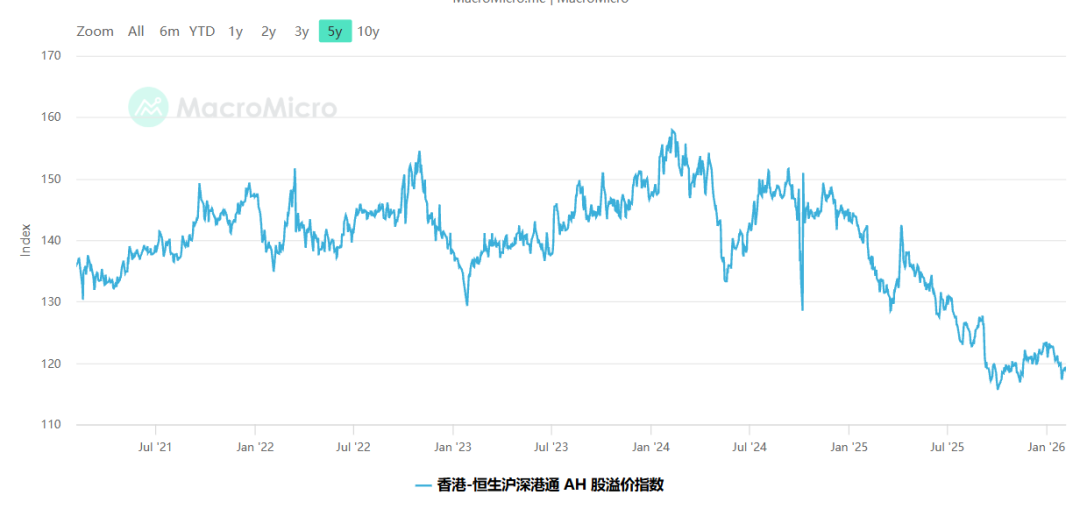
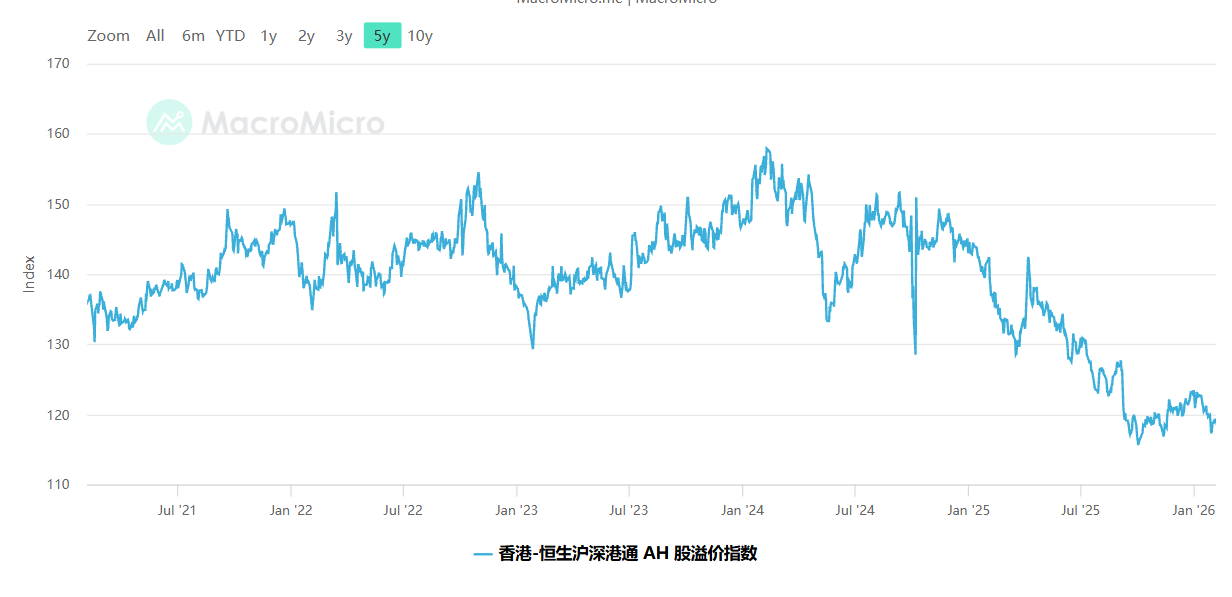
Core Viewpoint - The article discusses the narrowing of the AH premium, highlighting the significant reduction in the discount rate for companies listed in both A-shares and H-shares, particularly noting Dongpeng Beverage's recent listing as having the second-lowest discount rate since 2015 [1][4]. Group 1: AH Premium Dynamics - Dongpeng Beverage's H-share discount rate at 14% is significantly lower than the average of approximately 33% since 2015 [1]. - The overall AH premium index has decreased from a near ten-year high of 161.36 points in February 2024 to 119.44 points by February 2026, returning to levels seen in 2019 [1]. - The narrowing of the AH premium is attributed to improved liquidity in the Hong Kong market, driven by increased participation from southbound funds, a weak dollar environment, and improved profitability in Hong Kong stocks [3][4]. Group 2: Southbound Fund Influence - Southbound funds have become a stabilizing force in narrowing the AH premium, with their market participation exceeding 30% in August 2025 [4]. - In 2025, net inflows from southbound funds reached a record high of 1.4 trillion HKD, with over 120 billion HKD net inflows recorded by February 2026 [4]. - The influx of southbound funds has improved liquidity in the Hong Kong market, reducing the liquidity gap between A-shares and H-shares [4]. Group 3: Valuation Disparities - Some leading companies have experienced a phenomenon where H-share prices exceed A-share prices, known as "premium inversion," with notable examples including CATL and China Merchants Bank [5][6]. - The preference of foreign investors for globally competitive stocks leads to higher valuations for certain companies, impacting the AH premium [6]. - The valuation divergence between large-cap leading stocks and smaller-cap stocks reflects a "Matthew Effect," where larger companies attract more investment and liquidity [7][10]. Group 4: Market Structure Changes - The article notes that the AH premium is influenced by sector-specific dynamics, with significant variations observed across industries [10]. - The introduction of new listing rules allowing growth companies to list in Hong Kong may further alter the perception of AH premiums [11]. - The potential expansion of the dual-counter model allowing mainland investors to trade Hong Kong stocks in RMB could further narrow the valuation discount between A-shares and H-shares [11].


1200亿港元南向资金涌入港股
21世纪经济报道· 2026-02-09 14:21
Core Viewpoint - The article discusses the narrowing of the AH premium, highlighting the significant reduction in the discount rate for companies listed in both A-shares and H-shares, with a focus on the factors driving this trend and the implications for market dynamics [1][3]. Group 1: AH Premium Dynamics - The AH premium has decreased significantly, with the recent listing of Dongpeng Beverage showing a discount rate of only 14%, the second lowest since 2015, compared to an average of about 33% [1]. - The Hang Seng A-share premium index has declined from a near ten-year high of 161.36 points in February 2024 to 119.44 points by February 2026, returning to levels seen in 2019 [1]. Group 2: Factors Influencing Premium Narrowing - The core reason for the narrowing AH premium is the recovery of liquidity discounts in the Hong Kong market, driven by increased participation from southbound funds, a weak dollar environment, and improved earnings in the Hong Kong market [3]. - Southbound funds have reached a record net inflow of 1.4 trillion HKD in 2025, with over 120 billion HKD net inflow recorded in early 2026, indicating a strong trend of capital flow into the Hong Kong market [5]. Group 3: Market Structure and Investor Behavior - The participation of southbound funds has increased from 20% at the beginning of 2024 to around 35%, enhancing the pricing power of mainland investors in the Hong Kong market [6]. - The liquidity gap between A-shares and H-shares has narrowed due to the influx of southbound funds, which have improved the liquidity conditions in the Hong Kong market [5]. Group 4: Valuation Disparities and Market Preferences - Some leading companies have experienced a phenomenon where H-shares are priced higher than A-shares, with notable examples including CATL and China Merchants Bank, indicating a preference for globally competitive firms by foreign investors [7]. - The article notes a "Matthew Effect" in the market, where larger companies enjoy better valuations, while smaller companies face greater discounts, with smaller IPOs often seeing discounts of around 50% compared to larger firms [10][11]. Group 5: Future Trends and Market Adjustments - The trend of narrowing AH premiums and structural differentiation is expected to continue, with high-quality leading stocks potentially experiencing a "premium inversion" becoming a norm [12]. - Adjustments in listing rules allowing growth companies to list in Hong Kong may attract more high-growth firms to global investors, further influencing the AH premium dynamics [12].


南下资金1200亿涌入 AH价差七年最低|中环观察
2 1 Shi Ji Jing Ji Bao Dao· 2026-02-09 08:52
Core Viewpoint - The article discusses the narrowing of the AH premium, highlighting the significant reduction in the discount rate for companies listing in Hong Kong compared to their A-share counterparts, driven by improved liquidity in the Hong Kong market and increased participation from mainland investors [2][3]. Group 1: AH Premium Trends - Dongpeng Beverage's H-share discount rate at 14% is the second lowest since 2015, compared to an average discount of about 33% [2]. - The AH premium index has decreased from a near ten-year high of 161.36 points in February 2024 to 119.44 points by February 6, 2026, returning to levels seen in 2019 [2]. - The narrowing of the AH premium is attributed to the recovery of liquidity in the Hong Kong market, driven by increased southbound capital participation, a weak dollar environment, and improved profitability in Hong Kong stocks [2]. Group 2: Southbound Capital Influence - Historical trends show that a reduction in AH premium often coincides with increased participation from southbound capital, which has reached a record net inflow of 1.4 trillion HKD in 2025 [3]. - As of February 6, 2026, southbound capital has accumulated a net inflow of over 120 billion HKD since the beginning of the year [3]. - Southbound capital has improved liquidity in the Hong Kong market, with A-share annual turnover rates at 373% compared to only 105% for Hong Kong stocks as of June 2025 [3]. Group 3: Valuation Disparities - Some leading companies have experienced a phenomenon where H-shares are priced higher than A-shares, with notable examples including CATL and China Merchants Bank [4]. - The preference of foreign capital for globally competitive stocks leads to more generous valuations for these companies, resulting in lower AH premiums [5]. - The structural differences in investor bases between A-shares and H-shares contribute to the valuation disparities, with institutional investors dominating the Hong Kong market [3][5]. Group 4: Market Dynamics and Future Trends - The "Matthew Effect" is evident in the market, where leading stocks are favored while smaller companies face greater valuation challenges [6]. - Recent IPOs show that smaller A+H companies tend to have larger discount rates, with those under 10 billion HKD often seeing discounts around 50% [7]. - The trend of narrowing AH premiums is expected to continue, with high-quality leading stocks potentially experiencing persistent premium situations [9][10].
港股投资周报:恒生科技短期调整,港股精选组合年内上涨7.14%-20260207
Guoxin Securities· 2026-02-07 05:56
- The "Hong Kong Stock Selection Portfolio" model is constructed based on a dual-layer selection process that integrates fundamental and technical analysis. The stock pool is initially built using analyst recommendation events, such as upward earnings revisions, first-time coverage, and unexpected positive research report titles. Stocks with both fundamental support and technical resonance are selected to form the portfolio. The backtesting period spans from January 1, 2010, to December 31, 2025, with an annualized return of 19.08% and an excess return of 18.06% relative to the Hang Seng Index after considering transaction costs in a fully invested state[14][15][19] - The "Stable New High Stock Screening" factor is based on the concept of momentum and trend-following strategies, which are particularly effective in the Hong Kong stock market. The factor emphasizes stocks that have recently reached a 250-day high, with a specific calculation formula: $ 250\text{-day new high distance} = 1 - \frac{\text{Close}_{t}}{\text{ts\_max(Close, 250)}} $ Here, $\text{Close}_{t}$ represents the latest closing price, and $\text{ts\_max(Close, 250)}$ is the maximum closing price over the past 250 trading days. A value of 0 indicates a new high, while positive values indicate the degree of pullback from the high. Stocks are further filtered based on analyst attention, relative strength, price stability, and trend continuation metrics[20][22][23] - The backtesting results for the "Hong Kong Stock Selection Portfolio" model show an annualized return of 19.08%, an excess return of 18.06%, and an information ratio (IR) of 1.19 over the entire sample period. The maximum drawdown was 23.73%, with a tracking error of 14.60% and a return-to-drawdown ratio of 0.76[19] - The "Stable New High Stock Screening" factor identified stocks such as Nine Dragons Paper, with the highest number of stocks coming from the cyclical sector (14 stocks), followed by consumer, manufacturing, financial, technology, and pharmaceutical sectors. Specific stocks include Nine Dragons Paper, China Eastern Airlines, and Pacific Basin Shipping, among others[22][23][28]