
商业银行净息差

Search documents
LPR,维持不变
Zhong Guo Zheng Quan Bao· 2025-08-20 01:59
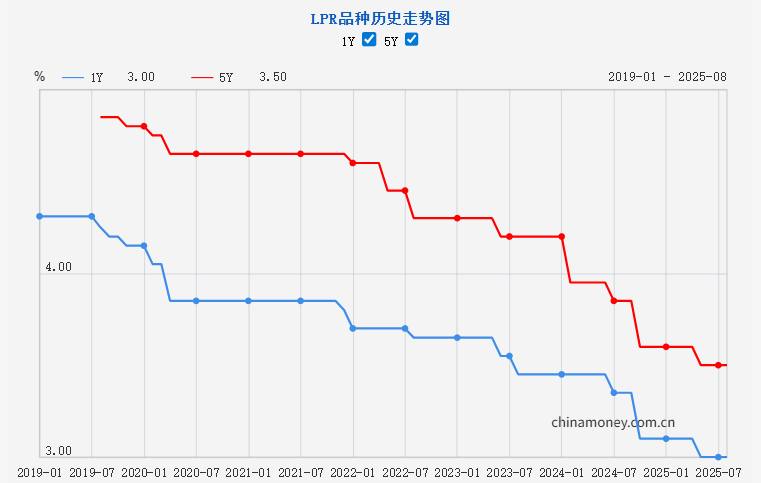
Core Viewpoint - The Loan Prime Rate (LPR) remains unchanged, aligning with market expectations, as the policy interest rates have stabilized, and the impact of recent financial support measures from the central bank needs further observation [1][2] Group 1: LPR and Interest Rates - The LPR for one year is 3.0% and for five years or more is 3.5%, both remaining unchanged for three consecutive months since a decline in May [2] - New corporate loan rates are approximately 3.2%, and new personal housing loan rates are about 3.1%, showing a year-on-year decrease of around 45 basis points and 30 basis points, respectively [1] - The overall financing costs in society are on a downward trend, indicating that a reduction in LPR is not urgent at this time [1] Group 2: Banking Sector Insights - The net interest margin of commercial banks for the first half of the year is 1.42%, reflecting a slight decrease of 0.01 percentage points from the first quarter, indicating low margins and limited motivation for banks to lower LPR quotes [1] - Future adjustments in policy interest rates and LPR quotes may have room for reduction as efforts to boost domestic demand and stabilize the real estate market continue [1]

商业银行二季度不良环比“双降”,净息差及关注类贷款呈现新变化
Bei Ke Cai Jing· 2025-08-18 12:58
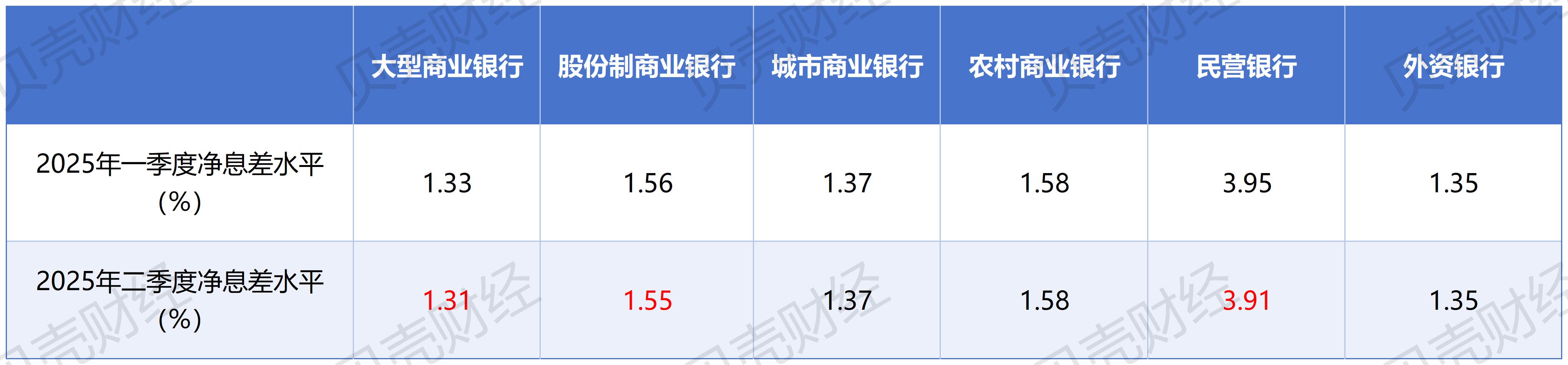
Core Insights - The banking sector in China showed stable performance in the first half of 2025, with a total net profit of 1.2 trillion yuan and a slight decrease in non-performing loans [1][8] - The non-performing loan balance stood at 3.4 trillion yuan, with a non-performing loan ratio of 1.49%, indicating a slight improvement in asset quality [1][8] Summary by Categories Profitability and Asset Quality - Commercial banks achieved a net profit of 1.2 trillion yuan in the first half of 2025, reflecting overall stability in the banking sector [1] - The non-performing loan balance decreased by 24 billion yuan from the previous quarter, while the non-performing loan ratio improved by 0.02 percentage points to 1.49% [1][8] Net Interest Margin - As of the end of June, the net interest margin for commercial banks was 1.42%, a decrease of 0.01 percentage points from the end of March, indicating a continued narrowing trend [3][7] - Private banks, such as WeBank, maintained the highest net interest margin above 3%, while large state-owned banks were close to the 1.3% threshold, with a net interest margin of 1.31% [4][7] Loan Classification and Provisions - Despite a decrease in non-performing loans, the amount of special mention loans increased from 4.95 trillion yuan at the end of March to 5 trillion yuan at the end of June, indicating potential future risks [8] - Loan loss provisions and the loan provision coverage ratio improved compared to the end of March, reflecting a cautious approach to credit risk management [8][10]
一周银行速览(05.16—05.23)
Cai Jing Wang· 2025-05-23 09:02
Regulatory Updates - The Loan Prime Rate (LPR) was lowered for the first time in 2025, with both the 1-year and 5-year LPRs reduced by 10 basis points to 3.00% and 3.50% respectively [1] - A joint initiative by eight regulatory bodies, including the Financial Regulatory Bureau and the People's Bank of China, introduced measures to support financing for small and micro enterprises, focusing on increasing financing supply and reducing costs [2] Banking Sector Performance - In Q1 2025, the net interest margin of commercial banks narrowed to 1.43%, a decrease of 9 basis points from the previous quarter, while the non-performing loan ratio slightly increased to 1.51% [3] - A total of 18 national banks implemented a new round of deposit rate cuts, with significant reductions across various terms, including a drop in the 3-month deposit rate from 0.8% to 0.65% [4] - The A-share banking sector market capitalization surpassed 10 trillion yuan, with the China Securities Bank Index reaching a high of 7751.80 points, supported by high dividends and low valuations [5] Corporate Developments - Ping An Life announced it has acquired a 10% stake in Agricultural Bank of China H-shares, triggering a mandatory disclosure under Hong Kong regulations [6] - Shanghai Bank elected Gu Jianzhong as the chairman of its sixth board of directors [7] - Wang Ming was appointed as the deputy secretary of the Party Committee at Shanghai Rural Commercial Bank, with expectations to become the bank's president [8] - Changsha Bank completed its board of directors' election, with Zhao Xiaozhong re-elected as chairman [10] - Huaxia Bank received approval for Yang Shujian's qualifications as chairman and director [11] Legal and Compliance Issues - The former vice president of China Construction Bank, Zhang Gengsheng, was arrested on charges of bribery and illegal loan issuance, with the case currently under further investigation [12]
1年期跌破1%、活期降至0.05%,新一轮存款利率下调落地
Di Yi Cai Jing· 2025-05-20 03:59
Core Viewpoint - The recent adjustment of deposit rates by major banks indicates a continued trend of lowering interest rates, with significant implications for the banking sector and depositors [1][3][4] Group 1: Deposit Rate Adjustments - Major state-owned banks and some joint-stock banks have lowered their deposit rates, with the most notable changes being a 25 basis point reduction in medium to long-term fixed deposit rates and a drop in the current deposit rate below 0.1% [1][2] - The new rates for major banks include a current deposit rate of 0.05%, and fixed deposit rates for various terms have been adjusted to 0.65% for 3 months, 0.85% for 6 months, 0.95% for 1 year, 1.05% for 2 years, 1.25% for 3 years, and 1.3% for 5 years [1][2] - This marks the seventh time since September 2022 that major banks have proactively lowered their deposit rates, with the last adjustment occurring seven months ago [1][3] Group 2: Impact on Depositors - For a 200,000 yuan deposit over three years, the interest difference due to the recent rate adjustment is 1,500 yuan, while for a 1,000,000 yuan deposit, the difference is 7,500 yuan [2] - The adjustments are expected to lead to a decrease in the overall cost of liabilities for banks, as they continue to focus on reducing deposit rates [2][3] Group 3: Future Expectations - It is anticipated that other joint-stock banks will follow suit in adjusting their deposit rates, although the timing may vary based on internal processes [3] - The space for further adjustments in deposit rates is expected to narrow, particularly as the current deposit rate has reached a historical low of 0.05% [3][4] - The recent adjustments align with the central bank's strategy to guide commercial banks in lowering deposit rates through a self-discipline mechanism [3][4]






央行再提利率风险,短期长端利率波动或有所加大
China Post Securities· 2025-05-13 07:31
Monetary Policy Insights - The central bank maintains a moderately loose monetary policy, shifting from "timely adjustments" to "flexible grasp" of policy implementation, indicating a focus on existing monetary policy rather than new incremental policies[2] - The central bank emphasizes interest rate risks, suggesting potential short-term adjustments in both short-term and long-term bond yields, with the 10-year government bond yield currently in the 1.6%-1.65% range[3] - The central bank's focus on the health of commercial banks may lead to a downward trend in deposit rates, as the net interest margin continues to narrow, impacting the stability of the banking system[4] Credit and Financing - There is an intention to increase credit supply to lower overall financing costs, with a shift towards total credit volume as constraints ease, while promoting consumption remains a key focus of monetary policy[4] - The weighted average interest rate for new loans in Q1 was 3.44%, up by 0.16 percentage points from the end of the previous year, indicating a need for improved efficiency in monetary policy transmission[25] - The report highlights a transition in real estate policy towards optimizing existing policies, particularly focusing on expanding financing support for affordable housing[26] Inflation and Demand - Effective demand improvement is crucial for stabilizing inflation, with fiscal policy expected to be more effective than monetary policy in this context, as current demand remains insufficient[28] - The report notes that the growth rate of social financing and broad money supply (M2) is maintained at 7%-8%, while the CPI growth rate is below 1%, indicating limited effectiveness of monetary policy in stimulating demand[28] Risk Factors - Risks include escalating geopolitical conflicts, unexpected financial crises abroad, and potential adjustments in long-term interest rates[5]