
国际收支平衡

Search documents
香港于Q3录得1365亿港元的国际收支赤字
Zhi Tong Cai Jing· 2025-12-22 09:00
International Balance of Payments - Hong Kong recorded an international balance of payments deficit of HKD 136.5 billion in Q3 2025, equivalent to 16.0% of its GDP, with reserve assets decreasing by the same amount [2][4] - In Q2 2025, Hong Kong had a surplus of HKD 105.5 billion, which was 13.4% of its GDP [2] Current Account - The current account for Q3 2025 showed a surplus of HKD 98.2 billion, representing 11.5% of GDP, indicating that savings exceeded investments [3] - Compared to Q3 2024, where the surplus was HKD 113.2 billion (13.9% of GDP), the decrease was mainly due to a reduction in net primary income inflows, although an increase in service trade surplus partially offset this decline [3] - Goods trade recorded a surplus of HKD 1.5 billion in Q3 2025, improving from a deficit of HKD 0.6 billion in the same period of 2024 [3] - Service trade surplus increased from HKD 38.8 billion to HKD 48.1 billion in Q3 2025 [3] - Primary income inflows and outflows were HKD 576.1 billion and HKD 521.5 billion respectively, resulting in a net inflow of HKD 54.5 billion, down from HKD 80.3 billion in Q3 2024 [3] Financial Account - Non-reserve financial assets saw an overall increase of HKD 271.0 billion in Q3 2025, which is 31.7% of GDP, compared to an increase of HKD 21.1 billion (2.7% of GDP) in Q2 2025 [4] - The overall increase in Q3 2025 was driven by net increases in other investments, securities investments, and financial derivatives, while direct investment net decrease partially offset this growth [4] - Reserve assets decreased by HKD 136.5 billion in Q3 2025, contrasting with an increase of HKD 105.5 billion in Q2 2025 [4] International Investment Position - As of the end of Q3 2025, Hong Kong's total external financial assets and liabilities were at high levels, amounting to HKD 5,958.68 billion (18.2 times GDP) and HKD 3,993.69 billion (12.2 times GDP) respectively [5] - The net value of Hong Kong's external financial assets reached HKD 1,964.99 billion (6.0 times GDP), up from HKD 1,836.47 billion (5.7 times GDP) at the end of Q2 2025 [5] - The ratio of net external financial assets to GDP is among the highest globally, providing a strong buffer against external shocks [5] External Debt - At the end of Q3 2025, Hong Kong's total external debt was HKD 1,574.61 billion (4.8 times GDP), an increase of HKD 28.25 billion from Q2 2025 [6] - The increase in external debt was primarily due to rising external debt in other sectors, along with increases in the banking sector and direct investment debt liabilities [6] - The banking sector accounted for 52.3% of total external debt, while other external debts comprised 29.9% and direct investment debt liabilities made up 16.5% [6]
中国为何此时筑牢虚拟货币防线?从石油到稳定币美元找新锚
Sou Hu Cai Jing· 2025-12-03 14:21
Group 1: Digital Currency Regulations - The U.S. White House has established a presidential task force on digital asset markets while banning the development of central bank digital currencies (CBDCs) within the U.S. [1] - China has intensified its crackdown on virtual currencies, with over 150 cases of money laundering related to virtual currencies reported since 2025, involving amounts exceeding 10 billion RMB [3]. - The People's Bank of China has identified stablecoins as a significant risk, with global cryptocurrency market volatility exceeding 70% in 2025, raising concerns about the transparency and safety of the underlying assets of stablecoins [3]. Group 2: U.S. Debt and Stablecoins - The U.S. federal debt is growing at nearly $2 trillion annually, surpassing $37.2 trillion, with stablecoins being seen as a new anchor for the dollar [4]. - Currently, the global stablecoin market is approximately $267.4 billion, with 95% being dollar-pegged stablecoins, which are heavily invested in short-term U.S. Treasury bonds [4]. - The "Payment Stablecoin Act" mandates that stablecoin issuers must invest 100% of their reserves in U.S. cash or short-term Treasury bonds, creating a mechanism for debt absorption that links stablecoin growth to U.S. debt demand [4]. Group 3: Historical Context and Future Outlook - The evolution of the dollar's anchoring mechanisms has transitioned from the gold standard established in 1944 to the current reliance on stablecoins, with over 98% of stablecoin market value pegged to the dollar [5]. - The U.S. is working on establishing a "digital dollar anchor," as emerging digital economic scenarios increasingly depend on this framework [5]. - The competition between the U.S. and China in the digital currency space is expected to deepen over the next five years as dollar stablecoins approach the trillion-dollar mark [8]. Group 4: Strategic Considerations for China - China's recent actions to strengthen its defenses against virtual currencies reflect strategic considerations, including the potential financial risks associated with the deep integration of U.S. stablecoins and Treasury bonds [6]. - Cross-border capital flows through virtual currencies have increased by 150% in 2024, posing new challenges for traditional regulatory measures [6]. - The internationalization of the renminbi is at a critical stage, with cross-border trade settlements in renminbi surpassing 31.5% in Q3 2024, necessitating measures to prevent stablecoin systems from creating barriers to this process [6]. Group 5: Digital Currency Initiatives in China - The pilot program for China's digital currency has expanded to 26 regions, covering various scenarios such as cross-border trade and supply chain finance [7]. - China is actively participating in the formulation of international digital currency regulations while balancing risk management and cooperation [7]. - The approval of 16 virtual asset service providers in Hong Kong since 2023 supports China's differentiated strategy of strict domestic regulation while piloting overseas [7].


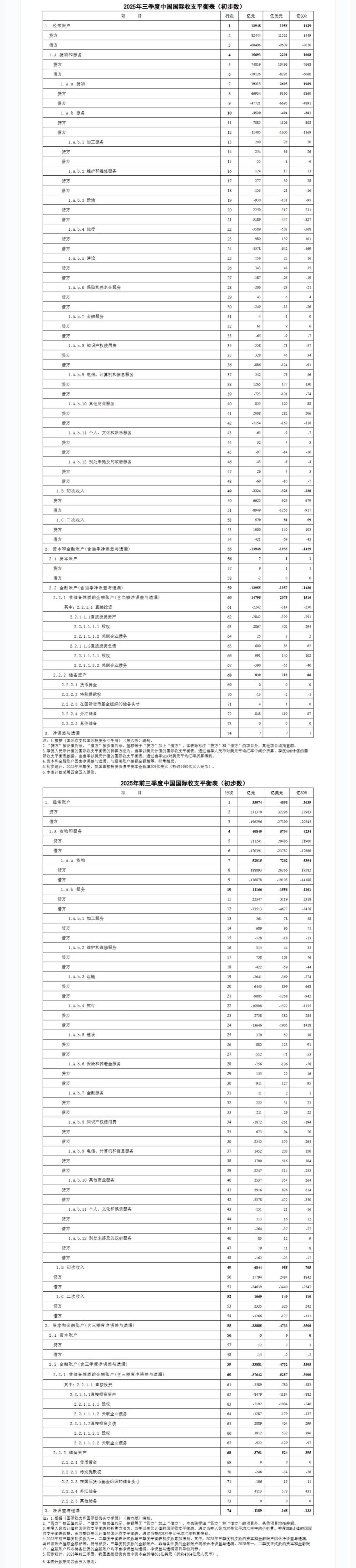
三季度我国经常账户顺差13948亿元 来华直接投资保持净流入
Zhong Guo Jing Ji Wang· 2025-11-10 06:15
Core Insights - In Q3 2025, China's current account surplus was 1.3948 trillion yuan, driven by a goods trade surplus of 1.9213 trillion yuan, while the capital and financial account recorded a deficit of 1.3948 trillion yuan [1][2] - For the first three quarters of 2025, the current account surplus reached 3.5074 trillion yuan, with a goods trade surplus of 5.2015 trillion yuan, and a capital and financial account deficit of 3.3885 trillion yuan [1][2] Summary by Categories Current Account - Q3 2025 current account surplus: 1.3948 trillion yuan (195.6 billion USD) [1] - Goods trade surplus in Q3 2025: 1.9213 trillion yuan (269.5 billion USD) [1] - Service trade deficit in Q3 2025: 352 billion yuan (49.4 billion USD) [1] - First three quarters 2025 current account surplus: 3.5074 trillion yuan (489.8 billion USD) [2] - Goods trade surplus for the first three quarters: 5.2015 trillion yuan (726.2 billion USD) [2] Capital and Financial Account - Q3 2025 capital and financial account deficit: 1.3948 trillion yuan (195.6 billion USD) [1] - First three quarters 2025 capital and financial account deficit: 3.3885 trillion yuan (473.3 billion USD) [2]
三季度我国经常账户顺差13948亿元
Jin Rong Shi Bao· 2025-11-10 01:26
Core Insights - The State Administration of Foreign Exchange of China reported a current account surplus of 13,948 billion yuan for Q3 2025, driven by a goods trade surplus of 19,213 billion yuan, despite service and primary income deficits [1] - For the first three quarters of 2025, the current account surplus reached 35,074 billion yuan, with a goods trade surplus of 52,015 billion yuan, indicating strong trade performance [1][2] - The capital and financial account showed a deficit of 13,948 billion yuan in Q3 2025, with net inflows from foreign direct investment into China [1] Summary by Categories Current Account - In Q3 2025, the current account surplus was 13,948 billion yuan, equivalent to 1,956 billion USD, with a goods trade surplus of 19,213 billion yuan (2,695 billion USD) [1] - For the first three quarters of 2025, the current account surplus totaled 35,074 billion yuan (4,898 billion USD), with a goods trade surplus of 52,015 billion yuan (7,262 billion USD) [2] Trade Balances - Q3 2025 saw a service trade deficit of 3,520 billion yuan and a primary income deficit of 2,324 billion yuan, while the secondary income recorded a surplus of 579 billion yuan [1] - In the first three quarters of 2025, the service trade deficit was 11,166 billion yuan, and the primary income deficit was 6,844 billion yuan, with a secondary income surplus of 1,069 billion yuan [1][2] Capital and Financial Account - The capital and financial account recorded a deficit of 13,948 billion yuan in Q3 2025, including net errors and omissions [1] - For the first three quarters of 2025, the capital and financial account deficit was 33,885 billion yuan, indicating significant outflows [1][2]
初步数据:前三季度我国经常账户顺差35074亿元
Xin Hua Wang· 2025-11-07 11:39
Core Viewpoint - The State Administration of Foreign Exchange of China reported a preliminary balance of international payments for the first three quarters of this year, indicating a significant current account surplus. Group 1: Current Account Overview - In the first three quarters of this year, China's current account surplus reached 35,074 billion yuan [1] - In USD terms, the current account surplus amounted to 4,898 million USD [1] Group 2: Trade Balance - The goods trade surplus was 52,015 billion yuan, while the services trade recorded a deficit of 11,166 billion yuan [1] - In USD, the goods trade surplus was 7,262 million USD, and the services trade deficit was 1,558 million USD [1] Group 3: Income Balance - The primary income recorded a deficit of 6,844 billion yuan, while the secondary income showed a surplus of 1,069 billion yuan [1] - In USD, the primary income deficit was 955 million USD, and the secondary income surplus was 149 million USD [1]
【金融街发布】国家外汇局:前三季度我国经常账户顺差35074亿元
Xin Hua Cai Jing· 2025-11-07 10:09
Core Insights - The State Administration of Foreign Exchange of China reported preliminary data on the international balance of payments for the third quarter and the first three quarters of 2025, indicating a significant surplus in the current account [1][2]. Group 1: Current Account Overview - In Q3 2025, China's current account surplus was 13,948 billion yuan, with a goods trade surplus of 19,213 billion yuan, a services trade deficit of 3,520 billion yuan, a primary income deficit of 2,324 billion yuan, and a secondary income surplus of 579 billion yuan [1]. - For the first three quarters of 2025, the current account surplus reached 35,074 billion yuan, with a goods trade surplus of 52,015 billion yuan, a services trade deficit of 11,166 billion yuan, a primary income deficit of 6,844 billion yuan, and a secondary income surplus of 1,069 billion yuan [1]. Group 2: Capital and Financial Account - In Q3 2025, the capital and financial account (including net errors and omissions) recorded a deficit of 13,948 billion yuan, while direct investment into China maintained a net inflow [1]. - For the first three quarters of 2025, the capital and financial account (including net errors and omissions) showed a deficit of 33,885 billion yuan [1]. Group 3: USD Valuation - In USD terms, the current account surplus for Q3 2025 was 1,956 billion USD, with a goods trade surplus of 2,695 billion USD, a services trade deficit of 494 billion USD, a primary income deficit of 326 billion USD, and a secondary income surplus of 81 billion USD [1]. - For the first three quarters of 2025, the current account surplus was 4,898 billion USD, with a goods trade surplus of 7,262 billion USD, a services trade deficit of 1,558 billion USD, a primary income deficit of 955 billion USD, and a secondary income surplus of 149 billion USD [2]. Group 4: SDR Valuation - In terms of Special Drawing Rights (SDR), the current account surplus for Q3 2025 was 1,429 billion SDR, with a goods trade surplus of 1,969 billion SDR, a services trade deficit of 361 billion SDR, a primary income deficit of 238 billion SDR, and a secondary income surplus of 59 billion SDR [2]. - For the first three quarters of 2025, the current account surplus was 3,639 billion SDR, with a goods trade surplus of 5,394 billion SDR, a services trade deficit of 1,161 billion SDR, a primary income deficit of 705 billion SDR, and a secondary income surplus of 110 billion SDR [2].

国家外汇局:三季度我国经常账户顺差13948亿元 来华直接投资保持净流入
Mei Ri Jing Ji Xin Wen· 2025-11-07 09:57
Core Viewpoint - The State Administration of Foreign Exchange of China released preliminary data on the international balance of payments for the third quarter and the first three quarters of 2025, indicating significant trends in China's current account and capital account [1] Group 1: Current Account - In the third quarter of 2025, China's current account surplus reached 1.3948 trillion yuan, driven by a goods trade surplus of 1.9213 trillion yuan [1] - The service trade recorded a deficit of 352 billion yuan, while the primary income showed a deficit of 232.4 billion yuan [1] - The secondary income balance resulted in a surplus of 57.9 billion yuan [1] Group 2: Capital and Financial Account - The capital and financial account, including net errors and omissions for the quarter, reported a deficit of 1.3948 trillion yuan [1] - Direct investment into China maintained a net inflow, indicating continued foreign interest in the Chinese market [1]
国家外汇管理局:三季度我国经常账户顺差13948亿元
智通财经网· 2025-11-07 09:24
Core Insights - The State Administration of Foreign Exchange (SAFE) released preliminary data on China's international balance of payments for the third quarter and the first three quarters of 2025, indicating a current account surplus of 13,948 billion yuan in Q3 2025 [1][2]. Group 1: Current Account - In Q3 2025, China's current account surplus was 13,948 billion yuan, with a goods trade surplus of 19,213 billion yuan, a services trade deficit of 3,520 billion yuan, a primary income deficit of 2,324 billion yuan, and a secondary income surplus of 579 billion yuan [2][3]. - For the first three quarters of 2025, the current account surplus reached 35,074 billion yuan, with a goods trade surplus of 52,015 billion yuan and a services trade deficit of 11,166 billion yuan [2][3]. Group 2: Capital and Financial Account - The capital and financial account recorded a deficit of 13,948 billion yuan in Q3 2025, with net inflows from foreign direct investment into China [2][3]. - For the first three quarters of 2025, the capital and financial account showed a deficit of 33,885 billion yuan [2][3]. Group 3: USD and SDR Valuation - In USD terms, the current account surplus for Q3 2025 was 1,956 million USD, with a goods trade surplus of 2,695 million USD and a services trade deficit of 494 million USD [2][3]. - The current account surplus for the first three quarters of 2025 was 4,898 million USD, with a goods trade surplus of 7,262 million USD [2][3]. - In terms of Special Drawing Rights (SDR), the current account surplus for Q3 2025 was 1,429 million SDR, with a goods trade surplus of 1,969 million SDR [3][4].
国际收支平衡、服务实体经济、推进高水平开放—— 三个视角看外汇市场五年新变化
Sou Hu Cai Jing· 2025-11-04 00:51
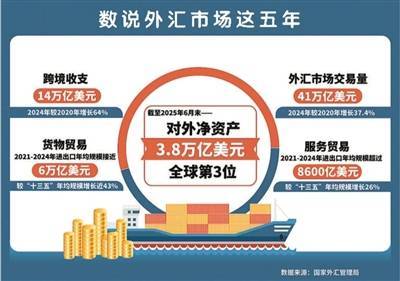
Core Insights - The cross-border payment and settlement scale in China has reached a historical high, with a total of $14 trillion expected by 2024, marking a 64% increase from 2020 [4][6] - The cross-border payment and settlement total for the first three quarters of this year reached $11.6 trillion, reflecting a year-on-year growth of 10.5% [4][6] - The "14th Five-Year Plan" period has seen a significant increase in the scale and stability of China's cross-border payments, with an average annual growth rate of 8 percentage points higher than the previous five-year period [4][6] Trade and Economic Activity - The average annual growth rate of foreign trade in Gansu Province has reached 13.9% since 2021, with the total import and export value expected to exceed 60 billion yuan for the first time in nearly a decade in 2024 [6] - The average annual scale of service trade imports and exports has exceeded $860 billion during the "14th Five-Year Plan" period, representing a 26% increase compared to the previous five-year period [7] Financial Market Developments - As of June 2025, China's foreign financial assets exceeded $11 trillion, while foreign liabilities surpassed $7.2 trillion, indicating a 25% and 10% increase respectively since the end of 2020 [8] - The implementation of a dual management framework for foreign exchange markets has enhanced the stability and optimization of international payments [8] Service Trade Improvements - The introduction of facilitation policies has significantly improved the efficiency of cross-border fund settlements for enterprises, with a reported 3,000 transactions amounting to over $64 million completed in the first half of the year [9][10] - The development of cross-border e-commerce has become a new driving force for foreign trade growth, with over 130,000 small and micro businesses benefiting from improved foreign exchange services [11] Open Market Initiatives - The issuance of Panda bonds by foreign institutions in China's interbank bond market has expanded, with cumulative issuance exceeding 1 trillion yuan [12] - Reforms to the Qualified Foreign Institutional Investor (QFII) and Renminbi Qualified Foreign Institutional Investor (RQFII) systems have simplified approval processes and enhanced cross-border capital management [13][14]
国际收支平稳运行有支撑
Jing Ji Ri Bao· 2025-10-21 00:38
Core Viewpoint - The international financial market has experienced increased volatility this year, but China's foreign exchange market has shown resilience and stability, maintaining a basic balance in international payments [1][2]. Group 1: International Balance of Payments - In the first half of the year, China's current account surplus reached 21,126 billion yuan, while the capital and financial account recorded a deficit of 19,936 billion yuan, indicating a reasonable equilibrium [1]. - The current account surplus reflects net income from exports, which leads to capital outflows through investments, thus the capital and financial account deficit should not be simply interpreted as capital flight [1]. Group 2: Economic Fundamentals - The stability of the international balance of payments supports currency stability, enhances international competitiveness, and promotes economic development, which are key macroeconomic objectives [2]. - China's economic foundation remains strong, with a focus on expanding domestic demand as a long-term strategy, supported by proactive fiscal policies and moderately loose monetary policies [2]. Group 3: Foreign Exchange Market Dynamics - The maturity of the foreign exchange market and improved regulatory capabilities are crucial for mitigating external risks [3]. - The foreign exchange market has become more stable, with the marketization of the RMB exchange rate mechanism improving, leading to increased exchange rate flexibility [3]. - Future developments in foreign trade and foreign investment are expected to be positively influenced by a more convenient, open, secure, and intelligent foreign exchange management system [3].