
大宗商品指数再平衡

Search documents
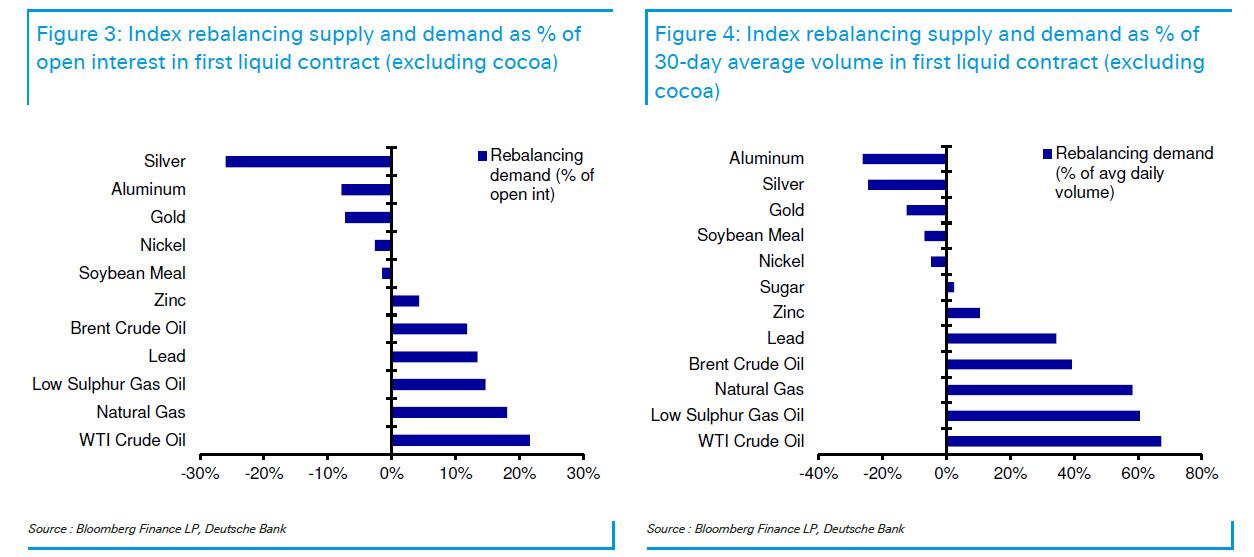
重要商品指数再平衡周五开启,两大投行预言“白银两周内调整”,高盛“关键还是伦敦”
Hua Er Jie Jian Wen· 2026-01-08 00:26
Core Viewpoint - The Bloomberg Commodity Index (BCOM) is set to undergo annual rebalancing, leading to significant selling pressure on silver, with an estimated $7.7 billion in silver sell orders expected to enter the market over the next two weeks, equating to 13% of the total open interest in the COMEX silver market [1][6][7]. Group 1: Rebalancing Impact - The rebalancing will reduce the weight of gold from 20.4% to 14.9%, with silver also facing a weight reduction [1][2]. - Deutsche Bank's analysis indicates that silver will experience the largest selling pressure during the rebalancing period, followed by aluminum and gold [2]. - The rebalancing period is scheduled from January 9 to January 15 [1]. Group 2: Market Dynamics - TD Securities highlights that the trading volume of the largest silver ETF has reached extreme levels, typically seen only at market peaks, indicating speculative fervor among retail investors [1][6]. - The report suggests that the recent surge in silver prices is not reflective of demand or supply fundamentals, but rather a speculative bubble that may lead to significant price corrections [6]. Group 3: Supply and Demand Factors - Goldman Sachs presents a contrasting view, emphasizing that liquidity in the London market is crucial for determining silver price movements. They predict that extreme price volatility will persist as long as the tight inventory situation in London remains unresolved [1][8]. - The tight inventory in London has led to increased borrowing costs for physical silver, indicating a supply squeeze [9][11]. Group 4: Future Price Projections - Goldman Sachs notes that lower inventory levels have created conditions for price squeezes, with sensitivity to demand changes significantly heightened during tight supply situations [11]. - If liquidity in London improves, there could be a notable downside risk for silver prices, especially if silver currently held in the U.S. returns to London, alleviating the tightness [12].


国新国证期货早报-20260107
Guo Xin Guo Zheng Qi Huo· 2026-01-07 01:48
Report Summary 1. Overall Market Performance on January 6, 2026 - A-shares showed strong performance, with the Shanghai Composite Index achieving a 13-day consecutive increase, reaching a new high since July 2015. The Shanghai Composite Index rose 1.50% to close at 4083.67, the Shenzhen Component Index rose 1.40% to 14022.55, and the ChiNext Index rose 0.75% to 3319.29. The trading volume of the two markets reached 28326 billion yuan, an increase of 2651 billion yuan from the previous day [1]. - The CSI 300 Index remained strong, closing at 4790.69, a increase of 72.95 [2]. 2. Futures Market Conditions 2.1. Stock Index Futures - The A-share market's strong performance led to positive sentiment in the stock index futures market [1]. 2.2. Coke and Coking Coal Futures - Coke: The weighted index showed narrow - range fluctuations, closing at 1654.7, a decrease of 11.8. Four consecutive rounds of price cuts have been implemented, and the market may discuss a fifth - round cut. The profit of coking enterprises is mostly at the break - even point, and the expected loss area of coking enterprises may expand [2][4]. - Coking Coal: The weighted index was slightly adjusted, closing at 1096.2 yuan, a decrease of 0.1. After the New Year's Day, the customs clearance volume of Mongolian coal quickly recovered, while the domestic mine operating rate decreased as expected. The pit - mouth auction situation improved marginally, and steel and coking enterprises replenished stocks appropriately [3][4]. 2.3. Zhengzhou Sugar Futures - Affected by factors such as the rebound of US sugar and the increase in spot prices, the Zhengzhou Sugar 2605 contract closed slightly higher on Tuesday. Due to the influence of funds, it continued to rise at night. Traders expect commodity index funds to buy a large amount of sugar during the annual re - balancing period starting on January 8 [4]. 2.4. Rubber Futures - Affected by the weather warning in Thailand's rubber - producing areas and the increase in global capital markets, the spot price in Southeast Asia increased. The Shanghai Rubber futures contract closed slightly higher on Tuesday and continued to rise at night. The total inventory at Qingdao Port continued to accumulate last week [4][5]. 2.5. Palm Oil Futures - On January 6, palm oil fluctuated in a narrow range, closing at 8500, a 0.14% increase from the previous day. From January 1 - 5, 2026, Malaysia's palm oil production decreased by 34.48% compared with the same period last month, while exports increased by 31.12% [5]. 2.6. Soybean Meal Futures - Internationally, CBOT soybean futures closed slightly lower on January 6. Brazil's soybean production is expected to be high, and Argentina's soybean sowing progress is good, strengthening the expectation of a loose global soybean supply. Domestically, the soybean meal main contract M2605 closed at 2776 yuan/ton, a 0.8% increase. The soybean inventory of oil mills increased slightly last week, and the soybean meal inventory decreased [5]. 2.7. Live Pig Futures - The live pig main contract LH2603 closed at 11810 yuan/ton on January 6, a 1.29% increase. The supply pressure at the beginning of January decreased, and the demand side was strong, but the long - term supply pressure has not been fundamentally alleviated [5]. 2.8. Shanghai Copper Futures - The main contract of Shanghai Copper reached a new high, with both trading volume and open interest increasing. The macro - environment is favorable, and the supply at the mine end is tight, but there are risks of weak downstream demand and inventory accumulation [5][6]. 2.9. Cotton Futures - The main contract of Zhengzhou Cotton closed at 15030 yuan/ton at night on Monday. Cotton spinning enterprises purchase cautiously, and the cotton inventory increased by 706 lots compared with the previous trading day [6]. 2.10. Iron Ore Futures - The iron ore 2605 main contract closed up 0.69% at 801 yuan on January 6. The global iron ore shipment is at a high level, and the port inventory is accumulating. The iron ore price is expected to fluctuate in the short term [6]. 2.11. Asphalt Futures - The asphalt 2602 main contract closed down 0.35% at 3144 yuan on January 6. The supply of asphalt from local refineries is expected to decrease in January, and the raw material supply is uncertain, but the price will fluctuate due to weak downstream demand [6]. 2.12. Log Futures - The log 2603 main contract opened at 771, closed at 774, and increased its open interest by 25 lots. The spot prices in Shandong and Jiangsu remained unchanged [6][7]. 2.13. Alumina Futures - The ao2605 contract closed at 2818 yuan/ton on January 6. The supply decreased due to the maintenance of a roasting furnace in Guizhou, and the demand from Inner Mongolia's electrolytic aluminum enterprises was limited. The market trading was dull [7]. 2.14. Shanghai Aluminum Futures - The al2602 contract closed at 24335 yuan/ton on January 6. The macro - environment is favorable, but the downstream demand is weakening [7]. 2.15. Steel Futures - The rb2605 contract closed at 3111 yuan/ton, and the hc2605 contract closed at 3263 yuan/ton on January 6. The iron ore inventory at Australian and Brazilian ports increased, and some steel mills are expected to resume production in January. The steel market supply - demand pressure may increase, and the steel price may fluctuate weakly in the short term [7][8]
黄金:成基石资产,2025再平衡或引短期波动
Sou Hu Cai Jing· 2025-12-18 06:23
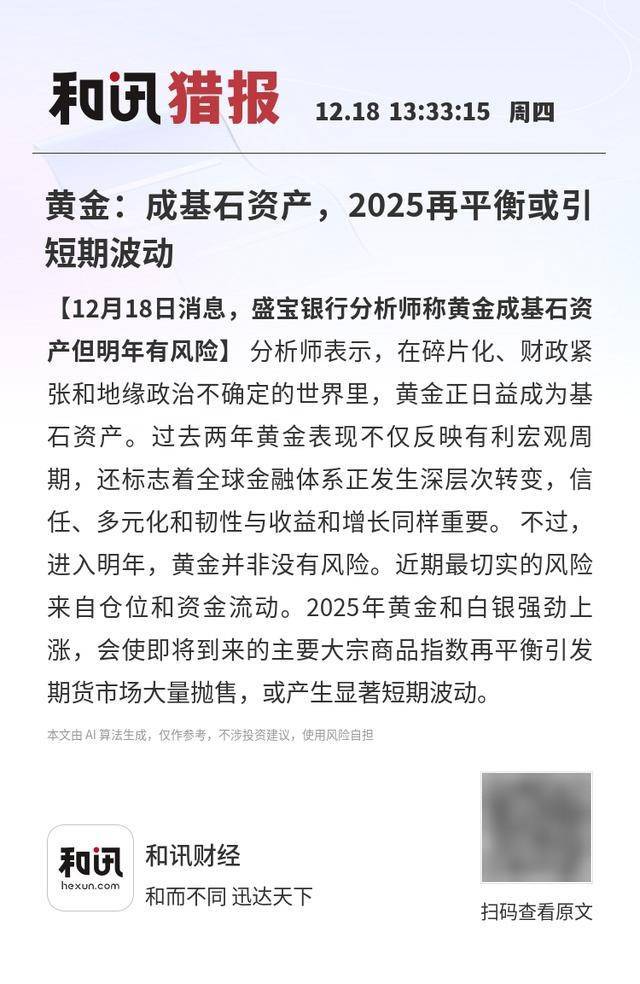
【12月18日消息,盛宝银行分析师称黄金成基石资 产但明年有风险】分析师表示,在碎片化、财政紧 张和地缘政治不确定的世界里,黄金正日益成为基 石资产。过去两年黄金表现不仅反映有利宏观周 期,还标志着全球金融体系正发生深层次转变,信 任、多元化和韧性与收益和增长同样重要。 不过, 进入明年,黄金并非没有风险。近期最切实的风险 来自仓位和资金流动。2025年黄金和白银强劲上 涨,会使即将到来的主要大宗商品指数再平衡引发 期货市场大量抛售,或产生显著短期波动。 本文由 Al 算法生成,仅作参考,不涉投资建议,使用风险自担 和讯财经 和而不同 迅达天下 【12月18日消息,盛宝银行分析师称黄金成基石资产但明年有风险】分析师表示,在碎片化、财政紧张 和地缘政治不确定的世界里,黄金正日益成为基石资产。过去两年黄金表现不仅反映有利宏观周期,还 标志着全球金融体系正发生深层次转变,信任、多元化和韧性与收益和增长同样重要。 不过,进入明 年,黄金并非没有风险。近期最切实的风险来自仓位和资金流动。2025年黄金和白银强劲上涨,会使即 将到来的主要大宗商品指数再平衡引发期货市场大量抛售,或产生显著短期波动。 本文由 AI算法生成, ...
黄金多头结构未破坏 反弹力度或来袭
Jin Tou Wang· 2025-12-18 06:04
Group 1 - The core viewpoint of the articles indicates that gold is increasingly becoming a cornerstone asset in a fragmented, fiscally constrained, and geopolitically uncertain world, reflecting deeper transformations in the global financial system [1] - Recent performance of gold is not only indicative of a favorable macro cycle but also highlights the importance of trust, diversification, and resilience alongside returns and growth [1] - The upcoming major commodity index rebalancing is expected to trigger significant selling in the futures market, potentially leading to notable short-term volatility in gold prices [1] Group 2 - From a technical perspective, if bullish pressure intensifies, liquidity above recent highs could push gold prices higher, with potential further upside if prices break and hold above $4344-$4350 [2] - The overall technical structure remains bullish, with prices consistently above the 100-day moving average, indicating effective mid-term trend support [2] - If gold prices successfully rise above the upper Bollinger Band near $4350, there is a possibility of challenging historical highs around $4380 and further approaching the psychological level of $4400 [2]