大宗商品指数再平衡

Search documents
白银短线拉升,有机构已开始做空
21世纪经济报道· 2026-01-09 14:44
Core Viewpoint - The silver market has experienced significant volatility since the beginning of the year, with prices reaching a historical high of $82.744 per ounce on January 6, followed by a sharp decline due to the Bloomberg Commodity Index's annual weight adjustment, which reduced the increase from 15% to 4% since 2026. However, buying interest has led to a rebound, with prices around $78.8 per ounce as of January 9 [1][3]. Group 1: Market Dynamics - The Bloomberg Commodity Index, a widely used benchmark in the commodity investment field, had an asset scale nearing $109 billion as of October 2025. The annual weight adjustment period for 2026 is from January 8 to 14, with silver's weight in the index reduced from 9% to just below 4%, leading to significant selling pressure [5]. - Citigroup estimates that the total sell-off for both gold and silver will be around $7 billion, with silver's asset management scale (AUM) at $12.9 billion and a target of $6 billion [5]. - Morgan Stanley has quantified the sell-off pressure on silver for 2026, indicating it will be more significant than in 2025, with silver facing the heaviest selling pressure compared to gold [5]. Group 2: Seasonal Trends and Technical Adjustments - January is traditionally a month of intense market dynamics for gold, with an 80% probability of price increases during the last ten trading days of the previous year and the first twenty of the new year. However, the technical sell-off due to index weight adjustments may counteract this seasonal trend [6]. - The Chicago Mercantile Exchange (CME) has raised margin requirements for precious metals multiple times, with the latest adjustment on January 8, aimed at ensuring adequate collateral coverage amid market volatility [6][7]. Group 3: Investor Sentiment and Positioning - Some investors are positioning themselves for a decline in silver prices, with analysts from TD Securities establishing short positions, anticipating significant selling pressure due to the Bloomberg Commodity Index's reweighting [10]. - Despite recent volatility, the overall sentiment for the precious metals sector in 2026 remains optimistic, with analysts suggesting that any weakness in silver could present buying opportunities [11][12]. Group 4: Supply and Demand Fundamentals - The World Silver Institute reports an average annual supply-demand gap of over 130 million ounces since 2021, totaling nearly 800 million ounces, which is equivalent to two years of global mine production. This gap is being filled by depleting inventories, which are at a ten-year low across major markets [14]. - The macroeconomic environment, including dovish signals from the Federal Reserve and new regulations in India that may boost silver demand, suggests that silver still has potential for strength in 2026, despite short-term volatility [13][14].


开年坐“过山车”:指数调整引白银急跌 机构多空博弈加剧
2 1 Shi Ji Jing Ji Bao Dao· 2026-01-09 09:57
Core Viewpoint - The silver market has experienced significant volatility since the beginning of the year, with prices reaching a historical high of $82.744 per ounce before a sharp decline due to the Bloomberg Commodity Index's annual weight adjustment. Despite short-term fluctuations, the overall bullish trend for silver remains intact, supported by global market instability and expectations of Federal Reserve rate cuts [1]. Group 1: Market Dynamics - The Bloomberg Commodity Index, a widely used benchmark in the commodity investment field, had an asset size nearing $109 billion as of October 2025. The annual weight adjustment period for 2026 is from January 8 to 14, with silver's weight in the index being reduced from 9% to just below 4% [2]. - Citigroup estimates that the sell-off for both gold and silver will amount to approximately $7 billion, with silver's asset management scale being reduced from $12.9 billion to a target of $6 billion [2]. - Morgan Stanley has quantified the sell-off pressure on silver, indicating it will face more significant selling pressure in 2026 compared to 2025, while gold's sell-off is expected to account for about 3% of its total open interest in the futures market [2]. Group 2: Seasonal Trends and Technical Adjustments - January is traditionally a month of intense market dynamics for gold investors, with an 80% probability of price increases during the last ten trading days of the previous year and the first twenty trading days of the new year. However, the large-scale technical sell-off due to index weight adjustments may counteract this seasonal trend [3]. - The Chicago Mercantile Exchange (CME) has raised the margin requirements for various precious metal futures, including silver, for the third time in a month, indicating increased market volatility and potential profit-taking [3]. - The Shanghai Futures Exchange has implemented multiple risk control measures for silver futures, including adjustments to margin ratios and trading limits, aimed at curbing speculative trading and promoting rational investment [4]. Group 3: Investor Sentiment and Positioning - Some institutions are positioning themselves to short silver, anticipating significant sell-off pressure due to the Bloomberg Commodity Index's reweighting. Analysts from TD Securities have established short positions in silver futures, expecting prices to drop significantly in the coming months [6][7]. - Despite recent price volatility, the overall sentiment in the market remains optimistic for the precious metals sector in 2026, with analysts suggesting that any weakness in silver could present buying opportunities [8]. - The silver market is expected to benefit from macroeconomic factors, including dovish signals from the Federal Reserve and new regulations in India that may increase demand for silver [8]. Group 4: Supply and Demand Fundamentals - The silver market has been facing a significant supply-demand gap, with an average annual shortfall of over 130 million ounces since 2021, leading to a cumulative deficit of nearly 800 million ounces [9]. - The current low inventory levels in major markets such as London, New York, and Shanghai, which have reached a ten-year low, further highlight the supply constraints in the silver market [9]. - The historical gold-silver ratio suggests that silver may have more upside potential compared to gold, with analysts projecting that if the ratio returns to historical lows, silver prices could reach as high as $135 per ounce or even $309 per ounce under extreme conditions [9].
重要商品指数再平衡开启,两大投行预言“白银两周内调整”,高盛“关键还是伦敦”
3 6 Ke· 2026-01-09 02:19
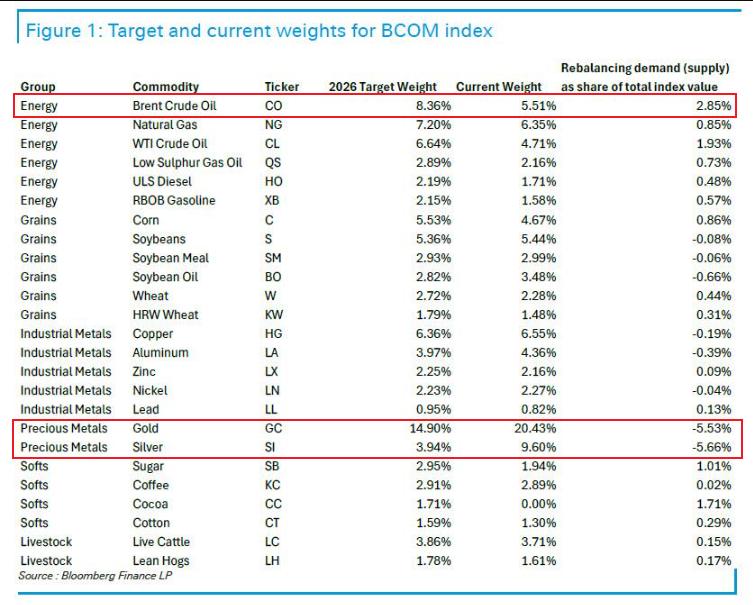
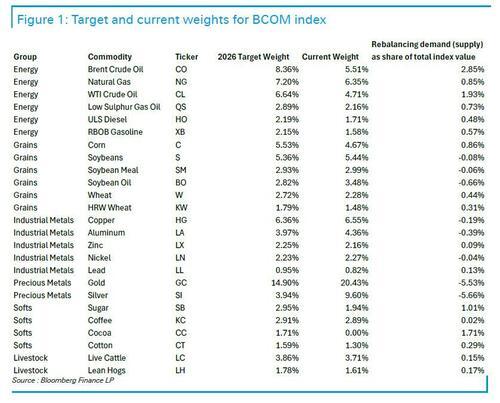
Core Viewpoint - The Bloomberg Commodity Index (BCOM) will undergo annual rebalancing, significantly reducing the weight of gold from 20.4% to 14.9% and silver from 9.6% to 3.94%, leading to substantial selling pressure on silver [1][2]. Group 1: Rebalancing Details - The rebalancing period will start after market close on January 8 and continue until January 14, with execution from January 9 to 15 [1]. - The BCOM index weights are calculated based on two-thirds trading volume and one-third global production, with a maximum weight limit of 15% for any single commodity to maintain diversification [1]. Group 2: Market Impact - Deutsche Bank and TD Securities estimate that $7.7 billion in silver sell orders will flood the market over the next two weeks, equating to 13% of the total open interest in the COMEX silver market, potentially causing significant price corrections [2][3]. - Silver is expected to experience the highest selling pressure during the rebalancing, followed by aluminum and gold, while WTI crude oil, natural gas, and low-sulfur diesel will see increased buying demand [4][5]. Group 3: Analyst Perspectives - Deutsche Bank analyst Michael Hsueh noted that the rebalancing is unfavorable for precious metals but beneficial for crude oil [3][4]. - TD Securities analyst Daniel Ghali highlighted that the trading volume of the largest silver ETF has reached extreme levels, indicating speculative fervor among retail investors, which may lead to a significant revaluation of silver prices [9]. - Goldman Sachs analyst Lina Thomas emphasized that liquidity in the London market is crucial for determining silver price trends, predicting continued extreme price volatility as long as inventory tightness persists [10][11].
特朗普宣布!军工股暴涨
Zhong Guo Ji Jin Bao· 2026-01-08 16:48
Group 1: Market Overview - The U.S. stock market showed mixed performance, with the Dow Jones rising over 100 points, while the Nasdaq index, heavily weighted by technology stocks, declined [2] - Chinese assets experienced a significant rally, with the Chinese concept stock index rising over 1%, and both major Hong Kong indices also increasing [3] Group 2: Defense Sector Performance - Defense stocks surged, with companies like Lockheed Martin, Northrop Grumman, and Kratos Defense & Security Solutions seeing substantial price increases [4] - Former President Trump proposed increasing the defense budget to $1.5 trillion by 2027, emphasizing the need for a strong military in a volatile global environment [5] Group 3: Technology Sector Performance - The Nasdaq index faced pressure primarily due to declines in major technology stocks, with the Nasdaq 100 index dropping by 1% as Nvidia and Apple saw significant losses [6] - Notable declines in the semiconductor sector included Sandisk down 11.75%, Micron Technology down 5.12%, and Intel down 3.70% [7] Group 4: Investor Sentiment and Economic Indicators - Investors are cautious ahead of the upcoming earnings season and the U.S. non-farm payroll data, with expectations of at least two rate cuts of 25 basis points each [6][8] - Concerns over geopolitical risks and regional security issues are influencing market positioning, leading to a more cautious approach among investors [8]

白银提前大跳水?一文了解将发生什么
凤凰网财经· 2026-01-08 15:09
Core Viewpoint - The article discusses the anticipated negative impact on precious metals, particularly gold and silver, due to the annual rebalancing of the Bloomberg Commodity Index (BCOM), which is expected to lead to significant sell-offs in these commodities [1][3][5]. Group 1: BCOM Rebalancing Impact - The BCOM rebalancing is set to occur from January 9 to January 15, with a focus on adjusting the weights of various commodities based on trading volume and global production [5]. - Gold's weight in the BCOM is expected to decrease from 20.4% to 14.9%, while silver's weight will drop from 9.6% to 3.94%, indicating a substantial sell-off in these metals [3][5]. - The rebalancing will result in the largest supply increases for silver, aluminum, and gold, while demand increases will be most significant for WTI crude oil, natural gas, and low-sulfur diesel [5][6]. Group 2: Historical Context and Price Correlation - Historical data shows that significant weight changes in the BCOM have generally correlated with price movements of the respective commodities, with the exception of gold in the previous year, where a weight reduction coincided with a price increase [9]. - The article references past rebalancing events and their effects on commodity prices, highlighting that the adjustments often lead to similar directional price changes [8][9].
重要商品指数再平衡今日开启,两大投行预言“白银两周内调整”,高盛“关键还是伦敦”
华尔街见闻· 2026-01-08 12:18
Core Viewpoint - The upcoming annual rebalancing of the Bloomberg Commodity Index (BCOM) will significantly reduce the weight of gold from 20.4% to 14.9% and silver from 9.6% to 3.94%, leading to substantial selling pressure on silver [1][2]. Group 1: Rebalancing Impact - Deutsche Bank and TD Securities estimate that $7.7 billion worth of silver will flood the market in the next two weeks, equating to 13% of the total open interest in the COMEX silver market, which may trigger a significant price correction [2][10]. - The rebalancing process is expected to unfold over several days, not just one, indicating a prolonged period of selling pressure on precious metals, particularly silver [5]. Group 2: Market Reactions - Analysts from Deutsche Bank suggest that the rebalancing will negatively impact precious metals while benefiting crude oil [3][5]. - TD Securities highlights that the trading volume of the largest silver ETF has reached extreme levels, typically seen only at market peaks, indicating speculative fervor among retail investors [3][10]. Group 3: Supply and Demand Dynamics - Goldman Sachs emphasizes that liquidity in the London market is crucial for determining silver price trends, with tight inventory conditions likely to lead to extreme price volatility [4][12]. - The current tightness in the London market is exacerbated by speculative activities surrounding U.S. trade policies, which have led to a significant outflow of silver from London inventories [12][13]. Group 4: Price Sensitivity - Deutsche Bank estimates that a sale of 2.4 million ounces of gold could lead to a price drop of 2.5%-3.0%, depending on the sensitivity model used [7]. - In tight market conditions, the sensitivity of silver prices to net demand has increased significantly, with a typical weekly demand of 1,000 tons pushing prices up by about 2%, now heightened to 7% [13].
白银提前大跳水?一文了解将发生什么
Feng Huang Wang· 2026-01-08 10:01
Core Viewpoint - The upcoming rebalancing of the Bloomberg Commodity Index (BCOM) is expected to negatively impact precious metals like gold and silver, while benefiting crude oil and other energy commodities [2][4]. Group 1: Market Predictions - Daniel Ghali from TD Securities predicted a potential 13% sell-off of open contracts in the COMEX silver market, leading to a significant drop in silver prices and ongoing liquidity issues [1]. - Hsueh from Deutsche Bank indicated that the rebalancing could result in a downward adjustment of gold's weight from 20.4% to 14.9%, and silver's weight from 9.6% to 3.94% [2][3]. Group 2: Rebalancing Details - The BCOM rebalancing will occur from January 9 to January 15, 2024, and will not be completed in a single day [5]. - The largest supply impact from the rebalancing is expected to come from silver, aluminum, and gold, while the largest demand impact will be seen in WTI crude oil, natural gas, and low-sulfur diesel [5]. Group 3: Historical Context - Historical data shows that significant weight changes in the BCOM have generally correlated with price movements of the respective commodities, with the exception of gold in the previous year [8]. - The estimated impact of a 2.4 million ounces gold sell-off could lead to a price decrease of 2.5% to 3.0%, depending on the analysis method used [7].
白银提前大跳水?一文了解将发生什么
财联社· 2026-01-08 09:45
Core Viewpoint - The article discusses the anticipated negative impact on precious metals, particularly gold and silver, due to the annual rebalancing of the Bloomberg Commodity Index (BCOM), which is expected to lead to significant sell-offs in these commodities [1][3][5]. Group 1: BCOM Rebalancing Impact - The BCOM rebalancing is set to adjust the weight of gold from 20.4% to 14.9%, while silver's weight will drop from 9.6% to 3.94% [3][5]. - The rebalancing process will occur over several days, from January 9 to January 15, 2024, affecting market dynamics gradually rather than instantaneously [5]. - Analysts predict that the supply impact from the rebalancing will be most significant for silver, aluminum, and gold, while demand will increase for WTI crude oil, natural gas, and low-sulfur diesel [5][7]. Group 2: Historical Context and Sensitivity Analysis - Historical analysis indicates that significant weight changes in the BCOM have generally correlated with commodity price movements, with the exception of last year when a reduction in gold's weight coincided with a price increase [9]. - The estimated impact of a sell-off of 2.4 million troy ounces of gold could lead to a price decrease of approximately 2.5% to 3.0%, depending on the analysis method used [7].
黄金和白银价格下跌 交易员为大宗商品指数再平衡做准备
Xin Lang Cai Jing· 2026-01-08 06:35
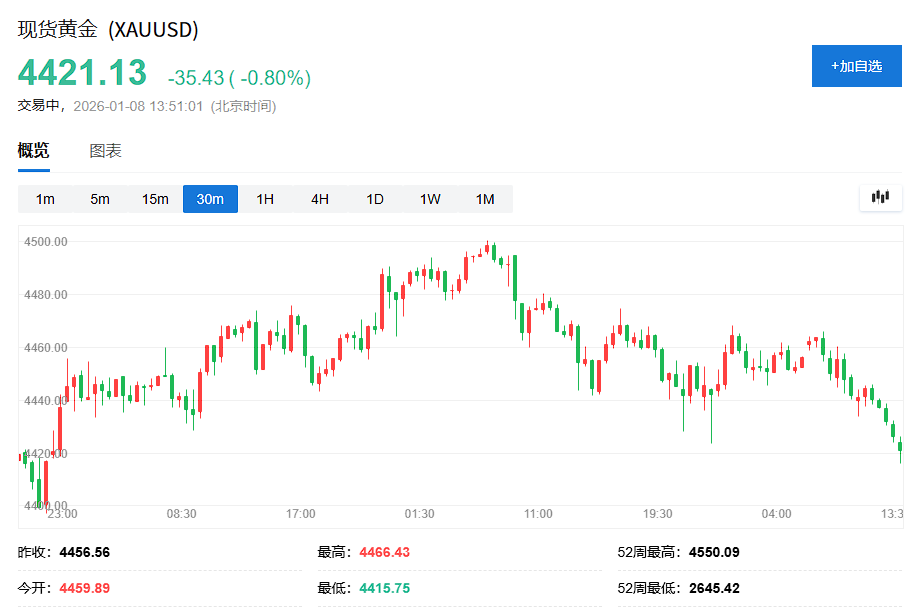
Core Viewpoint - Gold and silver prices have declined for the second consecutive day as investors prepare for the annual rebalancing of commodity indices, which may lead to the sale of futures contracts worth billions of dollars in the coming days [1] Group 1: Price Movements - Spot gold prices fell below $4,420 per ounce, following a nearly 1% drop on the previous trading day [1] - Silver prices dropped over 3% on Thursday, indicating heightened volatility and susceptibility to significant sell-offs [1] Group 2: Market Dynamics - Passive tracking funds began selling precious metal futures from Thursday to align with new weight requirements of indices, a routine operation that is particularly significant due to last year's surge in gold and silver prices [1] - Citigroup estimates that approximately $6.8 billion worth of silver futures may be sold to meet rebalancing requirements, which represents about 12% of the open interest in Comex [1]
贵金属继续调整!白银跌超3%、黄金下挫,重要商品指数再平衡今日开启
Hua Er Jie Jian Wen· 2026-01-08 06:17
Core Viewpoint - The precious metals market is experiencing a liquidity shock triggered by the rebalancing of the Bloomberg Commodity Index (BCOM), leading to significant price declines in gold, silver, and other metals [1][15][17]. Group 1: Market Adjustments - On January 8, the precious metals market saw a collective adjustment, with spot gold dropping to around $4,415, COMEX silver falling over 2%, and spot silver declining more than 3% to a low of $75.58 [1]. - The rebalancing process, which began on January 8 and will continue until January 14, involves a reduction in the weight of gold from 20.4% to 14.9% and silver from 9.6% to 3.94% in the BCOM index [15][18]. Group 2: Market Impact - Deutsche Bank and TD Securities anticipate a surge of $7.7 billion in silver sell orders over the next two weeks, equating to 13% of the total open interest in the COMEX silver market [15]. - The rebalancing is expected to result in futures sell-offs that will account for 9% of total silver positions and 3% of total gold positions [15]. Group 3: Historical Context - The decline in precious metals follows a rare and significant price surge, with gold increasing over 70% and silver rising nearly 150% in 2025, leading to a fragile market environment [17]. - The rebalancing is characterized as a large-scale technical sell-off, with analysts noting that the sell pressure on silver will be the most significant, followed by aluminum and gold [18][19]. Group 4: Future Projections - Estimates suggest that a sale of 2.4 million ounces of gold could lead to a price drop of 2.5% to 3%, depending on the sensitivity model used [19]. - Analysts predict that the upcoming sell orders will lead to a substantial repricing of silver, exacerbated by a liquidity vacuum in the market [20].