
奥巴马医改

Search documents
民主党惨败!美国政府停摆将迎落幕?特朗普出奇招:全民发钱!
Sou Hu Cai Jing· 2025-11-22 07:15
Group 1 - The recent U.S. government shutdown lasted over 40 days, highlighting intense political battles, with Trump emerging as a key figure [1][13] - The shutdown was primarily due to disagreements over the Affordable Care Act (ACA), with Democrats seeking to restore subsidies while Republicans, particularly Trump, opposed this [3][11] - Public sentiment towards the ACA is mixed, as it relies on government subsidies funded by taxpayers, raising concerns about efficiency and effectiveness [4][8] Group 2 - The inefficiencies of government services have led to public dissatisfaction, contrasting sharply with the efficiency of market-driven services [6][8] - In the healthcare sector, high costs are attributed to excessive government intervention disrupting market mechanisms, with examples illustrating the disparity in pricing for medical procedures [10][11] - The shutdown reflects a broader political struggle, with Democrats attempting to leverage the situation to force Republican concessions on healthcare, but ultimately failing [13][18] Group 3 - The Republican compromise involved redirecting $30 billion intended for healthcare subsidies directly to citizens, promoting individual choice in insurance [15] - Trump's use of social media and engaging communication strategies has effectively simplified complex issues, garnering public support and criticism of Democrats [16][20] - The outcome of the shutdown has positioned Republicans favorably in the political landscape, reinforcing their image of advocating for smaller government and free markets [18][22] Group 4 - Despite Trump's victory in this political battle, underlying issues such as government inefficiency, high healthcare costs, and bureaucratic challenges remain unresolved [22][23] - The current political climate in the U.S. is characterized by deep divisions and a lack of trust among the populace, complicating the path forward [23]


美国参议院通过临时拨款法案 待众议院表决 政府停摆有望于周三结束
智通财经网· 2025-11-11 07:03
Group 1 - The U.S. government shutdown has reached a historic record of 41 days, with a temporary funding bill passed in the Senate, potentially ending the shutdown soon [1] - The Senate approved the Continuing Appropriations and Extensions Act with a vote of 60 to 40, but it still requires approval from the Republican-controlled House of Representatives [1] - The core issue of the shutdown revolves around extending tax credits for the Affordable Care Act, affecting 24 million Americans who may face increased insurance premiums [1] Group 2 - The agreement indicates that Democrats find it challenging to leverage their limited influence against Trump's agenda in a Republican-controlled Washington [2] - Polls show that during the shutdown, the public primarily blames Congress's deadlock on Republicans rather than Democrats, indicating a shift in political risk [2] - The reopening of federal departments may lead to significant backlogs and delays, particularly affecting 42 million low-income Americans in the Supplemental Nutrition Assistance Program (SNAP) [2]
参议院迈出关键一步,特朗普点头,美政府停摆或进入倒计时
Jin Shi Shu Ju· 2025-11-11 00:33
Core Points - President Trump supports a bipartisan agreement aimed at ending the government shutdown, increasing the likelihood of reopening the government soon [1] - The Senate is expected to vote on the spending bill, which will then go to the House for approval [1][3] - The agreement has faced backlash from some Democrats who feel it does not address key issues such as the extension of subsidies for the Affordable Care Act [2][4] Group 1: Government Reopening - Trump announced sufficient Democratic support to reopen the government, stating that the shutdown is a negative situation [1] - Senate Majority Leader John Thune anticipates that the President will sign the legislation once passed by Congress [1] - The Senate passed a procedural measure to advance a temporary funding bill with a vote of 60 to 40 [3] Group 2: Legislative Process - The House Speaker Mike Johnson will notify House members 36 hours in advance to return for voting once the Senate passes the bill [2] - The funding bill will provide full-year funding for certain departments while offering temporary funding until January 30 for others [3] - The bill includes provisions to backpay furloughed government employees and restore withheld federal funds to states and localities [3] Group 3: Political Reactions - Some Democrats have expressed strong opposition to the agreement, criticizing it for not including the extension of ACA subsidies [2][4] - California Governor Gavin Newsom and Illinois Governor JB Pritzker have publicly condemned the agreement, calling it disappointing and a "empty promise" [2] - The agreement has sparked a debate within the Democratic Party, with some members feeling it does not meet their objectives [4][5]
重大突破!美国有史以来最长时间的政府停摆迎来转机了
Sou Hu Cai Jing· 2025-11-10 20:42
Core Points - The U.S. federal government shutdown has lasted for 40 days, but there may be a turning point as Senate Majority Leader John Thune reveals a limited spending proposal is taking shape [1] - Some Senate Democrats are likely to support the proposal if certain details, such as protections for government workers, are confirmed [3] - The ongoing shutdown is causing significant impacts, with warnings from officials about potential delays in air travel during the Thanksgiving period [5] - The economic cost of the shutdown is substantial, with an estimated loss of approximately $15 billion per week and a projected reduction of about 1.5 percentage points in the quarterly annualized GDP growth rate by mid-November [6] Group 1 - A limited spending proposal is being developed to address the government shutdown, with a procedural vote planned for this Sunday [1] - At least 10 Senate Democrats are expected to support a procedural motion to advance a combined spending bill and short-term funding arrangement [3] - The shutdown's impact is growing, with warnings from the Transportation Secretary about potential delays in air travel during the holiday season [5] Group 2 - The ongoing shutdown is causing significant economic losses, estimated at $15 billion per week, and is expected to reduce GDP growth by 1.5 percentage points [6] - There are ongoing discussions between parties, with Democrats proposing to extend subsidies for low-income Americans in exchange for reopening the government [6] - The political landscape is tense, with President Trump urging lawmakers to remain in Washington until a spending deal is reached [6]
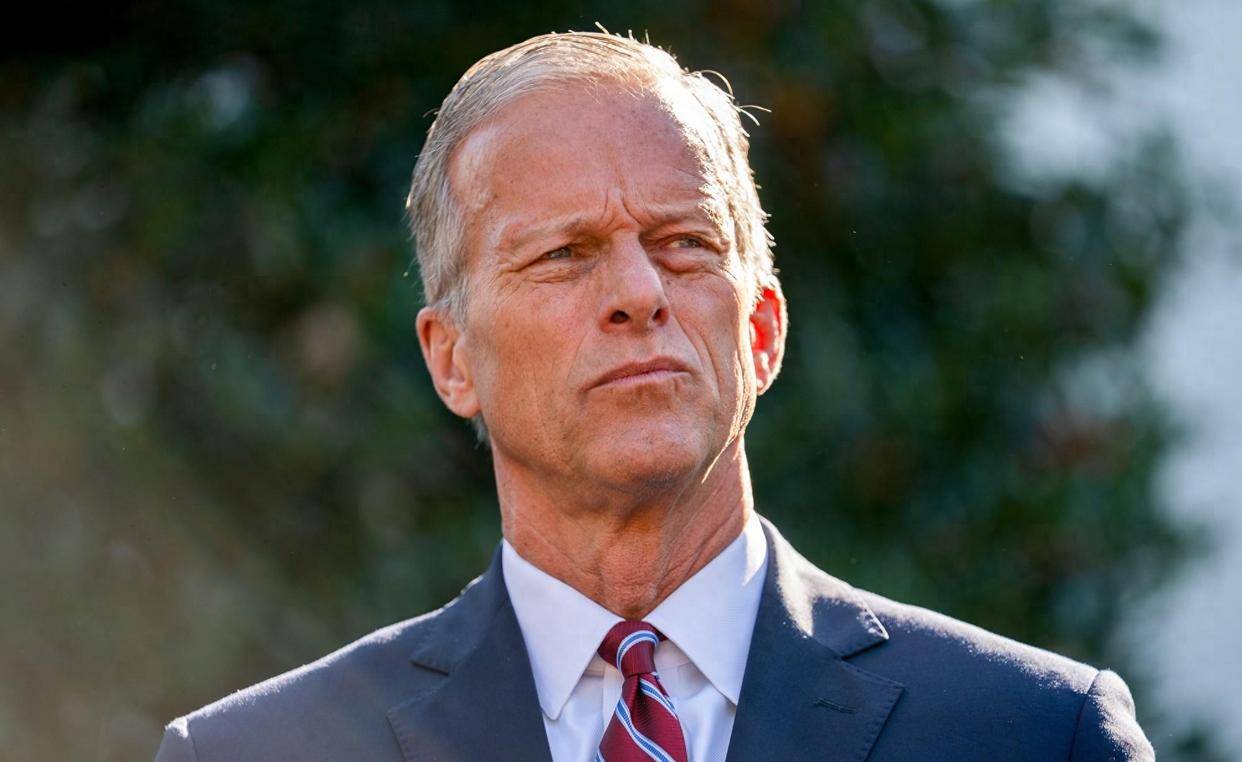
史上最长停摆现转机!美参议院达成临时协议 政府重启进入倒计时
智通财经网· 2025-11-10 12:55
Core Points - The U.S. Senate passed a procedural motion to end the longest government shutdown in history with a vote of 60 to 40, paving the way for a temporary funding agreement [1] - The agreement includes full funding for the Department of Agriculture, the Department of Veterans Affairs, and Congress until the end of the fiscal year, while other federal agencies will receive funding to operate until January 30, 2026 [1] - The agreement aims to restore pay for furloughed federal employees and resume federal funding for state and local governments [1] Group 1 - The Senate requires unanimous consent from all members to expedite the process, and any opposition could delay the vote by several days [1] - House Speaker Mike Johnson has informed members to prepare for a vote within 36 hours [1] - President Trump expressed optimism about nearing an end to the shutdown [1] Group 2 - Some Democratic senators supported the agreement due to provisions preventing federal layoffs until January 30 [2] - The House's voting outcome remains uncertain, as Democratic leaders oppose any agreement lacking an extension of the Affordable Care Act subsidies [2][3] - The current agreement does not meet the core demands of Democratic leaders, who seek to extend expiring ACA subsidies and repeal cuts to Medicaid [3] Group 3 - The ongoing government shutdown has lasted for 40 days, marking a record in U.S. history, with previous attempts to leverage shutdowns for policy gains failing [3][4] - The Democratic Party has rejected a no-strings-attached temporary spending bill that could have kept the government running until November 21 [4] - The White House has pressured Congress, threatening mass layoffs and withholding pay for over 600,000 furloughed federal workers [4] Group 4 - The likelihood of reaching an agreement on extending ACA subsidies before the December deadline remains unclear, with House Republicans opposing the extension [5] - The political standoff has resulted in an estimated economic loss of approximately $15 billion per week, with a projected 1.5 percentage point decline in GDP growth rate due to the shutdown [5] - The funding bill includes provisions favored by Democrats, such as rejecting cuts to international food aid and increasing security funding for Congress [5]
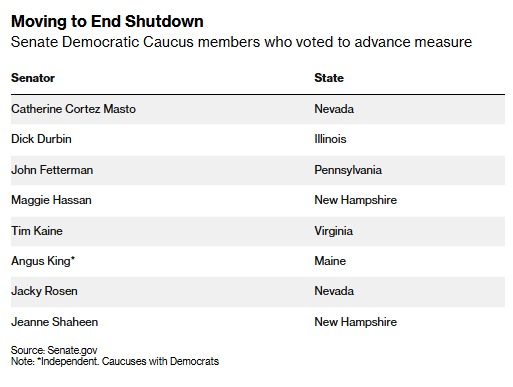
惨!美国政府关门36天破纪录,80万雇员无奈跑外卖,美股要崩了?
Sou Hu Cai Jing· 2025-11-09 04:54
Group 1: Government Shutdown Impact - The U.S. government shutdown has reached 36 days, surpassing the previous record of 35 days set in 2018, indicating a prolonged political standoff [1] - The core issue of the shutdown revolves around healthcare subsidies related to the Affordable Care Act, with both parties entrenched in their positions, leading to a lack of progress in negotiations [3][4] - The shutdown has resulted in significant economic losses, with estimates suggesting a potential GDP growth reduction of 0.2 percentage points per month, translating to over $50 billion in economic damage if it continues until the end of November [10] Group 2: Effects on Employment and Welfare - Approximately 800,000 federal employees are affected, either on unpaid leave or working without pay, leading to increased reliance on charitable organizations for basic needs [7][9] - Food assistance programs for 42 million Americans have been disrupted, with a significant portion of beneficiaries facing delays in receiving aid, marking a historic first in the program's 60-year history [7][10] Group 3: Financial Market Repercussions - The shutdown has triggered liquidity concerns in global financial markets, with the Treasury General Account (TGA) balance exceeding $1 trillion, indicating a reduction in available cash flow in the market [12][14] - The SOFR rate has surged to 4.22%, reflecting increased borrowing costs among banks, while the usage of the Federal Reserve's emergency lending facilities has reached record levels, signaling a cash crunch in the banking sector [12][14] Group 4: Broader Economic Consequences - The shutdown has led to flight cancellations and disruptions in the transportation sector, with a warning that up to 20% of flights could be affected, impacting millions of travelers [9][10] - Local businesses, particularly in Washington D.C., have seen a significant drop in sales, with some reporting declines of 15% to 20%, and small business loan approvals have come to a halt, threatening their viability [10][12]
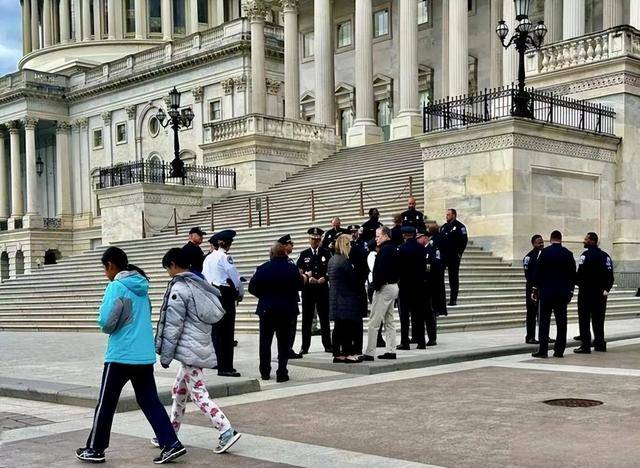
36天,美国联邦政府“停摆”创纪录!航空濒临关闭,军饷发放困难,债务增超6000亿美元......
Sou Hu Cai Jing· 2025-11-05 05:17
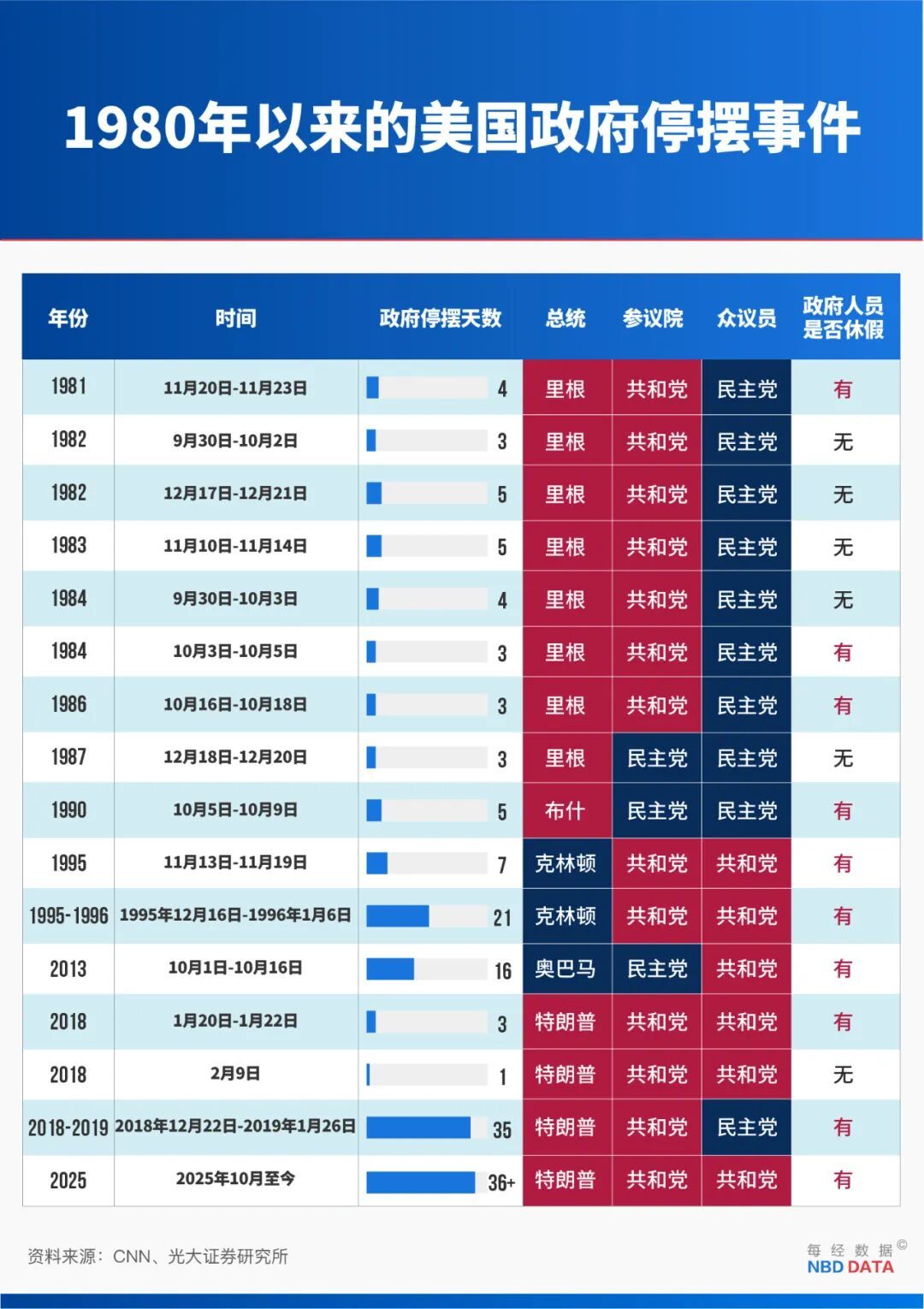
Core Points - The U.S. federal government shutdown has reached its 36th day, marking the longest shutdown in history, primarily due to partisan disagreements over key issues like healthcare subsidies [2][4] - The economic impact of the shutdown is becoming increasingly severe, with the Congressional Budget Office (CBO) projecting a potential decline in the annualized GDP growth rate by 1 to 2 percentage points in Q4 [2][11] - Key pressure points driving negotiations include disruptions in air traffic, the suspension of food stamp benefits for 42 million people, and impending military pay issues [2][18] Economic Impact - The CBO warns that if the shutdown lasts six weeks, the GDP growth rate could drop by 1.5 percentage points, and if it extends to eight weeks, the decline could reach 2 percentage points [11] - The economic losses from the shutdown are projected to be permanent, with estimates of $11 billion in lost output after six weeks and $14 billion after eight weeks [11] - Financial markets are reacting negatively, with a significant drop in stock prices and a decrease in expectations for Federal Reserve interest rate cuts due to the uncertainty created by the shutdown [17][15] Political Dynamics - The shutdown is a result of failed negotiations between Democrats and Republicans, with Democrats insisting on including healthcare subsidy extensions in any funding bill [6][10] - The Senate has seen 14 failed votes during the shutdown, highlighting the procedural challenges and the use of filibuster tactics by Democrats to leverage their demands [8][10] - Political analysts suggest that the pressure from the economic and social consequences of the shutdown may force both parties to reach a compromise soon [18][24] Potential Resolutions - Analysts predict that a compromise may involve a "clean" continuing resolution in exchange for future negotiations on healthcare subsidies, allowing both parties to save face [24][25] - The earliest potential date for the end of the shutdown is suggested to be November 16, as various pressures mount [21][23] - Observational signals for a nearing agreement include the reconvening of the House, positive developments in Senate negotiations, or a shift in President Trump's stance [25]
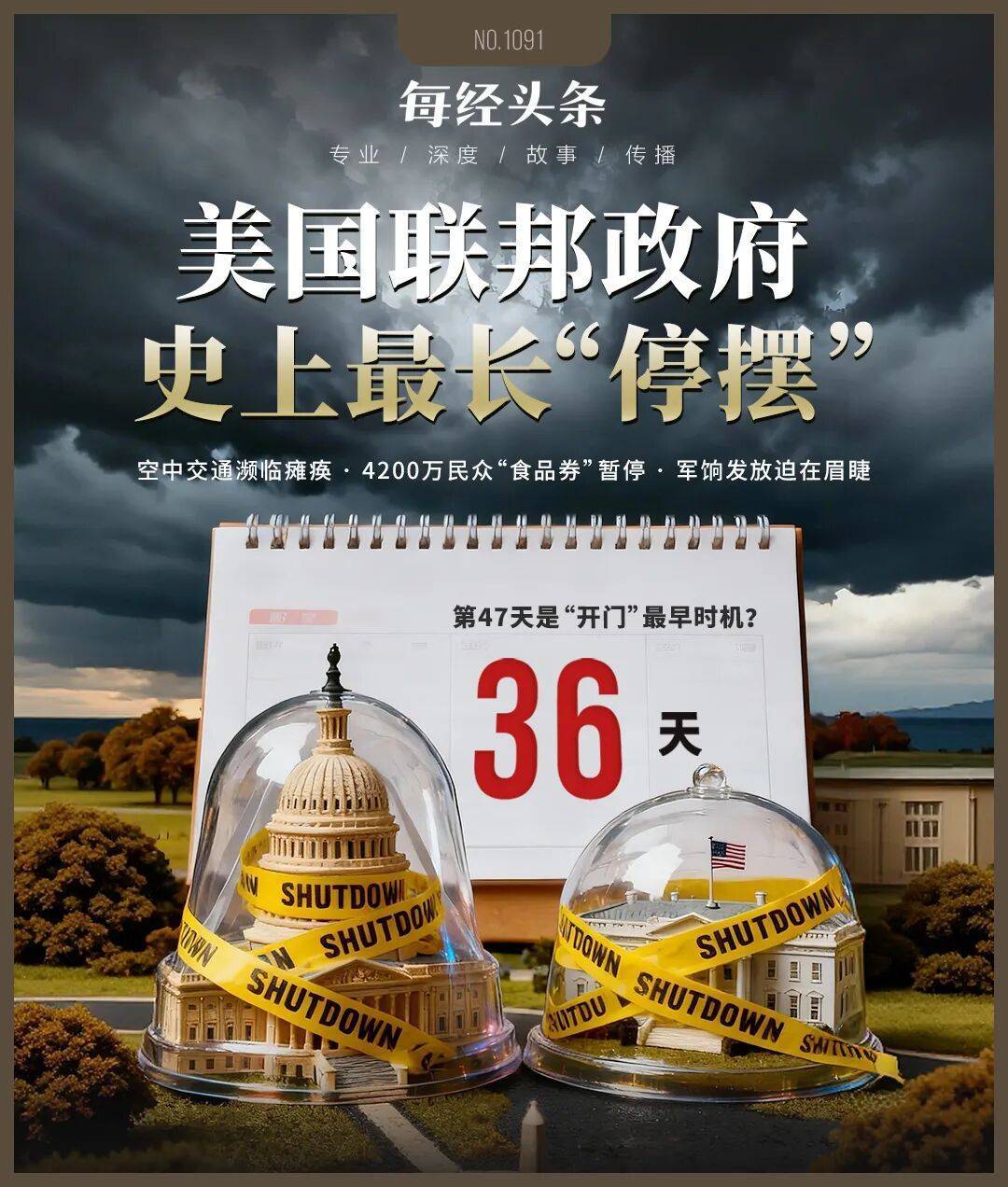
36天,美国联邦政府“停摆”创纪录!航空濒临关闭,债务增超6000亿美元……
Mei Ri Jing Ji Xin Wen· 2025-11-05 04:59
Core Points - The U.S. federal government shutdown has reached its 36th day, marking the longest shutdown in history, primarily due to partisan disagreements over key issues like healthcare subsidies [1] - The Congressional Budget Office (CBO) warns that the shutdown could reduce the annual GDP growth rate by 1 to 2 percentage points in the fourth quarter [1][12] - Key pressure points driving negotiations include disruptions in air traffic, the suspension of food stamp benefits for 42 million people, and impending military pay issues [1][21] Group 1: Government Shutdown Dynamics - The shutdown began on September 30 after Congress failed to pass any temporary funding bills, leading to 14 failed votes in the Senate over the past month [1][5] - The inability to reach a compromise stems from deepening partisan divides, particularly regarding the extension of enhanced subsidies under the Affordable Care Act (ACA) [4][11] - The current political stalemate is exacerbated by the procedural tool of "filibuster," which allows unlimited debate unless a supermajority is reached [10][11] Group 2: Economic Impact - The CBO estimates that a six-week shutdown could result in a permanent loss of approximately $11 billion in economic output, with losses increasing to $14 billion if the shutdown lasts eight weeks [12][13] - The economic costs are compounded by the absence of critical economic data releases due to the shutdown, creating uncertainty for the Federal Reserve's decision-making [16][19] - The market's confidence in potential interest rate cuts by the Federal Reserve has diminished, with expectations dropping from 90.5% to 69% for a December rate cut [17][19] Group 3: Pressure Points for Resolution - The aviation sector is facing significant disruptions, with a high absenteeism rate among air traffic controllers leading to flight delays and cancellations [21][23] - The suspension of the Supplemental Nutrition Assistance Program (SNAP) has created a direct political pressure on Republican lawmakers, as many beneficiaries reside in Republican-controlled states [21][24] - Military pay issues are also looming, with uncertainty surrounding the next scheduled payment on November 15, which could further compel action from Congress [24][27] Group 4: Potential Outcomes - Analysts suggest that a compromise may involve a "clean" continuing resolution in exchange for future negotiations on healthcare subsidies, allowing both parties to save face [27] - Observing the reconvening of the House and positive developments in Senate negotiations could signal that an agreement is nearing [27]
或陷史上最长政府“停摆” 美国人在经历着怎样的阵痛?
Sou Hu Cai Jing· 2025-10-22 06:09
Core Points - The U.S. government shutdown, which began on October 1, continues with no resolution in sight, affecting various sectors and millions of Americans [1][5][9] Impact on Employment and Income - Over 2 million federal employees are on unpaid leave, with approximately 750,000 forced to take unpaid leave, leading many to seek part-time jobs or apply for unemployment insurance [1][3] - If the shutdown persists for a month, it could result in an additional 43,000 job losses and a reduction of $30 billion in consumer spending [9] Effects on Various Sectors - The aviation sector is experiencing staff shortages, leading to flight delays across major cities, which could worsen as the Thanksgiving holiday approaches [3][5] - The real estate market is impacted, with programs like zero-down payment mortgages for rural areas halted, and delays in loan approvals due to IRS service suspensions [3] - Federal programs supporting food assistance and nutrition for low-income populations are at risk, with potential funding exhaustion for programs like the Special Supplemental Nutrition Program for Women, Infants, and Children [6] Political Stalemate - The shutdown has entered its fourth week, with no signs of resolution, as Democrats and Republicans remain deadlocked over temporary funding legislation, particularly concerning the Affordable Care Act [5][9] - The last major shutdown lasted 35 days, highlighting the potential for this current situation to become the longest in U.S. history [5] Broader Social Implications - The shutdown has led to the closure of numerous federally funded institutions, including museums and research centers, and has severely impacted food banks reliant on federal support [3][6] - Protests have erupted in major cities, with nearly 7 million participants expressing discontent over the political situation and its impact on livelihoods [9]

共和党内部分歧加剧,民主党信心倍增,谁将率先“撑不住”?
Jin Shi Shu Ju· 2025-10-10 09:27
Core Points - The Republican Party initially believed that repeated voting on the same bill would force the Democrats to yield, but after six failed votes, their resolve is being questioned as polls indicate they bear more responsibility for the deadlock [1] - President Trump has expressed an openness to healthcare negotiations, despite the ongoing government shutdown and the expiration of subsidies related to the Affordable Care Act [1][2] - The Senate Majority Leader and House Speaker acknowledge the stalemate but face increasing pressure to change their approach [1][2] Group 1 - The core issue of the deadlock revolves around the enhanced tax credits for the Affordable Care Act, which are set to expire at the end of the year, potentially increasing premiums for Americans not covered by employer plans [4] - The economic cost of the government shutdown is rising, affecting various sectors, including delayed economic data releases and staffing shortages in air traffic control [2][3] - There is skepticism about whether any healthcare policy details can be resolved quickly, especially given Republican opposition to providing any support for the Affordable Care Act [2][5] Group 2 - Some Republican lawmakers are showing willingness to negotiate on healthcare issues, particularly as millions of Americans face rising insurance premiums [5] - A potential bipartisan solution may emerge through a "small group" model in the Senate, which could allow for a face-saving resolution for both parties [5] - The timeline for negotiations remains uncertain, with questions about whether concessions on healthcare will need to be tied to any agreement to reopen the government [6]