
平台监管

Search documents
109人炒股群,108人是托
第一财经· 2025-12-03 15:59
Core Viewpoint - The article highlights a recent investment fraud case in Shanghai, where a senior citizen was nearly scammed out of 100,000 yuan by a fake investment group called "创投精英汇" (Investment Elite Group), which was primarily composed of actors posing as investors [5][8][11]. Summary by Sections Fraud Mechanism - The fraud involved a WhatsApp group with 109 members, where 108 were fake accounts designed to manipulate the real victim into believing in a lucrative investment opportunity [8][11]. - The victim, an elderly woman, was convinced by a supposed expert who claimed to have made significant profits through stock trading and lured her into the group [6][8]. Evidence of Fraud - The scammers provided a fake PowerPoint presentation about a company purportedly set to go public, which misled the victim into thinking the investment was legitimate [6][7]. - The investment app used by the victim was not affiliated with any legitimate securities firm, further indicating the fraudulent nature of the scheme [7][9]. Police Intervention - Police intervention at a bank prevented the victim from transferring her savings, highlighting the importance of vigilance in financial transactions [5][9]. - The police confirmed that the app and the company information were fabricated, and the victim was educated on fraud prevention [9][11]. Broader Implications - The article discusses the increasing sophistication of scams, which now often involve elaborate setups that create a false sense of community and legitimacy [11][12]. - It emphasizes the need for better platform governance to prevent such scams, including the removal of fake accounts and the implementation of warning systems for fraudulent investment apps [13][14][15].


109人炒股群,108个托……
财联社· 2025-12-03 14:11
Core Viewpoint - The article highlights a fraudulent investment scheme involving a fake stock opportunity called "中新股" (New Stock), which nearly led an elderly woman to lose her savings of 100,000 yuan. The scheme was orchestrated through a deceptive WeChat group named "创投精英汇" (Investment Elite Group), where most members were fake participants designed to manipulate and deceive potential victims [1][2][8]. Summary by Sections Fraudulent Scheme Description - The scheme involved a WeChat group with 109 members, of which 108 were identified as accomplices or "托" (stooges) [2][8]. - The elderly victim, referred to as Aunt Lu, was convinced by a supposed success story from a member who claimed to have made significant profits through the group [5][8]. Mechanism of Deception - Scammers provided a detailed PowerPoint presentation about a company purportedly set to go public, which misled the victim into believing in the legitimacy of the investment opportunity [7][8]. - The group claimed to have a complex investment structure involving different levels of shareholders, promising high returns by leveraging insider knowledge [7][8]. Law Enforcement Response - Police intervention at a bank prevented the transfer of funds, confirming that the investment app used by the victim was not affiliated with any legitimate financial institution [8][9]. - The police emphasized the importance of recognizing such scams, especially as they become more sophisticated and prevalent during the year-end period [8][9]. Broader Implications - The article discusses the rise of immersive scams that create a false sense of community and trust among victims, making it difficult for them to discern reality from deception [10][12]. - It highlights the need for better regulatory measures from platforms to prevent such scams, including the removal of fake accounts and the monitoring of suspicious activities [13][14][15].

新华网三评之一:“管不住”的套路,“够不着”的监管
Xin Hua She· 2025-11-07 09:02
Core Points - The article discusses the deceptive practices of online ticketing platforms that lure consumers with low prices but add hidden fees, leading to higher actual costs for consumers [2][3] - It highlights the challenges of regulatory oversight, as many platforms are based in major cities but operate nationwide, complicating enforcement and consumer protection [3] Group 1: Deceptive Practices - Online ticketing platforms often include additional services like "refund protection" in the guise of low prices, which ultimately results in higher costs for consumers [2][3] - Consumers face difficulties in avoiding these hidden charges due to tactics such as default selections for add-ons and small print disclosures [3] Group 2: Regulatory Challenges - Local regulatory bodies struggle to enforce rules against these platforms due to jurisdictional issues, leading to a lack of effective deterrence against deceptive practices [3] - There is a call for breaking down regional barriers in regulation to ensure that platforms can be held accountable regardless of their headquarters location [3] Group 3: Recommendations for Improvement - The article suggests that regulations should be updated to specifically address "low-price inducement" and "hidden bundling," with clear penalties to discourage such practices [3] - It emphasizes the need for simplifying the complaint process for consumers who fall victim to these tactics, ensuring they have a viable path for recourse [3]

销量、弹幕、点赞都能代刷!记者调查直播间“刷单”灰色产业链
Sou Hu Cai Jing· 2025-10-31 00:19
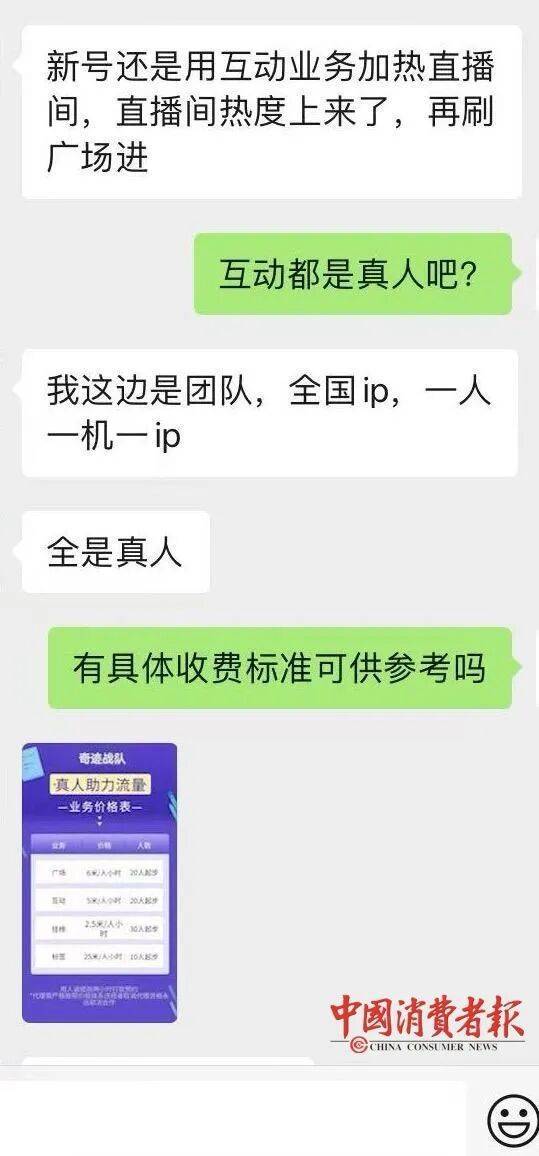
Core Viewpoint - The article highlights the prevalence of data manipulation in live-streaming sales, where merchants and influencers create a false sense of urgency and popularity through fabricated sales and interaction metrics, leading to consumer deception [1][6][8]. Group 1: Data Manipulation Practices - Many platforms have initiated promotional events, leading to a common scene where merchants and influencers fake sales, interactions, and viewer counts to create a "hot-selling" illusion [1]. - Companies offer services to customize sales and interaction metrics, including real-time comments and likes, to enhance the perceived popularity of products [1][7]. - A specific company, "Miracle Team," provides services to heat up live-streams using real users, emphasizing their operations are conducted by real people to avoid detection [2][3]. Group 2: Pricing and Services - The pricing for these manipulation services includes various tiers, such as 5 million per person per hour for interaction services and 6 million per person per hour for display services, with minimum participant requirements [3][5]. - The use of coded language, such as "米" instead of "元," is employed to evade platform regulations [3][4]. Group 3: Consumer Impact - The use of phrases like "limited" and "last chance" creates a sense of urgency among consumers, often leading them to make impulsive purchases without assessing product quality [6]. - Consumers are misled by inflated sales figures and reviews, which can result in financial losses due to purchasing subpar products [8][10]. Group 4: Regulatory Challenges - The article discusses the challenges faced by e-commerce and live-streaming platforms in regulating these deceptive practices, noting the complexity and covert nature of the operations [9]. - Experts suggest that platforms need to enhance their ability to detect fraudulent activities using advanced technologies and implement stricter penalties for violators [9]. Group 5: Recommendations for Consumers - Consumers are advised to critically evaluate the sales atmosphere and data presented in live-streams, seek information from multiple sources, and retain evidence of their purchases [10].
抖音清退中通冷链、吉时达等物流商
Mei Ri Jing Ji Xin Wen· 2025-10-27 11:57
Core Viewpoint - Douyin E-commerce has identified misuse of its platform by certain logistics companies, which provided false logistics tracking and other fraudulent services, harming consumer rights and disrupting platform operations [1] Summary by Categories Platform Actions - Douyin E-commerce will implement a cleanup of specific logistics companies on October 29, including Zhongtong Cold Chain, Jishida, Shuiqu Daijia, and Tiezhong Express, to ensure the authenticity of order fulfillment [1] Consumer Protection - The platform's measures aim to protect consumer rights by ensuring that order tracking aligns with actual delivery performance, thereby maintaining trust in the e-commerce ecosystem [1] Compliance and Regulation - The actions taken by Douyin E-commerce are in accordance with relevant rules to prevent the continuation of fraudulent activities within its logistics network [1]

马越然:面对“悬赏报恩”,平台不应弃守底线
Huan Qiu Wang Zi Xun· 2025-10-13 23:09
Group 1 - The core issue revolves around a staged video series titled "Reward for Finding a Lifesaver," which was revealed to be a carefully orchestrated hoax, leading to administrative penalties for several individuals [1] - The incident highlights a growing trust crisis in the self-media landscape, exacerbated by the worship of traffic and the platforms' failure to manage false promotions effectively [1][2] - Users are becoming increasingly desensitized and alert to fake promotions, indicating a shift in public awareness and skepticism towards scripted content [1] Group 2 - Platforms are encouraged to shift their focus from short-term traffic gains to cultivating long-term value, emphasizing the importance of authentic content creators who can foster stable advertising partnerships and user retention [2] - Regulatory measures should transition from reactive to proactive, with improved identification capabilities and stricter penalties for confirmed false promotions, including permanent bans and recovery of illicit earnings [2] - The platform's rules should reflect a commitment to authenticity, severing the profit chain of false monetization while supporting genuine creative expression [3]
路虎变丰田?携程租车被曝「货不对板」,验车单形同虚设? | BUG
Xin Lang Ke Ji· 2025-10-11 02:11
Core Viewpoint - The article highlights issues with Ctrip's car rental service, where customers have reported receiving different vehicles than what was booked, leading to accusations of false advertising and poor service quality [3][4][5][8][11]. Group 1: Customer Complaints - A prominent social media influencer reported renting a Land Rover Defender but received a Toyota Land Cruiser instead, which was in poor condition [5][8]. - Multiple customers have shared similar experiences, including receiving older models than what was advertised, raising concerns about the accuracy of vehicle descriptions on the platform [8][11]. - Users have expressed frustration over the verification process, claiming it is superficial and allows companies to evade responsibility for discrepancies [15][21]. Group 2: Company Response and Management - Ctrip has not publicly responded to the complaints raised by customers regarding the rental service [4][15]. - The company has faced scrutiny from regulatory bodies, with recent administrative talks highlighting potential violations of e-commerce laws [19][21]. - High-level executives at Ctrip have been selling shares, totaling approximately 760 million RMB, which has led to speculation about the company's future performance [4][21]. Group 3: Market Position and Competition - Ctrip ranks third in the online car rental market in China, holding a 13% market share, trailing behind Shenzhou Car Rental and Yihai Car Rental [22]. - The rapid growth of the online car rental market has led to increased competition, with new platforms emerging and challenging established players like Ctrip [22]. - The article indicates that Ctrip's service quality issues may hinder its ability to compete effectively in a market that is becoming increasingly saturated [18][22].


快评丨避免假农技师坑农,平台应当好“守门人”
Nan Fang Nong Cun Bao· 2025-08-25 04:04
Core Viewpoint - The article highlights the issue of fake agricultural experts exploiting farmers through online platforms, emphasizing the need for stricter regulation and accountability from these platforms to protect farmers from scams [1][5][11]. Group 1: Identification of the Problem - Many farmers have reported encountering fake agricultural experts online who falsely claim to have extensive experience and offer free agricultural guidance [2][3]. - These impostors use deceptive tactics such as creating fake personas, dramatizing their expertise, and aggressively marketing ineffective agricultural products [4][10]. - The phenomenon reflects a broader issue of moral decay in platform governance, where the pursuit of traffic and profit overshadows ethical responsibilities [11][18]. Group 2: Impact on Farmers - The so-called "expertise" provided by these individuals often lacks scientific validity, leading farmers to purchase overpriced and ineffective agricultural products driven by trust and anxiety [12][14]. - The platforms have been criticized for ignoring false information, allowing these scams to proliferate unchecked [15][16]. Group 3: Recommendations for Platforms - Platforms must abandon the excuse of "technical neutrality" and take responsibility for the dissemination of false information, as their inaction harms not only farmers but society as a whole [19][21]. - A proposed "three checks and three verifications" mechanism for agricultural accounts includes verifying educational credentials, professional qualifications, and work history [22][23]. - The implementation of AI technology for content verification and the establishment of a user-participation monitoring network are recommended to combat misinformation effectively [25][26][30]. Group 4: Importance of Agriculture - Agriculture is deemed vital for the nation, and farmers are essential to land cultivation, making the fight against misinformation in this sector crucial [28][30].

医疗科普莫成“流量生意”
Ren Min Ri Bao· 2025-08-20 02:56
Core Viewpoint - The article emphasizes the importance of maintaining ethical standards in the development of medical science communication through short videos, highlighting both the benefits and the potential pitfalls of this medium [1][2][3]. Group 1: Current Landscape of Medical Science Communication - A significant portion of the population engages with health science content via short video platforms, with 92.1% of 1.074 billion online viewers having encountered such content [1]. - While short video medical science communication can enhance public health literacy, issues such as misinformation, commercialization, and unethical practices are prevalent [1][2]. Group 2: Regulatory Measures and Industry Standards - Recent regulations from multiple government bodies aim to ensure the authenticity and scientific validity of medical science communication on social media platforms [1][2]. - Platforms are encouraged to implement robust regulatory mechanisms, such as peer review systems and operational guidelines for medical accounts, to enhance content quality and accountability [2][3]. Group 3: Future Directions and Opportunities - The article suggests that promoting high-quality content creation should be balanced with strict regulation, advocating for initiatives like "AI pre-review + expert verification" and credit systems for quality creators [3]. - The ongoing implementation of the "Healthy China 2030" initiative aims to improve the quality of medical science communication, ultimately benefiting public health [3].