开源AI

Search documents
这是2025年度AI十大趋势,4个维度10大结论,“开源AI进入中国时间”
量子位· 2025-12-10 10:54
Core Insights - The report highlights that by 2025, AI will transition from the "tool era" to the "partner era," significantly reshaping economic structures, social forms, and human lifestyles through ten key trends [3][34]. Group 1: Key Trends in AI Development - Trend 1: Computing infrastructure is becoming essential, with skyrocketing demand for data centers, making computing economy the primary engine of the intelligent industry [6]. - Trend 2: AI-native demands are reshaping chip innovation, with GPUs facing challenges and NPU becoming prevalent on the edge, while ASIC/FPGA are experiencing growth [9]. - Trend 3: Pre-training will determine the hierarchy of large models, while architectural innovation will influence pre-training levels, with mixed expert models becoming mainstream [13]. - Trend 4: Large models are entering the "inference time," with demands for inference driving model innovation [15]. - Trend 5: The period of information AI applications and physical AI research is emerging, with embodied intelligence becoming a focal point [18]. Group 2: AI Applications and Market Dynamics - Trend 6: AI is reshaping traffic entry points, transitioning from "people finding services" to "services finding people," with AI agents becoming the next generation of interaction paradigms [22]. - Trend 7: Multi-modal capabilities are key for AI application deployment, enabling systems to process and understand various information types, thus enhancing productivity [24]. - Trend 8: AI hardware is proliferating across devices like PCs, smartphones, and IoT, driven by lightweight models and edge computing technologies [25]. - Trend 9: AI4S is accelerating the realization of AGI, with AI reaching doctoral-level problem-solving capabilities in various fields [28]. - Trend 10: Open-source AI is entering a new phase in China, with the country transitioning from a participant to a leader in the AGI domain [31][33]. Conclusion - The report emphasizes that the AI industry is at a historic turning point, where technology is moving from model competition to scenario integration, and the future of AI involves not just technological iteration but also ecological reconstruction and fundamental changes in production and lifestyle [34][36].


2025年度十大AI趋势发布:重塑流量入口,开源AI已经进入中国时间
Sou Hu Cai Jing· 2025-12-10 06:10
Core Insights - The report highlights a significant shift in AI development from the "tool era" to the "partner era," indicating profound changes in economic structure, social forms, and human lifestyles by 2025 [3][34]. Group 1: Key Trends - Trend 1: Computing power is becoming a foundational infrastructure, with soaring demand for data centers, marking the computing economy as the primary engine of the intelligent industry [6]. - Trend 2: The native demand for AI is reshaping chip innovation, with GPUs facing challenges and NPU gaining traction, while ASIC/FPGA are experiencing growth [9]. - Trend 3: Pre-training will determine the hierarchy of large models, with architectural innovation influencing pre-training levels [13]. - Trend 4: Large models are entering the "inference time," with increasing demands for model innovation driven by complex tasks [16]. - Trend 5: The period of information AI applications and physical AI research is emerging, with embodied intelligence becoming a focal point [18]. - Trend 6: AI is reshaping traffic entry points, transitioning from "people finding services" to "services finding people," leading to the evolution of interaction paradigms [21]. - Trend 7: Multimodal capabilities are crucial for AI application deployment, enhancing productivity across various media types [24]. - Trend 8: AI hardware is proliferating across devices like PCs, smartphones, and cars, driven by lightweight models and edge computing technologies [25]. - Trend 9: AI is transitioning from a research tool to a research subject, enabling autonomous scientific discovery and reaching doctoral-level problem-solving capabilities [27]. - Trend 10: Open-source AI is entering a new phase in China, with the country shifting from a participant to a leader in the AGI domain [30][33]. Group 2: Strategic Implications - The report provides valuable strategic references for business managers, investment institutions, and technology practitioners, emphasizing the need for adaptation to these trends [5]. - China's advancements in open-source ecosystems, autonomous chips, and national computing networks are positioning it as a significant player in the global AI landscape [33].

德国一家50人AI公司,逼谷歌亮出底牌!成立一年半估值飙到230亿
创业邦· 2025-12-09 03:39
Core Insights - Black Forest Labs (BFL) has achieved a valuation of $3.25 billion after successfully raising $300 million in Series B funding, led by Salesforce Ventures and Anjney Midha [6][22] - The company has developed a new model, FLUX.2, which aims to enhance AI's ability to "think" visually, generating images with up to 4 million pixels and offering pixel-level control and multi-reference image fusion capabilities [6][24] - BFL's rapid growth story is rooted in the departure of top talent from Stability AI, who sought to regain control over their technological vision and entrepreneurial direction [9][12] Company Background - BFL was founded in 2024 in Germany by former researchers from Munich University, who were instrumental in the development of the popular open-source model Stable Diffusion [9][10] - The founding team left Stability AI due to dissatisfaction with the company's direction and financial struggles, leading to the establishment of BFL as a new venture [11][12] Product Development - BFL's first product, FLUX.1, was launched shortly after the company's formation and quickly gained recognition for its superior image generation capabilities, rivaling established models like Midjourney and DALL-E 3 [15][24] - The FLUX series is built on a unique "Flow Matching" architecture, which allows for high-quality image generation and editing, focusing on specific industry needs rather than attempting to be an all-encompassing model [24][25] Market Strategy - BFL has strategically positioned itself by integrating its technology into major platforms, such as xAI's Grok and Mistral AI's Le Chat, allowing it to reach millions of users quickly [21][34] - The company employs a dual business model, utilizing open-source versions to attract developers while monetizing through enterprise-level API services [25][26] Partnerships and Collaborations - BFL has formed significant partnerships with major tech companies, including Adobe, Canva, and Microsoft, which have integrated BFL's FLUX models into their products, expanding its reach to a vast user base [34][36] - Collaborations with hardware manufacturers like NVIDIA and Huawei have further solidified BFL's position in the market, enhancing its technological capabilities and ecosystem integration [36][40] Financial Performance - BFL's rapid ascent in valuation and funding reflects strong investor confidence in its technology and business model, contrasting with the financial struggles faced by larger competitors in the AI space [22][43] - The company has demonstrated that a smaller, agile team can achieve significant success without the need for massive capital investments typical of larger AI firms [41][43]

DeepSeek重磅上新,对标美国行业巨头,“所有群聊都炸锅了!”
Xin Lang Cai Jing· 2025-12-02 10:24
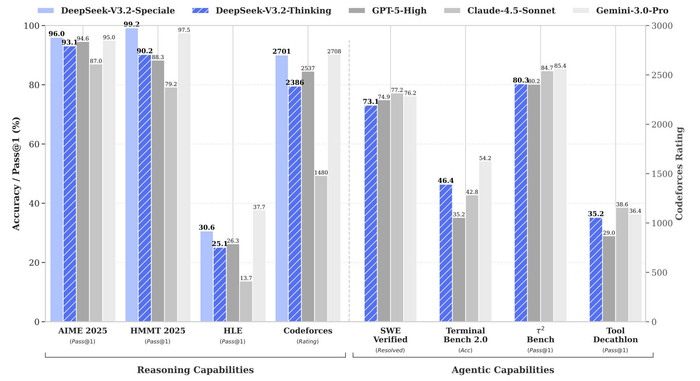
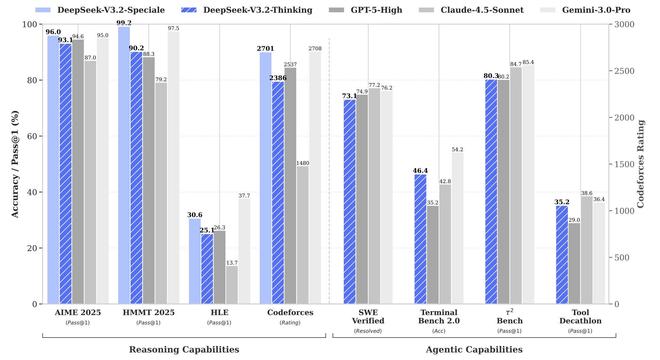
Core Insights - DeepSeek, a Chinese AI startup, launched two new models, DeepSeek-V3.2 and DeepSeek-V3.2-Speciale, achieving performance levels comparable to leading models from OpenAI and Google DeepMind [1][4][7] - The release coincides with the NeurIPS conference, generating significant interest in the AI research community [2][7] - The V3.2 model is designed for practical use, while the V3.2-Speciale focuses on enhanced reasoning capabilities, achieving gold medal-level performance in prestigious competitions [5][6][7] Model Performance - DeepSeek-V3.2 matches OpenAI's GPT-5 in mainstream reasoning benchmarks and is slightly below Google’s Gemini-3.0 Pro [4][6] - The V3.2-Speciale version excels in reasoning tests, achieving scores that rival Gemini-3.0 Pro [4][5] - Both models have shown significant improvements in efficiency, reducing computational costs and user wait times [4][6] Competitive Landscape - The success of DeepSeek's models indicates that Chinese open-source AI systems are becoming competitive with top proprietary models from Silicon Valley [7][8] - The trend towards open-source AI in China contrasts with the closed strategies of major US tech companies, which prefer to maintain control over their advanced technologies [9][10] - Recent data shows that the download share of open-source AI models from Chinese teams has surpassed that of US teams for the first time [8][9] Industry Implications - The advancements from DeepSeek suggest a shift in the AI model release paradigm, with Chinese companies frequently launching new models and versions [9][10] - The focus on open-source models in China may lead to broader applications of AI technology, potentially challenging the dominance of US AI labs [10]

对标美国行业巨头,“所有群聊都炸锅了”
Guan Cha Zhe Wang· 2025-12-02 08:46
Core Insights - DeepSeek, a Chinese AI startup, has launched two new models, DeepSeek-V3.2 and DeepSeek-V3.2-Speciale, which have achieved performance levels comparable to leading models from OpenAI and Google DeepMind [1][8] - The release of these models coincides with the upcoming NeurIPS conference, generating significant interest in the AI research community [2][8] Model Performance - DeepSeek-V3.2 is designed for practical use, achieving performance on par with OpenAI's GPT-5 in mainstream reasoning benchmarks, while DeepSeek-V3.2-Speciale excels in reasoning capabilities, matching Google DeepMind's Gemini 3.0 Pro [1][4] - The V3.2 model has shown a significant reduction in output length compared to Kimi-K2-Thinking, leading to lower computational costs and reduced user wait times [4] - DeepSeek-V3.2-Speciale has demonstrated exceptional performance in international competitions, including winning gold medals in IMO 2025 and IOI 2025, marking a significant achievement for open-source AI models [5][8] Competitive Landscape - The advancements made by DeepSeek indicate that Chinese open-source AI systems are becoming competitive with top proprietary models from Silicon Valley [8][10] - The trend towards open-source models in China contrasts with the closed strategies of major US tech companies, which tend to keep their advanced AI technologies proprietary [10][11] - Recent data shows that the download share of open-source AI models developed by Chinese teams has surpassed that of US teams for the first time, indicating a shift in the global AI landscape [9][10] Community and Industry Impact - The announcement of DeepSeek's new models has sparked excitement within the AI research community, with discussions and engagement across various platforms [2][8] - The models are now available on DeepSeek's official website, app, and API, with the Speciale version currently offered as a temporary API for community evaluation [5][7]
开源中国董事长马越出席香港开源论坛:开源基础设施服务香港智能转型
Sou Hu Cai Jing· 2025-11-27 08:49
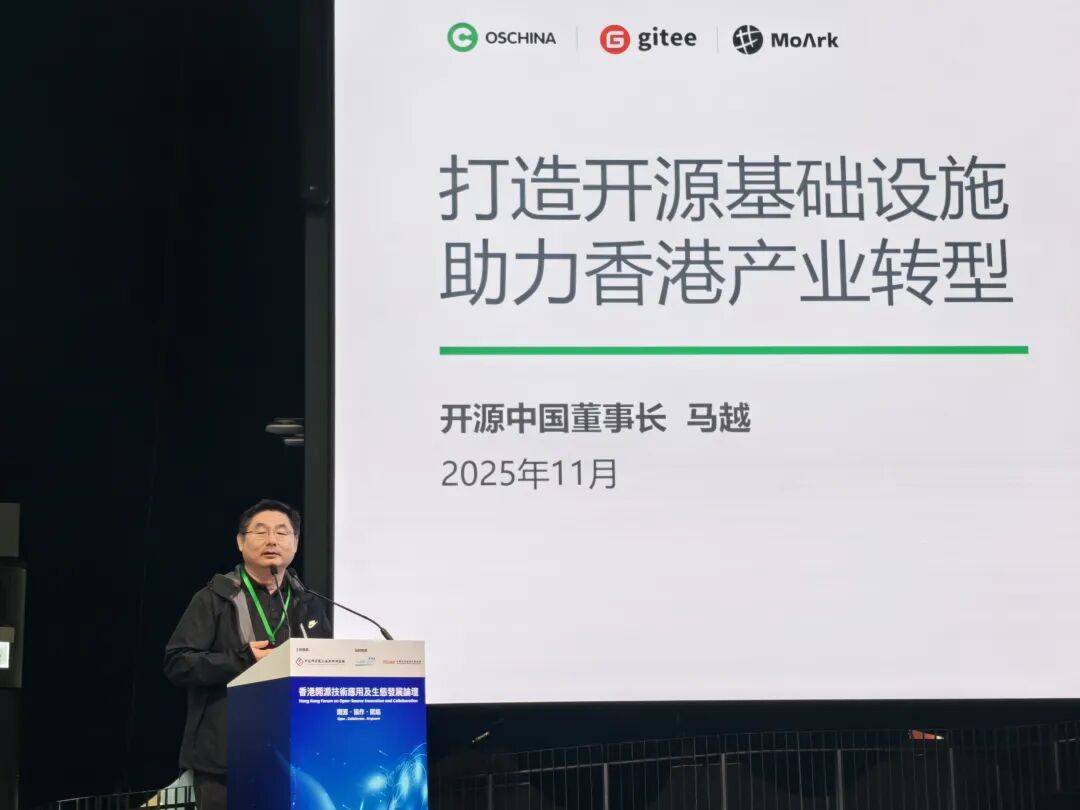
Core Insights - Open Source China is focusing on building a comprehensive open-source ecosystem, leveraging infrastructure to support local and global collaboration in AI technology and development [1][3][22] Group 1: Platform Development - Open Source China has established a full-stack system since its inception in 2008, including community, collaborative R&D, and AI platforms, with services spanning model markets, tool markets, and data set openness [3] - The platform "Moli Ark" has served over 300,000 developers, aggregating more than 17,000 models and over 10,500 datasets, supporting various domestic chips [5] Group 2: Financial Backing and Government Support - In 2025, Open Source China completed C and C+ rounds of financing, raising over 2 billion yuan, with a shareholder structure that includes national teams, local governments, and major tech companies [5][8] - Gitee is leading a project funded by the Ministry of Industry and Information Technology with a total investment of 200 million yuan, focusing on building capabilities for multi-language vulnerability scanning and compliance [8] Group 3: Domestic Tool Replacement - Gitee has launched a full-process DevOps platform to replace traditional overseas tools like Atlassian and GitLab, supporting project management and deployment [12] - The Xtreme AI system enhances R&D capabilities by analyzing open-source code assets, providing insights and knowledge reuse [14] Group 4: Local Infrastructure in Hong Kong - Open Source China aims to establish a trusted and secure open-source infrastructure in Hong Kong, addressing the increasing risks of regional bans on platforms like GitHub [16][18] - Planned deployments in Hong Kong include localizing Gitee DevOps capabilities and establishing a trusted center for component distribution and vulnerability tracking [18] Group 5: Regional Expansion and Future Outlook - The platform's capabilities will be promoted in Southeast Asia, the Middle East, and South America, using Hong Kong as a hub to serve the Belt and Road Initiative and BRICS developers [20] - Open Source China plans to initiate an IPO in Hong Kong in 2026, aiming to become the "first stock of open-source AI" and further promote the standardization and globalization of domestic infrastructure [22]
AtomGit正式上线,中国开源AI雏形已现
Tai Mei Ti A P P· 2025-11-25 03:12
Core Insights - The Chinese open-source industry is experiencing significant developments, with OpenHarmony and openEuler graduating as the first projects under the OpenAtom Open Source Foundation, indicating their maturity in technology, community governance, and ecological development [2] - The newly upgraded AtomGit platform has officially launched, accelerating the empowerment of China's open-source and AI ecosystem [2] - According to GitHub's 2024 Octoverse report, the global developer count has surpassed 150 million, with active developers reaching 22.8 million, and over 3 million new active developers added in 2024 alone [2] Market Growth - The global open-source software market is projected to maintain an 8.5% compound annual growth rate (CAGR) from 2025 to 2030, potentially exceeding $150 billion by 2030, driven by cloud computing, AI, and IoT [3] - In the AI sector, open-source models like Qwen and DeepSeek have achieved over 300 million downloads globally, with derivative models exceeding 100,000, capturing over 30% of the Hugging Face community [3] Structural Characteristics - China's open-source landscape shows a structural characteristic where projects like Qwen, DeepSeek, and PaddlePaddle are leading in AI large models, while there is still a lack of influence in foundational technology areas such as operating system kernels and databases [3] - The GitHub 2024 technical influence ranking indicates that AI large models are the primary engine of global technological innovation, with a significant cross-disciplinary and cross-national "super innovation network" effect [3] Value Realization Challenges - Despite the growth in scale, the average commercial lifespan of Chinese open-source projects is less than 18 months, with 70% of projects seeing a drop in activity within a year, and only 3% achieving sustainable profit models [4] - In comparison, international counterparts like RedHat and Canonical have established stable revenue streams, with RedHat's OpenShift generating over $3 billion annually [4] AI Open Source Imbalance - The imbalance in the AI open-source sector is evident, with Gartner predicting the global open-source software market to reach $150 billion by 2025, while Nvidia reports that China holds 80% of the world's open-source large models, yet their commercial value conversion efficiency is low [5] - The Chinese AI open-source community faces three systemic challenges: the disconnection between computing power, frameworks, and models; the dual-track collaboration between code and models; and the gap from demo to production delivery [6][7] AtomGit Platform Development - The AtomGit platform aims to integrate code, models, datasets, and computing resources, creating a unified infrastructure for AI development [8] - The platform faces challenges in merging diverse computing resources, system architecture, and ensuring a consistent user experience [9][10] Future Outlook - The development of open-source AI is transitioning from a hobbyist phase to becoming a foundational enterprise infrastructure, with predictions that by 2027, 70% of enterprise AI applications will be built on open-source models [11] - AtomGit's future business model will focus on basic services and value-added operations, supporting the growth of open-source projects and facilitating commercialization [11] Integration Strategy - AtomGit employs an integrated design for underlying storage, a unified account and permission management system, and resource scheduling mechanisms to enhance platform stability and performance [12]

蚂蚁国际开源AI预测大模型 超90%预测准确率+60%成本降幅
华尔街见闻· 2025-11-12 08:39
Core Insights - Ant International announced the open-source release of its AI forecasting model "Falcon TST" at the Singapore FinTech Festival 2025, marking it as the first large-scale time-series forecasting model based on a multi-segment pattern and a mixture of experts architecture, with over 2.5 billion parameters and optimal performance in various benchmark evaluations [1][3] Group 1 - The "Falcon TST" AI forecasting model was initially developed for internal use at Ant International for cash flow and foreign exchange risk prediction, achieving an accuracy rate exceeding 90% and potentially reducing foreign exchange costs by up to 60% [3] - The model can predict on an hourly, daily, or weekly basis and is applicable beyond finance, including weather changes, holiday consumption, financial market fluctuations, and cross-border human flow [3] - Ant International is collaborating with partners in industries such as aviation, banking, online travel, and e-commerce to explore specific applications of the model [3] Group 2 - In the aviation sector, the model can optimize foreign exchange hedging strategies, with pilot projects showing significant reductions in foreign exchange costs; it can also help reduce operational costs by 30% to 50% depending on the business model [3] - According to a report by the International Airports Council (ACI World), global air passenger volume is expected to reach 9.8 billion by September 2025, highlighting the importance of AI-driven precise forecasting for corporate profits and consumer benefits [3] - Ant International's Chief Innovation Officer stated that the decision to open-source the "Falcon TST" model aims to empower more industries and promote the iterative upgrade of AI technology in collaboration with academia and industry [3]

“杭州六小龙”聚首,梁文锋缺席
财联社· 2025-11-08 07:40
Core Insights - The "Six Little Dragons of Hangzhou" are leading advancements in various cutting-edge fields such as brain-computer interfaces, robotics, spatial intelligence, game technology, and open-source AI, showcasing China's transformation from a follower to a leader in technology [3][4][7]. Group 1: Industry Trends - The brain-computer interface sector has experienced significant growth over the past decade, transitioning from a niche interest to practical applications, driven by supportive policies [7]. - The rapid development of the robotics industry is attributed to China's strong manufacturing capabilities and core component integration technologies, enabling the creation of cost-effective and high-performance robots [9]. - The gaming industry in China has seen substantial growth, with local teams producing high-quality content that resonates with domestic users, as evidenced by the success of titles like "Black Myth: Wukong" [8]. Group 2: Technological Challenges - The lack of unified data standards in the field of embodied intelligence poses challenges for the development and integration of robotic systems [11]. - The complexity of human brain signal interpretation in brain-computer interfaces presents significant technical hurdles, particularly in applications like prosthetics [12]. - The robotics sector faces dual challenges of computational power and scene adaptability, necessitating innovative approaches to reduce data and computational requirements [14]. Group 3: Strategic Shifts - Companies are shifting their business models from serving human clients to focusing on machine clients, anticipating a future where the number of machines may exceed that of humans [13]. - The introduction of Spatial AI and digital twin products aims to address market needs in industrial robotics, reflecting a strategic pivot towards advanced technological solutions [14]. - The emphasis on open-source models in AI development is seen as a way to democratize access to technology and mitigate risks associated with monopolistic practices [14].

“杭州六小龙”聚首乌镇对话,接棒互联网大厂成新主角
Feng Huang Wang· 2025-11-08 05:53
Core Insights - The "Six Little Dragons of Hangzhou" are recognized for their contributions to cutting-edge fields such as brain-computer interfaces, robotics, spatial intelligence, game technology, and open-source AI, marking a shift in China's tech narrative from following to leading [1][5][6] Group 1: Industry Transformation - The past decade has seen significant advancements in the brain-computer interface sector, transitioning from experimental stages to real-world applications, driven by policy support [5] - The rapid development of the robotics industry is attributed to China's strong manufacturing capabilities and core component integration technologies, enabling the creation of cost-effective and high-performance robots [7] - The gaming industry has evolved, with local teams producing high-quality content that resonates with Chinese users, as evidenced by the success of "Black Myth: Wukong" [6] Group 2: Technological Challenges and Innovations - The lack of unified data standards in embodied intelligence poses challenges for the robotics sector, with varying data collection methods across manufacturers [9] - The complexity of human brain signal interpretation in brain-computer interfaces presents significant hurdles, with AI being utilized to address these challenges [9][10] - Companies are facing dual challenges of computational power and scene adaptation in robotics, necessitating innovative approaches to reduce data and computational requirements [12] Group 3: Strategic Shifts - Companies are shifting their business models from serving human clients to focusing on machine clients, anticipating a future where the number of machines may exceed that of humans [10][11] - The introduction of Spatial AI and digital twin products aims to enhance collaboration with industrial robots, reflecting a strategic pivot towards advanced technology solutions [11] - The emphasis on open-source models and collaborative development is seen as a way to democratize access to advanced AI technologies, mitigating risks of technological monopolies [12]