
新能源汽车产业高质量发展

Search documents
智库报告:多维发力推动新能源汽车产业高质量发展
Xin Hua Cai Jing· 2025-11-04 07:48
Core Insights - The report highlights the rapid development of China's new energy vehicle (NEV) industry, emphasizing its role as a core engine for green economic transformation and high-quality growth [1][2] - NEV industry is crucial for upgrading manufacturing towards high-end, intelligent, green, and international standards, supporting China's strategic goal of becoming a strong automotive nation [1] Industry Development - China's NEV industry is accelerating its quality improvement, becoming a significant force in shaping regional competitive advantages and restructuring the industrial landscape [1] - Traditional automotive cities are transforming, with cities like Shenzhen, Shanghai, and Beijing leading in intelligent connected vehicles, while Guangzhou and Chongqing are also enhancing their new advantages [1] - Hefei has transitioned from "catching up" to "leading" due to explosive production growth and integrated policy benchmarks [1] - Chengdu and Wuhan are enhancing their industrial competitiveness by leveraging leading vehicle manufacturers to strengthen and supplement the supply chain [1] Future Directions - Despite historical advancements, the NEV industry is still in a deep development phase, facing challenges in resource efficiency, technological autonomy, ecosystem collaboration, infrastructure completeness, and brand recognition [2] - The report suggests focusing on building industrial ecosystems, deepening advantageous sectors, optimizing consumer environments, and strengthening capital empowerment to promote high-quality development of the NEV industry [2]
新能源汽车购置税新规落地:门槛提升 需调整购车策略
Zhong Guo Zhi Liang Xin Wen Wang· 2025-10-15 06:56
Core Viewpoint - The announcement by the Ministry of Industry and Information Technology, the Ministry of Finance, and the State Taxation Administration outlines new technical requirements for the exemption of vehicle purchase tax for new energy vehicles (NEVs) from 2026 to 2027, transitioning from full exemption to a 50% reduction with a maximum tax reduction of 15,000 yuan per vehicle starting January 1, 2026 [1][2][10] Group 1: Policy Changes - The most significant change is the introduction of technical entry thresholds for tax-exempt vehicles, particularly increasing the pure electric range requirement for plug-in hybrid vehicles from 43 kilometers to 100 kilometers, a 132% increase [4][5] - The new policy will also enforce stricter energy consumption standards, requiring pure electric vehicles to meet specific energy consumption limits and plug-in hybrids to undergo dual assessments for energy consumption modes [5][6] Group 2: Consumer Impact - Consumers looking to purchase plug-in hybrid vehicles with a pure electric range under 100 kilometers must do so by December 31, 2025, to benefit from the current full tax exemption [7][9] - The new regulations may lead to a slight increase in the prices of entry-level plug-in hybrid models due to battery costs, and consumers should adjust their purchasing plans accordingly [7][9] - For those planning to buy vehicles that meet the new standards, it is advisable to focus on models released in the fourth quarter of this year, which comply with the new regulations [9] Group 3: Industry Implications - The introduction of these new regulations marks a transitional phase for the NEV industry, pushing for high-quality development and addressing current industry pain points while laying a foundation for long-term competitiveness [10] - The policy shift is not a withdrawal of support but rather a strategic move to guide the industry towards improved product quality and consumer experience [10]

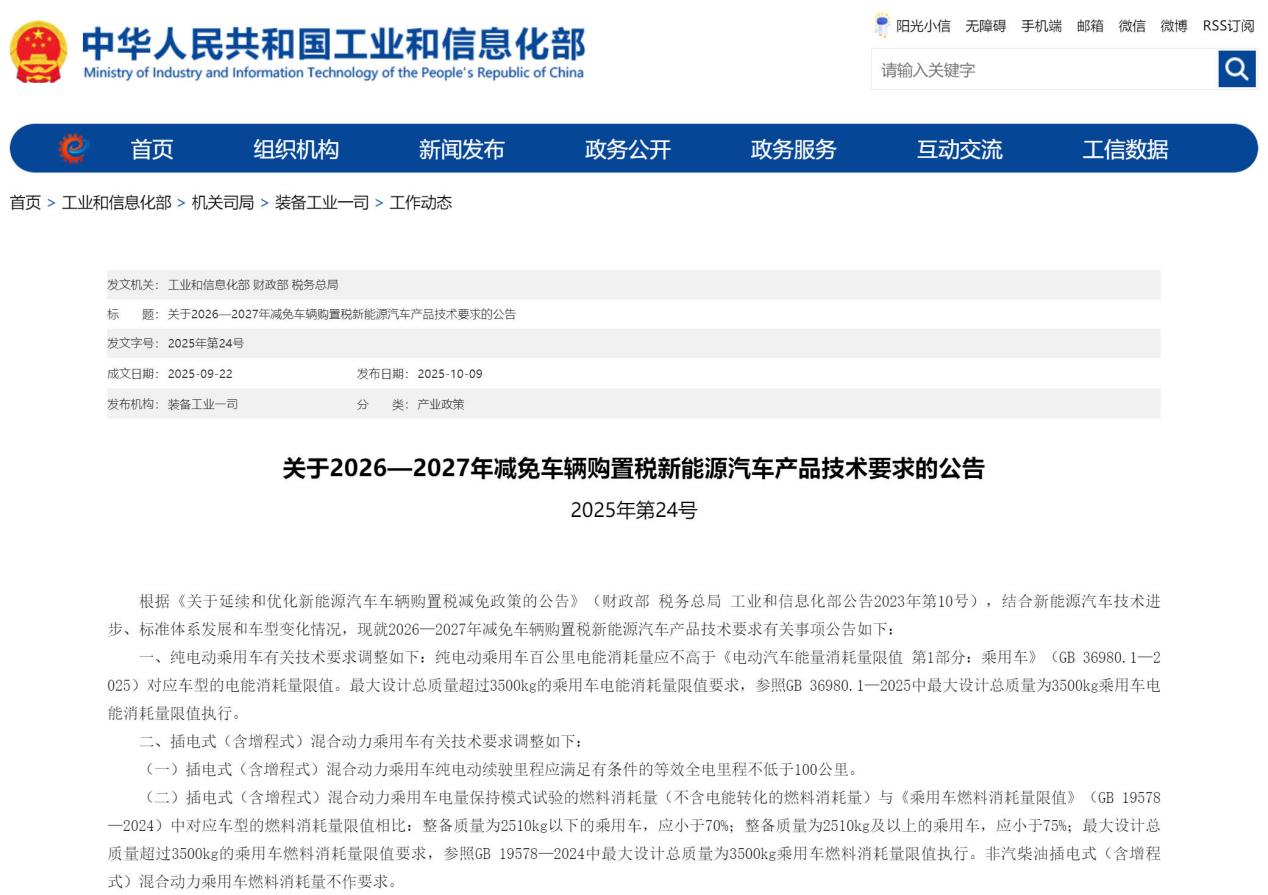
明年起实施,新能源车购置税减免技术门槛提高
Mei Ri Jing Ji Xin Wen· 2025-10-10 10:06
Core Points - The announcement introduces updated national standards for energy consumption in pure electric passenger vehicles and raises the pure electric range requirement for plug-in hybrid vehicles from 43 kilometers to 100 kilometers [2][7] - The changes aim to align policy with rapid advancements in battery technology and to encourage companies to increase R&D investments, phasing out outdated products and promoting high-quality development in the industry [2][6] Group 1: New Standards and Requirements - The new standards require pure electric passenger vehicles to meet specific energy consumption limits as defined in the mandatory national standard GB 36980.1—2025, which will be enforced starting January 1, 2026 [3][5] - The energy consumption limit for conventional models has been tightened by approximately 11% compared to previous phases, with the weight thresholds adjusted to 1090 kg and 2710 kg [5][6] - The new requirements are expected to indirectly curb the trend of oversized electric vehicles, as higher vehicle weight typically leads to increased energy consumption [5] Group 2: Impact on Plug-in Hybrid Vehicles - The announcement significantly raises the pure electric range requirement for plug-in hybrid vehicles, which is anticipated to enhance consumer experience and reduce daily travel costs [7][8] - Approximately 40% of currently available plug-in hybrid vehicles have a pure electric range below 100 kilometers, which may lead to a clearance sale by manufacturers before the new standards take effect [7][8] Group 3: Future of Tax Policies - The announcement signals a potential end to the current exemption from vehicle purchase tax for new energy vehicles, with expectations that a 5% tax rate will be implemented starting next year [10] - The new technical requirements are seen as a precursor to the upcoming half-price vehicle purchase tax policy for eligible models, which will be effective from January 1, 2026 [10]
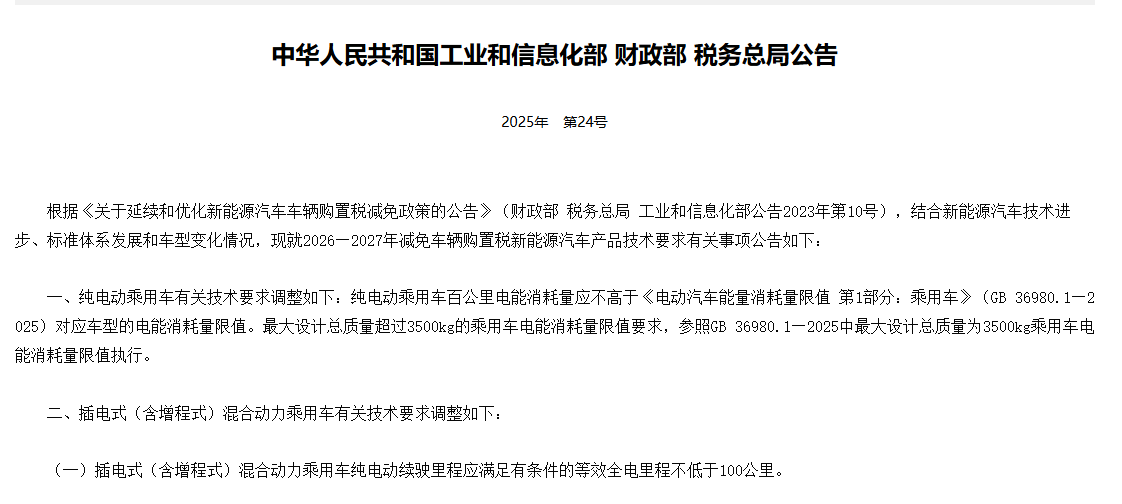
明年起实施!新能源车购置税减免技术门槛提高 专家:引导企业加大研发投入,淘汰落后产品
Mei Ri Jing Ji Xin Wen· 2025-10-10 09:27
Core Viewpoint - The Ministry of Industry and Information Technology (MIIT) and other departments have issued an announcement regarding the technical requirements for new energy vehicles (NEVs) to be eligible for vehicle purchase tax exemptions from 2026 to 2027, emphasizing the need for higher technical standards to promote quality development in the industry [1][4][9]. Summary by Sections Technical Requirements for NEVs - The announcement introduces updated national standards for the energy consumption of pure electric passenger vehicles, requiring a maximum energy consumption of 100 kilometers for plug-in hybrid vehicles, up from the previous 43 kilometers [4][10]. - The new standards aim to align with advancements in battery technology and encourage companies to invest in research and development, phasing out outdated products [4][9]. Implementation Timeline - The new technical requirements will take effect on January 1, 2026, for models listed in the directory of NEVs eligible for vehicle purchase tax exemptions [4][5]. Energy Consumption Standards - The energy consumption limit for pure electric passenger vehicles is set according to the national standard GB 36980.1-2025, which will be enforced starting January 1, 2026 [5][8]. - The new standard tightens energy consumption limits by approximately 11% compared to previous phases, reflecting the need for improved vehicle efficiency [8]. Market Impact - The increase in the pure electric range requirement for plug-in hybrid vehicles may lead to a clearance sale for models that do not meet the new standards, as around 40% of currently available models have a pure electric range below 100 kilometers [10][11]. - The announcement is seen as a signal that the exemption policy for NEV purchase taxes may be phased out, with a potential shift to a 5% tax rate starting next year [13]. Industry Response - Experts suggest that automakers should prepare for the new standards by enhancing their vehicle designs and focusing on improving the efficiency of their electric systems [4][9]. - The new requirements are expected to drive technological upgrades in battery capacity and hybrid systems, enhancing product safety and competitiveness [8][9].
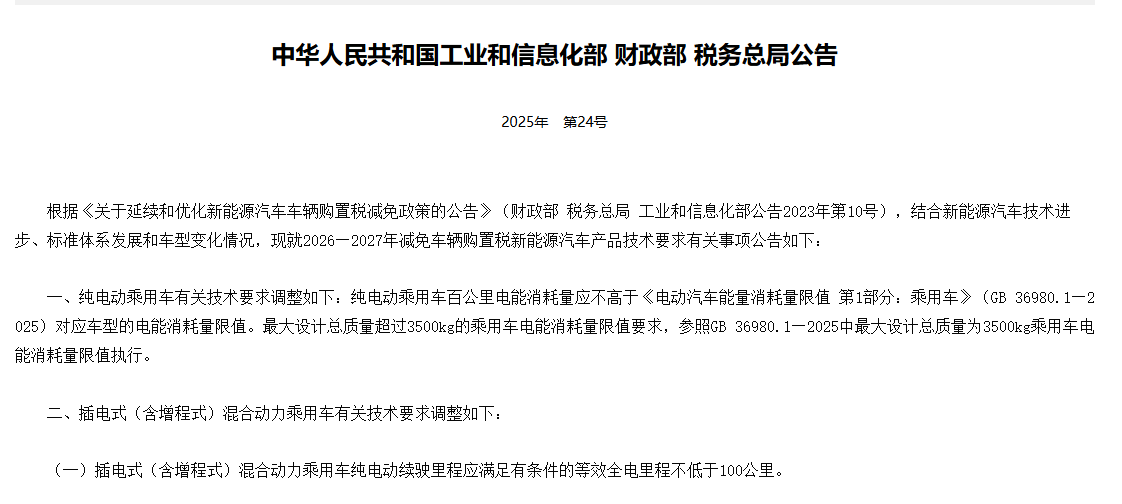
都市车界|新能源车购置税政策“提门槛” 插混车型续航须超100公里
Qi Lu Wan Bao· 2025-10-10 07:35
Core Insights - The Ministry of Industry and Information Technology, Ministry of Finance, and State Taxation Administration announced a continuation of the vehicle purchase tax exemption policy for new energy vehicles (NEVs) starting January 1, 2026, with significantly higher technical requirements aimed at promoting high-quality industrial development [1][3]. Policy Overview - The purchase tax exemption will remain in effect until the end of 2027, with a 50% tax reduction in 2026 and a maximum tax reduction of 15,000 yuan per vehicle [3][9]. - The new technical standards will disqualify models that do not meet the updated criteria from enjoying tax benefits, indicating a shift from policy subsidies to technological innovation [3][10]. Technical Requirements - For pure electric vehicles, the energy consumption per 100 kilometers must comply with the latest national standards, ensuring energy efficiency [4]. - For plug-in hybrid vehicles, the pure electric driving range requirement has increased from 43 kilometers to 100 kilometers, a 132% increase [1][5]. - Fuel consumption in electric mode must also be reduced according to specific weight categories, with stricter limits for heavier vehicles [5][6]. Transition and Compliance - Vehicles listed in the tax exemption directory before December 31, 2025, that meet the new requirements will automatically transition to the 2026 directory; non-compliant models will be removed [7][9]. - New models must be submitted for inclusion in the 2026 directory by December 12, 2025, with a dynamic regulatory mechanism in place for compliance [8]. Market Impact - The new requirements are expected to drive technological upgrades in the NEV sector, pushing manufacturers to enhance research and development efforts and phase out outdated products [10]. - As of September 2025, plug-in hybrid vehicles accounted for 30.7% of total NEV sales, indicating a significant market presence that may be affected by these new standards [10][11]. - The policy aims to align with advancements in battery technology and engine efficiency, ensuring that the market evolves towards high-quality development rather than mere scale expansion [10][11].
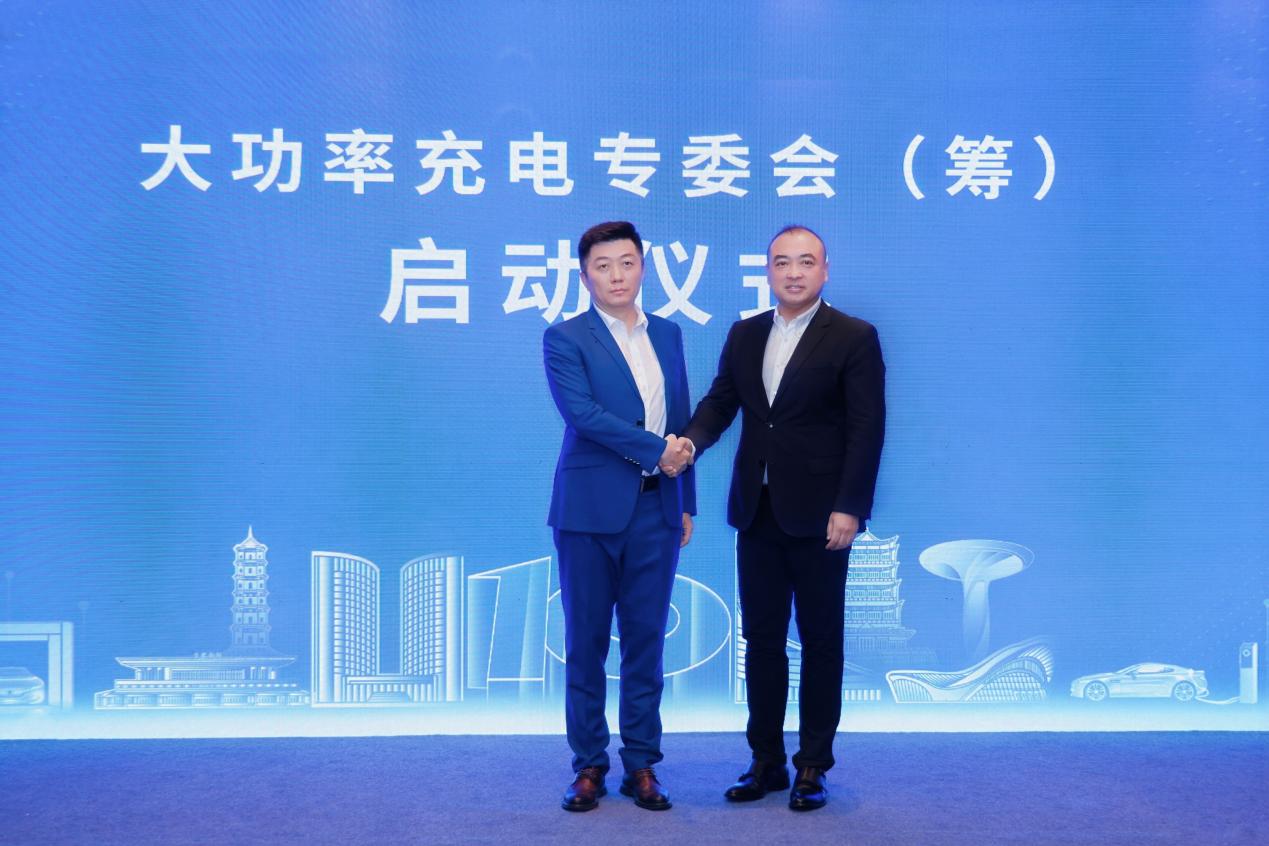
大功率充电专委会(筹)启动 吉利浩瀚能源牵头助推行业高质量发展
Zhong Guo Jin Rong Xin Xi Wang· 2025-09-30 10:07
Group 1 - The "High-Power Charging Professional Committee (Preparatory)" was officially launched at the 2025 China Automotive Charging and Swapping Ecology Conference, initiated by the China Charging Alliance and led by Geely Haohan Energy [2] - The first members of the committee include key enterprises from the automotive, operator, charging pile, and battery sectors, achieving full coverage of the charging industry ecosystem [2] - The establishment of the committee responds to the notice issued by the National Development and Reform Commission and other departments in July 2023, focusing on the promotion of high-power charging technology, industry collaboration, and standard formulation [2] Group 2 - The committee aims to gather industry strength to address energy replenishment anxiety and promote the high-quality development of the new energy vehicle industry [2] - During the conference, 15 charging stations operated by Haohan Energy received the "Five-Star Charging Station" certification from the China Charging Alliance, bringing the total number of five-star stations to 40 [2]
报告解读|城市新能源汽车产业智造活力迸发 六大建议助力产业高质量发展
Xin Hua Cai Jing· 2025-09-29 09:15
Core Insights - The report highlights the significant potential of the new energy vehicle (NEV) industry in China, emphasizing its role in regional development and industrial transformation [1] - The NEV industry is recognized for its ability to create GDP multiplier effects, promote innovation, and support carbon neutrality, making it a key driver for urban development strategies [1] Summary by Sections Report Overview - The "China Urban New Energy Vehicle Industry Intelligence Vitality Index Report 2025" was released at the 2025 Hefei International New Energy Vehicle Conference, focusing on the integration and innovative characteristics of the NEV industry [1][2] - The report was developed through collaboration between the China Economic Information Service and the Institute of Equipment Engineering Research, aiming to assess the regional development levels of the NEV industry [1][2] Evaluation Metrics - The evaluation framework includes five primary indicators: industrial support, innovation drive, environmental assurance, intelligent leadership, and development activity, with a total of 13 secondary and 29 tertiary indicators [2] - The index results were derived using the entropy method and expert opinions, supported by the "Tiansuan" intelligent analysis assistant developed by the China Economic Information Service [2] City Analysis - The report analyzes 15 key cities, including Shenzhen, Hefei, Shanghai, Chongqing, Beijing, and Wuhan, noting that cities like Shenzhen, Shanghai, and Beijing are leading in technology and product upgrades within the NEV sector [3] - Hefei is highlighted for its explosive production growth and exemplary policy integration, while cities like Wuhan are enhancing their industrial competitiveness through strong vehicle manufacturing leadership [3] Recommendations for Development - The report provides six recommendations for high-quality development of the NEV industry, including tailored city-specific strategies, strengthening local supply chains, and optimizing the consumer environment [4] - It emphasizes the importance of government and enterprise collaboration, international standard participation, and capital empowerment to support the industry's growth [4]
《中国城市新能源汽车产业智造活力指数报告2025》发布
Xin Hua Cai Jing· 2025-09-29 06:39
Core Insights - The "China Urban New Energy Vehicle Industry Intelligence Manufacturing Vitality Index Report 2025" was released at the 2025 Hefei International New Energy Vehicle Conference, highlighting the positive growth of the new energy vehicle (NEV) industry in various cities across China [1][3]. Group 1: Industry Performance - The overall vitality of NEV manufacturing in sample cities shows an upward trend, with cities like Shenzhen, Shanghai, Beijing, Chongqing, and Hefei demonstrating significant advantages in core technology breakthroughs, concentration of leading enterprises, and complete ecosystem construction [3]. - Cities such as Chengdu, Wuhan, and Xi'an are leveraging their leading enterprises and unique industrial clusters to create regional growth poles, while cities like Changzhou are focusing on deepening industrial chain support and exploring innovative models [3][4]. Group 2: Key Findings - The report indicates several highlights in the development of China's urban NEV industry, including rapid progress in key technology autonomy, deepening smart manufacturing, and increasingly tight collaboration across the industrial chain [4]. - Diverse application scenarios and innovative business models are stimulating new market vitality, supported by precise policy measures from various cities that inject strong momentum into industry acceleration [4]. Group 3: Recommendations - To promote high-quality development of urban NEV industries, the report suggests tailored strategies for different cities, strengthening collaborative innovation, optimizing consumer environments, and enhancing brand building through government and enterprise synergy [5]. - It also emphasizes the need for establishing international standards and upgrading overseas expansion systems, alongside reinforcing capital empowerment and innovative investment strategies [5].
我国新能源汽车如何持续发力?
Hu Xiu· 2025-08-12 23:34
Core Insights - The global electric vehicle (EV) industry is rapidly developing, with sales reaching approximately 7.3 million units by June 2024, accounting for 16.8% of the global automotive market. China has emerged as a manufacturing and consumption powerhouse in this sector, with exports reaching 928,000 units from January to September 2024, a year-on-year increase of 12.5% [1][2]. Industry Development Trends - China's EV industry has established a comprehensive supply chain, achieving significant advancements in technology research, market expansion, and brand development, particularly in the battery sector, where it holds a dominant global market share [1][2]. - The market penetration rate of EVs in China has surged from 0.1% in 2013 to 51.1% by September 2024, indicating a transition from initial growth to mainstream adoption [6][7]. - The competitive landscape features a leading player, BYD, followed by several strong domestic brands and emerging players like NIO and Xpeng, alongside tech companies like Xiaomi and Huawei entering the market [9][12]. Challenges Facing the Industry - Many EV companies are struggling with profitability despite increasing sales, with high R&D costs leading to significant financial losses. For instance, Xpeng reported a revenue of 6.55 billion yuan in Q1 2024 but incurred a net loss of 1.37 billion yuan [2][21]. - The industry faces geopolitical challenges, particularly from Western countries imposing trade restrictions and tariffs, which complicate the export of Chinese EVs and components [3][17]. - The reliance on imported core technologies, such as batteries and chips, poses a risk of supply chain disruptions, necessitating a focus on domestic innovation and self-sufficiency [23]. Strategic Recommendations for Sustainable Development - Companies should reassess their positions within the supply chain and consider mergers and acquisitions to enhance core competencies and resource integration [27][29]. - A focus on improving supply chain efficiency, resilience, and sustainable development practices is essential for long-term success [31][32]. - Continuous investment in technology R&D, particularly in battery management and autonomous driving, is crucial for maintaining competitive advantages [34]. - Establishing collaborative relationships with suppliers, service providers, and even competitors can foster a more robust ecosystem that benefits all parties involved [35][38]. - Expanding into international markets while understanding local regulations and consumer preferences is vital for growth and risk mitigation [40][41]. Government Support and Policy Recommendations - The government should facilitate industry consolidation through supportive policies for mergers and acquisitions, helping companies achieve resource sharing and competitive advantages [44]. - Establishing unified standards for battery technology and recycling processes can enhance efficiency and reduce redundant investments [45]. - Developing regulations for emerging technologies like autonomous driving and shared mobility will be essential for fostering innovation while ensuring safety and compliance [45]. Future Outlook - The Chinese EV industry is poised for continued growth, with the potential to drive advancements in other high-tech sectors, contributing to the nation's goal of becoming a manufacturing powerhouse [46].

碳酸锂数据日报-20250722
Guo Mao Qi Huo· 2025-07-22 09:53
Report Summary 1. Industry Investment Rating - No investment rating information is provided in the report. 2. Core View - The price increase is mainly due to supply - side disturbances, which boost market sentiment but have limited impact on the fundamentals. In the short term, the market sentiment is strong, and rumors support the futures price. However, the pricing weight of fundamental contradictions and hedging pressure may increase, and industry players can consider hedging at high prices. Also, the basis of the spot to the 08 contract has been repaired, which will stimulate warrant production and reduce the risk of a short squeeze [2]. 3. Summary by Related Catalogs Lithium Compounds - SMM battery - grade lithium carbonate has an average price of 68,000 with a rise of 1,350; SMM industrial - grade lithium carbonate has an average price of 66,350 with a rise of 1,300 [1]. Lithium Ore - Lithium spodumene concentrate (CIF China) has an average price of 730 with a rise of 19; lithium mica (Li20: 1.5% - 2.0%) has an average price of 990 with a rise of 45; lithium mica (Li20: 6% - 7%) has an average price of 1545 with a rise of 40; lithiophilite (Li20: 2.0% - 2.5%) has an average price of 5175 with a rise of 225; lithiophilite (Li20: 7% - 8%) has an average price with a rise of 320; phospho - lithiophilite has an average price of 6075 with a rise of 250 [1][2]. Lithium Futures Contracts - The closing prices and price increases of lithium carbonate futures contracts 2508, 2509, 2510, 2511, and 2512 are 71,260 (2.36%), 71,280 (2.53%), 70,520 (2.5%), 70,200 (2.69%), and 70,140 (2.57%) respectively [1]. Cathode Materials - The average price of lithium iron phosphate (power - type) is 32,075; the average prices of ternary materials 811 (polycrystalline/power - type), 613 (single - crystal/power - type), 523 (single - crystal/power - type) are 142,650, 120,175, and 115,195 respectively [2]. Inventory and Other Data - The weekly inventory of downstream is 41,271 tons with an increase of 506 tons; the weekly inventory of others is 43,310 tons with an increase of 1,880 tons; the daily registered warrant is 9,969 tons with a decrease of 270 tons; the weekly inventory of smelters is 58,039 tons with a decrease of 559 tons [2]. Profit Estimation - The cash cost of purchasing spodumene concentrate is 66,602; the profit of purchasing spodumene concentrate is not given; the cash cost of purchasing lithium mica concentrate is 71,484; the profit of purchasing lithium mica concentrate is - 6,008 [2]. Policy and Industry News - The Ministry of Industry and Information Technology will introduce a stable growth work plan for ten key industries including steel, non - ferrous metals, and petrochemicals, and will promote key industries to adjust the structure, optimize the supply, and eliminate backward production capacity. The Fourth Central Steering Group carried out a special research and discussion on rectifying the irrational competition in the new energy vehicle industry [2].