期货市场交易

Search documents
期货市场交易指引:2025年10月16日-20251016
Chang Jiang Qi Huo· 2025-10-16 02:03
Report Industry Investment Ratings - Macro-finance: Bullish in the medium to long term, recommend buying on dips for stock indices and holding a wait-and-see stance for treasury bonds [1][5] - Black building materials: Range trading for coking coal and rebar, and a wait-and-see approach for glass [1][7][8] - Non-ferrous metals: Recommend buying on dips for copper and aluminum, a wait-and-see or short-selling approach on rallies for nickel, range trading for tin and silver, and buying on dips for gold [1][10][12] - Energy and chemicals: PVC, caustic soda, styrene, rubber, urea, methanol are expected to oscillate; polyolefins to have wide-range oscillations; a short-selling strategy for the 01 contract of soda ash [1][20][23][29][30] - Cotton and textile industry chain: Cotton and cotton yarn to oscillate, PTA to have narrow-range oscillations, apples and jujubes to be slightly bullish [1][32][33][34] - Agriculture and animal husbandry: Short-selling on rallies for hogs and eggs, corn to have wide-range oscillations, soybean meal to have low-level oscillations, and oils to have limited corrections [1][37][40][43] Core Views - The A-share market showed a strong oscillation on October 15, with the Shanghai Composite Index regaining the 3900 level. The increase in new social financing and loans in September reflects positive economic signals. Stock indices may continue to oscillate, and are bullish in the medium to long term [5] - The bond market may focus on the Sino-US geopolitical and trade issues before the APEC meeting at the end of the month. Treasury bonds are expected to oscillate in the short term [5] - Black building materials are affected by factors such as rainfall, demand, and tariffs. Prices may first weaken and then strengthen in October [7] - Non-ferrous metals are influenced by global trade tensions, supply disruptions, and demand expectations. Copper and aluminum prices are expected to remain strong, while nickel and tin may oscillate [10][12][17] - Energy and chemical products face various challenges such as high supply, weak demand, and inventory accumulation. Most products are expected to oscillate or have a weakening trend [20][21][23] - The cotton and textile industry chain is affected by factors such as global supply and demand, Sino-US relations, and weather conditions. Apples and jujubes may be slightly bullish due to quality and supply issues [32][34][35] - In the agriculture and animal husbandry sector, hogs and eggs are under pressure due to supply and demand imbalances. Corn, soybean meal, and oils are affected by factors such as harvest, trade, and policy, with different trends [37][40][43] Summary by Category Macro-finance - Stock indices oscillated on October 15, with over 4300 stocks rising. The total market turnover was 2.09 trillion yuan, a decrease of 500 billion yuan. The increase in new social financing and loans in September indicates an improvement in economic activities. Stock indices are expected to continue to oscillate and are bullish in the medium to long term [5] - Treasury bond futures closed lower on October 15. The bond market may focus on Sino-US relations before the APEC meeting. Treasury bonds are expected to oscillate in the short term [5] Black building materials - Coking coal and rebar are affected by rainfall, demand, and tariffs. Prices may first weaken and then strengthen in October. RB2601 of rebar may have a buying opportunity around 3000 [7] - Glass is affected by factors such as production line resumption, inventory increase, and demand weakness. It is recommended to wait and see, and pay attention to the changes in Shahe production lines [8][9] Non-ferrous metals - Copper prices experienced significant fluctuations due to trade tensions and supply disruptions. The fundamentals are relatively stable, and the demand in the fourth quarter is expected to increase. It is recommended to hold long positions on dips [10] - Aluminum is affected by factors such as bauxite price decline, production capacity increase, and demand seasonality. It is recommended to find low positions to build long positions [12] - Nickel is affected by factors such as RKAB policy adjustment, supply and demand imbalance, and price fluctuations. It is recommended to wait and see or short-sell on rallies [17] - Tin is affected by factors such as supply shortage, demand recovery, and tariff expectations. It is recommended to conduct range trading [17] - Gold and silver prices are supported by factors such as interest rate cut expectations and risk aversion. It is recommended to trade cautiously and build positions after a full correction [18][19] Energy and chemicals - PVC is affected by factors such as high supply, weak demand, and inventory accumulation. It is expected to oscillate weakly, with the 01 contract temporarily paying attention to the 4800 pressure [20][21] - Caustic soda is affected by factors such as macro expectations, supply and demand, and export prospects. It is expected to oscillate, with the 01 contract temporarily paying attention to the range of 2380-2530 [22][23] - Styrene is affected by factors such as cost, supply and demand, and inventory. It is expected to oscillate weakly, temporarily paying attention to the 6900 pressure [23][24] - Rubber is affected by factors such as supply and demand, inventory, and macro environment. It is expected to oscillate, temporarily paying attention to the 15000 support [25][26] - Urea is affected by factors such as supply increase, demand dispersion, and inventory accumulation. It is expected to oscillate, and it is necessary to pay attention to factors such as compound fertilizer production and export policy [27] - Methanol is affected by factors such as supply recovery, demand support, and inventory increase. It is expected to oscillate, and it is necessary to pay attention to factors such as downstream demand and inventory changes [28][29] - Polyolefins are affected by factors such as supply pressure, weak demand, and cost decline. It is expected to oscillate weakly, with the L2601 contract paying attention to the 6900 support and the PP2601 contract paying attention to the 6600 support [29][30] - Soda ash is affected by factors such as oversupply, weak demand, and inventory pressure. It is recommended to maintain a short-selling strategy for the 01 contract [30][31] Cotton and textile industry chain - Cotton and cotton yarn are affected by factors such as global supply and demand, Sino-US relations, and price fluctuations. It is expected to oscillate, and the outlook is bearish [32][33] - PTA is affected by factors such as crude oil prices, supply and demand, and inventory accumulation. It is expected to have narrow-range oscillations, paying attention to the range of 4500-4750 [33][34] - Apples are affected by factors such as weather conditions, quality decline, and price increase. It is expected to be slightly bullish [34][35] - Jujubes are affected by factors such as weather conditions, supply and demand, and price stability. It is expected to be slightly bullish [35] Agriculture and animal husbandry - Hogs are affected by factors such as supply increase, demand weakness, and price pressure. It is recommended to short-sell on rallies, with different strategies for different contracts [37][39] - Eggs are affected by factors such as supply and demand balance, price support, and seasonal factors. It is recommended to partially close short positions for the 11 contract and wait for spot price guidance, and wait for rallies to short-sell for the 12 and 01 contracts [40][42] - Corn is affected by factors such as new grain listing, supply and demand balance, and price pressure. It is expected to have wide-range oscillations, with a bearish view on the 11 contract and attention to the 1-5 reverse spread [42][43] - Soybean meal is affected by factors such as harvest pressure, export slowdown, and supply and demand balance. It is expected to have low-level oscillations, paying attention to the 2900 support of the M2601 contract [43][44] - Oils are affected by factors such as macro risks, supply and demand balance, and price fluctuations. It is expected to have limited corrections, with the 01 contracts of soybean oil, palm oil, and rapeseed oil paying attention to the support levels of 8150-8200, 9200-9300, and 9800-9900 respectively [45][51]
长江期货市场交易指引-20250815
Chang Jiang Qi Huo· 2025-08-15 02:02
1. Report Industry Investment Ratings 1.1 Macro Finance - Index Futures: Bullish on dips [1][6] - Treasury Bonds: Sideways [1][6] 1.2 Black Building Materials - Rebar: Hold off for now [1][8] - Iron Ore: Sideways [1][8] - Coking Coal and Coke: Sideways [1][10] 1.3 Non - Ferrous Metals - Copper: Range trading or hold off [1][13] - Aluminum: Buy on dips after pullbacks [1][15] - Nickel: Hold off or short on rallies [1][17] - Tin: Range trading [1][17] - Gold: Range trading [1][18] - Silver: Range trading [1][18] 1.4 Energy and Chemicals - PVC: Sideways [1][20] - Soda Ash: Short 09 and long 05 arbitrage [1] - Caustic Soda: Sideways [1][22] - Styrene: Sideways [1][24] - Rubber: Sideways with a bullish bias [1][27] - Urea: Sideways [1][31] - Methanol: Sideways [1][32] - Polyolefins: Wide - range sideways [1][33] 1.5 Cotton Textile Industry Chain - Cotton and Cotton Yarn: Sideways with a bullish bias [1][37] - Apples: Sideways with a bullish bias [1][38] - Jujubes: Sideways with a bullish bias [1][38] 1.6 Agriculture and Animal Husbandry - Hogs: Bearish on rallies [1][40] - Eggs: Bearish on rallies [1][42] - Corn: Wide - range sideways [1][43] - Soybean Meal: Range - bound [1][46] - Oils and Fats: Sideways with a bullish bias [1][47] 2. Core Views of the Report - The overall futures market shows a diversified trend, with different investment strategies recommended for various sectors based on their supply - demand fundamentals, macro - economic factors, and policy impacts. For example, in the macro - finance sector, the index futures are expected to rise in the medium - term due to policy support and capital inflows, while the treasury bonds are constrained by the strong performance of the equity market. In the non - ferrous metals sector, copper is likely to maintain a high - level sideways trend due to a combination of factors such as economic data and inventory levels [6][13]. 3. Summaries According to Relevant Catalogs 3.1 Macro Finance - **Index Futures**: The US inflation data has affected the Fed's interest - rate cut expectations. The index has strengthened due to policy support, capital inflows, and event catalysts. After reaching a short - term high, it may consolidate, but the medium - term upward trend remains. Investors with positions can hold or lock in profits on pullbacks, while those without positions can consider buying on dips [6]. - **Treasury Bonds**: The bond market is currently constrained by the strong performance of risk assets. Although the equity market has ended its eight - day winning streak, the adjustment is limited, and the current equity - dominant pattern may continue to suppress the bond market in the short term. Attention should be paid to the upcoming economic data to see if it can support the bond market [6]. 3.2 Black Building Materials - **Rebar**: The rebar futures price has continued to decline. The cost is at a neutral level, and the supply - demand contradiction is not significant. The market should pay attention to the implementation of crude - steel production limits and the resumption of coking - coal production. It is expected to remain sideways in the short term, and investors can hold off or engage in short - term trading [8][9]. - **Iron Ore**: The iron - ore futures price has been weak. The supply and demand are in a state of weak balance. Considering the possible macro - positive factors in the fourth quarter, the iron - ore price is expected to be sideways with a bullish bias. It can be considered as a long leg when shorting other black - building materials [8][9]. - **Coking Coal and Coke**: The coking - coal market has limited supply growth and stable demand, with no prominent supply - demand contradictions. The coke market is in a tight supply - demand pattern, but the weak steel sales and high iron - water production are in a game. Attention should be paid to factors such as production - limit policies, iron - water production changes, and raw - material price fluctuations [11]. 3.3 Non - Ferrous Metals - **Copper**: The Chinese economic data is positive, and the Fed's possible interest - rate cut has supported the copper price. However, the domestic copper industry is in the off - season, and the downstream demand is weak. The inventory is expected to accumulate, but the decline in the copper price is limited. It is expected to remain sideways in the short term, with the Shanghai copper running in the range of 78,000 - 79,500 yuan/ton [13]. - **Aluminum**: The production capacity of alumina and electrolytic aluminum is increasing, while the downstream demand is affected by the off - season. The inventory has increased. Although there are still some positive factors such as interest - rate cut expectations, the short - term is expected to be sideways. Investors can consider buying on dips in August [15]. - **Nickel**: In the medium - to - long term, the nickel industry has an oversupply situation. The price of nickel ore is falling slowly, and the stainless - steel price is expected to be strong. It is recommended to short on rallies moderately [17]. - **Tin**: The domestic refined - tin production has increased, and the supply of tin ore is gradually improving. The semiconductor industry is expected to recover, and the inventory is at a medium level. It is recommended to conduct range trading, with the Shanghai tin 09 contract running in the range of 255,000 - 275,000 yuan/ton [17]. - **Gold and Silver**: The new US tariffs and weak employment data have increased the market's interest - rate cut expectations, and the precious - metal prices have rebounded. However, the Fed's hawkish remarks have also put pressure on the prices. It is expected that the prices of gold and silver will have support at the bottom and are recommended for range trading [18][19]. 3.4 Energy and Chemicals - **PVC**: The cost is at a low - profit level, the supply is high, and the demand is affected by the real - estate market and export factors. The inventory is slightly lower than last year, and the export sustainability is questionable. It is expected to be sideways in the short term, with the 09 contract focusing on the range of 4,900 - 5,100 yuan/ton [20][21]. - **Caustic Soda**: The supply is abundant, the demand has rigid support but the growth rate is slowing down. The 09 contract is expected to be sideways in the range of 2,400 - 2,550 yuan/ton, and investors can consider buying on dips for the peak - season contracts [22][23]. - **Styrene**: The cost is affected by factors such as oil prices and pure - benzene production. The supply is expected to increase, and the demand is weakening. The macro - environment is improving slightly. It is expected to be sideways, with the price focusing on the range of 7,100 - 7,400 yuan/ton [24][26]. - **Rubber**: After a continuous rise, the rubber price has slightly corrected, but the cost support remains strong, and the inventory has decreased. It is expected to be sideways with a bullish bias, focusing on the range of 15,200 - 15,600 yuan/ton [27][28]. - **Urea**: The supply has decreased slightly, the agricultural demand is sporadic, and the compound - fertilizer demand is increasing. The price is expected to be range - bound, with support at 1,700 - 1,730 yuan/ton and resistance at 1,800 - 1,830 yuan/ton [31]. - **Methanol**: The supply has decreased slightly, the demand from the methanol - to - olefins industry is stable, and the traditional demand is weak. The inventory in the port area has increased rapidly. The methanol price is expected to be sideways with a bearish bias [32][33]. - **Polyolefins**: The supply has tightened slightly, the downstream demand has a replenishment need, but the recovery rate of the operating rate is slower than the same period. The polyolefin price is expected to be sideways in the short term, with the L2509 contract focusing on the range of 7,200 - 7,500 yuan/ton and the PP2509 contract focusing on the range of 6,900 - 7,200 yuan/ton [33][34]. - **Soda Ash**: The impact of the relevant policies on production is limited. The supply is increasing, and the inventory is expected to accumulate. The 09 contract is expected to face pressure, and it is recommended to short the 09 contract [36]. 3.5 Cotton Textile Industry Chain - **Cotton and Cotton Yarn**: According to the USDA report, the global cotton supply - demand situation has improved. With the approaching of the peak season and the tight spot market, the cotton price is expected to be sideways with a bullish bias [37]. - **Apples**: The early - maturing apples in the western region have limited trading, and the inventory apples in the Shandong region have slow sales. The price of early - maturing apples is weak, and the inventory apples are stable. With the upcoming supply increase of early - maturing paper - bag Gala apples, attention should be paid to the quality and price trends. The apple price is expected to remain high and sideways [38]. - **Jujubes**: The jujube - fruit is in the swelling period, and the price in the sales area has increased. The jujube price is expected to rise sideways in the near future [38]. 3.6 Agriculture and Animal Husbandry - **Hogs**: In the short term, the supply is increasing, and the demand is in the off - season. The pig price is expected to continue to bottom out. In the medium term, the price may rebound due to improved consumption, but the rebound height is limited. In the long term, the supply will continue to increase, and the price will be under pressure. The 09 contract can be observed, and investors can consider shorting the 11 and 01 contracts on rallies and pay attention to the long 05 and short 03 arbitrage [40][41]. - **Eggs**: The current egg price is at a low level, and the demand may increase during the Mid - Autumn Festival and school - opening periods. However, the supply is sufficient, and the high - supply situation in the long term is difficult to reverse. It is recommended to short on rallies for the main 10 contract, and consider going long on dips for the 12 and 01 contracts if the culling process accelerates [42]. - **Corn**: The spot price fluctuates slightly, and the 09 contract is expected to be range - bound between 2,250 - 2,300 yuan/ton. Attention should be paid to policies and substitute products [44][45]. - **Soybean Meal**: The US soybean supply has tightened, and the price has a rising trend, but the increase is limited. The domestic soybean and soybean - meal inventories are accumulating, and the spot - price increase is restricted. In the medium - to - long term, the price may be strong. Investors can hold long positions in the M2511 and M2601 contracts and reduce positions on rallies [46][48]. - **Oils and Fats**: The short - term prices of soybean, palm, and rapeseed oils are expected to be sideways with a bullish bias. The 01 contracts of these oils have support and resistance levels, and it is recommended to buy on dips. Attention should be paid to the rapeseed - oil 11 - 01 reverse arbitrage [47][55].
中国期货业协会:7月中国期货市场成交量同比增长48.89%
智通财经网· 2025-08-05 06:42
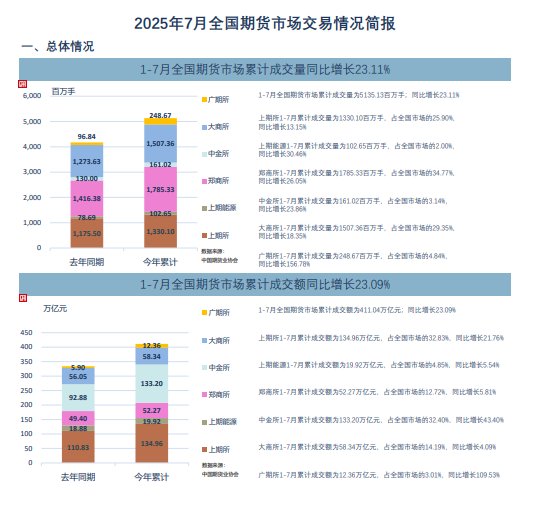
Core Insights - The national futures market in China experienced significant growth in July, with trading volume reaching 1.059 billion contracts, a year-on-year increase of 48.89%, and a trading value of 71.31 trillion yuan, up 36.03% year-on-year [1][3][5]. Trading Volume Summary - From January to July, the cumulative trading volume of the national futures market was 5.135 billion contracts, reflecting a year-on-year growth of 23.11% [2]. - The Shanghai Futures Exchange accounted for 25.90% of the total trading volume, with 1.330 billion contracts traded, marking a 13.15% increase year-on-year [2]. - The Zhengzhou Commodity Exchange had a trading volume of 1.785 billion contracts, representing 34.77% of the national market, with a year-on-year growth of 26.06% [2]. Trading Value Summary - The cumulative trading value from January to July was 411.04 trillion yuan, showing a year-on-year increase of 23.09% [2]. - The Shanghai Futures Exchange's trading value was 134.96 trillion yuan, accounting for 32.83% of the total market, with a year-on-year growth of 21.76% [2]. - The Zhengzhou Commodity Exchange's trading value was 52.27 trillion yuan, representing 12.72% of the national market, with a year-on-year increase of 5.81% [2]. Open Interest Summary - As of the end of July, the total open interest in the national futures market increased by 3.98% compared to the previous month [8]. - The Shanghai Futures Exchange's open interest was 1.144 billion contracts, accounting for 21.94% of the national market, with a month-on-month decrease of 2.33% [8]. Product Trading Performance - In July, the top three products by trading volume on the Shanghai Futures Exchange were gold (24.95%), silver (14.80%), and crude oil (8.89%) [12]. - The Zhengzhou Commodity Exchange's top products included soda ash (19.38%), glass (18.18%), and caustic soda (12.26%) [12]. - The Dalian Commodity Exchange's leading products were coking coal (26.66%), palm oil (12.24%), and soybean meal (10.45%) [12]. Financial Futures Performance - The top three financial futures by trading volume in July were the CSI 1000 stock index futures (27.52%), 30-year treasury bond futures (15.45%), and CSI 300 stock index futures (14.04%) [13].