流动性拐点

Search documents
华夏基金顾鑫峰:资本市场正迎来三大历史性拐点
Zhong Guo Jing Ji Wang· 2025-09-01 01:17
Core Viewpoint - The article highlights the positive outlook of fund manager Gu Xinfeng from Huaxia Fund, emphasizing three historical turning points in the capital market: liquidity, industrial cycle, and confidence, which together form the foundation for a sustained market uptrend [1] Liquidity - The current federal funds rate is between 4.25% and 4.50%, indicating that many global funds are experiencing a risk-free return exceeding 4% [2] - The anticipated interest rate cuts by the Federal Reserve, projected to occur seven times by 2026, are seen as a systemic benefit for global equity assets, particularly for the currently low-valued Chinese capital market [2] - The low absolute level of the ten-year government bond yield in China suggests weak attractiveness for bonds, leading to a shift in favor of equity assets as the Fed enters a rate-cutting cycle [2] Industrial Cycle - Gu Xinfeng emphasizes that new industrial cycles often drive sustained market growth, with the current cycle being powered by AI, which enhances productivity across various sectors and creates new demand [3] - The ongoing AI infrastructure phase is leading to surging orders for AI chips, optical modules, PCBs, and server companies, resulting in performance exceeding expectations [3] - The investment opportunities in this industrial cycle are just beginning, as the AI infrastructure is expected to enable exponential economic growth [3] Confidence - The article notes that many industries are experiencing a "DeepSeek" moment in China, where the country is transitioning from imitation to innovation, particularly in sectors like innovative pharmaceuticals [4] - Factors contributing to this shift include an engineer dividend, cost advantages in talent, and a strong work ethic, which have led to breakthroughs in industries such as new energy vehicles and photovoltaics [4] - The recognition of Chinese core assets by global funds is expected to increase, with a potential rise in the premium of Hong Kong-listed companies over A-shares [4]
铅锡领涨有色金属 黑色系高开低走
Xin Hua Cai Jing· 2025-08-08 06:59
Group 1: Commodity Market Overview - The commodity futures market saw most prices rise on the 21st, with the three major oilseed prices increasing by over 2%, and soybean oil leading with a nearly 3.2% rise [1][2] - The overall net inflow of funds in the commodity futures market was 387 million, with 932 million flowing into the agricultural products sector and 686 million flowing out of the black chain index [1] Group 2: Oilseed Market Dynamics - Domestic soybean crushing volume reached a record high of 2.18 million tons for the week ending on the 18th, driven by demand for holiday stockpiling [2] - Despite high operating rates this week, a decline in operating rates is expected next week, with increased soybean import costs and inflation expectations supporting short-term strength in oilseed prices [2] Group 3: Lead and Other Metals Performance - Lead futures rose by 1.99%, following a reduction in positions, while tin also increased by 1.87%, leading the non-ferrous metals sector [2] - Analysts suggest that lead prices may experience range-bound fluctuations due to weakening support from battery demand, although the cost of recycled lead is showing some support [2][4] Group 4: Iron Ore and Nickel Market Trends - Iron ore prices opened with a nearly 1% increase but closed down by nearly 3%, reflecting a decline of close to 100 yuan/ton from early September highs [3] - The overall supply-demand balance for iron ore remains relatively stable, but there is potential for marginal easing in fundamentals, leading to price adjustment pressures [3] Group 5: Broader Market Sentiment - Nickel, glass, and manganese silicon all fell by over 1.9%, with urea and rebar also declining by more than 1.5% [4] - Market sentiment is influenced by poor stock market performance, raising concerns about liquidity turning points, which could resonate with industrial commodities [4]
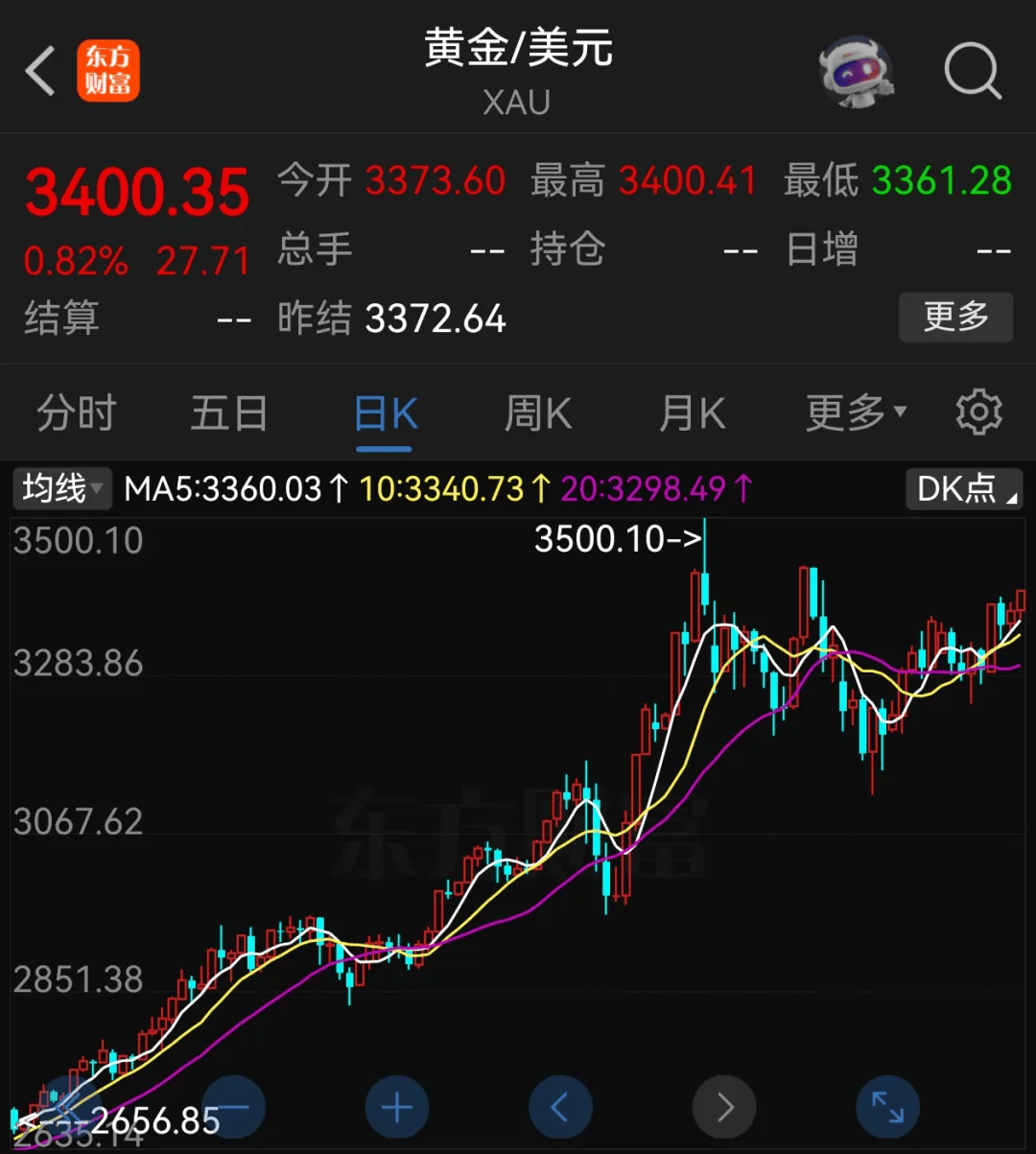
黄金狂飙突破3400美元关口,白银单日飙涨4%!
Sou Hu Cai Jing· 2025-06-05 14:36
Group 1 - The surge in gold prices, breaking the $3400 per ounce mark, reflects deep-seated global investor anxiety regarding economic prospects [1][3] - The recent increase in gold purchases by central banks, up 37% year-on-year in May, indicates a growing trend of countries accumulating gold as a hedge against currency credit concerns [3] - Geopolitical tensions, particularly in the Middle East and rising right-wing movements in Europe, are contributing to the demand for gold as a safe haven asset [3] Group 2 - Silver's recent price increase is driven by its industrial demand, particularly in solar energy, where it accounts for over 50% of its usage [4] - The spike in silver prices is also linked to the shift of funds from gold to silver, as the gold-silver ratio currently stands at a historical high of 85:1, suggesting potential for silver to catch up [5] - The silver market's smaller size makes it more susceptible to speculative trading, as evidenced by a 12% increase in open interest for silver futures [6] Group 3 - Despite the bullish sentiment, there are concerns about potential market corrections if the Federal Reserve signals a more aggressive interest rate path [7] - Technical indicators show that both gold and silver are in overbought territory, with historical data suggesting a high probability of price corrections following significant daily gains [7] - The potential tightening of global liquidity, particularly if the Bank of Japan reduces its bond purchases, could negatively impact precious metals [7] Group 4 - Forecasts for gold prices vary, with Goldman Sachs raising its three-month target to $3550 due to geopolitical risks, while Morgan Stanley suggests that current prices already reflect these risks and recommends profit-taking [8] - A cautious approach is being adopted by some investors, with strategies to maintain long positions in gold while adjusting stop-loss levels, indicating a nuanced market sentiment [8] - The discussion around gold among retail investors may signal a nearing peak in the current market cycle, while central banks may view the $3400 level as a new baseline for foreign reserves [8]

中金 | 美债季报:第二个流动性拐点
中金点睛· 2025-03-31 23:46
Core Viewpoint - The article discusses the impact of the U.S. debt ceiling on Treasury supply and liquidity, predicting a potential increase in 10-year Treasury yields to 4.8% after the debt ceiling issue is resolved, driven by supply-demand imbalances and resilient inflation [1][2]. Group 1: Economic and Policy Analysis - Since mid-January, the debt ceiling has limited Treasury supply, leading to a liquidity turning point and a decrease in the 10-year yield from 4.8% to around 4.2% [1]. - The uncertainty surrounding Trump's policies has negatively impacted market confidence, but recent data suggests economic resilience, with stable housing demand and a rebound in job creation [4][14]. - The article anticipates that the pessimistic sentiment regarding the economy may bottom out in the second quarter, aided by the potential implementation of tax cuts and deregulation policies [4][5]. Group 2: Fiscal Outlook - The fiscal deficit has not shown signs of reduction, with the cumulative deficit for the first five months of the fiscal year reaching $1.15 trillion, compared to $828.1 billion in the same period last year [18][20]. - The proposed "One Big Beautiful Bill" could further increase the deficit, with a projected net increase of approximately $2.8 trillion in the basic deficit by 2034 [24][25]. Group 3: Monetary Policy and Liquidity Risks - The article highlights that the debt ceiling has led to a tightening of liquidity, with the Federal Reserve preparing for potential liquidity risks as the debt ceiling is expected to be resolved by June [27][28]. - The Fed has already begun to slow down its balance sheet reduction, decreasing the monthly reduction from $250 billion to $50 billion [28]. Group 4: Supply and Demand Analysis - The supply of Treasuries is expected to increase post-debt ceiling resolution, with projected net financing of approximately $1.4 trillion in the third quarter [27][33]. - Demand for Treasuries remains weak, with significant reliance on money market funds, while foreign demand has decreased, particularly from key countries like Japan and the UK [36][39]. Group 5: Interest Rate Projections - The article predicts that long-term interest rates will continue to rise, potentially exceeding 4.8% after the debt ceiling is resolved, due to increased supply and persistent demand shortages [45][46]. - The anticipated economic recovery and potential tax cuts may support higher nominal growth rates, which could lead to an increase in interest rates [47][58].