
消费者权益

Search documents
X @外汇交易员
外汇交易员· 2025-09-25 05:40
Regulatory Response - Market regulators address inconsistent video platform ad lengths and labeling [1] - The State Administration for Market Regulation (SAMR) has guided major video platforms to optimize ad delivery systems [1] - The aim is to balance ad revenue with user experience and protect consumer rights [1]
国庆临近机票锁座引争议,多航司推里程兑换选座
Jing Ji Guan Cha Wang· 2025-09-22 02:38
Core Viewpoint - Domestic airlines are facing criticism for locking a significant number of seats during online check-in, limiting consumer choice and potentially violating consumer rights and pricing laws [1] Group 1: Consumer Experience - Many consumers have reported limited seat selection when checking in online for flights, particularly on routes such as Beijing to Urumqi and Sanya, where front-row and certain window and aisle seats are often locked [1] - Airlines are offering pre-selected seat upgrade services, with international flights typically requiring payment for seat selection, while domestic flights may require mileage redemption [1] Group 2: Regulatory Concerns - Experts argue that the practice of locking seats for additional revenue may be illegal, infringing on consumer rights to information, choice, and fair trade [1] - There is a call for airlines to clarify the proportion of locked seats and to publicly disclose seat selection rules [1] Group 3: Industry Practices - The practice of paid seat selection began in low-cost airlines abroad and was adopted by domestic airlines around 2015, initially for safety reasons but has since evolved into a controversial revenue-generating service [1] - The lack of authoritative regulation and the limited number of airlines reduce accountability, allowing airlines to operate without facing significant penalties for these practices [1] - Historically, the only notable penalty occurred in 2016 when the Beijing Development and Reform Commission fined China United Airlines over 440,000 yuan for similar practices [1]
【法治之道】 特斯拉车主车顶维权案胜诉的意义
Zheng Quan Shi Bao· 2025-09-18 17:49
Core Viewpoint - The court ruling in favor of Zhang Yazhou, the Tesla owner, highlights the need for transparency in the smart automotive industry and challenges the prevailing "technical arrogance" that has led to data monopolization by companies like Tesla [1][2][3] Group 1: Legal and Ethical Implications - The court's decision mandates Tesla to provide complete driving data from the half-hour before the accident, emphasizing consumer rights and accountability in the face of corporate data withholding [1][2] - This case serves as a judicial precedent that counters the notion that technological advancement justifies information monopolization, reinforcing that consumer rights should not be undermined by technical barriers [2][3] Group 2: Industry-Wide Concerns - The issue of "brake failure" controversies in the smart automotive sector reflects a broader problem where companies deny responsibility while consumers struggle to prove their claims, perpetuating a cycle of distrust [2][3] - The ruling urges the smart automotive industry to recalibrate its ethical standards, advocating for data transparency and the establishment of standardized data interfaces for consumer access [3] Group 3: Regulatory Recommendations - There is a call for regulatory bodies to enhance existing regulations, such as the "Automotive Data Security Management Regulations," to clarify data ownership and usage rights [3] - Establishing independent third-party data oversight platforms is recommended to ensure fair interpretation and storage of accident data, alongside stricter penalties for data monopolization practices [3]

朱丹蓬:做餐饮要尊重消费者知情权,标明是否是预制菜,吃不吃是我的事
Feng Huang Wang Cai Jing· 2025-09-13 04:32
Core Viewpoint - The pre-prepared food industry faces consumer skepticism regarding safety and nutrition, despite its long-standing presence in daily life, such as in train and airline meals [1] Group 1: Industry Insights - Pre-prepared meals have been part of daily life, exemplified by green train, high-speed rail, and airline meals [1] - There is a growing concern among consumers about the safety and nutritional value of pre-prepared meals [1] Group 2: Consumer Rights - From a consumer rights perspective, dining companies should respect consumers' right to know and choose, ensuring that products are clearly labeled as pre-prepared meals [1] - Consumers should have the autonomy to decide whether to consume pre-prepared meals [1]
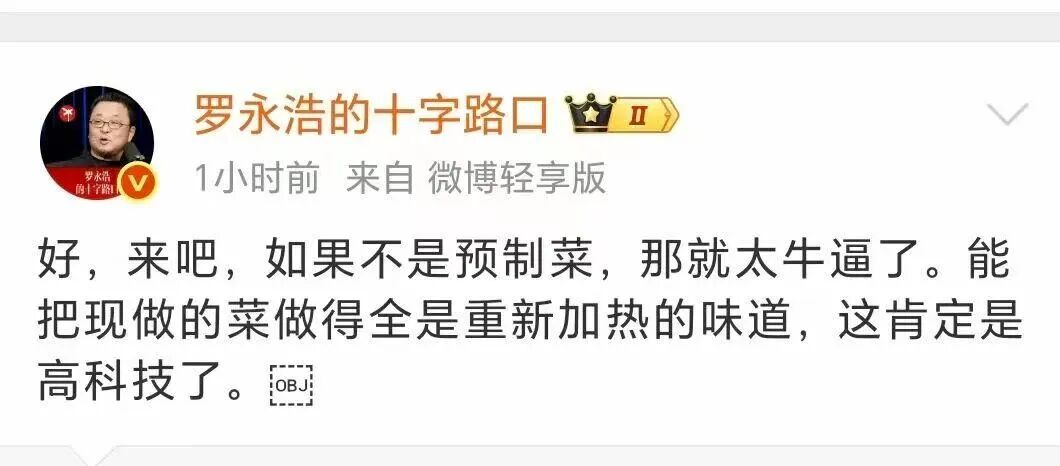
西贝贾国龙:一定要告罗永浩,罗永浩:好,来吧
3 6 Ke· 2025-09-12 02:11
Group 1 - The core issue revolves around the accusation made by Luo Yonghao that Xibei serves mostly pre-made dishes at high prices, which has led to significant public attention and controversy [1][2] - Xibei's founder, Jia Guolong, has expressed a strong intention to sue Luo Yonghao, emphasizing the damage caused to the brand by his statements [1][2] - Xibei's customer service has denied the use of pre-made dishes, stating that their signature dishes are freshly prepared, which contrasts with Jia Guolong's previous comments about the prevalence of pre-made dishes in high-end cuisine [2][3] Group 2 - The incident has sparked a broader public discussion regarding the definition and labeling of pre-made dishes, as well as consumer rights [2][5] - Luo Yonghao has called for legislation to require restaurants to disclose the use of pre-made dishes, highlighting consumer rights to information [2][5] - The situation is reminiscent of a previous conflict involving Luo Yonghao and Siemens, where he publicly criticized the quality of Siemens products, leading to significant media coverage and consumer awareness regarding product quality [6]

给五星好评才能就餐:就不怕“霸王评”砸了口碑?
Xin Jing Bao· 2025-04-17 07:51
三亚某餐厅须给五星好评才可以就餐?4月16日,三亚市市场监督管理局就此发布情况通报。 通报称,4月15日,有网民在抖音平台反映,其在三亚林某记海南风味餐厅就餐时遇到"店内服务态度 差""购买的团餐菜品疑似提前做好""须给五星好评才可以就餐"等问题,引发网民关注。接报后,三亚 市市场监督管理局已联合三亚市综合行政执法局立即开展调查,现正在调查中。 若强制评分属实,这种试图通过强制好评来提升店铺评分的做法,不仅违背了基本的商业诚信,更是一 种短视的商业行为。餐饮业口碑至关重要,但如果商家只顾及网络上虚拟的口碑,却忽视了现实顾客的 体验,多少有点儿舍本逐末。长此以往,没几个人敢在这样的餐厅吃饭。 必须强调的是,因为当地执法部门的调查结果还未出炉,所以,这些指控依旧属于网友的单方说法。在 此背景下,人们在讨论具体问题时也该"让子弹再飞一会儿"。而人们期待当地执法部门能够尽快给出权 威的调查结论,以更好厘清责任。 一家面向市场经营的餐厅,竟有如此离谱的操作?在社交平台上,消息一经曝光,就引起了网友的广泛 质疑:什么餐厅这么"霸道"?不仅存在服务态度差、菜品疑似提前做好等问题,消费者动筷前还必须 得"走个五星好评的流程" ...