
清洁技术

Search documents
特朗普“大而美”法案弄巧成拙,中国电力实力碾压欧美
Sou Hu Cai Jing· 2025-10-03 05:13
Group 1 - The "Big and Beautiful" bill, pushed by Trump, passed the US House of Representatives with a narrow margin of 218 to 214, unexpectedly strengthening China's position in the global energy sector [1] - The bill includes significant measures such as eliminating tax credits for electric vehicles seven years early, tightening wind and solar subsidies, and prohibiting companies using Chinese technology from receiving subsidies, which ultimately undermines the US energy industry [5] - In 2024, 81% of new power generation capacity in the US is expected to come from solar and energy storage systems, but the implementation of this bill has cut off the development momentum of this sector [5] Group 2 - In 2000, China's annual electricity generation was 1,300 TWh, less than one-third of the US; by 2025, it is projected to exceed 10,000 TWh, surpassing the US's 5,000 TWh [7] - China's hydropower, wind power, and solar power installed capacity all rank first globally, with the cost of electricity in China being 40% lower than in the US [7] - The ecological project in Xinjiang has led to a significant increase in green areas, with 479 million mu of new greening area added in the past year, and the economic output from desert agriculture exceeding 30 billion yuan [9] Group 3 - Companies are making practical choices in response to the impact of Trump's bill, with Tesla criticizing the bill while expanding its Shanghai factory capacity, and Apple relocating 30% of its iPhone production to Mexico but paying for Chinese components in RMB [11] - The transformation of the Tohun River in Changji City has become a symbol of high-quality development, earning multiple national honors and significantly improving air quality [11][14] - The contrasting energy and ecological policies between China and the US are shaping distinctly different futures, with China's clean technology rise providing a strategic buffer in global geopolitical conflicts [14]


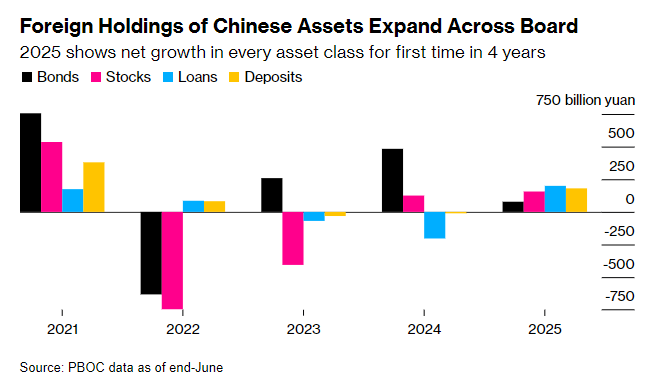
外媒:科技进步、市场活力双驱动,外资对华投资热情升温
Zhong Guo Xin Wen Wang· 2025-09-29 05:19
Core Insights - Foreign investment enthusiasm in China is rising due to rapid advancements in the high-tech industry and a strong stock market performance [1][2] Group 1: Technology Sector Developments - The development of China's technology sector, including the launch of self-developed AI models by major companies like Alibaba and breakthroughs by chip firms such as Cambricon, has boosted market confidence [2] - The CSI 300 index rose by 16% this quarter, while the tech-heavy ChiNext index surged nearly 50%, making it one of the best-performing indices globally [2] Group 2: Investor Sentiment - A significant portion of global investors, particularly 90% of U.S. clients surveyed, expressed a clear intention to increase investments in the Chinese market, reaching the highest level since early 2021 [2] - Current data indicates that foreign investor participation in Chinese stocks, especially A-shares, has reached a cyclical high [2] Group 3: Economic Resilience - The increase in foreign interest in Chinese assets is driven by improvements in fundamentals and China's demonstrated economic resilience in the face of U.S. trade restrictions [3] - Investors are seeking alternatives to U.S. dollar assets due to rising U.S. fiscal deficits and the Federal Reserve's shift to a rate-cutting cycle [3] Group 4: Long-term Opportunities - In the first half of the year, foreign capital has increased its holdings in Chinese stocks, bonds, loans, and deposits, a trend likely to continue [4] - The growth of the dim sum bond market, particularly in the issuance of RMB-denominated bonds by Chinese tech companies, reflects an expanding global investor base [4] - There exists a significant gap between China's global economic influence and the low allocation of foreign investments, representing important long-term opportunities [4]
外媒:科技进步、市场活力双驱动 外资对华投资热情升温
Zhong Guo Xin Wen Wang· 2025-09-29 04:53
Core Insights - Foreign investment interest in China's market is significantly increasing due to the rapid development of the high-tech industry and strong stock market performance [1][2] Group 1: Technology Sector Developments - Major Chinese tech companies like Alibaba are launching self-developed AI models, while chip companies like Cambricon are making breakthroughs, boosting market confidence in the high-tech sector [2] - The CSI 300 index rose by 16% this quarter, and the ChiNext index, focused on tech stocks, surged nearly 50%, making it one of the best-performing indices globally [2] - 90% of U.S. clients recently contacted by a strategist expressed a clear intention to increase investments in the Chinese market, the highest level since early 2021 [2] Group 2: Economic Resilience and External Factors - The increase in foreign interest in Chinese assets is driven by improvements in fundamentals and the country's resilience in the face of U.S. trade restrictions [3] - Investors are seeking alternatives to U.S. dollar assets due to the U.S. government's confrontational trade policies and the Federal Reserve entering a rate-cutting cycle [3] Group 3: Long-term Investment Opportunities - In the first half of this year, foreign capital has increased its holdings in Chinese stocks, bonds, loans, and deposits, a trend likely to continue [4] - The issuance of RMB-denominated bonds by Chinese tech companies in Hong Kong has expanded, attracting a growing base of global investors [4] - There is a significant gap between China's global economic influence and the low allocation of foreign investors, representing important long-term opportunities [4]
“不可投资”标签已撕 全球资本正爆买中国资产
智通财经网· 2025-09-29 02:38
Group 1 - The core viewpoint of the articles indicates a significant shift in global investment sentiment towards the Chinese market, driven by stock market rebounds and technological advancements [1][4][7] - Goldman Sachs reported that hedge fund activity in the A-share market reached a near-high in recent years, contrasting sharply with the "uninvestable" sentiment expressed by some clients in 2021 [1][4] - The influx of foreign capital into various Chinese assets is at a scale not seen in the past decade, with a notable increase in foreign investment in Chinese stocks, bonds, loans, and deposits [4][11] Group 2 - The rise of the technology sector, including advancements in AI and chip technology, is reshaping investment logic and attracting global investors to Chinese assets [7][8] - Data shows that foreign long-term fund inflows into the Chinese market reached $1 billion by the end of August, reversing the outflow of $17 billion from the previous year [8] - The Shanghai Composite Index and the ChiNext Index have seen significant gains, with the former up 16% and the latter nearly 50% in the recent quarter, although both indices remain below their 2021 peaks [8][10] Group 3 - Despite the positive trends, some institutions remain cautious due to past regulatory crackdowns and ongoing geopolitical tensions that may deter investment in Chinese assets [10] - The Chinese government’s commitment to stabilizing the economy and the ongoing U.S.-China trade tensions are expected to enhance China's industrial strength, further attracting foreign investment [11][12] - The issuance of RMB bonds by Chinese tech companies in Hong Kong has reached record levels, indicating strong interest from global investors [11][12]



惠誉:美国政策调整或将拖慢太阳能、风能项目开发步伐
Xin Lang Cai Jing· 2025-08-26 23:55
Core Viewpoint - Recent changes in federal policies may slow down the development pace of solar and wind energy projects in the U.S. [1] Group 1: Impact on Renewable Energy Projects - Fitch Ratings indicates that solar and wind projects, particularly those in early stages, are especially vulnerable to the new policy changes [1] - The 2025 tax and spending plan shortens the construction window for technology-neutral tax credits, imposing stricter timelines for most solar and wind projects [1] - The U.S. Treasury has issued stricter guidelines for solar and wind tax credits, tightening safe harbor provisions and requiring facilities to meet certain scale criteria to qualify as under construction [1] Group 2: Other Clean Technologies - Incentives for other clean technologies, including nuclear energy and independent storage, remain largely unchanged and may capture a larger share of new installed capacity [1]

美媒:一条美国正落后于中国的新道路
Huan Qiu Shi Bao· 2025-08-15 11:31
Core Insights - The article highlights a significant divergence in carbon emissions trends between the United States and China in the first half of 2023, with China's emissions decreasing by 2.7% while the U.S. saw an increase of 4.2% [1][2]. Emission Trends - China's carbon dioxide emissions have shown a year-on-year decrease, marking a reversal from the previous decade's trends, largely attributed to a rise in solar power capacity [1][2]. - In May 2023 alone, China added an impressive 92.92 GW of solar power capacity, bringing its total to over 1,000 GW, while the U.S. had only about 134 GW by the end of June [2]. Energy Consumption Changes - The International Energy Agency reported a 2.6% year-on-year decline in China's coal consumption, despite the country still consuming over half of the world's coal [1]. - The U.S. experienced a 14% increase in coal-fired power generation in the first half of 2023, driven by strong electricity demand and rising natural gas prices [3]. Future Projections - Analysts caution that it is premature to declare a long-term trend based on the current data, as short-term economic factors like weather and energy prices can significantly influence emissions [1][3]. - There is a growing concern that the U.S. is moving in the opposite direction of China regarding renewable energy deployment and electric vehicle adoption [3].
美欧关税协议若得以落实 欧盟清洁技术或受严重冲击
news flash· 2025-07-31 09:29
Core Points - The US-EU tariff agreement poses a significant threat to EU clean technology manufacturers, particularly affecting the electric vehicle and grid equipment sectors, which account for 52% and 27% of EU clean technology exports respectively [1] - The clean technology industry in the EU has been thriving, largely driven by demand from US buyers, achieving a growth rate of 58% last year and exporting clean technology products worth $84 billion, with $20 billion of that going to the US [1] - The new tariff agreement jeopardizes the strong trade relationship between the EU and the US, as the EU has agreed to impose a 15% tariff on all goods exported to the US, raising concerns among companies in the electric vehicle value chain about their competitiveness [1]
英媒:中国正在主导清洁能源供应链
Huan Qiu Wang Zi Xun· 2025-07-25 22:40
Group 1 - The article highlights that U.S. tariffs on China, effective from August 1, are unlikely to negatively impact China's economy or trade volume, and may even boost them due to the current global trade dynamics favoring China over the U.S. [1] - China is leading the clean energy sector, with a projected contribution of over 10% to its GDP by 2024, while the U.S. is regressing in clean energy development and shifting focus back to fossil fuels [1] - China's investment in clean energy reached approximately 13.6 trillion RMB, nearly equivalent to the total fossil fuel expenditure of other regions, indicating its dominance in the clean energy supply chain [2] Group 2 - China is making significant advancements in clean energy technologies, including thorium reactors, which could provide a breakthrough in clean energy, contrasting with the U.S.'s lack of action in this area [2] - The recent achievements in nuclear fusion research, particularly with the EAST project, demonstrate China's leadership in this field, outpacing U.S. efforts in terms of project progress and investment [2] - A joint statement from China and the EU emphasizes their commitment to climate change cooperation, signaling a shift in climate leadership amid U.S. withdrawal from climate initiatives [3]
国科投资科创债发行获准注册,债券市场新政后第7家股权投资机构
Sou Hu Cai Jing· 2025-06-11 03:19
Group 1 - The core point of the news is that Guoke Investment has registered a scale of 300 million yuan for its science and technology innovation bonds, which will be fully used to invest in the Guoke Ruihua Phase IV Fund established and managed by Guoke Investment in 2024 [2][3] - Guoke Investment is one of the oldest investment institutions in China, originally established in 1987 by the National Economic Commission and the Chinese Academy of Sciences [2] - Since its transformation into a market-oriented private equity investment fund management institution in 2006, Guoke Investment has invested in over 140 companies, with 27 of them successfully going public [2] Group 2 - More than 50% of the exited listed projects have achieved over 5 times cash returns, 30% have achieved over 10 times, and over 10% have achieved over 20 times cash returns [2] - Guoke Investment has a cumulative fund management scale exceeding 12 billion yuan, with multiple funds achieving excellent returns and gaining long-term trust from various domestic and international investors [3] - The Guoke Ruihua Phase IV Fund focuses on comprehensive technology investments, particularly in artificial intelligence, clean technology, biotechnology, and their cross-integration fields [3]

英媒:“小电驴”推动中国替代电池研发热潮
Huan Qiu Wang Zi Xun· 2025-06-03 23:12
Core Insights - The article discusses the rise of sodium-ion battery technology in China, particularly in the context of electric two-wheelers, highlighting the competitive advantage China has gained in this alternative battery sector [1][2] Industry Overview - Sodium-ion batteries are emerging as a viable alternative to traditional lead-acid and lithium-ion batteries, with the former being less energy-dense and having fewer charge cycles, while sodium-ion batteries offer a more cost-effective solution [2] - The vast availability of sodium, which is approximately 400 times more abundant than lithium, positions sodium-ion batteries as a more accessible and potentially cheaper option for large-scale production [2] Market Dynamics - The popularity of electric two-wheelers in Asia, particularly in China, creates a favorable environment for the economies of scale necessary for sodium-ion battery adoption [2] - Chinese companies are leading in the mass production of sodium-ion batteries, which could help reduce reliance on critical mineral resources and alleviate supply chain bottlenecks [2] Technological Advantages - Sodium-ion batteries are considered safer than lithium-ion batteries due to their more stable chemical properties, which reduce the risk of overheating and combustion [2] - These batteries are also less affected by harsh environmental conditions, making them a more reliable choice for various applications [2] Infrastructure Development - China is investing in large-scale factories dedicated to the production of sodium-ion batteries, with some already operational, indicating a strong commitment to this technology [2]