
癌症筛查

Search documents
Exact Sciences(EXAS) - 2025 Q2 - Earnings Call Transcript
2025-08-06 22:00
Financial Data and Key Metrics Changes - Exact Sciences delivered a record 1,300,000 test results, with core revenue growth accelerating to 16% year over year, generating an all-time high of $138,000,000 in adjusted EBITDA [3][4] - Adjusted EBITDA increased by 26%, with a margin expansion of 130 basis points, driven by pricing and productivity gains [5] - GAAP net income was negative $1,000,000, including $15,000,000 in one-time costs related to operational efficiency [5] - Free cash flow reached $47,000,000, bringing year-to-date free cash flow to $46,000,000, an increase of $95,000,000 compared to the same period last year [5][6] Business Line Data and Key Metrics Changes - Screening revenue increased by 18% to $628,000,000, with growth driven by rescreens, CareGAP programs, and improved commercial execution [4] - Precision Oncology revenue grew by 9% to $179,000,000, led by international adoption of Oncotype DX [4][5] - Revenue from sublicensing Twin Strands technology contributed $7,500,000 [5] Market Data and Key Metrics Changes - Cologuard brand awareness reached all-time highs, with top-of-mind awareness matching or exceeding colonoscopy [12] - The colon cancer screening landscape is shifting towards a Cologuard-first approach, as indicated by recent advocacy from the AGA work group [12][13] - Cologuard's momentum is evident, with the company delivering its twenty millionth result, doubling from ten million in just three years [11] Company Strategy and Development Direction - The company is raising total revenue guidance for the year to between $3,130,000,000 and $3,170,000, reflecting a $55,000,000 increase at midpoint [7][8] - A multi-year productivity plan aims for $150,000,000 in annual savings by 2026, focusing on operational efficiencies and AI integration [9][10] - The company reaffirms its long-term target of 15% compounded revenue growth and over 20% adjusted EBITDA margins by 2027 [9] Management's Comments on Operating Environment and Future Outlook - Management expressed confidence in the growth trajectory, citing strong commercial execution and brand awareness as key drivers [11][12] - The company anticipates increased cash flow in the second half of the year as accounts receivable from Cologuard Plus claims are paid [6] - Management acknowledged challenges in blood-based colorectal cancer screening but remains optimistic about future developments and the potential of the Phrenome acquisition [14][15] Other Important Information - The company has secured Medicare coverage for OncoDetect, enhancing its precision oncology offerings [3][21] - The launch of CancerGuard, a blood-based multi-cancer early detection test, is set for next month, targeting a $25,000,000,000 addressable market [19][20] Q&A Session Summary Question: Strategic fit of the Phrenome agreement - Management highlighted that the agreement adds a blood-based option to their portfolio, complementing existing tests and enhancing market leadership [26][27] Question: Factors contributing to strong growth - Management attributed growth to the successful launch of Cologuard Plus and improvements in commercial execution, with strong performance across all business segments [32][34] Question: Blood test performance and FDA submission timeline - Management stated that the Phrenome test showed promising sensitivity and specificity, with the final module submitted to the FDA, but did not provide a specific timeline for approval [39][40] Question: Concerns about resource allocation and strategic prioritization - Management disagreed with the notion that past acquisitions were unsuccessful, emphasizing the impact of Cologuard and the potential of the blood-based screening market [49][50] Question: Market share expectations for blood-based testing - Management projected that blood-based testing could capture 5% to 10% of the market, depending on future guideline recommendations [88][90]

年年体检正常,为啥还是得了癌症?
Hu Xiu· 2025-07-31 05:43
Core Viewpoint - The article discusses the complexities and limitations of cancer screening, emphasizing that not all screening methods are effective and that many can lead to false positives and false negatives [1][2][3]. Group 1: Limitations of Current Screening Methods - Effective cancer screening should improve survival rates, but many existing methods do not meet this standard [2][4]. - False negatives (missed tumors) and false positives (incorrectly identified tumors) are significant issues in cancer screening, leading to unnecessary anxiety and financial burden [7][8]. - Many commonly used tumor markers are not recommended for healthy individuals due to high rates of false results [7][10]. Group 2: Recommended Screening Methods - Recommended screening methods include colonoscopy for colorectal cancer, gastroscopy for gastric cancer, low-dose spiral CT for high-risk lung cancer, mammography and ultrasound for breast cancer, and cytology and HPV testing for cervical cancer [8][11]. - The age at which screening should begin varies by cancer type, with guidelines suggesting starting at 45 for colorectal cancer and 40 for breast cancer [11][12]. Group 3: Future Directions in Cancer Screening - There is ongoing research into new screening methods, including liquid biopsies that detect cancer-related DNA in blood and the use of artificial intelligence for early tumor detection through imaging [12][13].
年年体检却突然确诊癌症,1000元套餐还要做吗?
Hu Xiu· 2025-07-29 10:02
Core Viewpoint - The case of Zhang Xiaoling highlights significant concerns regarding the reliability of commercial health check-up services, particularly in cancer detection, raising questions about the effectiveness of routine screenings and the potential for misdiagnosis [2][4][27]. Group 1: Company and Service Reliability - Zhang Xiaoling underwent annual health check-ups at Aikang Guobin for ten years without being informed of any cancer risks, despite her eventual diagnosis of advanced kidney cancer [2][8]. - Aikang Guobin stated that they had reviewed Zhang's medical records and found no flaws in their kidney examinations, asserting their lack of responsibility in her case [3][7]. - The incident has sparked public debate about the trustworthiness of commercial health check-up institutions and the adequacy of cancer screening methods [4][27]. Group 2: Screening Limitations - Experts suggest that routine health check-ups primarily identify chronic diseases like hypertension and diabetes, with limited effectiveness in cancer detection [5][29]. - Various screening methods, such as ultrasound and CT scans, have inherent limitations, and a combination of different tests is recommended for more accurate results [5][19]. - The common use of tumor markers like CEA in screenings is criticized, as they are not reliable for early detection of certain cancers, including kidney cancer [11][12][14]. Group 3: Patient Experience and Misdiagnosis - Zhang's experience reflects a broader issue where patients report instances of missed cancer diagnoses despite normal results from commercial health check-ups [6][27]. - Misinterpretation of test results and inadequate communication from health check-up providers can lead to delayed diagnoses and treatment [16][18]. - The case emphasizes the need for better patient education regarding the significance of test results and the importance of follow-up examinations when abnormalities are detected [8][19]. Group 4: Recommendations for Improvement - Medical professionals recommend that individuals, especially those at higher risk, should seek more comprehensive evaluations, including advanced imaging techniques like CT or MRI, rather than relying solely on routine check-ups [30][31]. - Regular health screenings should be tailored to individual health profiles, considering factors such as age, family history, and existing health conditions [30][36]. - The importance of maintaining personal health records and undergoing early cancer screenings is emphasized to improve early detection rates and treatment outcomes [35][36].


这样体检才有用(看新闻·说健康)
Ren Min Ri Bao Hai Wai Ban· 2025-07-23 22:29
Core Insights - The article discusses the importance of regular health check-ups and the common misconceptions surrounding them, emphasizing the need for early detection of diseases, particularly cancer [4][10][11]. Group 1: Health Check-up Misconceptions - PET-CT is not a suitable health screening tool; it is primarily used for assessing already diagnosed cancer patients and has significant costs and radiation exposure [5][6]. - Claims that a single drop of blood can detect all cancers are misleading; current technology does not support such comprehensive testing [7]. - Testing for trace elements is not recommended unless for specific medical reasons, as results can be unreliable [9]. Group 2: Cancer Statistics and Risks - In China, approximately 4.3 million people are diagnosed with cancer annually, with a significant increase in incidence after the age of 40 [10][12]. - The primary risk factor for cancer is age, as cellular division and genetic mutations accumulate over time, increasing the likelihood of cancer development [10][12]. Group 3: Importance of Early Screening - The primary value of health check-ups lies in the early detection of diseases, particularly in identifying precursors to cancer, which can significantly reduce the risk of progression to full-blown cancer [11][12]. - It is recommended that individuals begin cancer screenings at age 40, especially those with a family history of cancer [12][13]. Group 4: Recommended Screening Tests - A cost-effective and efficient screening regimen is proposed, including tests for Helicobacter pylori, HPV, hepatitis B, and specific cancer screenings for both men and women [14][15][17][18]. - Early detection through these screenings can lead to better treatment outcomes and long-term survival rates for common cancers such as gastric, colorectal, lung, cervical, and breast cancer [18][29].
律师十年体检“未见异常”到癌症晚期,爱康国宾陷“假体检”争议
2 1 Shi Ji Jing Ji Bao Dao· 2025-07-17 10:11
Core Points - The incident involving lawyer Zhang Xiaoling, who was diagnosed with late-stage cancer after ten years of health check-ups at Aikang Guobin, raises serious concerns about the reliability of commercial health check-up institutions [1][2] - The public's trust in commercial health check-up services is declining, as evidenced by widespread discussions and shared negative experiences on social media platforms [1][4] - The health check-up industry is facing scrutiny due to issues such as misdiagnosis, missed diagnoses, and inadequate communication of health risks [1][5] Company Summary - Aikang Guobin, founded by Zhang Ligang in 2004, has faced multiple complaints regarding its health check-up services, including issues related to misdiagnosis and data security [4][7] - The company went public on NASDAQ in 2014 but has since seen a decline in net profits, leading to its privatization in 2019 [3][7] - Complaints against Aikang Guobin have reached 1,306, highlighting systemic issues within the organization [4] Industry Summary - The health check-up industry is experiencing a crisis of confidence, with reports of "fake check-ups" and inadequate screening practices becoming more common [7] - Experts emphasize the importance of regular health check-ups for early detection of diseases like kidney cancer, which often presents with subtle symptoms [3][8] - The Chinese government has initiated plans to improve cancer screening and prevention, aiming for a five-year survival rate of 46.6% by 2030 [7][8]
新版北京健康报告发布,男性“超重”率明显高于女性
Bei Ke Cai Jing· 2025-06-27 02:32
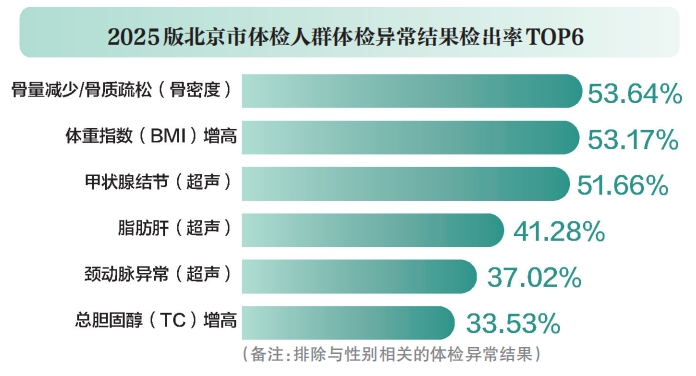
Core Insights - The report highlights the increasing health issues among the population in Beijing, emphasizing the importance of regular health check-ups [1][2][8] - The data collected from 1.483 million health check-ups reveals alarming trends in various health indicators, particularly among different age groups and genders [1][5] Group 1: Health Issues Identified - Bone density reduction/osteoporosis has become the leading health concern in Beijing, with a detection rate of 53.64% [2] - The detection rate for increased Body Mass Index (BMI) and thyroid nodules also exceeds 50%, marking them as significant health threats [2] - Fatty liver, carotid artery abnormalities, and elevated total cholesterol levels have detection rates above 30% [2] Group 2: Gender-Specific Health Trends - Male participants show a higher prevalence of increased BMI, with detection rates nearing 70%, and a fatty liver detection rate of 55.11% among men aged 40-49 [5] - In contrast, females have a higher detection rate of thyroid nodules at over 57%, with a significant increase in breast nodules from 25.33% in 2021 to 40.53% [5] Group 3: Cancer Detection Rates - Thyroid cancer has the highest detection rate among the cancer cases identified, exceeding 48%, with a total of 1,535 cancer diagnoses among the health check-up participants [8] - The cancer detection rate among individuals under 40 years old is concerning, with nearly one-third of the diagnosed cases falling into this age group [8] - The report suggests that the high detection rate of thyroid cancer is due to the widespread use of ultrasound in health check-ups, with a participation rate of 78.85% for thyroid ultrasounds [8]
把健康主动权掌握在自己手中(热议)
Ren Min Ri Bao· 2025-06-19 21:51
Core Viewpoint - The article emphasizes the importance of health awareness and the need for specialized cancer screening to detect malignancies early, as routine health check-ups may not suffice for cancer detection [1][2]. Group 1: Health Awareness and Screening - The Shanghai Anti-Cancer Association and Fudan University Cancer Hospital released the "2025 Recommendations for Screening and Prevention of Common Malignant Tumors," highlighting over 20 types of cancers and their high-risk groups, aiming to promote early detection and prevention [1]. - The health literacy level among Chinese residents increased from 19.17% in 2019 to 31.87% in 2024, indicating a significant improvement in health awareness, although disparities still exist between urban and rural areas [2]. Group 2: Knowledge Dissemination and Quality Control - There is a need for collaborative efforts from government, communities, families, and individuals to enhance the dissemination of quality health knowledge, as the current information available online is often inconsistent and misleading [3]. - Establishing expert health knowledge databases and incentivizing health experts to promote accurate health information is crucial for improving public health literacy [3]. Group 3: Lifestyle and Personal Health Management - Lifestyle and behavioral factors account for 60% of health influences, making it essential to adopt healthy behaviors such as balanced diets, regular exercise, and mental well-being [4]. - Active participation in health management, including regular scientific health check-ups tailored to different age groups, is vital for early disease detection and prevention [4]. Group 4: Individual Responsibility - Individuals are encouraged to take responsibility for their health by learning about health knowledge and adopting a civilized and healthy lifestyle, thereby gaining control over their health [5].
Exact Sciences(EXAS) - 2025 Q1 - Earnings Call Transcript
2025-05-01 22:02
Financial Data and Key Metrics Changes - In the first quarter, the company delivered 1,200,000 total results to patients, with core revenue growing by 11% and non-GAAP operating expenses increasing by only 4%, leading to a more than 60% increase in adjusted EBITDA [6][11][12] - Screening revenue exceeded guidance, increasing by 14% to $540 million, while Precision Oncology revenue grew by 4% to $167 million on a core basis [11][12] - Adjusted EBITDA increased by 61% to $63 million, with adjusted EBITDA margin expanding by 280 basis points [12][18] Business Line Data and Key Metrics Changes - Cologuard growth was driven by rescreens, CareGAP programs, and new ordering providers, with rescreens now accounting for over 25% of total Cologuard orders [11][55] - The CareGAP program grew triple digits last year and is expected to continue strong double-digit growth this year [9][12] - The launch of Cologuard Plus is anticipated to deliver increased value, improved performance, and higher adoption rates [10][19] Market Data and Key Metrics Changes - Customer engagement by the field force increased by over 30% year over year, with more than 190,000 providers ordering during the first quarter, marking a nearly 10% increase year over year [16][32] - The company ended the quarter with cash and securities of $786 million, reflecting a $249 million convertible note paydown [14] Company Strategy and Development Direction - The company is focused on enhancing its commercial execution, with a purpose-built commercial organization and expanded field team engaging providers at record rates [6][8] - The launch of Cologuard Plus is positioned to revolutionize colorectal cancer screening, with a focus on making it the first option in healthcare provider screening toolkits [19][20] - The company is also advancing its precision oncology portfolio with the launch of OncoDetect, aimed at benefiting six million cancer patients [21][22] Management's Comments on Operating Environment and Future Outlook - Management expressed optimism about the strong start in 2025, highlighting the successful launch of two innovative products and the positive impact of commercial improvements [25] - The company expects continued revenue growth, with total revenue guidance increased to between $3.07 billion and $3.12 billion for the year [14][15] - Management noted that they are on track to generate meaningful free cash flow growth through productivity and working capital initiatives [13][14] Other Important Information - The company has taken actions to optimize costs, expecting annual savings of $18 million, with $9 million coming in 2025 [13] - The launch of CancerGuard is planned for the second half of 2025, enabling population-level screening for cancer [24] Q&A Session Summary Question: Focus on commercial execution and changes made - Management highlighted that the volume of calls by sales representatives is up, with a 10% increase in per-rep productivity, indicating an engaged sales force [30][32] Question: Guidance unpacking and revenue outlook - Management indicated that the increased guidance is primarily due to improvements in commercial execution, with expectations of 13% growth in the first half and 15% in the second half of the year [40] Question: Sales and marketing investments - Management acknowledged higher sales and marketing expenses but emphasized that revenue growth significantly outpaced these investments, indicating effective leverage [45] Question: Rescreens contribution to total volume - Management confirmed that rescreens are a significant growth driver and could contribute a couple of points to overall volume this year [56] Question: Blood testing pipeline and timeline - Management expressed confidence in the timeline for blood testing developments, with a readout expected in midsummer [68][79] Question: Cologuard Plus traction and mix - Management reported that Cologuard Plus is currently available for Medicare Part B patients, with expectations for growth as more payers contract for coverage [82][85] Question: Commercial payer discussions and pricing for CancerGuard - Management indicated positive discussions with payers regarding Cologuard Plus and noted that pricing for CancerGuard has not yet been finalized [90]
检查没做对,得了癌症都不知道!20种常见恶性肿瘤筛查“金标准”来了
人民日报· 2025-04-24 13:18
Core Viewpoint - The article emphasizes the importance of proper cancer screening methods, highlighting that routine health check-ups do not equate to effective cancer screening, which can lead to missed diagnoses of serious conditions like cancer [1]. Group 1: Cancer Incidence in China - In 2022, the estimated incidence of the top 10 malignant tumors in China included 1,060,600 cases of lung cancer, 517,100 cases of colorectal cancer, and 466,100 cases of thyroid cancer, among others [2]. Group 2: Cancer Screening Recommendations - The article discusses the release of the "Recommendations for Screening and Prevention of Common Malignant Tumors in Residents (2025 Edition)" during the National Cancer Prevention and Control Week, which outlines high-risk groups and the "gold standards" for screening for over 20 types of malignant tumors [3]. Group 3: Specific Cancer Screening Guidelines - For colorectal cancer, the gold standard for screening is colonoscopy, with recommendations for starting at age 45 and conducting annual fecal immunochemical tests or colonoscopies every 5-10 years until age 75 [6]. - For breast cancer, mammography is the gold standard, with screening starting at age 40 and recommended every 1-2 years [9]. - For lung cancer, low-dose spiral CT is the gold standard for high-risk populations, suggesting screening for those aged 40 and above with a significant smoking history [12]. - For liver cancer, serum alpha-fetoprotein (AFP) and liver ultrasound are the gold standards, with recommendations for screening men over 35 and women over 45 every 6 months [17]. - For esophageal cancer, the gold standard is endoscopy, with recommendations for high-risk groups to undergo screening every 2 years [26]. - For cervical cancer, the gold standard includes cytology and high-risk HPV testing, with specific age-based recommendations for screening [34]. - For prostate cancer, serum PSA testing is the gold standard, recommended for men over 40 with a good health status [44]. - For bladder cancer, urine tests and ultrasound are the gold standards, with annual screening starting at age 70 for general risk populations [47]. - For kidney cancer, ultrasound and urine tests are the gold standards, with annual screening recommended for those over 50 [51]. - For thyroid cancer, clinical neck examination and ultrasound are the gold standards, with annual checks starting at age 30 [54]. - For skin cancer, clinical skin examinations and biopsies are the gold standards, with recommendations for high-risk individuals to undergo regular checks [73].

觅瑞更新招股书:专注癌症筛查解决方案,上半年核心业务收入同比增长超60%
IPO早知道· 2024-11-04 11:12
根据弗若斯特沙利文的资料, 觅瑞 是开发及商业化用于癌症及其他疾病早期检测 的、精准的、无 创的、可负担的、基于血液的miRNA检测试剂盒的先驱者与领导者 ; 根据弗若斯特沙利文的资料, 觅瑞 是全球为数不多的已获得分子癌症筛查行业IVD产品监管批准的公司之一,同时也是全球范围 内首家且唯一一家获得分子胃癌筛查IVD产品监管批准的公司。 今年上半年,核心产品GASTROClear的毛利率超80%。 本文为IPO早知道原创 作者|Stone Jin 微信公众号|ipozaozhidao 据IPO早知道消息,Mirxes Holding Company Limited(以下简称"觅瑞")于11月4日更新招股 书,继续推进港交所主板上市进程,中金公司和建银国际担任联席保荐人。 成立于2014年的觅瑞作为一家起源于新加坡的微小核糖核酸("miRNA")技术公司,专注于在全球范 围内普及疾病筛查诊断解决方案。 截至2024年10月31日,觅瑞拥有一种核心产品(即GASTROClear)、两种其他商业化产品(即 LungClear及Fortitude)以及六种处于临床前阶段的候选产品。 其中,觅瑞的核心产品GASTROC ...