
绿氢

Search documents
绿电波动下,如何让电解槽稳定高效?
势银能链· 2026-01-19 04:28
Core Viewpoint - The article emphasizes the advancements and strategic positioning of Xiamen Qihang Hydrogen Energy Technology Co., Ltd. in the hydrogen energy sector, particularly focusing on their innovative solutions for electrolyzer power supply and intelligent systems [4][7]. Group 1: Company Overview - Xiamen Qihang Hydrogen Energy was established under the national-level hydrogen energy research platform, the Jiageng Innovation Laboratory, and is recognized as a national-level technology-based small and medium-sized enterprise [4]. - The company has accumulated multiple invention patents and software copyrights, and has participated in the formulation of industry standards, holding certifications such as ISO9001, ISO14001, and ISO45001 [4]. Group 2: Technological Innovations - The company has developed a product philosophy of "better understanding electrolyzers," focusing on the integration of power supply equipment with electrolyzer characteristics, dynamic response needs, and long-term operational degradation patterns [4][7]. - Qihang Hydrogen Energy has created a range of electrical equipment for hydrogen energy, covering power outputs from 30 kW to 20 MW, adaptable to various electrolyzer technologies including ALK, PEM, and AEM [5]. Group 3: Intelligent System Upgrades - The company is advancing the intelligent upgrade of hydrogen production electrical systems, integrating data collection, status monitoring, fault diagnosis, and energy efficiency analysis to optimize power distribution and support operational decision-making [7]. - The intelligent hydrogen production power supply, designed for grid-connected scenarios, boasts a full-load efficiency exceeding 97.5% and supports a wide current output range from 2000 A to 96000 A, allowing for flexible expansion in medium to large hydrogen production stations [8]. Group 4: Industry Recognition - Qihang Hydrogen Energy was awarded the "2025 Annual Technology Power Award" at the TrendBank Hydrogen Energy and Fuel Cell Industry Annual Conference for its innovative hydrogen production power supply and intelligent solutions [10].


氢储运将沿着“低压到高压、气态到多相态”的技术方向演进
势银能链· 2026-01-19 04:28
Core Viewpoint - The article emphasizes the critical role of hydrogen energy, particularly green hydrogen, in achieving carbon neutrality and the urgent need for advancements in large-scale storage and transportation technologies to facilitate its widespread application [4][10]. Group 1: Industry Context - In 2023, global and Chinese carbon emissions reached historical highs, highlighting the urgency of energy transition. China, as the largest carbon emitter, has positioned hydrogen as a key component of its future energy system [4]. - By 2050, China's hydrogen demand is projected to approach 60 million tons, accounting for at least 10% of terminal energy consumption, with an industry chain annual output value potentially reaching 12 trillion yuan and a reduction of approximately 700 million tons of CO2 emissions [4]. Group 2: Storage and Transportation Challenges - The current annual hydrogen production in China is about 37 million tons, with a low penetration rate of green hydrogen. The key challenge lies in the safe, efficient, and economical storage and transportation of hydrogen [4]. - The report analyzes three main hydrogen storage methods: gaseous, liquid, and solid, indicating that high-pressure gaseous storage will remain dominant for a considerable time due to its mature technology and lower energy consumption [4][10]. Group 3: Company Capabilities - CIMC Hydrogen has established a comprehensive storage and transportation equipment matrix, leveraging its parent company CIMC Group's industrial platform to create a research and manufacturing network across major Chinese regions and extending its business to over ten countries globally [5]. - The company offers various storage solutions, including large-scale static storage for GW-level green hydrogen/ammonia projects and high-pressure gaseous storage equipment, enhancing hydrogen loading capacity and transportation efficiency [6][7]. Group 4: Commercialization and Market Presence - CIMC Hydrogen has participated in significant domestic green hydrogen projects, providing comprehensive services from hydrogen storage engineering to transportation and refueling systems [8]. - The company has successfully secured international orders by demonstrating superior delivery times and automation capabilities, showcasing its competitive strength beyond just pricing [8]. Group 5: Future Trends and Innovations - The article predicts that with evolving standards, large-scale centralized hydrogen storage will become mainstream, and the development of IV-type hydrogen transport vehicles will enhance transportation efficiency [9][10]. - CIMC Hydrogen aims to support the commercialization of hydrogen energy through a systematic approach, integrating decades of experience in high-pressure and low-temperature equipment manufacturing into the hydrogen sector [10][11].

制储输用发力,开启能源“加氢减碳”之门
Zhong Guo Hua Gong Bao· 2026-01-13 06:26
Core Viewpoint - The hydrogen energy industry is seen as a key solution to energy issues, particularly in the context of expanding renewable energy capacity and addressing the challenges of wind and solar energy consumption [1]. Group 1: Green Hydrogen Development - Traditional hydrogen production mainly relies on fossil fuel reforming and industrial by-product gases, but there is significant demand for green hydrogen to replace gray hydrogen under carbon peak scenarios [2]. - By 2060, it is predicted that 30% of China's end-use thermal demand will come from non-fossil fuels, primarily through green electricity conversion, with a potential demand for 200 million tons of green hydrogen requiring approximately 10 trillion kilowatt-hours of green electricity [2]. - Water electrolysis is recognized as a crucial green hydrogen production technology, with advancements in equipment leading to cost reductions and broader applications [2]. Group 2: Hydrogen Storage Technologies - Efficient, safe, and low-cost hydrogen storage technologies are essential for energy peak shaving and valley filling [4]. - Current hydrogen storage methods include high-pressure, liquid, and solid-state storage, with liquid hydrogen being highlighted for its high storage efficiency and suitability for large-scale applications [4]. - Solid-state hydrogen storage, utilizing materials like carbon nanomaterials and metal hydrides, offers advantages such as higher storage density and longer cycle life compared to other methods [4]. Group 3: Hydrogen Transportation - Hydrogen transportation is critical for the industrial promotion of hydrogen energy, with pipeline transport being suitable for stable, continuous hydrogen demand in industrial clusters [5]. - Challenges in China's hydrogen pipeline transport include differences in hydrogen blending technology and a lack of unified national standards, which hinder industrialization [5]. - Non-metallic composite flexible pipelines are proposed as alternatives to metal pipelines, offering better corrosion resistance and lower costs [6]. Group 4: Market Opportunities in Hydrogen Energy - The hydrogen energy industry is entering a window of opportunity, with applications expanding in transportation, industry, and other energy sectors [7]. - Hydrogen energy has significant potential in the transportation sector, including hydrogen-powered heavy trucks and rail systems, which can replace diesel engines [7]. - In the industrial sector, hydrogen can replace coal in steel production, addressing carbon emissions at the source and enabling the production of high-quality steel [7].
【人民网】中国科学家“点毒成金”:让硫化氢废气变身“双料资源
Ren Min Wang· 2026-01-08 01:55
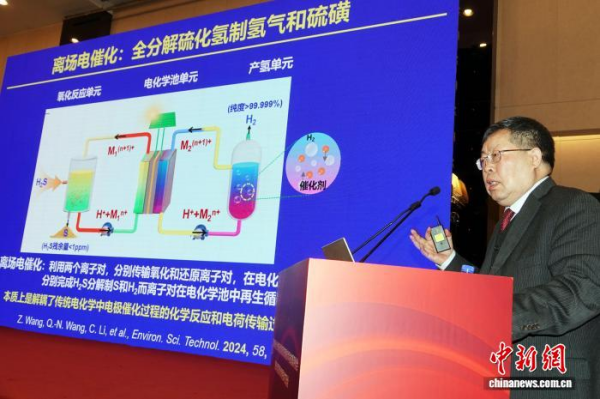
Core Viewpoint - The development of a new technology for the efficient and clean treatment of hydrogen sulfide (H2S) has been achieved by a team led by Academician Li Can from the Dalian Institute of Chemical Physics, which is recognized as a leading international solution in the energy and chemical industry [1][2]. Group 1: Technology Development - The "off-site electro-catalytic complete decomposition of hydrogen sulfide to produce hydrogen and sulfur technology" has been successfully developed, addressing the challenge of scaling up the decomposition of H2S [2][3]. - This technology decouples chemical reactions and charge transfer, allowing for the oxidation of H2S to sulfur and proton reduction to hydrogen to occur separately in a reactor, enhancing safety and reliability [2][3]. Group 2: Industrial Application - The team has initiated the first industrial demonstration project in the coal chemical sector, utilizing H2S as a byproduct from a methanol production facility [3]. - The demonstration plant has a capacity of 100,000 cubic meters per year and has achieved complete conversion of H2S, with sulfur purity exceeding 99.95% and hydrogen purity exceeding 99.999% [3]. Group 3: Environmental and Economic Impact - The technology offers a new pathway for the complete elimination and resource utilization of H2S, contributing to ecological protection and dual resource recovery of hydrogen and sulfur [4]. - If implemented using renewable energy sources, the technology could recover approximately 730,000 tons of clean low-carbon hydrogen annually from the 8 billion cubic meters of H2S processed in China, representing 40% of the planned green hydrogen production capacity by 2030 [4].

【中国新闻网】硫化氢如何变废为宝?中国首创技术“一箭双雕”实现工业应用
Zhong Guo Xin Wen Wang· 2026-01-07 02:58
Core Viewpoint - The "Off-site Electrocatalytic Complete Decomposition of Hydrogen Sulfide to Hydrogen and Sulfur Technology" developed by the team led by Academician Li Can has successfully transitioned from laboratory to industrial application, addressing environmental challenges posed by hydrogen sulfide emissions while providing a dual resource recovery of hydrogen and sulfur [4][5][7]. Group 1: Technology Overview - The technology offers a new pathway for the complete elimination and resource utilization of hydrogen sulfide, significantly reducing pollution and protecting the ecological environment while achieving dual resource recovery [4][7]. - The industrial demonstration project utilizes hydrogen sulfide as a raw material from a methanol plant, employing a modular design that includes three main units for sulfur production, proton reduction for hydrogen, and an electrochemical cell [5][8]. - The demonstration unit has operated continuously for over 1,000 hours, achieving complete conversion of hydrogen sulfide with sulfur purity greater than 99.95% and hydrogen purity exceeding 99.999% [5][8]. Group 2: Environmental and Economic Impact - The technology is expected to provide a key green transformation solution for industries such as natural gas, petrochemicals, and coal chemical sectors, supporting the development of low-carbon industrial practices [7][9]. - The team has applied for 26 patents related to this technology, with 12 already granted, indicating a strong intellectual property foundation [8]. - If implemented widely, the technology could recover approximately 730,000 tons of clean low-carbon hydrogen from the annual treatment of 8 billion cubic meters of hydrogen sulfide in China, contributing significantly to the country's green hydrogen production goals [10].
2026-PEM电解水必将浴火重生 破茧成蝶——专访枡水科技CEO王新磊
势银能链· 2025-12-31 02:04
Core Viewpoint - The article discusses the current state and future prospects of the PEM hydrogen production industry, emphasizing the importance of technology innovation and cost reduction in achieving large-scale production and market acceptance of green hydrogen [1]. Group 1: Company Achievements - As of now, the company has signed contracts exceeding 100 million yuan, shipped over 10,000 membrane electrodes, and achieved kilogram-level mass production of low-iridium catalysts [2]. - The company has developed a proton exchange membrane that is ready for collaborative mass production and has completed the acquisition of intellectual property and related assets from Sichuan Borsma [2]. Group 2: Challenges in the Industry - The company faces challenges such as price competition that disregards product performance, which can lead to the use of low-quality membrane electrodes that pose safety risks [3]. - Low-quality membrane electrodes can compromise the control of "oxygen in hydrogen," leading to severe safety incidents if the oxygen content exceeds critical limits [4]. Group 3: Quality of Membrane Electrodes - High-quality membrane electrodes must balance performance, stability, and safety parameters, with rigorous testing under dynamic conditions to ensure reliability [6]. - The company emphasizes that high-quality membrane electrodes can ultimately reduce the overall cost of electrolyzers by improving efficiency rather than cutting corners [7]. Group 4: Cost Reduction and Market Position - The cost of electrolyzers using the company's 50-micron membrane electrode has been significantly reduced to 1.177 million yuan per MW, with further optimization expected [8]. - The company plans to build 1-2 off-grid hydrogen production plants based on the 50-micron electrolyzer by 2026, showcasing the advantages of PEM technology in real-world applications [11]. Group 5: Strategic Planning and Product Offerings - The company has integrated key materials and processes into a "PEM Seven-in-One" solution, which combines multiple components to lower system costs and accelerate product deployment [15]. - The company offers consulting services to assist clients in system design and optimization, leveraging its extensive experience in the PEM field [17]. Group 6: Future Outlook - The company believes that the cost of PEM electrolyzers will drop to 100 USD/KW (approximately 700,000 yuan/MW) by 2026, aligning with the goal of achieving green hydrogen at 1 USD/kg [21]. - The company invites partners who share the vision of advancing the green hydrogen industry to join in overcoming challenges and achieving practical innovations [21].

下个周期,氢能热潮如何继续“升温”
Zhong Guo Hua Gong Bao· 2025-12-30 03:39
Core Insights - The hydrogen energy industry in China is transitioning from pilot exploration to a new phase of orderly development, with ongoing enthusiasm for growth [1] Group 1: Hydrogen Production - The electrolyzer is a critical component in hydrogen production, directly converting electrical energy into chemical energy, and its performance significantly impacts the economic viability of hydrogen energy [2] - Challenges exist in the electrolyzer sector, particularly regarding the stability of power supply from renewable sources like solar and wind, necessitating advancements in high-performance electrodes and membranes [2] - Innovations in electrode materials, such as customized gradient porous substrates and modified nickel-based catalysts, can enhance the efficiency and reduce costs of alkaline electrolyzers [2] Group 2: Hydrogen Storage and Transportation - Liquid hydrogen is identified as a promising solution for the storage and transportation of green hydrogen, with domestic production capacity expected to reach 60 tons per day by 2026 [4] - The development of large-scale hydrogen liquefaction equipment is underway, and a commercial model integrating renewable energy and application scenarios is being established [4] - The international market for green hydrogen, particularly in regions like the Middle East, presents significant opportunities for Chinese hydrogen equipment technology and enterprises [4] Group 3: Hydrogen Utilization - The application of hydrogen is expected to diversify, expanding from transportation to industrial, energy, and construction sectors [5] - The industrial sector is projected to focus on replacing fossil fuels with green hydrogen, with a steady increase in penetration rates for industries like ammonia and methanol by 2030 [5] - Liquid hydrogen applications in transportation, including aviation and maritime sectors, are anticipated to lead industry development, with potential uses in high-temperature superconducting motors and fuel for aviation turbines [6]
2026年中国宏观经济五大趋势展望:环球市场动态
citic securities· 2025-12-30 02:01
Market Overview - A-shares experienced a pullback after an initial rise, with the Shanghai Composite Index closing up 0.04% at 3,965 points, marking a nine-day winning streak, while the Shenzhen Component and ChiNext Index fell by 0.49% and 0.66% respectively[15] - The Hang Seng Index declined by 0.71% to 25,635 points, with major tech stocks like Alibaba dropping 1.8%[10] - The KOSPI index in South Korea rose by 2.2% to 4,220 points, leading gains in the Asia-Pacific region[20] Economic Predictions for China - In 2026, China's macroeconomic growth is expected to be driven by domestic demand recovery, with investment shifting from total pressure to structural optimization[5] - Export growth is anticipated to remain resilient, supported by easing US-China relations and diversified market deployments, contributing to a moderate appreciation of the RMB[5] Commodity and Forex Market - Gold and silver prices fell by 4.5% and 8.7% respectively after reaching new highs, while copper prices hit a historical peak due to supply concerns[26] - International crude oil prices rose over 2%, with WTI crude oil reaching $58.08 per barrel[26] Fixed Income Market - Global focus on geopolitical developments has led to increased risk aversion, with European bond markets showing significant gains and US Treasury yields slightly rising[4] - The yield on 10-year US Treasuries decreased by approximately 1.8 basis points to 4.11%[29] Sector Performance - In the US market, technology stocks are expected to yield a reasonable target of 20% returns in 2026, driven by EPS growth despite potential market volatility[8] - The carbon fiber sector is projected to benefit from the booming commercial aerospace industry, with companies like Jilin Chemical Fiber and Guangwei Composite expected to gain[18]
电力设备与新能源行业12月第5周周报:光伏产业链涨价趋势形成,锂电材料价格博弈加剧-20251229
Bank of China Securities· 2025-12-29 01:03
Investment Rating - The report maintains an "Outperform" rating for the power equipment and new energy industry [1]. Core Insights - The photovoltaic industry chain is experiencing a price increase trend, while the price competition for lithium battery materials is intensifying [1]. - In the fourth quarter, which is the peak sales season for new energy vehicles, domestic sales of new energy vehicles are expected to maintain high growth in 2025, driving demand for batteries and materials [1]. - The solid-state battery industrialization is progressing, and attention should be paid to the verification progress of related materials and equipment companies [1]. - The report emphasizes a "de-involution" strategy as the main investment theme for photovoltaics, with the integration and acquisition of polysilicon production capacity becoming more proactive [1]. - The demand for wind power is expected to continue growing, with a focus on wind turbines and offshore wind power [1]. - The energy storage sector remains highly prosperous, with recommendations to focus on energy storage cells and large-scale integrated plants [1]. - Hydrogen energy is anticipated to open up demand for green hydrogen, with a focus on downstream hydrogen-based energy applications [1]. - The report suggests monitoring core suppliers in the nuclear fusion sector as it represents a long-term catalytic direction for future energy development [1]. Summary by Sections Market Overview - The power equipment and new energy sector rose by 5.37% this week, outperforming the Shanghai Composite Index, which increased by 1.88% [10]. - The wind power sector saw the highest increase at 7.14%, followed by the photovoltaic sector at 6.56% [13]. Lithium Battery Market - The price of lithium carbonate has continued to rise, with battery-grade lithium carbonate priced at approximately 98,000 RMB per ton, reflecting an 8% increase [25]. - The price of lithium iron phosphate battery cells has also seen an upward trend, with prices for various models ranging from 0.285 to 0.425 RMB per watt-hour [26]. Photovoltaic Market - The price of polysilicon remains stable, with tight supply and weak downstream demand affecting price transmission [15]. - The price of silicon wafers has shown a significant increase, driven by rising silver prices and industry self-discipline [16]. - The price of battery cells has increased to 0.34 RMB per watt, with manufacturers actively raising prices due to cost pressures [17]. Energy Storage Market - The price of energy storage systems has rebounded, with prices for various configurations ranging from 0.40 to 0.82 RMB per watt-hour [27]. - The demand for energy storage remains strong, particularly in overseas markets, contributing to price stability [26].

吉电股份:梨树风光制绿氢生物质耦合绿色甲醇项目部分运用PEM制氢设备
Zheng Quan Ri Bao Wang· 2025-12-25 10:39
Group 1 - The core viewpoint of the article is that Jidian Co., Ltd. (stock code: 000875) has confirmed the use of PEM hydrogen production equipment in its Lishu Wind-Solar Coupled Green Hydrogen Biomass Green Methanol Project [1] Group 2 - The company responded to investor inquiries on an interactive platform regarding its project [1]
