贸易转移

Search documents
7月我国出口继续高增,贸易转移现象突出
Xin Lang Cai Jing· 2025-08-07 12:02
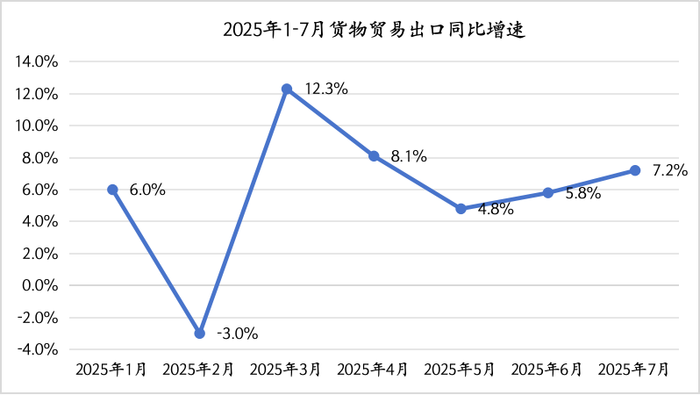
Core Viewpoint - In July, China's exports increased by 7.2% year-on-year in USD terms, accelerating from June's growth, driven by a shift in export focus towards non-US regions due to fluctuating US tariff policies [1][3][5]. Export Performance - China's exports to the US fell by 21.7% year-on-year, a decline that widened by 5.6 percentage points compared to the previous month [5]. - Exports to the EU grew by 9.2%, an increase of 1.6 percentage points from the previous month [5]. - Exports to ASEAN countries rose by 16.6%, with notable growth rates to Vietnam (27.9%), Indonesia (12.0%), and the Philippines (10.7%) [5]. - Exports to South Korea increased by 4.6%, recovering from a decline of 6.7% in the previous month [5]. Trade Dynamics - The "rush to export" and "transshipment" effects were significant contributors to the export growth in July, as companies sought to mitigate the impact of US tariffs [3][5]. - The proportion of exports to Belt and Road Initiative countries reached 50.5%, with a year-on-year growth of 10.4% from January to July [6]. Future Outlook - Analysts predict increased uncertainty in the export environment for the second half of the year, with potential gradual declines in export growth [7]. - The recent drop in import growth for processing trade from 16.9% to 9.8% in July indicates potential downward pressure on future exports [7]. - The US's consideration of new tariffs on sectors like semiconductors and pharmaceuticals could further disrupt global trade [7][8]. Economic Context - The current average tariff rate imposed by the US on Chinese goods is estimated at 40.4%, while Southeast Asian countries face tariffs between 19% and 20% [8]. - The US has announced a 40% transshipment tax for countries circumventing tariffs through third-party routes, increasing pressure on China's transshipment trade [8]. - Some analysts argue that China's strong export performance over the past three quarters is not solely due to "rush to export" but also reflects a recovery in global consumption and rising overseas inventory demand [8][9].

21专访|华泰资产王军:像重视招商引资一样重视消费
2 1 Shi Ji Jing Ji Bao Dao· 2025-07-24 09:56
Economic Performance - In the first half of the year, China's GDP reached 66.05 trillion yuan, growing by 5.3% year-on-year, laying a solid foundation for achieving the annual target of around 5% [1] - The manufacturing sector showed significant support, with industrial added value increasing by 6.4% year-on-year, and high-tech manufacturing growing by 9.5% [4][5] - Exports demonstrated resilience, with a total trade surplus of $586 billion, marking a 34.7% year-on-year increase [5] External Trade Dynamics - The trade environment is influenced by U.S. tariff policies, with potential risks of export decline in the second half due to demand exhaustion and new tariffs [1][7] - China expanded its trade partnerships, with exports to emerging markets like Africa and ASEAN showing significant growth, indicating a strategy to mitigate external risks [6] Consumer Spending and Income - Despite a 5.3% increase in disposable income, consumer spending potential remains underutilized due to economic transformation and real estate market adjustments [8][9] - Recommendations include enhancing domestic circulation, increasing residents' income, and prioritizing consumer spending in fiscal policies [9][10] Investment Outlook - Investment dynamics are expected to weaken, particularly in manufacturing and real estate, with private investment growth remaining low [13][14] - Infrastructure investment is anticipated to maintain resilience, supported by special bonds and policy financing [13] Fiscal and Monetary Policy - There is room for interest rate cuts and a need for proactive fiscal policies to support economic stability and growth [15][16] - The focus should be on fiscal expansion through special bonds and targeted financial tools to stimulate effective investment [16]

2025年6月贸易数据解读:6月对美出口降幅显著收窄推动整体出口增速回升,上半年外部经贸环境剧烈波动下出口韧性突出
Dong Fang Jin Cheng· 2025-07-21 08:56
Export Performance - In June 2025, China's exports increased by 5.8% year-on-year, a rise of 1 percentage point compared to May[3] - Exports to the US fell by 16.1% year-on-year in June, but the decline narrowed by 18.4 percentage points from the previous month, contributing approximately 2.7 percentage points to overall export growth[4] - For the first half of 2025, China's exports grew by 5.9% year-on-year, an acceleration of 2.2 percentage points compared to the same period last year[6] Import Trends - In June 2025, imports rose by 1.1% year-on-year, with a 4.5 percentage point increase from May[7] - Imports from the US decreased by 15.5% year-on-year in June, with the decline narrowing by 2.6 percentage points from the previous month[7] - Cumulatively, imports in the first half of 2025 fell by 3.9% year-on-year, a slowdown of 6.0 percentage points compared to the same period last year[10] Market Dynamics - The reduction in US tariffs following the Geneva talks in May has led to a significant recovery in exports to the US, although tariffs remain high at approximately 41.3%[4] - The "temporary suspension" of global tariffs by the US has allowed Chinese companies to continue exporting to markets outside the US, with exports to ASEAN growing by 16.8% year-on-year in June[4] - The overall trade environment remains volatile, with expectations of a decline in export growth to around 1.0% in July due to ongoing high tariffs and weakening external demand[6]
关税影响高频跟踪(6月12日):关税_脉冲”引起贸易量波动
HTSC· 2025-06-13 07:53
Trade Trends - In May, U.S. imports showed weakness, but a recovery is expected in June, although it may not return to the high levels seen in Q1[2] - After the tariff reduction in mid-May, shipping rates significantly increased, indicating a rise in trade demand[2] - Container data shows a notable decline in U.S. imports from China in May, while imports from countries like Vietnam remained high due to tariff impacts[2] Economic Indicators - The global manufacturing PMI export orders rose by 0.7 to 48 in May, with notable improvements in developed and emerging markets excluding China[4] - U.S. consumer spending on services and goods has weakened, with hotel occupancy rates slightly below seasonal norms and retail indices showing a slowdown[4] - Investment expectations among U.S. businesses showed a low recovery in May, while production indicators weakened[5] Inflation and Financial Conditions - Inflation expectations remain stable, with retail prices rising slightly since mid-May, reflecting ongoing tariff impacts[5] - Financial conditions in the U.S. have continued to improve since mid-May, as indicated by Goldman Sachs and Bloomberg financial condition indices[6] Risks and Observations - The potential for renewed volatility in U.S. tariff policies poses a risk, alongside the possibility of weaker-than-expected employment data[7]
英国央行货币政策委员曼恩:贸易转移预计不会影响英国消费者。
news flash· 2025-06-02 22:01
Core Viewpoint - The Bank of England's monetary policy committee member Mann stated that trade shifts are not expected to impact UK consumers [1] Group 1 - The anticipated trade transfer will not have a significant effect on consumer behavior in the UK [1]
英国央行货币政策委员曼恩:由于贸易转移,世界经济中的商品价格将会下降。
news flash· 2025-05-14 06:13
Core Viewpoint - The Bank of England's monetary policy committee member Mann suggests that due to trade shifts, commodity prices in the global economy are expected to decline [1] Group 1 - The statement indicates a potential decrease in commodity prices as a result of changes in global trade patterns [1]
英国央行委员泰勒:全球不确定性和贸易转移会导致通货紧缩。
news flash· 2025-05-12 16:36
Core Viewpoint - The comments from Bank of England member Taylor highlight that global uncertainty and trade shifts may lead to deflationary pressures in the economy [1] Group 1 - Global uncertainty is identified as a significant factor influencing economic conditions [1] - Trade transfers are contributing to the potential for deflation [1] - The implications of these factors could affect monetary policy decisions moving forward [1]
欧盟官员:欧盟酝酿对美关税政策反制措施,包含所有选项
财联社· 2025-05-06 13:58
Core Viewpoint - The European Union (EU) is preparing countermeasures against the United States' tariffs on EU products, asserting its position against perceived unfair agreements from the US [1] Group 1: Tariff Impact - US tariffs currently cover 70% of EU exports to the US, with potential increases to 97% following further investigations into pharmaceuticals, semiconductors, and other products [1] - The EU faces a 25% import tariff on steel, aluminum, and automobiles, with the possibility of this tariff rising to 20% after a 90-day suspension announced by President Trump [1] Group 2: Negotiation Stance - The EU emphasizes the importance of negotiating a fair and balanced solution with the US, urging the US to demonstrate willingness to reach an agreement [1] - The EU plans to utilize the 90-day suspension period to prepare further rebalancing measures and ensure a fair competitive environment in case negotiations fail [1] Group 3: Monitoring Trade Shifts - The EU is taking steps to prevent an influx of imports resulting from the shifting of trade due to US tariffs, with a working group set to release initial findings by mid-May [1]