资产上链

Search documents
美国炒币大厂也开始“996福报”
Hu Xiu· 2025-08-28 06:45
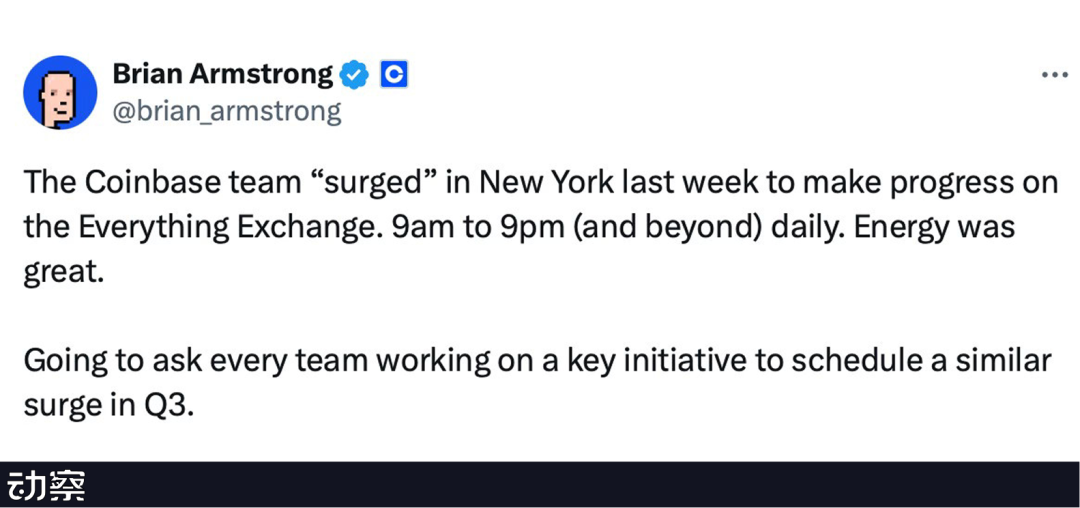
Group 1 - Coinbase is adopting a "996" work culture, similar to practices in China, as CEO Armstrong boasts about the New York team's long working hours to develop the Everything Exchange [2][3] - The intense work culture has sparked a divide in opinions, with Western users criticizing it as a toxic overwork culture, while Asian users view it as normal [3] - Coinbase's financial struggles are evident, with a 94% year-on-year drop in net profit in Q1 2025, and Q2 profits largely driven by investment gains rather than core operations [4][5] Group 2 - The cryptocurrency exchange industry is facing a crisis, with Coinbase's revenue and trading volume declining significantly due to market changes and increased competition from ETFs and decentralized finance [25][27] - Coinbase's Q1 2025 revenue was $2 billion, a 24.2% increase, but net profit fell sharply, indicating a shrinking business model for centralized exchanges [26][28] - The introduction of ETFs has altered investor behavior, leading to a shift of funds away from traditional exchanges like Coinbase [29][30] Group 3 - Coinbase is undergoing a transformation to become the "Everything Exchange," aiming to integrate all assets on-chain and enhance the trading experience [39][40] - The company is making strategic acquisitions to build a comprehensive infrastructure, including the purchase of Deribit for options trading and other firms to enhance its service offerings [48][50] - Coinbase's future strategy focuses on stablecoins, wallets, and institutional services, moving beyond reliance on retail trading [51][56] Group 4 - The competitive landscape for exchanges has shifted from superficial metrics like transaction speed and fees to deeper infrastructure development and long-term strategies [60][63] - The current competition is characterized by a focus on building foundational services and ecosystems rather than just attracting short-term trading volume [64][65] - Exchanges are now competing for control over critical entry points for funds, identities, and settlement networks, indicating a significant evolution in the industry [63][66]


奥瑞德股价上涨10% 完成全国首单算力资产RWA发行
Jin Rong Jie· 2025-08-11 09:32
Group 1 - The latest stock price of Aorede is 4.16 yuan as of August 11, 2025, reflecting a 10.05% increase from the previous trading day [1] - The opening price on the same day was 3.89 yuan, with a high of 4.16 yuan and a low of 3.86 yuan, resulting in a trading volume of 2,328,588 hands and a transaction amount of 939 million yuan [1] - Aorede's main business involves the optical optoelectronics sector, and the company is registered in Heilongjiang Province [1] Group 2 - Recently, Aorede completed the first nationwide issuance of computing power asset RWA, with an asset scale reaching several tens of millions [1] - The underlying assets of this project are AI servers held by its subsidiary, Shenzhen Zhikuanli Digital Technology Co., Ltd., with technical support from Ant Group for asset on-chain implementation [1] - On August 11, the net inflow of main funds into Aorede was 108 million yuan, accounting for 1.07% of the circulating market value, while the cumulative net outflow over the past five trading days was 36.32 million yuan, representing 0.36% of the circulating market value [1]

暴跌16.7%!是机会吗?所有资产上链!Coinbase要做“万物交易所”
美股IPO· 2025-08-02 14:18
Core Viewpoint - Coinbase is undergoing a significant strategic transformation to become an "everything exchange," planning to move all assets, including stocks, derivatives, and prediction markets, onto the blockchain for trading [1][3][10]. Group 1: Strategic Expansion - The CEO Brian Armstrong announced on social media that Coinbase aims to consolidate all trading assets in one place, emphasizing the inevitability of assets moving on-chain [3][5]. - The company plans to introduce tokenized equities as a key next step, viewing the $100 trillion traditional stock market as a prime opportunity for blockchain transformation [10][11]. - Coinbase's expansion strategy aims to provide a unified platform for trading diverse assets, moving beyond traditional cryptocurrency trading pairs [11][12]. Group 2: Competitive Landscape - This initiative intensifies competition with other platforms like Robinhood, Gemini, and Kraken, which have already opened tokenized stock products to users outside the U.S. [12]. - Coinbase's goal is to become a top financial services application within the next decade, as stated by its CEO [12]. Group 3: Regulatory Environment - Recent changes in the regulatory environment are encouraging Coinbase to accelerate its diversification efforts, with clearer guidelines on stablecoins and a more defined digital asset regulatory framework [13][14]. - Despite a 26% decline in revenue in Q2, the company views these developments as catalysts for growth, with a 12% increase in stablecoin activity revenue partially offsetting weaker trading income [14][15]. - The launch of the "Base App" indicates Coinbase's shift from a cryptocurrency trading platform to a comprehensive financial services provider, aiming to redefine the boundaries of digital asset trading in a supportive regulatory environment [15].

万亿资产上链革命:稳定币×RWA×DeFi重构B端融资新生态
Sou Hu Cai Jing· 2025-07-31 04:48
Core Insights - The global regulatory framework for crypto assets is rapidly evolving, with significant developments such as the EU's MiCA regulation, the US GENIUS Act, and Hong Kong's Ensemble project sandbox, indicating a strategic competition for digital financial sovereignty [1] - The "stablecoin + RWA + DeFi" model is disrupting traditional financial infrastructure, serving as a key driver for attracting trillions of dollars in assets on-chain [1] - The total value locked (TVL) in the RWA sector has reached a new high of $12.863 billion, but this remains small compared to the global $800 trillion in real assets, highlighting a bottleneck due to the lack of stablecoins [1] Group 1 - The revolution in finance directly addresses three major pain points for SMEs: difficulty in accessing global funds, challenges in pricing non-standard assets, and high costs of cross-border settlements [1] - Stablecoins provide a core value scale and medium of circulation for the RWA system, enabling the tokenization of private credit and government bonds, which currently dominate 92% of the RWA market [1] - The asset tokenization revolution is at a critical point, with BlackRock's BUIDL government bond fund enabling 24/7 income-generating asset trading, and Longxin Group tokenizing charging pile revenue rights to open new financing channels for asset-light operators [1][2] Group 2 - The efficiency revolution driven by "stablecoin-RWA-DeFi" is systematically addressing the liquidity challenges of non-standard assets for SMEs, high costs of cross-border settlements, and high technical compliance barriers [2] - Traditional finance's low collateral rates for assets like charging pile revenue rights are being disrupted by compliant tokenization, which offers a 33% premium rate [2] - Cross-border payments are transitioning from 3-5 days for settlement with friction costs exceeding 4% to instant T+0 clearing with only 0.5% costs through smart contracts [2][3]
民生证券:构建稳定币-RWA生态闭环 相关资产上链有望成为拉开Web3.0时代大幕
智通财经网· 2025-07-26 09:57
Core Viewpoint - The collaboration between government and enterprises is creating a stablecoin ecosystem anchored by high-quality Chinese assets, with RWA assets on-chain expected to usher in the era of Web 3.0 [1][5] Group 1: Stablecoin and RWA - Stablecoins focus on "fiat currency tokenization," while RWA emphasizes "asset tokenization," enhancing asset liquidity and providing low-risk, stable-return financial products in the Web 3.0 space [2] - Hong Kong is leading the world in stablecoin legislation, closely following the U.S. legislative progress [2] Group 2: Blockchain Layers - The progression from consortium chains to Layer 2 public chains and then to Layer 1 public chains highlights the advantages of each layer, including compliance with KYC/AML regulations and high transaction performance [3] - Layer 1 public chains serve as the foundational layer for consensus, data storage, and smart contract execution, while Layer 2 enhances performance and liquidity [3] Group 3: RWA Development Phases - The first phase of RWA focuses on foundational construction, with assets being tokenized and offering fixed returns similar to traditional investments [4] - The second phase activates liquidity through a layered architecture, enabling a closed-loop of "financing-splitting-circulation" for RWA [4] - The third phase aims to create a mature global RWA ecosystem with cross-chain transactions becoming the norm [4] Group 4: Investment Recommendations - The report suggests monitoring companies involved in RWA asset tokenization, such as Aorede, Longxin Group, and Xiexin Energy, during the foundational phase [5] - For the liquidity activation phase, attention should be given to trading platforms and internet brokerages like Yao Cai Securities and Dongfang Wealth [5] - In the global asset network integration phase, major internet giants like JD.com and Alibaba are recommended for observation [5]

宇信科技密集接受调研透露稳定币布局 跨境支付与资产上链成焦点
Jing Ji Guan Cha Wang· 2025-07-14 10:03
Group 1 - Yuxin Technology has initiated systematic layouts in stablecoin issuance, payment, and financial innovation, aiming to support the development of new asset and circulation ends through technology and solution outputs [1] - The recent investor relations activities highlight the alignment of stablecoin business with Yuxin Technology's global strategy, reflecting the acceleration of financial technology companies' participation in the stablecoin ecosystem [1][2] - The Chinese government has released clear signals for stablecoin development, emphasizing innovation and research in digital currencies, which aligns with Yuxin Technology's strategic direction [2] Group 2 - Hong Kong is actively advancing its stablecoin framework, with the "Stablecoin Ordinance" set to take effect on August 1, 2023, and the launch of a "stablecoin issuer sandbox" by the Hong Kong Monetary Authority [3] - Yuxin Technology aims to create innovative business models, particularly in overseas markets, by implementing a diversified product portfolio and a comprehensive service model that integrates operations and products [4] - The company plans to leverage its extensive experience serving over 1,000 financial institutions to address the technical and business challenges of connecting the banking system with the stablecoin system [4] Group 3 - Yuxin Technology's strategy is closely aligned with current market opportunities, particularly in the tokenization of bonds and real-world assets (RWA), leveraging its strengths in credit services [5] - The company has established a mature ecosystem operation capability, helping financial institutions expand their business scale through technology empowerment [6] - The stablecoin industry is expected to bring benefits to financial IT and companies with stable asset holdings, with Yuxin Technology positioned to benefit from this trend [6] Group 4 - The rise of stablecoins reflects a global demand for efficiency and trust in the financial system, with Yuxin Technology's efforts representing a shift of Chinese financial IT capabilities to new markets [7] - The development of stablecoins presents new opportunities for the financial industry, requiring collaborative efforts from industry participants to foster a healthy ecosystem [7] - Stablecoins are seen as a core bridge connecting traditional finance and the crypto world, with the potential to enhance cross-border payment efficiency and reshape the international monetary landscape [8]

金融创新还是噱头?Robinhood代币化股票产品遭遇欧洲监管风暴
Hua Er Jie Jian Wen· 2025-07-08 13:55
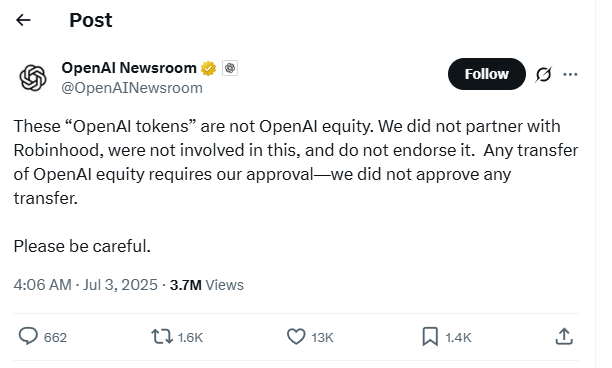
Core Viewpoint - Robinhood's introduction of tokenized stock trading in Europe has sparked regulatory scrutiny and investor caution, particularly due to the inclusion of tokens for private companies like OpenAI and SpaceX [1][3]. Group 1: Product Overview - Robinhood's new product allows European users to trade tokens linked to U.S. stocks through blockchain, with over 150,000 users across 30 EU countries [2]. - These tokens are digital assets anchored to real equity, theoretically granting holders certain economic benefits like dividends, but typically excluding voting rights [2]. - Other institutions, including Kraken and BlackRock, are also developing tokenized securities, indicating a growing interest in "asset tokenization" in global capital markets [2]. Group 2: Market Reactions - OpenAI publicly criticized Robinhood's offering, stating that the tokens do not represent actual company equity and that any equity transfer requires their approval, which has not been granted [3]. - Following OpenAI's statement, Robinhood's stock price experienced a significant drop, raising concerns about the safety and actual representation of tokenized stocks [5]. Group 3: Regulatory Challenges - Robinhood's choice to launch the tokenized product in Europe is partly due to the ambiguous regulatory environment in the U.S. regarding such products [6]. - The Bank of Lithuania has initiated an investigation into Robinhood's tokenized stock product, seeking clarification on the information provided to customers [6]. - Robinhood's CEO expressed confidence in the product's compliance with regulations, asserting that it can withstand rigorous scrutiny [6].

京东稳定币的核心,在于“稳定”
Sou Hu Cai Jing· 2025-06-27 04:13
Group 1 - The core value of stablecoins lies not in the coins themselves but in the industries and scenarios they connect to, providing support for these sectors [2][4] - Stablecoins serve as a bridge between the virtual economy and the real economy, enabling the on-chain representation of physical assets [4][5] - The focus on stablecoins should shift from their investment attributes to their ability to reduce costs and increase efficiency across various applications [5][6] Group 2 - Stablecoins can significantly lower cross-border payment costs by up to 90% and improve transaction efficiency to within 10 seconds, as highlighted by industry leaders like JD.com's founder [5][6] - The application of stablecoins extends beyond cross-border payments to retail payments and supply chain finance, enhancing overall operational efficiency [6] - Regulatory frameworks are being established globally to ensure the stability of stablecoins, emphasizing the importance of maintaining their core principle of "stability" [8]
详解金融科技与AI算力的“核聚变”:RWA+算力租赁
2025-06-24 15:30
Summary of Key Points from the Conference Call Industry Overview - The conference discusses the integration of Real World Assets (RWA) and stablecoins within the financial technology sector, particularly in the context of the cryptocurrency market and its evolving landscape [1][2][3]. Core Insights and Arguments - RWA introduces off-chain assets into the cryptocurrency market, catering to investors' demand for stable yield assets, especially during market volatility [1]. - Hong Kong is actively promoting legislation and sandbox programs for stablecoins and RWA, aiming to build a comprehensive ecosystem that effectively implements on-chain applications [1][4]. - Ant Group is strategically positioning itself in the RWA and stablecoin markets, planning to apply for a stablecoin license in Hong Kong and engaging in green finance and trade supply chain finance [1][8]. - Longxin Group successfully financed 100 million RMB by packaging the revenue rights of 9,000 charging piles into an asset bundle for RWA financing, demonstrating RWA's potential in enhancing asset liquidity and financing efficiency [1][9]. - The relationship between stablecoins and RWA is symbiotic, with stablecoins facilitating transactions and RWA providing investment returns similar to traditional financial products [2]. Legislative Developments - The U.S. Senate passed a stablecoin bill on May 20, and Hong Kong's government released a draft stablecoin regulation shortly after, indicating rapid legislative progress in both regions [4]. - Hong Kong is advancing two sandbox plans: one for stablecoins and another for RWA, to ensure effective implementation of on-chain applications [5][6]. Market Dynamics - The cryptocurrency market has transitioned from a bull to a bear phase, increasing the demand for stable, low-risk asset allocations [3]. - RWA financing enhances asset credibility through blockchain technology, allowing for continuous data monitoring and addressing challenges faced by traditional REITs [10]. Future Prospects - The RWA market is expected to grow significantly, providing new financing channels and increasing liquidity for various asset types [11][12]. - Ideal RWA anchor assets should exhibit continuous market growth, transparent yield rates, and clear financing demand, with potential candidates including charging piles, photovoltaic power stations, and computing power leasing [15][16]. Company-Specific Insights - Aored, after restructuring and receiving state-owned capital injection, has become a model for computing power leasing, boasting approximately 1.1 billion RMB in computing assets with yields exceeding 30% [20][21]. - The computing power leasing market is anticipated to expand, with companies like Aored leading the way through innovative financing models [21]. Additional Considerations - The integration of RWA and computing power leasing is driven by mutual demand, as RWA investors often have computing needs, creating a complementary relationship [18]. - The financing costs for RWA are projected to decrease in the future, potentially reaching around 5% as regulatory compliance improves and interest rates decline [14]. This summary encapsulates the key points discussed in the conference call, highlighting the evolving landscape of RWA and stablecoins, legislative advancements, market dynamics, and specific company strategies.
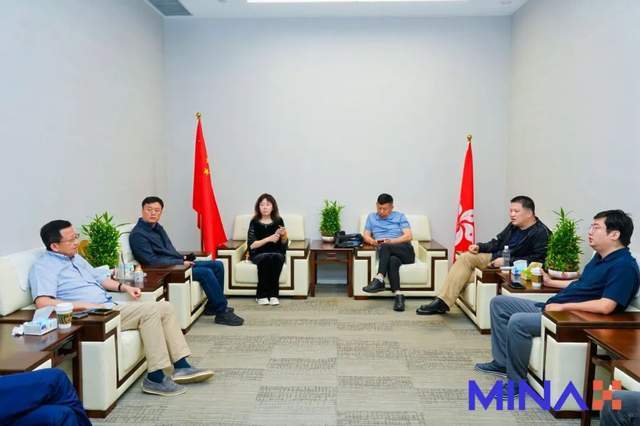
郑定向会长出席MINAX品牌上市论坛
Sou Hu Cai Jing· 2025-04-27 10:59
Core Insights - The MINAX brand listing forum and Asiabrand Black Horse 100 entrepreneurship salon took place in Hong Kong, focusing on the globalization of digital assets and the innovation of China's RWA model [1][3] Group 1: RWA Accelerator and Strategic Goals - The Hong Kong Blockchain Technology Application Association aims to drive innovation in China's RWA model through a dual focus on technology compliance and breaking down barriers to global asset circulation [3][5] - The association has proposed a closed-loop ecosystem involving "domestic asset digitization - cross-border data flow - international market trading" by leveraging the data cross-border policy advantages of Hainan Free Trade Port and Hong Kong's status as an international financial center [3][5] Group 2: Core Model Analysis - A compliant cross-border data channel is being established based on Hainan's data policies, addressing the "last mile" issue of data export in accordance with China's data security assessment and Hong Kong's virtual asset policy [5] - The use of a national-level alliance chain as the underlying blockchain technology ensures traceability and immutability of the entire process through asset on-chain storage, smart contract execution, and tokenization [5] - The MINAX exchange connects Southeast Asia, the Middle East, and Western markets, facilitating low-cost financing and high liquidity asset circulation for domestic enterprises using the RWA model [5] Group 3: Collaboration and Future Directions - The association and MINAX will closely collaborate to create a compliant and asset-liquid RWA pathway unique to China, empowering the internationalization of domestic assets [6] - The Hong Kong MINAX brand listing forum marks a significant step from technical validation to large-scale application of China's RWA model, with a commitment to building an open, compliant, and inclusive digital asset ecosystem [7]