资本市场牛市

Search documents
大规模的存款搬家,开始出现了?
大胡子说房· 2025-09-18 11:15
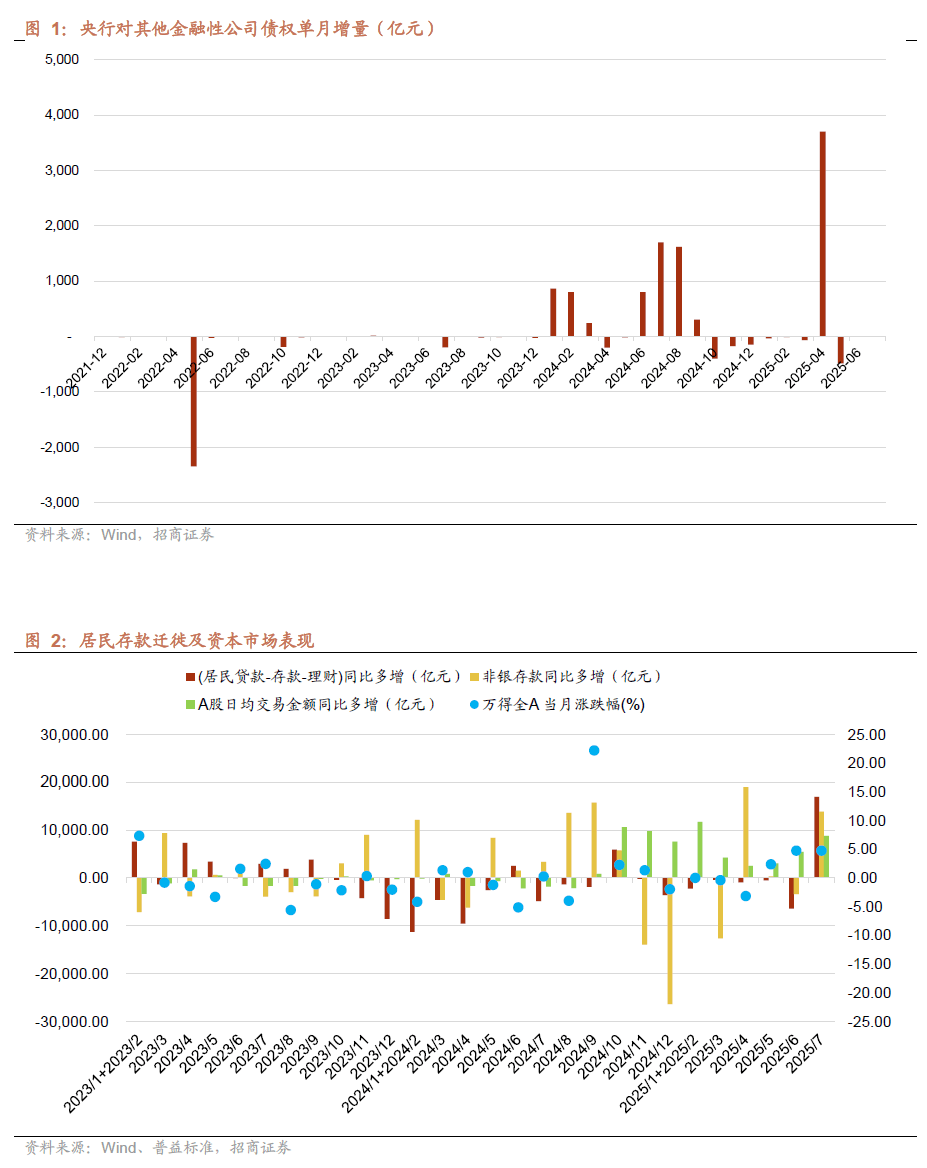
Core Viewpoint - The article highlights a significant shift in deposit trends, indicating a movement of funds from traditional bank deposits to non-bank financial institutions, driven by the rising interest in the capital market and a more rational approach to investment by residents and enterprises [2][9][10]. Summary by Sections Deposit Data - In August, new corporate deposits increased by 299.7 billion yuan, a year-on-year decrease of 50.3 billion yuan [3]. - New household deposits were 110 billion yuan, down 600 billion yuan compared to last year [3]. - In July, the stock of household deposits was approximately 1.11 trillion yuan, reflecting a year-on-year reduction of 780 billion yuan [4]. Non-Bank Financial Institutions - Non-bank financial institutions, such as brokerages, funds, and insurance companies, saw a significant increase in deposits, with an addition of 1.18 trillion yuan in August, a year-on-year increase of 550 billion yuan [6]. - In July, the increase in non-bank deposits was even higher at 2.14 trillion yuan [7]. - Cumulatively, non-bank deposits increased by 5.87 trillion yuan in the first eight months of the year, marking a historical high for the same period [8]. Fund Movement and Market Sentiment - The outflow of deposits from banks to non-bank institutions suggests a growing interest in the capital market, indicating a large-scale "deposit migration" [9]. - This migration is characterized by a more rational approach, with funds moving towards stable financial products rather than high-risk investments [12]. - Popular products include those with relatively fixed returns, which have attracted significant interest compared to traditional deposits [14]. Market Dynamics - The article notes that the current deposit migration is still in its early stages, with a substantial amount of funds yet to enter the market [16]. - The speed of deposit migration is closely linked to the performance of stock indices, with a notable increase in new account openings in August, reaching approximately 2.65 million, a 35.1% month-on-month increase and a 165% year-on-year increase [19][20]. - The article emphasizes that the attitude of the public towards the capital market is directly correlated with the market's performance [23]. Future Outlook - The potential acceleration of deposit migration will depend on the speed of index increases, with rapid gains likely to encourage more retail investors to enter the market [22][24]. - The article concludes that the current wave of deposit migration is expected to surpass previous instances, driven by a collective effort to restore asset prices and ensure widespread participation in market gains [26][28].


反内卷影响详细测算:牛市的逻辑:产能过剩下行拐点到来
Xinda Securities· 2025-08-29 02:04
Group 1: Industrial Capacity and Economic Trends - As of Q2 2025, China's industrial capacity reached 186.7 trillion yuan, accounting for 135.7% of GDP, down from 144.9% in Q4 2022[11] - China's industrial capacity has undergone three expansion phases: 2018, 2021, and 2023-2024[14] - The first capacity surplus occurred in 2015-2016, the second in 2020 due to the pandemic, and the third began in 2023, driven by capacity expansion and weak demand[30] Group 2: "Anti-Involution" Policy Impacts - The "anti-involution" policy is expected to create a turning point for declining capacity surplus and rising PPI, improving corporate profitability[7] - Historical data shows that each resolution of capacity surplus and recovery of PPI has led to a bull market in capital markets[61] - The capital market is anticipated to enter a bull market as a result of the "anti-involution" policy, similar to past instances in 2016-2017 and 2020-2021[61] Group 3: Risks and Future Considerations - Risks include slower-than-expected progress on "anti-involution," geopolitical risks, and potential deviations from historical patterns[3] - The need for demand-side measures to balance growth dynamics is emphasized, as reliance on manufacturing growth may weaken[60] - Enhancing non-manufacturing dynamics is crucial for achieving balanced growth, with potential strategies including infrastructure investment and boosting consumer spending[60]
招商证券:如果是短期快速牛市,其带来的可能是暴富效应,可能导致财富再分配和社会贫富分化扩大
Sou Hu Cai Jing· 2025-08-18 05:27
Group 1 - The article discusses the trend of deposit migration in China, highlighting that a significant amount of deposits will mature annually, with estimates of 83 trillion, 91 trillion, and 105 trillion yuan for the years 2023, 2024, and 2025 respectively, indicating a strong liquidity support for capital markets [1][2] - It is noted that the migration of residents' deposits to capital markets is likely a result of market heat rather than a cause, emphasizing that emotional fluctuations are short-term variables while beliefs are more stable [2][3] - The article suggests that for stable long-term capital market returns, the focus should shift away from narratives that stimulate short-term bull market emotions, as these could negatively impact medium to long-term returns [2][3] Group 2 - The potential of residents' deposits should first be viewed as consumption potential and then as liquidity potential, with a focus on enhancing consumer confidence to boost corporate performance and return on equity (ROE) [3][4] - The article warns against overemphasizing deposit migration as a reason for bull markets, as this could lead to unpredictable micro liquidity states, which may not be beneficial for long-term market development [3][4] - The analysis indicates that the current banking sector has a low price-to-earnings (PE) ratio of about 7 times compared to the overall market PE of 21 times, suggesting that banks, as holders of high-quality debt, present better annualized returns [5][6] Group 3 - The macro liquidity outlook suggests that without additional fiscal budget increases, the current fiscal expansion's year-on-year intensity will begin to decline in August, with social financing growth potentially reaching its peak [4][5] - The article highlights that the liquidity in the interbank bond market may become unstable due to the decline in fixed deposit yields, leading to a shift towards shorter-term deposits and increased unpredictability in market liquidity [4][5] - Investment recommendations emphasize a long-term perspective and balanced allocation, suggesting that banks with superior free cash flow and excess provisions should be prioritized for investment [5][6]