
跨境收支

Search documents
中国人民银行副行长、国家外汇管理局局长朱鹤新:“十四五”以来我国外汇储备始终稳定在3万亿美元以上
Zheng Quan Ri Bao· 2025-09-22 16:11
Core Viewpoint - The press conference highlighted the achievements of China's financial sector during the "14th Five-Year Plan" period, emphasizing the stability and resilience of the foreign exchange market amidst a complex external environment [1][2][3] Group 1: Achievements in Foreign Exchange Sector - The foreign exchange sector has effectively balanced development and security, supporting the new development pattern with a stable foreign exchange reserve above $3 trillion [1] - The cross-border capital flow has shown strong vitality, with a projected cross-border payment scale of $14 trillion in 2024, a 64% increase from 2020, and an average annual growth rate 8 percentage points higher than the previous five-year period [1] - The foreign exchange market has maintained stability, with increased market vitality and resilience, characterized by a balanced international payment and a reasonable current account surplus to GDP ratio [1] Group 2: Market Functionality and Structure - The foreign exchange market has expanded significantly, with a trading volume of $41 trillion in 2024, a 37% increase from 2020, and a diverse range of participants including 703 banks and 115 non-bank institutions [2] - The infrastructure for trading, clearing, and payment has improved, reducing transaction costs and settlement risks, thereby better serving the real economy [2] - The rational and orderly trading in the foreign exchange market has enhanced its stability, with the proportion of enterprises using foreign exchange hedging rising from 17% in 2020 to around 30% [2] Group 3: Future Outlook - The long-term positive economic fundamentals and steady high-level opening up will support a stable international payment balance, while the market-oriented formation mechanism of the RMB exchange rate continues to improve [3] - Enhanced macro-prudential management of the foreign exchange market will provide a stronger foundation for healthy development in the "15th Five-Year Plan" period [3]
【金融街发布】国家外汇局局长朱鹤新:“十四五”期间我国外汇市场运行平稳 活力和韧性都在增强
Xin Hua Cai Jing· 2025-09-22 14:12
Core Insights - The foreign exchange market in China has shown stability and resilience since the 14th Five-Year Plan, with significant growth in cross-border receipts and foreign exchange market trading volume projected for 2024 [1][2] Group 1: Cross-Border Receipts and Foreign Exchange Market - In 2024, China's cross-border receipts are expected to reach $14 trillion, a 64% increase from 2020, with an average annual growth rate 8 percentage points higher than during the 13th Five-Year Plan [1] - The foreign exchange market trading volume is projected to be $41 trillion in 2024, reflecting a 37% increase from 2020, with both spot and derivative trading growing simultaneously [1] Group 2: Market Participation and Infrastructure - As of June 2023, 703 banks and 115 non-bank institutions, including 296 foreign institutions, are participating in the interbank foreign exchange market, covering major currencies to meet diverse trading needs [2] - Continuous improvements in trading, clearing, and payment mechanisms have effectively reduced transaction costs and settlement risks, better serving the real economy [2] Group 3: Market Stability and Future Outlook - The RMB exchange rate has shown increased flexibility, with its share in cross-border trade rising from 16% to nearly 30%, enhancing the resilience of the foreign exchange market [2] - The macro-prudential management system of the foreign exchange market is gradually improving, providing a robust framework to manage external risks and challenges [2]

高质量完成“十四五”规划丨“十四五”以来我国外汇储备始终稳定在3万亿美元以上
Xin Hua Wang· 2025-09-22 10:27
Core Points - China's foreign exchange reserves have remained stable above $3 trillion since the 14th Five-Year Plan, with over $3.2 trillion in the past two years, serving as a crucial stabilizer for the economy [1] - The cross-border receipts and payments reflect the vibrancy of China's foreign economic activities, with a projected scale of $14 trillion in 2024, a 64% increase from 2020, and an annual growth rate 8 percentage points higher than during the 13th Five-Year Plan [1] - The foreign exchange market has expanded significantly, with a trading volume of $41 trillion expected in 2024, a 37% increase from 2020, and participation from 703 banks and 115 non-bank institutions as of June this year [1] - The government has successfully addressed external shocks through a dual management framework of macro-prudential and micro-regulation, with over 6,100 foreign exchange cases resolved since the 14th Five-Year Plan [1] Industry Focus - Enhancing the efficiency of trade foreign exchange receipts and payments, facilitating cross-border investment and financing, and improving banks' foreign exchange service capabilities are key priorities in China's foreign exchange sector [2] - The government aims to create a market-oriented, rule-of-law, and internationalized foreign exchange business environment while balancing financial openness and security to support a higher-level open economy [2]
我国应对外部风险挑战底气为何更足?国家外汇局朱鹤新答21记者
2 1 Shi Ji Jing Ji Bao Dao· 2025-09-22 10:25
Core Insights - The press conference highlighted the achievements of China's financial sector during the "14th Five-Year Plan" period, emphasizing the stability and resilience of the foreign exchange market despite a complex external environment [1][2]. Group 1: Foreign Exchange Market Performance - The foreign exchange market in China has shown stable operation with enhanced vitality and resilience, characterized by robust cross-border capital flows and trade activities [2]. - In 2024, China's cross-border capital flows are projected to reach $14 trillion, a 64% increase from 2020, with an average annual growth rate during the "14th Five-Year Plan" period being 8 percentage points higher than the previous five-year period [2]. - The trading volume in the foreign exchange market is expected to reach $41 trillion in 2024, reflecting a 37% increase from 2020, with both spot and derivative transactions growing simultaneously [2]. Group 2: Market Structure and Participation - As of June 2023, 703 banks and 115 non-bank institutions are participating in the interbank foreign exchange market, including 296 foreign institutions, indicating a broadening of market participation [3]. - The infrastructure for trading, clearing, and payment has been continuously improved, effectively reducing transaction costs and settlement risks, thereby better serving the real economy [3]. Group 3: Market Stability and Future Outlook - The foreign exchange market has demonstrated rational and orderly trading, with the dual floating and increased elasticity of the RMB exchange rate acting as stabilizers for the macro economy and international balance of payments [3]. - The ratio of enterprises using foreign exchange hedging has increased from 17% in 2020 to approximately 30%, while the RMB's share in cross-border trade has risen from 16% to nearly 30%, indicating enhanced market resilience [3]. - Looking ahead, the long-term positive fundamentals of the Chinese economy and steady high-level opening-up are expected to support a stable international balance of payments, providing a solid foundation for the healthy development of the foreign exchange market during the "15th Five-Year Plan" [3].
高质量完成“十四五”规划|“十四五”以来我国外汇储备始终稳定在3万亿美元以上
Sou Hu Cai Jing· 2025-09-22 10:20
Group 1 - The core viewpoint is that China's foreign exchange reserves have remained stable above $3 trillion since the 14th Five-Year Plan, with a current level exceeding $3.2 trillion, serving as a crucial stabilizer for the economy and finance [1] - The cross-border receipts and payments reflect the vibrancy of China's foreign economic activities, with a projected scale of $14 trillion in 2024, representing a 64% increase from 2020, and an average annual growth rate 8 percentage points higher than during the 13th Five-Year Plan [1] - The foreign exchange market has expanded significantly, with a trading volume of $41 trillion expected in 2024, a 37% increase from 2020, and participation from 703 banks and 115 non-bank institutions as of June this year [1] Group 2 - The focus of China's foreign exchange work includes enhancing the efficiency of trade foreign exchange receipts and payments, facilitating cross-border investment and financing, and improving banks' foreign exchange service capabilities [2] - The next steps involve creating a market-oriented, legal, and international foreign exchange business environment while balancing financial openness and security to support the establishment of a higher-level open economic system [2]
国家外汇管理局:8月外资总体净买入境内股票和债券
Sou Hu Cai Jing· 2025-09-20 05:02
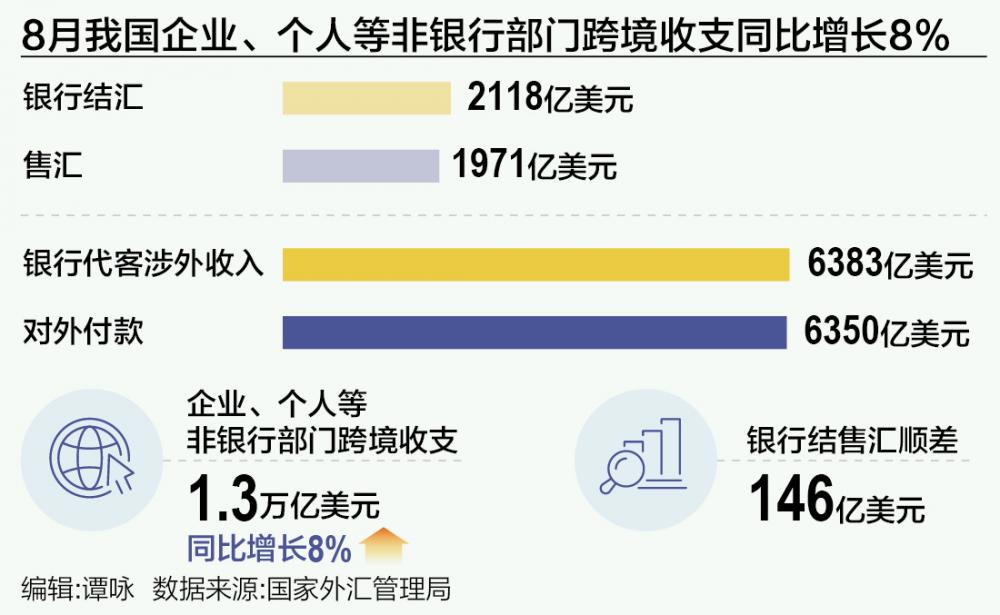
Group 1 - The core viewpoint of the article highlights the stable operation of China's foreign exchange market in August 2025, with active trading and a basic balance in supply and demand [4] - In August 2025, banks settled 15,103 billion RMB and sold 14,058 billion RMB, while the cumulative settlement from January to August reached 113,938 billion RMB and cumulative sales were 113,078 billion RMB [1][2] - The non-bank sector's cross-border receipts and payments reached 1.3 trillion USD in August, reflecting an 8% year-on-year growth, indicating steady development in cross-border trade and investment activities [4] Group 2 - In August, banks recorded a net inflow of cross-border funds amounting to 3.2 billion USD, with a surplus of 14.6 billion USD in bank settlement and sales [4] - The net inflow from goods trade remained stable, while foreign investment in domestic stocks and bonds showed a net inflow, and service trade and investment income saw a decrease from seasonal highs [4]

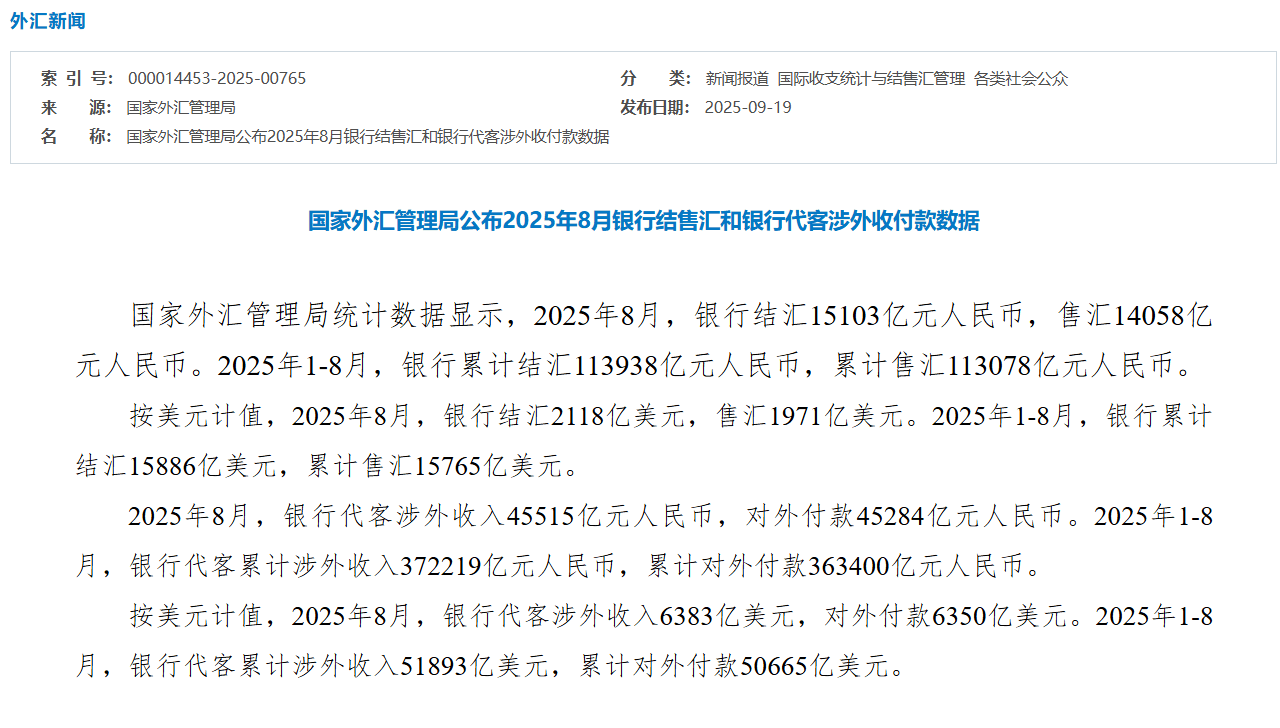
8月我国企业、个人等非银行部门跨境收支同比增长8%
2 1 Shi Ji Jing Ji Bao Dao· 2025-09-19 23:10
Core Viewpoint - China's foreign exchange market remains active, with significant growth in cross-border receipts and payments in August, indicating a stable development in trade and investment activities [1] Group 1: Cross-Border Receipts and Payments - In August, non-bank sectors, including enterprises and individuals, recorded cross-border receipts and payments of $1.3 trillion, representing an 8% year-on-year increase [1] - Both current account and capital account cross-border receipts and payments experienced growth, reflecting a robust economic environment [1] Group 2: Trade and Investment Development - The steady development of cross-border trade and investment is highlighted, suggesting positive trends in economic activities and international engagement [1]
外汇局:8月外资净买入境内股票和债券
Zheng Quan Shi Bao· 2025-09-19 14:46
Group 1 - The foreign exchange market in China is operating smoothly, with active trading observed in August 2025 [1] - In August 2025, non-bank sectors, including enterprises and individuals, conducted cross-border receipts and payments totaling $1.3 trillion, marking an 8% year-on-year increase [1] - The overall balance of supply and demand in the foreign exchange market is maintained, with a net inflow of $3.2 billion and a surplus of $14.6 billion in bank settlement and sale of foreign exchange [1] Group 2 - In August 2025, banks recorded foreign-related income of 45,515 billion RMB and foreign payments of 45,284 billion RMB [2] - Cumulative foreign-related income for the first eight months of 2025 reached 372,219 billion RMB, while cumulative foreign payments totaled 363,400 billion RMB [2] - In dollar terms, banks' foreign-related income in August 2025 was $6,383 billion, with payments amounting to $6,350 billion [2]
8月我国非银行部门跨境收支达1.3万亿美元
Xin Hua Wang· 2025-09-19 09:47
新华社北京9月19日电(记者刘开雄)国家外汇管理局19日发布数据显示,8月,企业、个人等非银 行部门跨境收支1.3万亿美元,同比增长8%。 同期,跨境资金净流入32亿美元,银行结售汇顺差146亿美元。分项目看,货物贸易资金净流入保 持稳定,外资总体净买入境内股票和债券,服务贸易和投资收益资金净流出由季节性高位回落。 "总的来看,当前我国外汇市场交易活跃,外汇供求基本平衡,市场预期保持稳定。"国家外汇管理 局副局长、新闻发言人李斌说。 【纠错】 【责任编辑:邱丽芳】 ...
上半年陕西跨境收支总额明显回升
Shan Xi Ri Bao· 2025-08-08 00:08
Group 1 - The State Administration of Foreign Exchange (SAFE) in Shaanxi Province has successfully turned the cross-border income and expenditure growth rate from negative to positive, with a total cross-border income and expenditure amounting to nearly $26 billion in the first half of the year, representing a year-on-year increase of 1.19% and a recovery of 4.05 percentage points compared to the same period last year [1] - The net inflow of cross-border income and expenditure reached $1.269 billion, showing a nearly 40% year-on-year growth [1] - In terms of goods trade, the cross-border income and expenditure scale reached $18.088 billion, with a year-on-year increase of 0.71%, and a trade surplus of $3.975 billion, which is a significant increase of 46.01% [1] Group 2 - The service trade in Shaanxi Province has shown a robust growth trend, with a cross-border income and expenditure scale of $3.471 billion in the first half of the year, reflecting a year-on-year increase of 15.81% [2] - The cross-border income from service trade was $1.549 billion, up 12.66% year-on-year, driven mainly by a significant increase in business service income [2] - The outflow of foreign direct investment capital from Shaanxi Province reached $284 million, marking a year-on-year growth of 24.56% [2]