跨境收支

Search documents
海南跨境收支规模达1154亿美元
Ren Min Ri Bao· 2026-02-04 19:25
Core Insights - The financial performance of Hainan Province in 2025 shows significant growth, particularly in cross-border transactions and credit expansion [1] Group 1: Cross-Border Transactions - In 2025, Hainan's cross-border payment and receipt scale reached $115.4 billion, marking a year-on-year increase of 6.1%, setting a historical record [1] - The cross-border RMB settlement amount reached 551.4 billion yuan, with a year-on-year growth of 11.6%, and the settlement amount for new business formats like cross-border e-commerce surged by 120.5% [1] - The multi-functional free trade account (EF account) system has developed steadily, with 810 accounts opened by the end of 2025, and a business volume of 350.9 billion yuan, connecting 91 countries and regions [1] Group 2: Credit Growth - By the end of 2025, the total balance of various loans in Hainan reached 1.4057 trillion yuan, reflecting a year-on-year growth of 10.7%, ranking second in the nation [1] - The balance of foreign currency loans reached $18.5 billion, positioning Hainan sixth in the country [1] - Structural monetary policy tools have been effectively utilized, with a total of 16.555 billion yuan allocated for agricultural and small business support through re-loans and rediscounts throughout the year [1]
数据彰显我国外汇市场继续保持平稳运行 “韧性”“稳健”“有序”成为亮点
Yang Shi Wang· 2025-12-20 01:53
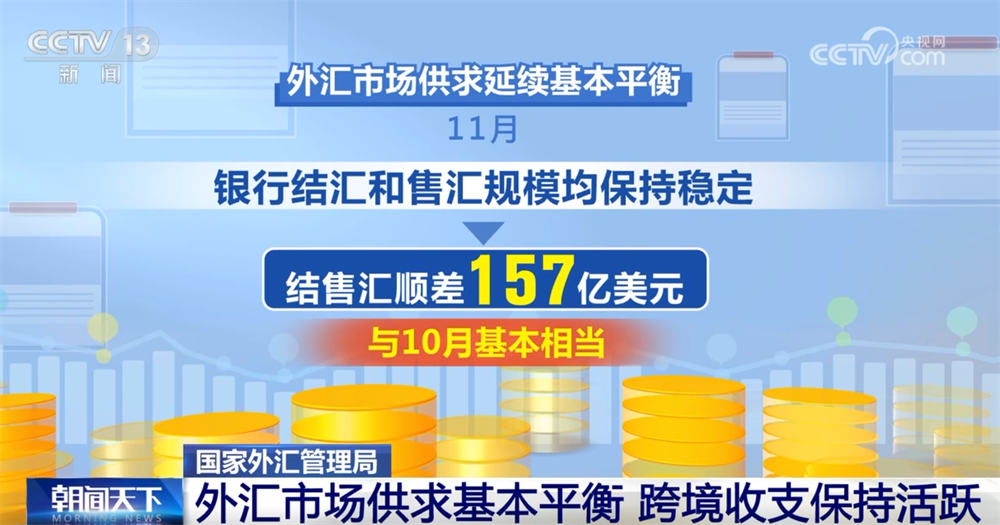
Group 1 - The core viewpoint is that China's foreign exchange market remains stable, with a notable balance in supply and demand, despite fluctuations in the international financial market [1][2][6] - In November, banks settled 1.484 trillion RMB and sold 1.3732 trillion RMB, resulting in a settlement surplus of 15.7 billion USD, which is consistent with October's figures [1][2] - The cross-border income and expenditure for non-bank sectors reached 1.3 trillion USD in November, reflecting an 8% month-on-month increase, with a surplus of 17.8 billion USD, lower than the average surplus of 24 billion USD from September to October [3] Group 2 - The foreign trade and foreign investment in China show resilience, with stable cross-border capital flows and expectations in the foreign exchange market remaining steady [6]

11月跨境收支保持活跃 证券投资资金流动更趋平稳
Zheng Quan Shi Bao· 2025-12-19 17:30
Core Viewpoint - The foreign exchange market in China remains stable, with a net inflow of cross-border funds amounting to 17.8 billion USD in November 2025, reflecting a balanced supply and demand situation in the market [1][2]. Group 1: Foreign Exchange Market Performance - In November, the bank's foreign exchange settlement and sales maintained stability, with a surplus of 15.7 billion USD, indicating a more balanced supply and demand in the foreign exchange market compared to the previous month [1]. - The overall foreign exchange market is characterized by steady trading and orderly operations, with the foreign trade and foreign investment showing resilience [1]. Group 2: Cross-Border Fund Flows - The total scale of cross-border receipts and payments for non-bank sectors, including enterprises and individuals, reached 1.3 trillion USD in November, reflecting an 8% month-on-month increase and maintaining a high level of activity [1][2]. - The surplus in cross-border receipts and payments for the month was 17.8 billion USD, continuing the trend of net inflows of cross-border funds [1]. Group 3: Main Channels of Cross-Border Fund Flows - Goods trade remains the primary channel for net inflows of funds, while service trade, investment income, and direct investment flows remain stable [2]. - Recent trends indicate that capital flows under securities investment have also become more stable [2].
国家外汇局:我国外汇市场继续保持平稳运行
Zheng Quan Ri Bao· 2025-12-19 16:28
Group 1 - In November 2025, banks in China reported a foreign exchange settlement of 209.5 billion USD and a foreign exchange sale of 193.8 billion USD, maintaining a stable balance in the foreign exchange market [1] - From January to November 2025, the cumulative foreign exchange settlement reached 2,276.9 billion USD, while the cumulative foreign exchange sale was 2,180.4 billion USD [1] - In November 2025, the foreign exchange income from non-bank sectors amounted to 654.5 billion USD, with foreign payments totaling 636.7 billion USD, indicating active cross-border transactions [1] Group 2 - The foreign exchange market in China has remained stable, with a basic balance in supply and demand, and a settlement surplus of 15.7 billion USD in November, consistent with October's figures [2] - Cross-border income and expenditure for non-bank sectors totaled 1.3 trillion USD in November, reflecting an 8% month-on-month increase, with a surplus of 17.8 billion USD, lower than the average surplus of 24 billion USD from September to October [2] - The primary source of net capital inflow continues to be merchandise trade, while service trade, investment income, and direct investment flows remain stable, indicating resilience in foreign trade and investment [2]
国家外汇管理局:11月外汇市场供求延续基本平衡,跨境收支保持活跃
Sou Hu Cai Jing· 2025-12-19 10:51
Core Viewpoint - The foreign exchange market in China has maintained stability in November 2025, with a balanced supply and demand despite fluctuations in the international financial market and a weakening US dollar [1] Group 1: Foreign Exchange Market Performance - The foreign exchange market in China has continued to operate smoothly, with both bank foreign exchange settlement and sales remaining stable [1] - The foreign exchange settlement surplus in November was $15.7 billion, which is comparable to October's figures [1] Group 2: Cross-Border Capital Flows - Cross-border income and expenditure from non-bank sectors, including enterprises and individuals, totaled $1.3 trillion in November, reflecting an 8% month-on-month increase [1] - The cross-border capital flow surplus was $17.8 billion, lower than the average surplus of $24 billion observed in September and October [1] Group 3: Trade and Investment Insights - Goods trade remains the primary channel for net capital inflows, while service trade, investment income, and direct investment flows have remained stable [1] - Recent trends indicate that capital flows under securities investment have become more stable [1]
国家外汇管理局:11月外汇市场供求延续基本平衡 跨境收支保持活跃
智通财经网· 2025-12-19 10:43
Core Insights - The foreign exchange market in China has maintained stability despite fluctuations in the international financial market, with a weakening US dollar index and stronger performance of major non-US currencies [1][2] Group 1: Market Performance - The supply and demand in the foreign exchange market have remained basically balanced, with a settlement surplus of 15.7 billion USD in November, which is comparable to October's figures [1][2] - Cross-border receipts and payments have remained active, with total cross-border income and expenditure for non-bank sectors reaching 1.3 trillion USD in November, reflecting an 8% month-on-month increase [1][2] Group 2: Cross-Border Transactions - The cross-border balance showed a surplus of 17.8 billion USD in November, which is lower than the average surplus of 24 billion USD observed in September and October [1][2] - Goods trade continues to be the primary channel for net capital inflows, while service trade, investment income, and direct investment flows have remained stable [1][2]
国家外汇管理局副局长李斌:11月外汇市场供求延续基本平衡 跨境收支保持活跃
Xin Lang Cai Jing· 2025-12-19 10:11
Core Viewpoint - The foreign exchange market in China remains stable, with a balanced supply and demand, despite fluctuations in the international financial market and a weakening US dollar [1] Group 1: Foreign Exchange Market Stability - The foreign exchange market in China has maintained a basic balance in supply and demand, with a settlement surplus of 15.7 billion USD in November, which is roughly the same as in October [1] - The cross-border income and expenditure of non-bank sectors, including enterprises and individuals, totaled 1.3 trillion USD in November, reflecting an 8% month-on-month increase [1] Group 2: Cross-Border Capital Flow - The cross-border capital flow showed a surplus of 17.8 billion USD in November, which is lower than the average surplus of 24 billion USD in September and October [1] - Goods trade remains the primary channel for net capital inflows, while service trade, investment income, and direct investment flows have remained stable [1]
三个视角看外汇市场五年新变化
Ren Min Ri Bao Hai Wai Ban· 2025-11-03 22:39
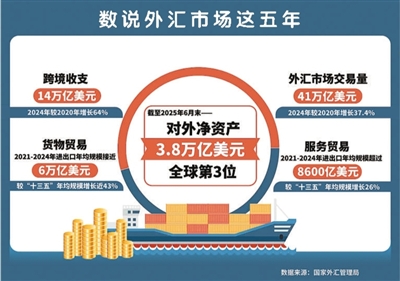
Core Viewpoint - The cross-border payment and settlement scale in China has significantly increased during the "14th Five-Year Plan" period, with a projected total of $14 trillion in 2024, marking a 64% growth compared to 2020, and a 10.5% year-on-year increase in the first three quarters of this year [3][5][6]. Group 1: Cross-Border Trade - The scale of cross-border trade has expanded, with the average annual growth rate during the "14th Five-Year Plan" period being 8 percentage points higher than that of the "13th Five-Year Plan" [3]. - The total value of imports and exports in Gansu Province is expected to exceed 60 billion yuan for the first time in nearly a decade, with an average annual growth rate of 13.9% since 2021 [5]. - The average annual scale of service trade imports and exports has exceeded $860 billion, representing a 26% increase compared to the "13th Five-Year Plan" period [6]. Group 2: Financial Stability - As of June 2025, China's foreign financial assets exceeded $11 trillion, while foreign liabilities surpassed $7.2 trillion, resulting in a net foreign asset of $3.8 trillion, ranking third globally [7]. - The foreign exchange market has been enhanced with a dual management framework, which has effectively responded to external shocks and maintained a stable environment for cross-border payments [7]. Group 3: Service Trade Facilitation - The efficiency of cross-border fund settlement has significantly improved due to the implementation of facilitation policies, allowing companies to complete transactions much faster than before [8][9]. - The introduction of direct settlement for cross-border e-commerce transactions has streamlined processes, reducing the time required for fund settlement to one working day [10]. Group 4: Open Market Developments - The issuance of Panda bonds by foreign entities in China's interbank bond market has continued to grow, with cumulative issuance surpassing 1 trillion yuan [11]. - Reforms in the Qualified Foreign Institutional Investor (QFII) and Renminbi Qualified Foreign Institutional Investor (RQFII) systems have simplified approval processes and enhanced cross-border capital management [12]. - The overall scale of foreign investment in domestic securities has increased by 6% since the beginning of the "14th Five-Year Plan" [13].
前三季度广西金融运行平稳
Sou Hu Cai Jing· 2025-11-01 00:26
Group 1: Financial Performance - In the first three quarters, Guangxi's social financing scale increased by 424.85 billion yuan, with total deposits and loans reaching 4.92 trillion yuan and 5.66 trillion yuan respectively, reflecting year-on-year growth of 6.4% and 6.0% [1] - The financing structure in Guangxi has improved, with net financing from corporate and government bonds and domestic stock financing totaling 165.564 billion yuan, an increase of 42.526 billion yuan year-on-year, accounting for 39% of the social financing scale increment [1] - The weighted average interest rate for newly issued loans in Guangxi was 3.1%, a decrease of 51 basis points year-on-year [1] Group 2: Sectoral Insights - Guangxi's medium to long-term loans for the manufacturing sector grew at a rate 11.9 percentage points higher than the overall loan growth [1] - Loans to small and micro enterprises and inclusive small micro loans increased by 11.3% and 11.1% year-on-year respectively, while green loans increased by 93.3 billion yuan since the beginning of the year [1] - The foreign exchange market in Guangxi showed a positive trend, with a total foreign exchange receipt and payment scale of 52.758 billion USD, a year-on-year increase of 17.67% [2]
超10万亿元!国家外汇局透露
Shang Hai Zheng Quan Bao· 2025-09-22 21:47
Core Insights - The foreign exchange market in China has shown resilience and vitality, with significant growth in cross-border capital flows and foreign investments [1][3][5] Group 1: Foreign Exchange Market Performance - As of July, foreign institutions and individuals held over 10 trillion yuan in domestic stocks, bonds, and deposits, with the RMB's share in cross-border trade rising to nearly 30% [1][5] - The cross-border capital flow is projected to reach 14 trillion USD in 2024, a 64% increase from 2020, with an average annual growth rate during the "14th Five-Year Plan" period 8 percentage points higher than the previous period [3][4] - The trading volume in the foreign exchange market is expected to be 41 trillion USD in 2024, a 37% increase from 2020, indicating a deepening market with sufficient capacity for various transactions [3][4] Group 2: Market Structure and Functionality - The foreign exchange market has become more complete and deepened, with 703 banks and 115 non-bank institutions participating, including 296 foreign institutions [3][4] - The infrastructure for trading, clearing, and payment has improved, effectively reducing transaction costs and settlement risks, thereby better serving the real economy [3][4] Group 3: Stability and Management - The RMB exchange rate has shown increased flexibility, acting as an automatic stabilizer for the macro economy and international balance of payments, with the corporate foreign exchange hedging ratio rising from 17% in 2020 to around 30% [4][5] - The macro-prudential management system for the foreign exchange market is gradually improving, with enhanced counter-cyclical adjustment tools to manage external risks [4][5] Group 4: Future Outlook - The long-term positive fundamentals of the Chinese economy and steady high-level opening-up are expected to support a stable international balance of payments [4][6] - The foreign exchange reserve has remained stable above 3 trillion USD, providing a strong foundation for economic stability and growth [6]