外汇市场

Search documents
大摩闭门会-跨资产对话-能源冲击下的外汇市场应对策略
2026-03-30 05:15
Summary of Key Points from Conference Call Industry Overview - The discussion revolves around the foreign exchange market's response to energy shocks, particularly focusing on the implications of rising oil prices on various currencies and the overall market dynamics [1][2]. Core Insights and Arguments - If oil prices rise to $150, demand destruction is expected, leading to a stronger US dollar, with EUR/USD projected to drop to 1.13. The Swedish Krona (SEK) and British Pound (GBP) are anticipated to be the weakest among G10 currencies [1][2]. - The Swiss Franc (CHF) is identified as the preferred safe-haven currency, while the Norwegian Krone (NOK) is expected to perform well due to its oil export status. The Japanese Yen (JPY) is projected to strengthen slightly despite trade condition pressures [1][2]. - Emerging market (EM) currencies are expected to show significant differentiation, with the Polish Zloty (PLN), Hungarian Forint (HUF), Mexican Peso (MXN), and South African Rand (ZAR) facing the most depreciation pressure. Conversely, currencies like the Brazilian Real (BRL), Colombian Peso (COP), and Malaysian Ringgit (MYR) are expected to perform best due to their ties to energy [1][2][3]. - Interest rate differentials are becoming less influential on exchange rates, with risk premiums taking precedence. The European Central Bank's (ECB) hawkish pricing can only partially offset the negative impacts of oil prices and trade conditions [1][5]. Additional Important Insights - The current market pricing indicates a calm situation, with limited net long positions in the US dollar. The best hedging strategy for G10 currencies is to hold short positions in EUR/CHF, while in emerging markets, it is recommended to go long on USD/ZAR and USD/BRL [1][4]. - In scenarios of rising oil prices leading to supply constraints, the weakest currencies are expected to be those in Europe, particularly PLN and HUF, which are highly sensitive to the euro's performance [2][3]. - The overall sentiment among investors is cautious, with many avoiding significant risk due to uncertainties stemming from geopolitical tensions. There is a slight net long position in the US dollar, but it is not substantial. The market is pricing in a belief that tensions will not escalate to a point where oil prices reach $150 [7].
2月外汇市场分析报告:人民币汇率加速升值,结售汇顺差环比收敛
Bank of China Securities· 2026-03-20 13:06
1. Report Industry Investment Rating - No information provided on the industry investment rating in the report 2. Core Viewpoints of the Report - In February, the foreign exchange market continued the late - January trend of a stronger US dollar and an even stronger RMB. The central parity rate of the RMB strengthened continuously, and the on - shore trading price appreciated faster. Attention should be paid to the negative impact of the appreciation on export enterprises [2][3] - Affected by the Spring Festival holiday, cross - border capital inflows continued to slow down, but the capital inflow under the goods trade item remained at a record high for the same period, continuing to play a leading role in cross - border capital flows. Capital under the securities investment item turned into a net outflow, and the decline in the scale of overseas holdings of domestic RMB bonds narrowed [2] - The gap between domestic foreign exchange supply and demand narrowed significantly month - on - month in February, which was related to the accelerated appreciation of the RMB and the weakened willingness of the market to settle foreign exchange. However, the willingness of market participants to settle foreign exchange in the spot and forward markets remained relatively strong, and the motivation to purchase foreign exchange was relatively weak, with the bank's foreign exchange settlement and sales surplus still at a high level [2] - To prevent the possible financial impact of RMB appreciation on export enterprises, it is necessary to continuously guide enterprises to further increase the proportion of RMB invoicing in cross - border trade [2] 3. Summary by Relevant Catalogs 3.1 Foreign Exchange Market Trends - At the end of February, the intensification of the geopolitical situation in the Middle East caused the US dollar index to rise, ending three consecutive months of decline. Against this background, the RMB exchange rate continued its appreciation trend. The central parity rate of the RMB strengthened continuously, and the on - shore RMB exchange rate trading price appreciated at an accelerated pace, reaching new highs [3] - On February 25th and 26th, the accelerated appreciation of the on - shore RMB exchange rate was accompanied by an increase in foreign exchange trading volume, indicating the emergence of a pro - cyclical herd effect. On February 27th, the central bank adjusted the foreign exchange risk reserve ratio for forward foreign exchange sales, causing the RMB exchange rate to slightly correct, but it still appreciated by 1.35% compared to the end of the previous month [4] - In February, the deviation of the "three prices" of the RMB exchange rate slightly increased. The on - shore spot exchange rate was stronger than the central parity rate for the third consecutive month, and the average daily deviation increased. The offshore spot exchange rate was generally stronger than the on - shore spot exchange rate, and the average daily deviation also increased [4] - The average value of the on - shore spot exchange rate rose for the sixth consecutive month. The average values of the spot exchange rate with a 3 - month and 5 - month lag increased for the twelfth and tenth consecutive months respectively, reaching new highs [5] - In February, the RMB exchange rate index rebounded. The CFETS RMB exchange rate index, the RMB exchange rate index referring to the BIS currency basket, and the RMB exchange rate index referring to the SDR currency basket all rose, reaching new highs [5] - The nominal effective exchange rate index of the RMB continued its appreciation trend since August 2025, and the real effective exchange rate index continued its upward trend since July 2025, narrowing the cumulative decline in the real effective exchange rate of the RMB since April 2022 [5] 3.2 Cross - border Capital Flows - In February, the surplus of banks' foreign - related receipts and payments on behalf of customers decreased from $82.1 billion in the previous month to $35.6 billion, but it was still a record high for the same period. The surplus of foreign - currency foreign - related receipts and payments decreased, and the deficit of RMB foreign - related receipts and payments increased [11] - Under the goods trade item, the surplus of foreign - related receipts and payments decreased month - on - month, mainly due to a larger decrease in foreign - related income than in expenditure. However, both foreign - related income and export volume under the goods trade item were at record highs for the same period, with year - on - year growth [12] - Under the securities investment item, foreign - related income ended three consecutive months of growth, and the item turned into a net outflow. The scale of foreign - related income and expenditure remained at a high level, indicating high activity of cross - border capital under the securities investment item. The holdings of domestic RMB bonds by overseas institutions continued to decrease, but the decline significantly narrowed [17] 3.3 Domestic Foreign Exchange Supply and Demand - In February, the bank's spot and forward (including options) foreign exchange settlement and sales had a surplus for the twelfth consecutive month, and the surplus scale narrowed for the second consecutive month but was still at a relatively high level. The average daily surplus scale also decreased [21] - The surplus of banks' foreign exchange settlement and sales on behalf of customers decreased, the net forward and option foreign exchange settlement scale decreased, and the deficit of banks' own foreign exchange settlement and sales increased [21] - After excluding the forward performance amount, the exchange settlement rate of foreign exchange receipts decreased for the second consecutive month, and the exchange purchase rate of foreign exchange payments increased slightly. The exchange settlement rate was at a new high for the same period in the past three years, and the exchange purchase rate was at a new low for the same period in the past four years [24] - The cumulative outstanding net forward foreign exchange settlement amount on behalf of customers by banks increased for the eighth consecutive month, reaching a record high. The forward foreign exchange settlement demand was relatively strong, and the forward foreign exchange purchase demand further weakened [24] 3.4 Special Topic: Increasing the Proportion of RMB Invoicing - The appreciation of the RMB may have a negative impact on export enterprises. From the perspective of the exchange gains and losses of non - financial listed companies in the A - share market, in years when the RMB exchange rate appreciated significantly, many listed companies suffered exchange losses [34] - There is a common misunderstanding that RMB settlement is equivalent to RMB invoicing. Even if an enterprise uses the RMB for cross - border settlement, if there are foreign - currency - denominated receipts, payments, assets, or liabilities, it may still face exchange rate risks [35] - According to statistics, the proportion of RMB invoicing in cross - border trade in Russia and Mongolia is relatively high, but in other countries and regions, the proportion is significantly lower. The average proportion of RMB invoicing in exports and imports in all countries and regions in the dataset in 2023 was far lower than that of the US dollar and the euro [36] - It is estimated that the proportion of RMB invoicing in China's cross - border trade in 2023 was about 10%, significantly lower than the RMB settlement share. The current policy goal is to maintain the basic stability of the RMB exchange rate, and it is necessary to guide enterprises to increase the proportion of RMB invoicing in cross - border trade [38] - Financial institutions should adhere to the principle of "giving priority to the domestic currency", provide comprehensive RMB financial services to foreign - trade enterprises, and improve the convenience of cross - border RMB use. Enterprises should also enhance their industrial competitiveness to support the continuous increase in the proportion of RMB invoicing [39]
法国兴业银行:美元的下跌幅度可能有限
Ge Long Hui A P P· 2026-03-16 12:26
Core Viewpoint - The recent stagnation in the dollar's upward trend has led to a decline in the exchange rate of the dollar against a basket of currencies, although the decline is expected to be limited [1] Group 1: Market Analysis - The dollar index reached its highest point in over nine months on Friday, indicating that bullish positions on the dollar may have become excessive [1] - A reversal in the dollar's recovery trend is observed in the foreign exchange market [1] Group 2: Currency Outlook - It is challenging to foresee a sustained rebound for the euro or the pound against the dollar [1] - The dollar typically benefits from rising energy prices, as the U.S. is a net exporter of oil [1] - The demand for safe-haven assets also contributes to the dollar's strength [1]


Week Ahead for FX, Bonds: Middle East Developments, Oil Prices in Focus; U.S. Inflation Due
WSJ· 2026-03-06 17:12
Core Viewpoint - The situation in the Middle East is escalating following attacks by the U.S. and Israel on Iran, leading to a broader conflict involving multiple countries in the region [1] Group 1 - The U.S. and Israel have initiated military actions against Iran, which is a significant development in the geopolitical landscape [1] - The conflict has the potential to spread further across various countries in the Middle East, raising concerns about regional stability [1]


“欧元一强”面临拐点
日经中文网· 2026-03-01 00:33
Core Viewpoint - The article discusses the emerging shadows over the "Euro strong" trend starting from the fall of 2025, driven by expectations of a hawkish shift in monetary policies from Japan and the United States [2][4]. Group 1: Monetary Policy Shifts - The U.S. Federal Reserve's January FOMC meeting minutes indicated that raising policy rates may be appropriate if inflation continues to exceed targets, prompting a reevaluation of the dollar [4]. - There are signs of changing perceptions regarding the yen, with expectations of a potential interest rate hike in Japan, although the new government under Prime Minister Kishi may struggle to maintain a hawkish stance due to fiscal policy considerations [4][6]. Group 2: Market Dynamics - Following the overwhelming victory of the ruling party in Japan's February elections, expectations for a new round of interest rate hikes by the Bank of Japan have increased, with predictions of a hike possibly occurring in mid-2026 [6]. - Hedge funds and speculative funds are influencing market price fluctuations, with significant increases in euro positions expected after the fall of 2025, which could lead to accelerated euro sell-offs if monetary policies in Japan and the U.S. lean towards hawkishness [7]. Group 3: Risks and Uncertainties - There are uncertainties regarding whether the dollar and yen can effectively absorb investment funds moving away from the euro, influenced by factors such as U.S. tariff policies and geopolitical tensions [9]. - The article emphasizes that the shift of investment funds towards the dollar and yen is contingent upon global economic stability and the prospect of interest rate hikes [9].

国家外汇管理局:1月我国外汇市场总计成交27.54万亿元人民币
Yang Shi Wang· 2026-02-27 11:24
Core Viewpoint - The data from the State Administration of Foreign Exchange indicates a significant volume of transactions in China's foreign exchange market in January 2026, highlighting the market's robust activity and liquidity [1] Group 1: Market Overview - In January 2026, the total transaction volume in China's foreign exchange market reached 27.54 trillion yuan, equivalent to approximately 3.93 trillion USD [1] - The interbank market accounted for the majority of transactions, with a total of 22.93 trillion yuan, or about 3.27 trillion USD [1] - The customer market transactions amounted to 4.61 trillion yuan, which is around 0.66 trillion USD [1] Group 2: Market Segmentation - The spot market saw a cumulative transaction volume of 10.39 trillion yuan, translating to approximately 1.48 trillion USD [1] - The derivatives market had a cumulative transaction volume of 17.14 trillion yuan, equivalent to about 2.45 trillion USD [1]
国家外汇管理局:2026年1月中国外汇市场总计成交27.54万亿元人民币
智通财经网· 2026-02-27 08:46
Core Insights - The total turnover of China's foreign exchange market reached 27.54 trillion RMB (approximately 3.93 trillion USD) in January 2026 [1] Group 1: Market Breakdown - The customer market turnover by banks amounted to 4.61 trillion RMB (approximately 0.66 trillion USD) [1] - The interbank market turnover was 22.93 trillion RMB (approximately 3.27 trillion USD) [1] Group 2: Market Segmentation - The spot market cumulative turnover was 10.39 trillion RMB (approximately 1.48 trillion USD) [1] - The derivatives market cumulative turnover reached 17.14 trillion RMB (approximately 2.45 trillion USD) [1]
突发!离岸人民币短线跳水
Sou Hu Cai Jing· 2026-02-27 04:45
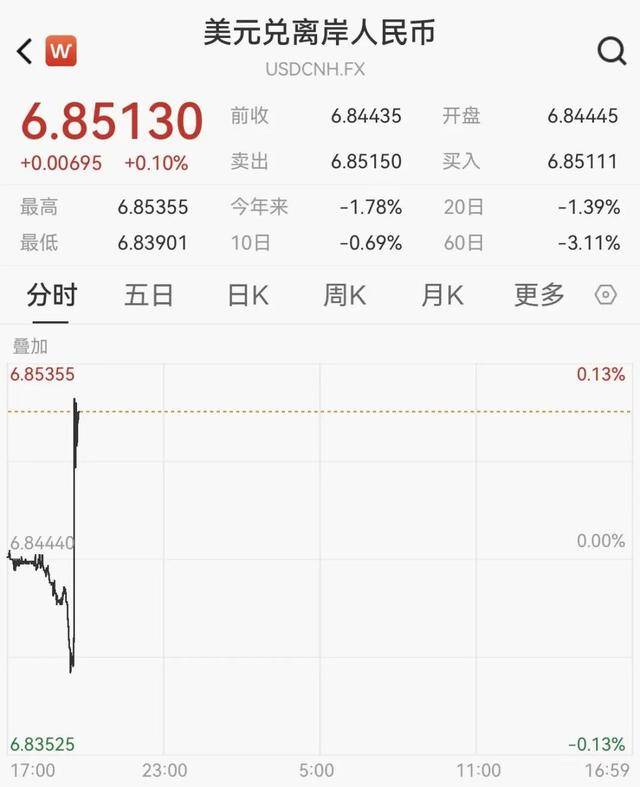
Group 1 - The offshore RMB to USD exchange rate experienced a sharp decline, falling below the 6.85 mark, which has attracted significant market attention [1] - As of the latest data, the USD/CNH exchange rate opened at 6.84445, with a previous close of 6.84435, reflecting a slight increase of 0.10% [2] - The highest exchange rate recorded this year was 6.85355, indicating a year-to-date decrease of 1.78% [2] Group 2 - In response to the current foreign exchange market conditions, the People's Bank of China (PBOC) announced measures to support enterprises in managing exchange rate risks, including a reduction of the foreign exchange risk reserve ratio for forward sales from 20% to 0% effective March 2, 2026 [2] - The PBOC will continue to guide financial institutions in optimizing services for enterprises' exchange rate hedging, aiming to maintain the RMB exchange rate at a reasonable and balanced level [2]
李斌: 我国外汇市场交易活跃、预期平稳 跨境资金流动更趋稳定
Jin Rong Shi Bao· 2026-02-24 01:28
Core Viewpoint - The State Administration of Foreign Exchange (SAFE) reported on the foreign exchange market situation for January 2026, indicating a stable operation despite increased volatility in international financial markets [1] Group 1: Foreign Exchange Market Performance - In January, the bank's foreign exchange settlement and sales surplus decreased by 20% compared to the previous month [1] - Non-bank sectors, including enterprises and individuals, saw a net inflow of cross-border funds drop by 28% from the previous month [1] - The foreign exchange market remains active with stable expectations, and cross-border capital flows are becoming more stable [1] Group 2: Factors Influencing Market Trends - Seasonal factors contributed to a rapid increase in enterprise receipts and settlements at the end of the year, but this growth has recently slowed as demand is gradually released [1] - Net inflow of funds under goods trade decreased by 27% compared to the previous month, while net outflow under service trade increased by 23% [1] - Net inflow from securities investment remained stable [1]
20048亿元、4.71万亿元,稳健运行!从1月金融数据透视经济“开门红”
Yang Shi Wang· 2026-02-14 04:10
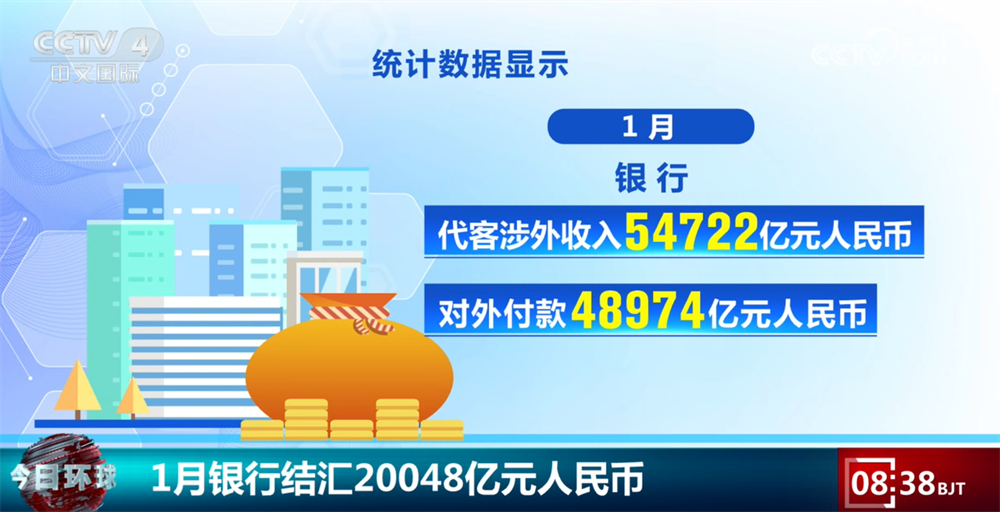
Core Viewpoint - The State Administration of Foreign Exchange (SAFE) reported that China's foreign exchange market remains stable despite increased volatility in international financial markets, with cross-border capital continuing to show net inflows, although the scale has decreased compared to the previous month [1][3]. Group 1: Bank Settlement and Sale Data - In January, banks settled foreign exchange transactions amounting to 20,048 billion RMB and sold 14,457 billion RMB [1][4]. - The net inflow of cross-border funds from non-bank sectors, including enterprises and individuals, decreased by 28% compared to the previous month [3][4]. Group 2: Cross-Border Fund Flows - The net inflow of funds under the goods trade category fell by 27% month-on-month, while the net outflow under the services trade category increased by 23% [3][4]. - The net inflow from securities investments remained stable [3]. Group 3: Financial Data and Credit Growth - In January, the total amount of RMB loans increased by 4.71 trillion RMB, with the total loan balance reaching 276.62 trillion RMB, reflecting a year-on-year growth of 6.1% [5]. - Corporate loans increased by 4.45 trillion RMB in January, with medium- and long-term loans accounting for over 70%, providing significant support to key sectors such as manufacturing and emerging industries [9]. Group 4: Personal Loan Trends - The demand for personal loans has been supported by pre-holiday consumption activities, with various consumer needs being released ahead of the Spring Festival [11]. - The extension of the personal consumption loan interest subsidy policy until the end of 2026 is expected to enhance consumer willingness and support personal loan growth [11].