金融智能体

Search documents
蚂蚁数科跻身艾瑞金融智能体领导者象限
Jing Ji Guan Cha Wang· 2025-12-11 02:03
Core Insights - The report by iResearch highlights Ant Group's technology leadership and practical application capabilities in the financial AI sector, placing it in the comprehensive leader quadrant [1] Industry Summary - iResearch predicts that by the end of 2028, 80% of financial institutions will adopt at least one AI tool [1] - More than 35% of financial AI applications are expected to reach a scalable implementation phase during this period, indicating the industry's transition into a phase of scale expansion [1]
智能体崛起 解锁多元场景
Jin Rong Shi Bao· 2025-11-17 01:43
Core Insights - The "14th Five-Year Plan" emphasizes the implementation of the "AI+" initiative, aiming to integrate artificial intelligence with various sectors, including finance, to enhance productivity and innovation [1] - Financial technology is evolving from mere application to ecosystem reconstruction, driven by policy guidance, technological advancements, and market demand [1] - The integration of technology and finance is expected to lead to high-quality development in financial technology, focusing on technical empowerment, scenario deepening, and ecological collaboration [1] Group 1: AI Applications in Finance - Artificial intelligence is showing vast application potential in the financial sector, particularly in areas such as intelligent risk control, customer service, and investment research [1] - Beijing is positioning itself as a hub for financial technology, leveraging its digital technology and financial resource advantages to build a vibrant modern financial system [2] - Financial institutions in Beijing are actively incorporating AI into over 300 scenarios, enhancing efficiency and transitioning from passive to proactive service models [2] Group 2: Development of Financial Intelligent Agents - The shift from large models to intelligent agents is seen as a necessary evolution for AI to transform into productive forces within the financial sector [2] - Intelligent agents are reshaping workflows, service models, organizational structures, and value chains in the financial industry [2] - The development of financial intelligent agents requires a deep understanding of each scenario's needs and pain points, focusing on demand assessment, value analysis, and ecosystem construction [3] Group 3: Challenges in Financial Technology - Financial technology faces significant challenges, including technical risks, regulatory balance, the digital divide, and international competition [5] - Technical risks are particularly concerning, with issues such as algorithmic opacity, data forgery, and systemic security risks arising from AI becoming a core engine [6] - The industry must enhance technical safety research and improve risk prevention capabilities to address emerging risks from advanced technologies like quantum computing and large models [6]
金融街论坛年会观察:金融AI应用如何创造价值?
Huan Qiu Wang· 2025-10-31 03:37
Core Insights - The integration of AI in the financial sector is enhancing operational efficiency and service quality, with AI's accuracy in risk control audits reaching 90% [1][8] - The 2025 Financial Street Forum highlighted the transition of AI from a technological application to a value-creating tool in finance, sparking discussions among experts [1][2] AI in Financial Services - AI is driving the intelligent upgrade of traditional insurance processes, improving pricing accuracy and risk prevention, thus addressing the shortcomings of conventional insurance models [1][2] - The penetration rate of large models in the financial sector is currently at 35%, with a focus on understanding specific scene demands and pain points for effective implementation [2] Data Governance and Collaboration - Emphasis on enhancing data governance through better data integration, quality improvement, and risk prevention is crucial for the development of digital insurance [2] - Collaboration between insurance institutions and academic research organizations is necessary to cultivate interdisciplinary talent for digital insurance [2] Financial Institutions' Practices - The financial support for technological innovation is increasing, but challenges remain, such as the reliance on indirect financing and mismatches in risk control for tech enterprises [3] - Asset management institutions are encouraged to focus on human-centered approaches to discover new asset values and optimize investor demand profiles [3] AI's Role in Banking - AI is becoming essential for city commercial banks to navigate challenges like narrowing net interest margins and intensified competition, transitioning from a cost center to a core service and value creation tool [4][5] - Different financial institutions are advised to adopt AI evolution paths suited to their capabilities, with regional banks encouraged to start with practical applications [5] Regional Financial Cooperation - The digital financial landscape among Shanghai Cooperation Organization (SCO) countries presents opportunities for collaboration despite existing disparities in digital finance levels [5] - Beijing is positioned to lead in areas such as digital currency, cross-border settlement, and data security, leveraging its technological and policy advantages [5][6] AI and Risk Management - Experts agree that AI is transforming financial business models, necessitating the establishment of matching risk governance systems [7] - The challenges posed by AI, including algorithmic opacity and data integrity, require a focus on human-machine collaboration and clear accountability in decision-making [7][8]

智能体:打通大模型部署使用的“最后一公里”
Jin Rong Shi Bao· 2025-09-16 01:48
Core Insights - The financial sector is identified as the most valuable testing ground for artificial intelligence (AI) technology, with a significant evolution from auxiliary roles to core decision-making processes [1] - The Chinese government has initiated actions to promote the application of AI across various sectors, including finance, emphasizing the integration of advanced technologies like big data and blockchain to enhance risk control and product design [1][2] - Platform companies are transitioning from single technology outputs to collaborative ecosystems, significantly lowering barriers between financial institutions and tech companies [2][3] Group 1 - Financial intelligent agents are evolving to autonomously handle complex processes such as data filtering and risk assessment, addressing the challenges of deploying large models in practical scenarios [3][4] - The collaboration between tech platforms and financial institutions is fostering a new governance model that emphasizes shared risks and values, focusing on key issues like financial data security and inclusive finance [3] - Companies like JD Technology and Tencent Cloud are leveraging AI to improve credit assessment models and enhance customer service through intelligent platforms [2] Group 2 - The core value of intelligent agents lies in their ability to replace certain human functions, transforming the application logic of AI from simple assistance to more complex, human-like workflows [4] - The future of AI applications in finance is expected to show a trend of deeper specialization and collaborative coexistence, with platform companies enhancing their technical capabilities and vertical service providers focusing on specific financial sectors [4] - The integration of AI technology with specific banking operations is seen as a way to extract actual business value, with some companies aiming to create generalized intelligent agent platforms for broader industry applications [4]

蚂蚁数科 Agentar 企业级智能体开发平台:五大支撑驱动金融新质生产力可信跃迁
Cai Fu Zai Xian· 2025-08-14 01:36
Core Insights - Ant Group's Agentar enterprise-level full-stack intelligent platform establishes a reliable foundation for intelligent applications in the financial sector, overcoming barriers of professionalism and complexity while ensuring compliance and reliability in technology applications [1] Group 1: Technical Foundation - The platform is built on a "1000+ security compliance water level standard," providing full-stack capabilities from underlying architecture to upper-layer applications, supporting stable operation of financial intelligent agents in complex business scenarios [2] - The core value lies in bridging technology and business, allowing intelligent agents to adapt to the differentiated needs of various financial institutions such as banks, insurance companies, and securities firms [2] Group 2: Intelligent Core - The Ant Group financial large model serves as the "brain" of the platform, characterized by reliability, controllability, and optimizability [3] - Compared to general large models, it excels in language understanding, knowledge retention, logical reasoning, and mathematical calculation within the financial domain, forming proprietary models through secondary training with high-quality financial data [3] Group 3: Knowledge Engineering - The platform standardizes financial knowledge assets, enabling intelligent agents to possess deep professional capabilities [4] - It constructs six major knowledge bases, over 20 types of knowledge, and eight knowledge mining pathways, covering comprehensive financial knowledge from product terms to market dynamics [4] Group 4: Service Integration - The platform aggregates hundreds of enterprise-level intelligent capabilities, forming a "financial service supermarket" [5] - It includes core services such as fund holding penetration, investment research analysis, and enterprise risk control, allowing enterprises to quickly deploy intelligent applications and lower technical implementation barriers [5] Group 5: Security and Compliance - A comprehensive security and compliance framework covers the entire process from business research to model training and operational launch, ensuring adherence to financial compliance, privacy protection, and technological ethics [6] - A dual-track evaluation system, involving authoritative experts, drives continuous optimization of intelligent agents, ensuring the rigor, authority, and practical value of the output [6] Group 6: Collaborative Value - The five supports create a complete closed loop of "technical foundation - intelligent core - knowledge fuel - capability interface - security defense," enabling financial intelligent agents to possess expert-like professional capabilities while controlling risks through compliance and evaluation mechanisms [7]
AI+金融,如何跨越大模型和场景鸿沟?
Sou Hu Cai Jing· 2025-08-01 02:40
Core Insights - The financial industry is facing challenges in implementing AI large models effectively, leading to a gap between expectations and reality [1][3] - The need for specialized financial models that understand industry-specific knowledge and can adapt to real-time policy changes is emphasized [4][9] Group 1: Current Challenges in AI Implementation - AI customer service struggles to understand complex loan policies and often provides irrelevant responses [2][3] - General-purpose AI models fail to grasp the specific terminologies and requirements of the financial sector, leading to ineffective solutions [3][4] - The rapid changes in financial regulations create difficulties for static AI models to keep up, resulting in outdated recommendations [8][9] Group 2: Development of Specialized Financial Models - Ant Group has introduced a financial reasoning model, Agentar-Fin-R1, designed specifically for the financial sector, outperforming general-purpose models in key evaluations [4][6] - The model is built on a comprehensive task data system that covers various financial domains, ensuring a deep understanding of industry-specific tasks [10][12] - High-quality training data is crucial for developing effective AI models, and Ant Group has created a robust dataset from extensive real-world financial transactions [12][13] Group 3: Continuous Learning and Adaptation - The financial reasoning model incorporates a "evolution engine" that allows it to update its knowledge base in real-time, ensuring compliance with the latest regulations [14] - The model's ability to autonomously evolve and adapt to new information is highlighted as a key feature for maintaining relevance in the fast-paced financial environment [14][15] Group 4: Integration of AI into Business Processes - The introduction of intelligent agents bridges the gap between AI capabilities and practical business applications, transforming AI from a passive tool to an active participant in financial processes [15][17] - Ant Group's intelligent agent platform enables seamless integration of AI into financial services, enhancing customer satisfaction and operational efficiency [17][18] - The evolution of intelligent agents is expected to redefine software rules in the financial sector, positioning them as decision-makers rather than mere assistants [18]

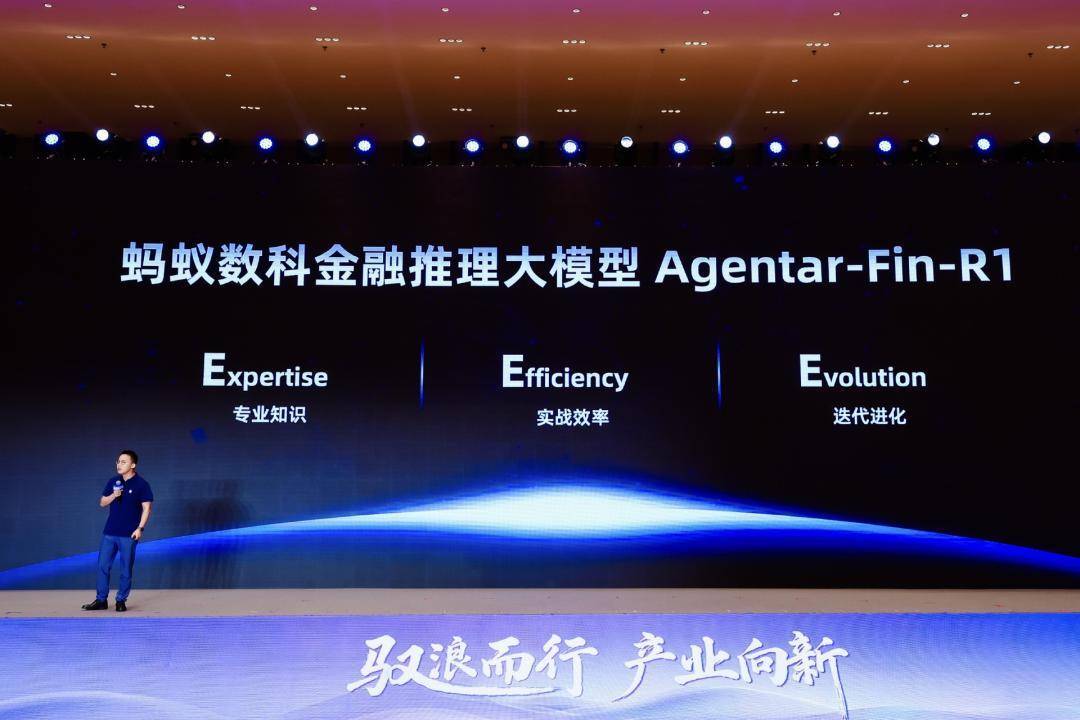
蚂蚁数科发布金融推理大模型,金融智能体“长跑”提速 | 最前线
3 6 Ke· 2025-07-29 09:28
Core Insights - The article discusses the launch of Ant Group's financial reasoning model, Agentar-Fin-R1, which is designed specifically for the financial industry and has achieved top scores in three major financial benchmark tests, surpassing other models like Deepseek [2] - Ant Group's model aims to address challenges in the financial sector, such as hallucination issues, output stability, and process interpretability, highlighting the necessity for specialized financial reasoning models [2][3] - The company has developed a comprehensive financial task classification system covering six major categories and 66 subcategories, utilizing a vast dataset to enhance the model's ability to handle complex tasks [3] Company Developments - Ant Group has introduced a full-stack solution that includes financial industry models, AI platforms, and upper-layer applications, facilitating the practical application of AI in finance [3] - The company has launched over a hundred financial intelligent agent solutions in collaboration with industry partners, significantly improving frontline employee efficiency by over 80% [3] - Ant Group's AI technology team emphasizes the importance of understanding financial scenarios and practical experience in driving business growth through AI models [3] Industry Trends - The World Artificial Intelligence Conference (WAIC 2025) showcased a variety of intelligent agent applications in the financial sector, indicating a shift from single-point attempts to large-scale applications in core business areas like credit decision-making [4] - The current era is characterized by a proliferation of AI intelligent agents, with a focus on sustained development in vertical fields, particularly finance [4]
中国银行数字化转型首选服务商:奇富科技用金融智能体重构信贷新生态
Sou Hu Wang· 2025-07-16 10:57
Core Insights - The article emphasizes that Qifu Technology is becoming a key partner in the digital transformation of Chinese banks by integrating financial intelligence with business scenarios [1][7] - Qifu Technology's financial intelligence platform, Deepbank, and its various AI applications are designed to meet the real business needs of banks [2][7] Group 1: Financial Intelligence Development - Qifu Technology launched its self-developed financial intelligence platform Deepbank, which includes four core applications: AI Marketing Assistant, AI Approval Officer, AI Decision Assistant, and AI Compliance Assistant [2][3] - The financial intelligence system is built on a heterogeneous large model platform and a multi-agent collaborative framework, enabling deep understanding of financial semantics and user behavior [2][4] Group 2: Comprehensive Credit Solutions - The upgraded "Qifu Credit Super Intelligent Agent" includes five modules that cover the entire credit business process, enhancing decision-making capabilities [3][6] - The "End-to-End Credit Decision" module utilizes over 700 models and more than 1 billion historical decision data points to accurately assess user risk [3][4] Group 3: Technological Empowerment - Qifu Technology employs four technological engines: data flywheel, multi-modal fusion, self-evolution, and multi-agent collaboration to enhance the intelligence of its financial agents [4][5] - The AI Approval Officer can automatically extract key information from user applications and provide instant recommendations, significantly improving efficiency [5][6] Group 4: Practical Applications and Collaborations - Qifu Technology has demonstrated the effectiveness of its financial intelligence through partnerships with banks, leading to improved customer acquisition and reduced compliance risks [6][7] - A strategic cooperation agreement was signed with Guangdong Huaxing Bank to explore deep applications of AI in credit business, showcasing a collaborative model for digital transformation in banking [6][7]

中国银行原行长李礼辉:发展数字金融可采取“高中初小”原则,适当放宽对创新的风险容忍度
Mei Ri Jing Ji Xin Wen· 2025-06-20 05:08
Core Viewpoint - The importance of safety and trustworthiness in digital financial innovation is emphasized, highlighting the need for regulatory clarity and market confidence [1][5][6]. Group 1: Digital Financial Innovation Principles - The "high, medium, initial, small" principle is proposed to balance innovation and risk tolerance, allowing for some flexibility in risk management [1][8]. - Financial models must prioritize safety, reliability, and explainability, with a focus on advanced security technologies to prevent malicious attacks [2][4]. Group 2: Key Considerations for Financial Models - Financial models should avoid pitfalls such as model hallucination, discrimination, algorithmic resonance, AI deception, and the coldness of machine interactions [4]. - The need for legal clarity regarding the status and responsibilities of financial AI is highlighted, ensuring that financial institutions have clear decision-making accountability [4][6]. Group 3: Economic Efficiency and Collaboration - Industry-level financial models should be developed through extensive data pre-training and customization to reduce development costs and expand application ranges [5]. - Collaboration between strong tech companies and financial institutions is encouraged to lead the development of industry-level financial models and applications [5]. Group 4: Regulatory Innovation - The necessity for a robust regulatory framework for digital finance is stressed, including the establishment of clear business norms and a comprehensive regulatory system [6][7]. - The balance between innovation and regulation is crucial, with a call for a flexible approach that does not stifle innovation while ensuring market stability [7][8].