
AI经济

Search documents
12月FOMC会议:如期降息,表态中性偏鸽
LIANCHU SECURITIES· 2025-12-12 09:28
Group 1: Federal Reserve Actions - On December 10, the Federal Reserve announced a 25 basis points rate cut, lowering the federal funds rate target range to 3.5%–3.75%[1] - The Fed's statement was more dovish than market expectations, with a 90% pre-meeting consensus on a rate cut, but concerns about it being the last cut were prevalent[1] - The Fed restarted short-term bond purchases, with a monthly expansion of $40 billion, to maintain ample reserve levels[4] Group 2: Economic Outlook - The Fed raised its GDP growth forecast for 2026 while lowering inflation and unemployment rate expectations, indicating a marginal improvement in the economic outlook[1] - The unemployment rate description was updated to reflect a more pronounced weakening in the labor market, with average monthly non-farm job gains since April being only 40,000[1] - The dot plot indicated that four members expect the 2025 rate to be between 3.75% and 4.00%, showing internal dissent within the FOMC[1] Group 3: Market Reactions - Following the dovish Fed statement, market expectations for rate cuts in 2026 were adjusted, leading to an increase in major U.S. stock indices and a decline in bond yields[1] - The CME FedWatch Tool indicated a significant probability of rate cuts in 2026, with expectations for approximately two cuts throughout the year[5][11]
证券市场周刊-第44期2025
2025-12-04 15:37
Summary of Key Points from the Conference Call Industry or Company Involved - The conference call discusses the integration of three securities firms under the Huijin system, marking a significant event in the domestic securities industry and indicating a shift towards creating globally competitive investment banks [12][2][11]. Core Points and Arguments - **Integration of Securities Firms**: The merger of the three firms sets a record for the largest single integration in China's securities industry, signaling the start of a fourth wave of mergers and acquisitions aimed at enhancing competitiveness on a global scale [12][2]. - **Market Adjustments**: The market experienced a correction after six consecutive months of gains, with the Shanghai Composite Index dropping approximately 2% as of November 28. This adjustment is seen as a normal market behavior following a prolonged uptrend [8][9]. - **Sector Performance**: The technology sector, particularly the STAR 50 Index, has seen a significant pullback of about 17% from its October peak, indicating a broader trend of profit-taking among investors [8][9]. - **Long-term Market Outlook**: Analysts from Guotai Junan Securities express optimism about the long-term growth potential of the Chinese capital market, suggesting that the market is in a developmental cycle with significant upward potential for stock indices [9][10]. - **Policy Focus for 2026**: Attention is shifting towards the upcoming Central Economic Work Conference, which will set the economic agenda for 2026. Investors are advised to remain cautious and await clearer policy signals [10][11]. - **Investment Opportunities**: There is a recommendation to focus on traditional manufacturing and resource sectors, with particular emphasis on industries where China holds a competitive advantage, such as chemicals, non-ferrous metals, and new energy [11][12]. Other Important but Possibly Overlooked Content - **Consumer Spending and Economic Growth**: The government is implementing measures to enhance consumer spending, which is crucial for driving economic growth. The focus is on improving the supply-demand balance in the consumer goods market [47][51]. - **Currency Strength**: The Chinese yuan has appreciated against the US dollar, reaching a one-year high, which is attributed to a weaker dollar environment and strong performance in the domestic equity market [50]. - **Sector-Specific Growth**: The innovative pharmaceutical sector is experiencing a significant recovery, with upstream research services seeing substantial performance improvements due to better financing conditions and recovering industrial demand [17]. - **Agricultural Modernization**: The Dayaogu Group is positioning itself as a leader in agricultural modernization, leveraging technology to enhance productivity and quality in the food supply chain [6]. This summary encapsulates the key insights from the conference call, highlighting the strategic movements within the securities industry, market trends, and broader economic indicators that could influence investment decisions.
海亮股份(002203) - 002203海亮股份投资者关系管理信息20251202
2025-12-02 08:00
Group 1: Copper Foil Product Development - The company has made significant advancements in copper foil technology, including nickel-plated copper foil and ultra-high tensile copper foil, which have received positive feedback from top-tier battery manufacturers [1][2] - The Indonesian factory is the first overseas copper foil plant in China, currently collaborating with 5 out of the top 10 global power battery clients and 2 out of the top 3 3C digital clients, with supply agreements starting in 2026 [2] Group 2: U.S. Market Situation - The Texas base is experiencing steady growth, with processing fees for copper products increasing due to tariff policies, varying by product and customer demand [2] - The company plans to accelerate capacity ramp-up to meet local market demands and focus on high-value product production lines [2] Group 3: Thermal Management Product Layout - Copper is a crucial material in the thermal management sector, with the company leveraging over 30 years of copper processing experience to upgrade technology and ensure stable supply [3] - The demand for copper-based materials is surging due to the explosion of AI and computing power, particularly in data centers, leading to increased business from top thermal management companies [3]

K型经济下,美国消费韧性前景存疑
Orient Securities· 2025-11-20 08:49
Economic Overview - In Q2 2025, the US real GDP recorded a high growth rate of 3.8% quarter-on-quarter, with Q3 expectations reaching 4%[6] - The divergence in opinions regarding the US economic outlook is increasing, with recession risks becoming more pronounced[10] Employment and Consumption Dynamics - The US job market is showing signs of accelerated decline, with August non-farm payrolls adding only 22,000 jobs, indicating a near-recession performance[11] - Despite the deteriorating job market, personal consumption expenditures contributed 1.7% to Q2 GDP, with a year-on-year growth of 2.74% in August[19][24] Income and Wealth Effects - Nominal disposable income growth for US residents remains stable at around 4.6%, supported by a 5% increase in wage income and an 8.5% rise in government transfer payments[28][31] - The wealth effect from rising stock prices has led to a historical high in household net worth, reaching $197 trillion in Q2 2025, with a ratio of net worth to disposable income at 782%[35][40] Structural Consumption Resilience - High-income households are primarily driving consumption resilience, with their spending growth significantly outpacing that of low-income households, which saw a cumulative increase of only 7.9% compared to 16.7% for high-income households since 2018[62][65] - The concentration of wealth among high-income groups is evident, with the top 1% holding nearly 50% of their assets in stocks and mutual funds, while low-income households are more reliant on real estate[45][48] Future Outlook and Risks - The sustainability of consumption resilience is contingent on the continuation of the technology cycle and its impact on income and wealth effects[69] - Risks include potential job losses in large enterprises, which could exacerbate the decline in consumer spending if high-income job losses occur[77][81]
一周冲上全球前5,这款“卖声音赚钱”的App,暴露了AI时代的真相
3 6 Ke· 2025-09-29 00:41
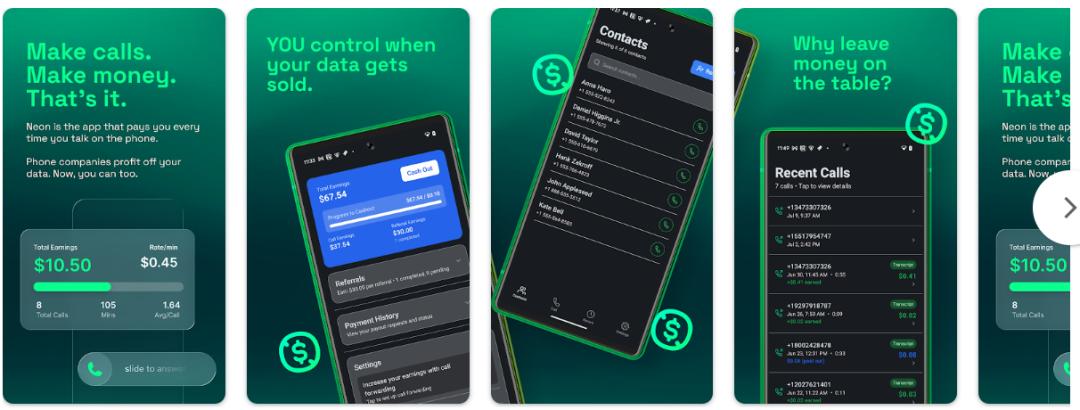
Core Insights - Neon-Money Talks is a voice chat app that gained rapid popularity in 2025, claiming users can earn money by making calls, with potential earnings of up to $30 per day [1][3] - The app's business model involves selling users' voice data to AI companies for training purposes, raising significant privacy concerns [1][8] - Following a TechCrunch report highlighting security vulnerabilities, the app was taken down for a "comprehensive security audit" shortly after its launch [1][17] Group 1: Business Model and Growth - Neon offers users $0.45 per minute for calls with other Neon users, and $0.15 per minute for calls to regular phone numbers, incentivizing usage [3][6] - The app achieved a peak download rate of 81,000 in a single day, climbing to the 5th position in the App Store overall rankings [1][6] - Users can earn significant amounts, with potential monthly earnings exceeding 6,000 RMB if they consistently use the app [6][9] Group 2: Privacy and Security Concerns - Users unknowingly consent to the permanent sale of their voice data, which can be modified and resold by Neon [8][9] - The app has received a low rating of 2.6/5 on the App Store, with many users reporting difficulties in withdrawing their earnings [11][12] - TechCrunch's investigation revealed that the app does not adequately protect user data, allowing access to personal information and recordings [17][18] Group 3: Market Trends and Implications - The trend of monetizing personal data in the AI economy raises ethical questions about privacy and individual rights [21][29] - The market for AI training data is projected to grow significantly, with the digital human market expected to reach $519.4 billion by 2025 [27][29] - Companies like Synthesia and HeyGen are already generating substantial revenue by acquiring and utilizing human data for AI applications [28][29]

全天候无劳动力限制,AI经济正在到来
深思SenseAI· 2025-09-28 01:36
Group 1 - The article discusses the evolution of human economic activities through digitalization, highlighting the transition from manual to electronic forms of computation, which began with the invention of the computer in 1946 [2][3] - The digitalization of economic activities is seen as an inevitable process, where algorithms can drive economic activities, leading to increased efficiency and intelligence in decision-making [3][7] - The internet and mobile internet have significantly improved matching efficiency in three main areas: information, goods, and social interactions, transforming how humans engage in economic activities [8][10][11] Group 2 - The emergence of AI marks a new phase in the digitalization process, where AI can perform specific tasks and has the potential to generalize its capabilities across various applications [12][15] - By 2025, AI is expected to surpass human capabilities in general work delivery, with models like OpenAI's GPT-3 showing significant advancements in intelligence and functionality [15][18] - The AI economy is characterized by the ability of computers to participate in the entire "collect information - decision - action" chain, leading to a fully automated economic system [20][21] Group 3 - The AI economy will enable continuous operation without human intervention, significantly increasing productivity and efficiency in various sectors [21][22] - AI applications are already being developed to automate tasks in digital environments, with potential expansions into physical tasks as technology matures [22][23] - The concept of unlimited labor supply is introduced, where AI can replicate its capabilities at a low marginal cost, potentially transforming economic structures [24][26][28] Group 4 - The reduction of transaction costs is a key benefit of digitalization, as AI and digital tools streamline information flow and decision-making processes [33][35] - The article emphasizes that AI can reduce irrational decision-making in economic activities, leading to more rational and efficient outcomes [37][39] - Historical insights can be leveraged through AI's memory capabilities, allowing for better decision-making by referencing past solutions to contemporary problems [40][41]
PROS Holdings, MBX Biosciences, Metsera, Anywhere Real Estate And Other Big Stocks Moving Higher On Monday - Diginex (NASDAQ:DGNX), Banco BBVA Argentina (NYSE:BBAR)
Benzinga· 2025-09-22 14:29
Group 1 - U.S. stocks showed mixed performance, with the Dow Jones index declining over 100 points on Monday [1] - PROS Holdings, Inc. shares surged 40% to $22.97 following the announcement of its acquisition by Thoma Bravo [1] - MBX Biosciences, Inc. saw a significant increase of 144% to $24.40 after its once-weekly Canvuparatide met primary endpoints in a Phase 2 trial [3] - Metsera, Inc. gained 62.8% to $54.25 amid reports of a near acquisition deal with Pfizer [3] - Anywhere Real Estate Inc. experienced a 57% rise to $11.13 due to a combination announcement with Compass in an all-stock transaction [3] - The ODP Corporation's shares increased by 33.6% to $27.82 after announcing a definitive agreement to be acquired by an affiliate of Atlas Holdings [3] - Banco BBVA Argentina S.A. shares rose 17.7% to $9.64 following U.S. Treasury Secretary Bessent's statement of support for Argentina [3] - Grupo Supervielle S.A. also saw a 16% increase to $5.83 under similar circumstances regarding U.S. support for Argentina [3] - Lumen Technologies, Inc. rose 12.5% to $6.43 after announcing significant progress in building infrastructure for the AI economy [3] - IREN Limited gained 10.7% to $42.88 after doubling its AI Cloud capacity to 23,000 GPUs [3]






海亮股份:适配固态电池的镀镍铜箔等新型铜箔产品已具备量产出货能力
Ge Long Hui A P P· 2025-09-17 12:25
Core Viewpoint - Hailiang Co., Ltd. (002203.SZ) is focusing on continuous innovation in advanced copper foil technology, achieving industry-leading indicators in ultra-thin and high-resistance copper foils, with new nickel-plated copper foil products suitable for solid-state batteries ready for mass production and receiving positive feedback from leading battery companies [1] Group 1: Product Development - The company has made breakthroughs in high-end copper foil products such as RTF and HVLP, with expected sales of over 2,000 tons in the first half of 2025 [1] - New types of copper foil products, including nickel-plated copper foil for solid-state batteries, have been developed and are ready for mass production [1] Group 2: Market Demand and Growth - The demand for copper-based materials for cooling applications is expected to surge due to the explosive growth in global computing power and AI economy, with a more than 100% increase in order volume compared to the same period last year [1] - The company has established long-term partnerships with leading cooling enterprises in the US, China, and Taiwan, which are driving the demand for its products [1] Group 3: Product Offerings - The company provides a variety of products for data centers and AI computing fields, including self-developed heat pipe materials, oxygen-free copper, and customized copper bars [1]
海亮股份:适配固态电池的镀镍铜箔等新型铜箔产品已具备量产出货能力 散热用铜基材料上半年接单量同比增长超100%
Mei Ri Jing Ji Xin Wen· 2025-09-17 12:00
Core Viewpoint - Hailiang Co., Ltd. (002203.SZ) is focusing on continuous innovation in advanced copper foil technology, achieving industry-leading indicators in ultra-thin and high-resistance copper foils, particularly for lithium batteries [1] Group 1: Product Development - The company has developed new copper foil products, including nickel-plated copper foil suitable for solid-state batteries, which are now ready for mass production and have received positive feedback from leading battery manufacturers [1] - Breakthroughs have been made in high-end copper foil products such as RTF and HVLP, with expected sales of over 2,000 tons in the first half of 2025 [1] Group 2: Market Demand - The demand for copper-based materials for heat dissipation is expected to surge in 2025 due to the explosive growth of global computing power and AI economy, with the company's order volume in the first half of the year increasing by over 100% compared to the same period last year [1] - The company is providing a variety of products, including self-developed heat pipe materials, oxygen-free copper, and custom-shaped copper bars, particularly in the data center and AI computing sectors [1]
海亮股份(002203) - 002203海亮股份投资者关系管理信息(20250912-20250917)
2025-09-17 11:38
Group 1: Company Overview and Development - Zhejiang Hailiang Co., Ltd. has a strong focus on innovation in copper foil products, particularly for the new energy sector and 5G communication PCB applications [1] - The company has achieved industry-leading technical indicators in lithium battery copper foil, including nickel-plated copper foil for solid-state batteries, which is now ready for mass production [1] Group 2: Product Development and Market Demand - In the first half of 2025, the company sold over 2,000 tons of high-end copper foil products, driven by the surge in demand for RTF and HVLP copper foils [2] - The company has established supply agreements with five of the top ten global power battery customers and two of the top three 3C digital customers, set to commence in 2026 [2] Group 3: Regional Market Performance - The Southeast Asia market, particularly India, has shown significant growth potential due to urbanization and infrastructure development, increasing demand for copper pipes and fittings [4] - Hailiang's operations in Vietnam and Thailand reported revenue growth of 13% and 25% respectively in the first half of 2025, indicating a positive regional development trend [5] Group 4: Production Capacity and Future Outlook - The Texas facility's production capacity increased to 50,000 tons by August 2025, with expectations to reach 90,000 tons by the end of 2025 [3] - The company plans to enhance production of high-value-added products and expand its product lines in response to market demands [4]