
Micro LED

Search documents
研报 | 錼创科技将并购Lumiode,以加速近眼显示Micro LED发展
TrendForce集邦· 2025-12-19 06:40
Core Insights - PlayNitride announced the acquisition of 100% of Lumiode, Inc. for $2 million, aiming to enhance its technology and patent portfolio while expanding its North American customer base and sales channels [2][4] Group 1: Acquisition Details - The acquisition is expected to be completed by the end of 2025, which will add new feasibility for Micro LED in near-eye display applications [4] - PlayNitride aims to develop Micro LED AR glasses without being limited by existing CMOS solutions [4] Group 2: Market Position and Technology - PlayNitride plays a significant role in the Micro LED industry, providing services including Micro LED chips, COC processes, mass transfer technology, and turnkey solutions [3] - Lumiode focuses on near-eye display and medical markets with its unique Active TFT Thin Film technology, which may replace costly CMOS wafer bonding solutions [3][4] Group 3: Market Projections - TrendForce estimates that global shipments of Micro LED AR glasses will reach 21 million units by 2030, with a penetration rate of 65% for Micro LED technology in overall AR glasses [4][11]

利亚德:目前Hi-Micro的需求海外相对更旺盛
Zheng Quan Ri Bao Wang· 2025-12-18 10:43
Core Viewpoint - The company Liard (300296) has introduced its new generation Hi-Micro, which represents the most advanced Micro LED packaging technology, featuring substrate-free Micro LED chips that are smaller, brighter, faster in response, and more stable and reliable [1] Group 1 - The Hi-Micro technology is widely applicable in high-end display scenarios [1] - There is a relatively higher demand for Hi-Micro technology overseas [1]

艾比森(300389) - 2025年12月18日投资者关系活动记录表
2025-12-18 10:24
Group 1: Company Performance and Strategy - The company achieved significant growth in Q3 due to a focus on international market penetration and localized operations, enhancing brand recognition and customer value [2][3] - The company is expanding its global presence by establishing or renovating experience centers in key regions such as North America, Europe (Germany), Asia-Pacific (Singapore), and Latin America (Brazil) [2][3] - The development strategy emphasizes technology leadership, high-quality LED products, and a comprehensive service lifecycle to attract premium customers and expand brand influence [6] Group 2: Core Competencies - The company maintains a leading position in technology through continuous innovation and investment in cutting-edge areas like Micro LED and virtual production [3][7] - Brand influence has been strengthened through over 20 years of global operations, transitioning from product sales to a comprehensive international brand, technology, and service model [7][8] - A robust service system supports the company’s competitive edge, providing comprehensive pre-sale, in-sale, and post-sale support [8] Group 3: Market Trends and Product Development - The global performance market is growing, leading to increased demand for LED rental screens, with products being used in major events like concerts and music festivals [5] - The company has developed a product matrix that caters to various stage rental needs, ensuring high-quality local service and technical support [5] - Recent applications include notable events such as BLACKPINK's tour and the Tomorrowland festival in Brazil [5] Group 4: Awards and Recognition - The company received multiple awards at the 2025 Industry Conference, including recognition for its management practices and innovations in COB and virtual production technologies [9] - The company was named a "Benchmark Enterprise of 2025" and ranked among the top ten LED display companies, showcasing its operational excellence [9] - The company contributed to the "2025 Global LED Display Research White Paper," providing insights into new display technologies and applications [9]

沃格光电(603773):沃显领航,光拓新域
China Post Securities· 2025-12-16 11:14
Investment Rating - The report maintains a "Buy" rating for the company, indicating an expected relative increase in stock price of over 20% compared to the benchmark index within the next six months [6][13]. Core Insights - The company has shown steady revenue growth, with a 15.66% year-on-year increase in revenue for the first three quarters of 2025, reaching 1.9 billion yuan. However, the net profit attributable to shareholders decreased by 35.45% to -67 million yuan [3][4]. - The company's glass processing and display device businesses are developing steadily, benefiting from industry trends towards lightweight, high-definition, and large-size products. A significant technological breakthrough in glass-based ECI technology is expected to enhance profitability and solidify the company's leading position in the glass processing sector [4][5]. - The company is advancing its glass-based TGV technology and GCP technology, which are being extended to various fields, including Micro LED direct display and advanced packaging for high-performance chips. This diversification is expected to accelerate commercialization and enhance market competitiveness [5]. Financial Projections - Revenue projections for the company are 2.65 billion yuan in 2025, 3.33 billion yuan in 2026, and 5 billion yuan in 2027, with corresponding net profits of -110 million yuan, 141.78 million yuan, and 498.55 million yuan respectively. The company anticipates significant growth in net profit starting in 2026 [6][9][12]. - The report highlights a projected revenue growth rate of 19.4% in 2025, 25.6% in 2026, and 50.4% in 2027, indicating a strong upward trend in financial performance [9][12]. Company Overview - The latest closing price of the company's stock is 32.40 yuan, with a total market capitalization of 7.3 billion yuan. The company has a total share capital of 225 million shares, all of which are circulating [2]. - The company's largest shareholder is Yi Weihua, and it has a debt-to-asset ratio of 67.7% [2]. Market Performance - The stock has shown a performance trend with a notable increase of 57% from December 2024 to December 2025, reflecting positive market sentiment towards the company's growth prospects [8].

利亚德:截止半年度,公司Micro LED新签订单已超6亿元,同比增长40%以上
Ge Long Hui· 2025-12-10 12:00
Core Viewpoint - Leyard (300296.SZ) emphasizes that Micro LED is a strategic product for the company, targeting broader application markets and is a key focus of its R&D efforts [1] Group 1: Financial Performance - The company has achieved a doubling of revenue from Micro LED over the past two years [1] - As of the half-year mark, new orders for Micro LED have exceeded 600 million yuan, representing a year-on-year growth of over 40% [1]
京东方或将再采购8.6代OLED设备
WitsView睿智显示· 2025-12-09 10:42
Core Viewpoint - Avaco, a South Korean display equipment manufacturer, is likely to secure a follow-up order for the second phase of BOE's 8.6-generation OLED production line, following a letter of intent (LOI) from BOE [1] Group 1: Business Developments - Avaco has received a purchase intention letter from BOE for the procurement of vapor deposition logistics equipment for the second phase of its OLED production line [1] - The B16 production line, located in Chengdu, Sichuan, China, is crucial for BOE's strategy in the tablet and laptop OLED market, with a planned capacity of 32,000 units per month [1] - Avaco's performance has rebounded significantly this year, with double-digit growth in both revenue and profit for the first three quarters, attributed to the successful delivery of the first phase project and the procurement opportunity for the second phase [1] Group 2: Technical Strengths - Avaco possesses sputtering coating equipment and vacuum logistics systems, along with expertise in atomic layer deposition (ALD) technology and related automation logistics technology for OLED packaging [4] - The product line of Avaco covers various display technologies, including LCD, OLED, and next-generation Micro LED [4] Group 3: Market Position and Strategy - Avaco has historically been a core supplier for the "LG system," having established a close partnership with LG Display since its inception [4] - To reduce reliance on a single customer and address cyclical fluctuations in the display industry, Avaco has been actively diversifying its customer base, focusing on the Chinese market [4] - In addition to BOE, Avaco is also engaging with other Chinese panel manufacturers such as TCL Huaxing and Tianma [4] Group 4: Business Expansion - Avaco is expanding its business beyond the display sector, transitioning towards lithium battery manufacturing equipment in response to the slowdown in display panel investments [4] - The company has successfully developed roll presses and slitters for battery electrode manufacturing, leveraging its expertise in rolling and precision handling, and has begun supplying to major battery manufacturers like LG Energy Solution [4]


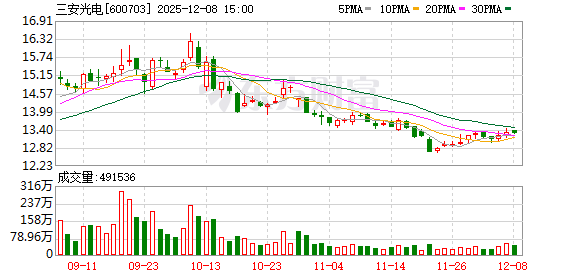
三安光电:全资子公司艾迈谱光电在Micro LED方面拥有2,000KK/月产能
Mei Ri Jing Ji Xin Wen· 2025-12-08 16:36
Core Viewpoint - Company Sanan Optoelectronics (三安光电) is focusing on becoming a leader in the industrialization of Micro LED display devices through its wholly-owned subsidiary, Aimpulse Optoelectronics (艾迈谱光电) [2] Group 1 - The latest production capacity of Aimpulse Optoelectronics is reported to be 2,000KK per month [2]

TrendForce:预计2029年Micro LED芯片产值将达4.608亿美元
Zhi Tong Cai Jing· 2025-12-01 06:57
Core Insights - The Micro LED chip market is projected to reach $460.8 million by 2029, driven by advancements in large display manufacturing processes and the introduction of new AR glasses and smartwatches [1] - Micro LED technology is expanding beyond consumer electronics into the optical interconnects sector, particularly due to increased demand from AI servers, which may enhance technology development and chip demand [1] Display Applications - Micro LED is gradually penetrating the market, benefiting from improved manufacturing processes and yield rates, as well as the expansion of automotive products [1] - Despite high power consumption and costs, Micro LED has the potential to meet the extreme brightness demands of outdoor sports watches and can integrate physiological sensing capabilities [3] - Long-term optimization and market maturation are necessary for Micro LED to achieve large-scale application and compete with more established OLED technology [3] Non-Display Applications - In the optical communications field, the demand for data centers is driving the search for more cost-effective light sources, with Micro LED offering low power consumption, higher data transmission density, and better temperature stability [4] - The display industry is expected to facilitate rapid cost reductions for Micro LED due to economies of scale in the coming years [4]
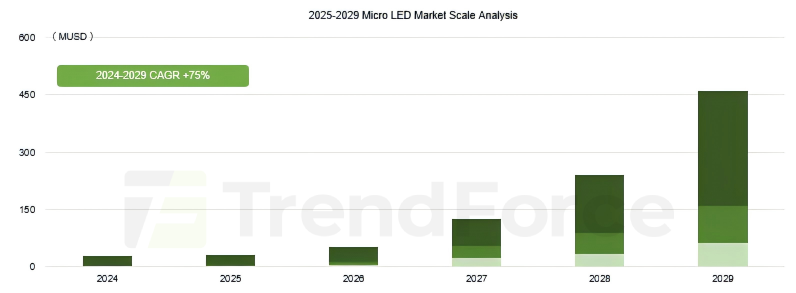
显示与非显示应用拓展驱动,预计2029年Micro LED芯片产值将达4.608亿美元
TrendForce集邦· 2025-12-01 06:43
Core Insights - Micro LED technology is gradually penetrating various display applications, benefiting from improved manufacturing processes and the introduction of new products like AR glasses and smartwatches, with the chip value expected to reach $4.608 billion by 2029 [2] - In non-display applications, Micro LED is expanding into the optical interconnects sector, driven by AI server demand, which may enhance technology advancement and chip demand [2] Display Applications - The launch of Garmin's first Micro LED smartwatch, Fenix 8 Pro, signifies the industry's initial steps into high-value applications, although high power consumption and costs pose challenges for market acceptance compared to OLED [4] - Long-term trends indicate that Micro LED can meet the high brightness demands of outdoor environments for sports watches and has potential for integration with health monitoring and navigation features [4] Optical Interconnects - The increasing demand for data centers is driving the search for more economical light sources, with Micro LED offering low power efficiency, higher data transmission density, and better temperature stability, potentially leading to rapid cost reductions in the coming years [6]
艾比森(300389) - 2025年11月18日投资者关系活动记录表
2025-11-18 10:56
Group 1: Company Performance and Strategy - The company achieved significant growth in the first half of 2025, with a positive growth trend expected to continue into Q3 2025 due to international market penetration and localized operations [2][3]. - Absen focuses on maintaining technological leadership by investing in cutting-edge technologies such as Micro LED and virtual production, ensuring sustained commercial competitiveness [3][4]. - The company has redefined its brand positioning from "LED display application and service provider" to "global leader in LED display technology and applications," reflecting a commitment to industry leadership and customer service [4]. Group 2: Business Operations and Product Offerings - Absen is a leading global provider of LED display products, offering a full range of solutions from outdoor to indoor applications, with a diverse product line including advertising, stage, and smart screens [5]. - The company has made progress in its energy storage business, providing safe and sustainable products and services across Europe, Asia-Pacific, and domestic markets [5][6]. - Absen has successfully developed LED virtual studios, addressing key technical challenges and achieving positive market feedback with numerous landmark projects globally [6]. Group 3: Core Competencies - The company maintains a competitive edge through six core competencies: technological leadership, brand influence, service excellence, cost competitiveness, extensive sales network, and organizational culture [6][7]. - Absen has built a robust service system that supports customers throughout the entire lifecycle of the product, enhancing customer satisfaction and loyalty [6]. Group 4: Employee Incentives and Governance - The company has implemented three employee stock ownership plans (ESOPs) for 2022, 2023, and 2025, with incentive funds of 50 million, 40 million, and 60 million yuan respectively, aimed at aligning employee interests with company performance [8]. - These ESOPs are designed to improve corporate governance, enhance employee engagement, and attract and retain top talent, thereby supporting long-term strategic development [8].