
风险管理

Search documents
回顾2025|第七届“蒙格斯智库年度作家”榜单揭晓
Xin Lang Cai Jing· 2026-01-03 07:12
来源:蒙格斯报告 探索前沿、研判趋势、赋能实践 于不确定性中锚定发展确定性 以理性洞察穿透时代迷雾 把握经济发展的核心脉搏 从DeepSeek的横空出世到AI泡沫风险防控 从美国关税冲突博弈到地缘政治解构 从资本市场起伏到消费活力提振 蒙格斯智库专家学者们 AI浪潮重塑产业生态 地缘博弈交织经贸变局 解构AI浪潮驱动的产业变革路径 拆解关税冲突背后的经贸博弈逻辑 预判资本市场波动趋势 探寻提振消费活力的有效路径 引领读者洞悉复杂变局 与不确定性交织下的财经核心脉络 感知时代转型进程中的强劲发展动能 为致敬过去一年的丰硕思想成果 蒙格斯特别推出年度重磅企划 "蒙格斯2025年度阅读量TOP10文章"以及 第七届"蒙格斯智库年度作家"评奖 致敬每一份智慧洞见与深度思考 展望崭新的2026年 期待专家学者们在前沿领域持续深耕细作 创作出更多映照时代的思想华章 房地产曾是中国经济高速发展的重要引擎,其金融化属性催生了行业繁荣,却也暗藏投机泡沫与高空置 率的隐忧——城镇住房空置率持续攀升,租售失衡导致刚需难满足、资源浪费等多重困境。当"堵"式调 控难破僵局,"租售并举"成为破题关键。文章聚焦房地产金融化的核心矛盾,探索 ...


中国不接盘之后,美债压垮帝国的体面!三条路难道都是慢性死法?
Sou Hu Cai Jing· 2026-01-02 08:08
Core Viewpoint - The article discusses the increasing pressure on the U.S. government due to rising debt and interest payments, highlighting the need for a reassessment of fiscal strategies as traditional buyers of U.S. debt become more cautious [5][16]. Group 1: U.S. Debt and Interest Dynamics - The U.S. debt has been steadily increasing, projected to exceed $38 trillion by 2025, with interest payments entering a new norm of over $1 trillion annually [7]. - The U.S. government faces a dilemma between paying interest and continuing to spend, indicating that its cash and borrowing capacity are not infinite [5][3]. - As major buyers of U.S. debt, including foreign central banks, become more cautious, the belief that the U.S. will never face financial issues is weakening [10][12]. Group 2: Global Market Reactions - Countries are diversifying their reserves, increasing gold holdings, and reducing reliance on U.S. debt, reflecting a shift in risk management strategies [10][14]. - China's holdings of U.S. debt have decreased to around $688.7 billion, while its gold reserves have been increasing for 13 consecutive months [12][31]. - The trend of de-dollarization is not an immediate collapse of the dollar system but a gradual shift towards a more multipolar financial landscape [29][35]. Group 3: U.S. Fiscal Strategies - The U.S. has three main strategies to address high debt and interest pressures: fiscal reform, tax increases, and spending cuts [18]. - Each strategy presents challenges, such as potential social unrest from spending cuts or backlash from tax increases [20]. - The option of "technical delay" through political negotiations may become problematic if market conditions do not support new debt issuance at manageable interest rates [23][25]. Group 4: Future Implications - The rising share of interest payments in the budget is squeezing other spending areas, leading to persistent high fiscal deficits, projected to remain at the trillion-dollar level for the 2025 fiscal year [23]. - The global shift towards non-dollar assets and diversified reserves indicates a long-term structural adjustment rather than an immediate crisis [27][37]. - The future of the U.S. financial system will depend on its ability to maintain fiscal discipline and adapt to a changing global economic environment [37].

煤焦钢产业添风险管理工具,大商所焦煤期权节后上市
Di Yi Cai Jing· 2025-12-31 14:43
大商所期权家族添新 12月31日,证监会发布通知,同意大商所焦煤期权注册。同日,大商所发布焦煤期权合约和焦煤期权上 市交易有关事项的通知(下称"通知"),对焦煤期权的上市交易时间、交易合约、挂牌基准价等事项进 行了明确。 早在2013年,大商所上市了焦煤期货。2025年前11个月,焦煤期货日均成交量104万手,日均持仓量67 万手,期现价格相关性达到97%。 根据通知,焦煤期权即将于1月16日上市,首批9个合约将以期货合约为标的。交易手续费和持仓限额方 面,焦煤期权交易手续费为0.5元/手,套期保值交易手续费减半收取,行权履约手续费与交易手续费相 同;持仓限额为8000手。 但是近年来,焦煤受供需、政策等多重因素影响,价格波动较为剧烈,产业企业对运用衍生品工具开展 精细化风险管理的需求日益强烈。 大商所相关负责人对记者称,焦煤期权上市后,将与相对应的焦煤期货、焦炭期货,以及铁矿石期货、 期权一起,为相关产业提供覆盖钢铁原燃料的更全面的风险管理工具体系。 此外,大商所还在通知中明确了焦煤期权的挂牌基准价、交易指令、行权与履约、组合保证金、相关费 用、做市商制度及合约询价等内容。 格林大华期货黑色研究员纪晓云分析 ...
焦煤期权将在大连商品交易所上市
Sou Hu Cai Jing· 2025-12-31 10:18
根据通知,交易时间方面,焦煤期权自2026年1月16日(周五)上午8:55-9:00集合竞价,9:00上市交 易。1月16日(周五)当晚,焦煤期权与标的期货同步开展夜盘交易。手续费和持仓限额方面,焦煤期权 交易手续费为0.5元/手,套期保值交易手续费减半收取,行权履约手续费与交易手续费相同;持仓限额 为8000手。此外,大商所还在通知中明确了焦煤期权的挂牌基准价、交易指令、行权与履约、组合保证 金、相关费用、做市商制度及合约询价等内容。 大商所方面表示,下一步,大商所将与市场各方共同做好焦煤期权上市前的各项准备工作,确保焦煤期 权平稳上市运行,同时强化市场培育、为企业用好期权工具提供助力,更好服务煤焦钢产业和实体经济 高质量发展。(完) 2013年,大商所上市了焦煤期货。上市以来,焦煤期货市场运行平稳,规模不断扩大,功能有效发挥, 价格影响力稳步提升,越来越多的产业企业利用焦煤期货进行套期保值。2025年前11个月,焦煤期货日 均成交量104万手,日均持仓量67万手,期现价格相关性达到97%,服务实体经济能力显著增强,为焦 煤期权的推出奠定了坚实基础。 近年来,焦煤受供需、政策等多重因素影响,价格波动较为剧烈 ...
大商所期权“家族”将添新成员!焦煤期权将于明年1月16日上市
Sou Hu Cai Jing· 2025-12-31 09:04
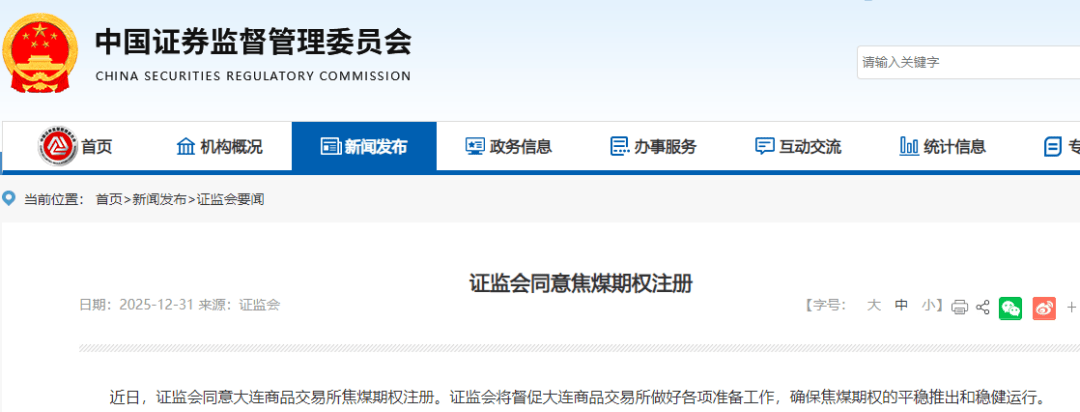
12月31日,中国证监会发布通知,同意大商所焦煤期权注册。同日,大商所发布焦煤期权合约和焦煤期权上市交易有关事项的通知,对焦煤期权的上市交 易时间、交易合约、挂牌基准价等事项进行了明确。 据期货日报记者了解,焦煤是钢铁行业、煤化工产业的核心基础原料。我国是全球最大的焦煤生产国和消费国,2024年,我国主焦煤生产量1.65亿吨,占 全球产量的53%;消费量2.06亿吨,占全球消费量的63%。 为服务产业有效管理价格波动风险,2013年,大商所上市了焦煤期货。上市以来,焦煤期货市场运行平稳,规模不断扩大,功能有效发挥,价格影响力稳 步提升,越来越多的产业企业利用焦煤期货进行套期保值。 近年来,焦煤受供需、政策等多重因素影响,价格波动较为剧烈,产业企业对运用衍生工具开展精细化风险管理的需求日益强烈。焦煤期权上市后,将与 相对应的焦煤期货、焦炭期货,以及铁矿石期货、期权一起,为相关产业提供覆盖钢铁原燃料的更全面的风险管理工具体系,更好满足产业链企业精细化 和多元化的风险管理需求,对保障国家战略性资源稳定供应、服务实体经济高质量发展具有重要意义。 根据大商所通知,交易时间方面,焦煤期权自2026年1月16日8:55—9 ...
大商所期权家族将添新成员 焦煤期权将于1月16日上市
Xin Lang Cai Jing· 2025-12-31 08:00
热点栏目 自选股 数据中心 行情中心 资金流向 模拟交易 客户端 12月31日,中国证监会发布通知,同意大商所焦煤期权注册。同日,大商所发布焦煤期权合约和焦煤期 权上市交易有关事项的通知(以下简称"通知"),对焦煤期权的上市交易时间、交易合约、挂牌基准价 等事项进行了明确。 据了解,焦煤是钢铁行业、煤化工产业的核心基础原料。我国是全球最大的焦煤生产国和消费国,2024 年,我国主焦煤生产量1.65亿吨,占全球产量的53%;消费量2.06亿吨,占全球消费量的63%。 为服务产业有效管理价格波动风险,2013年,大商所上市了焦煤期货。上市以来,焦煤期货市场运行平 稳,规模不断扩大,功能有效发挥,价格影响力稳步提升,越来越多的产业企业利用焦煤期货进行套期 保值。2025年前11个月,焦煤期货日均成交量104万手,日均持仓量67万手,期现价格相关性达到 97%,服务实体经济能力显著增强,为焦煤期权的推出奠定了坚实基础。 近年来,焦煤受供需、政策等多重因素影响,价格波动较为剧烈,产业企业对运用衍生品工具开展精细 化风险管理的需求日益强烈。焦煤期权上市后,将与相对应的焦煤期货、焦炭期货,以及铁矿石期货、 期权一起,为相关 ...

九泰基金新年寄语:征途虽远,履践必达
Xin Lang Cai Jing· 2025-12-31 07:54
Core Viewpoint - The company expresses gratitude to partners and investors while reflecting on the challenges and achievements of 2025, emphasizing a commitment to risk management, professional development, and customer trust as it moves into 2026 [2][3][7]. Group 1: Risk Management - The company prioritizes risk control in its business development, enhancing its risk management system across all operations. It focuses on macro, meso, and micro analysis to create returns and protect investors' interests during market fluctuations [3][4]. - Compliance and internal control measures are strengthened to ensure transparent and efficient operations, maintaining good compliance indicators throughout the year [3][4]. Group 2: Investment Strategy - The company emphasizes the importance of professional capability in the asset management industry, increasing investment in research and optimizing processes. Core products have shown resilience and strong performance, surpassing performance benchmarks while controlling volatility [4][5]. - The company aims to deepen industry research and enhance insights into economic adjustments and industrial upgrades, adhering to long-term, value, and responsible investment principles [18]. Group 3: Customer Trust and Service - The company has improved service pathways and deepened channel collaboration, resulting in a 29.28% increase in new fund clients to 72,242 and a 93.65% increase in total subscription amount to 1.22 billion yuan [5][16]. - Customer satisfaction has steadily improved, reflecting the company's commitment to providing sincere and professional service [5][16]. Group 4: Future Outlook - The company acknowledges the complex macro environment but remains optimistic about China's long-term economic fundamentals and the growth of wealth management demand, which presents opportunities for the asset management industry [18]. - Plans for 2026 include enhancing core capabilities, reinforcing risk management, and building a more diverse customer service system to foster trust [18][19]. Group 5: Talent Development - The company recognizes talent as its most valuable asset and aims to cultivate a professional culture while improving training and incentive mechanisms to build a capable team [19].

徽商期货武汉营业部荣膺“武汉市钢材流通优秀服务商”
Xin Lang Cai Jing· 2025-12-31 05:49
Core Viewpoint - Huishang Futures' Wuhan branch was awarded the title of "Outstanding Service Provider in Steel Circulation in Wuhan" at the third Hubei Steel Supply Chain Conference, highlighting its contributions to the steel industry and its focus on high-quality development in Hubei province [1][4]. Group 1 - The conference aimed to promote collaboration within the steel industry, address internal competition issues, and explore new paths for high-quality development in Hubei's steel sector [1][4]. - Huishang Futures has established strong partnerships with over twenty steel enterprises in Wuhan and surrounding areas, focusing on local market needs [1][4]. - The company provides professional risk management tools, including futures and options, to help steel enterprises effectively mitigate price risks and stabilize operations [1][4]. Group 2 - The professional team at Huishang Futures customizes hedging solutions for various enterprises, assisting them in building risk management systems and enhancing operational stability [1][4]. - The company supports enterprises in transitioning from spot traders to value integrators within the industry chain [1][4].
建信基金:筑牢风险防控屏障 护好百姓资产安全
Zhong Guo Jin Rong Xin Xi Wang· 2025-12-31 03:32
Core Viewpoint - The article emphasizes the commitment of the company to sustainable long-term value creation for investors, aligning with the recently released "Action Plan for Promoting High-Quality Development of Public Funds" which aims to reshape the industry ecosystem and prioritize investor interests [1] Group 1: Risk Management Framework - The company has established a comprehensive risk management system that balances daily management and crisis management, ensuring timely resolution of various investment risks [2] - A "three lines of defense" risk control system has been implemented, where investment personnel are responsible for the first line of defense, risk control and compliance personnel for the second, and audit personnel for the third, enhancing risk awareness and prevention [2] - The company has adopted a "3+3" management model focusing on market risk, credit risk, and liquidity risk, along with three risk assurance measures including new investment product evaluation and performance attribution [4] Group 2: Professional Capability - The company adheres to the philosophy that "risk management creates value," enhancing its professional risk management capabilities and improving the foresight of risk management processes [3] - The company has developed a robust investment risk management system that covers the entire investment risk lifecycle, from pre-investment to post-investment [3] Group 3: Technological Advancement - The company has been advancing towards a systematic, quantitative, and intelligent risk management approach since 2016, significantly improving risk management efficiency [5][6] - An intelligent risk control system has been developed, integrating applications, models, and data, and enhancing the company's risk management capabilities [6] Group 4: Collaborative Synergy - The company strengthens risk collaboration with its parent bank, China Construction Bank, leveraging shared resources and enhancing risk prediction capabilities [7] - Strategic cooperation with its second-largest shareholder, a major U.S. financial services firm, has been deepened to enhance professional capabilities in investment risk management [7] Group 5: Commitment to High-Quality Development - The company actively responds to the call for high-quality development in the industry, focusing on reforming its investment research system and optimizing product innovation [8][9] - Efforts are being made to enhance compliance culture and risk management capabilities, ensuring a robust risk management framework that protects investor assets [9][10]
深耕主责主业 锐意改革创新 强化风险防控 以高质量发展谱写能源特色保险经纪新篇章
Jin Rong Shi Bao· 2025-12-31 01:54
Core Viewpoint - Yingda Chang'an Insurance Brokerage Co., Ltd. aims to become a leading domestic and internationally recognized energy-focused insurance brokerage company, providing comprehensive risk management solutions based on professional risk management capabilities and centered on insurance brokerage [1] Group 1: Commitment to Core Business - The company emphasizes its core mission of serving the real economy, focusing on the power grid, energy industry chain, and national strategic initiatives to empower high-quality development [2] - Yingda Chang'an prioritizes risk protection for the power grid, offering tailored insurance solutions to mitigate potential risks and ensure comprehensive coverage [3] Group 2: Support for Industrial Development - The company actively engages with large state-owned enterprises, facilitating the construction of intelligent insurance management platforms and supporting significant projects, thereby enhancing financial vitality in the industrial chain [4] - Yingda Chang'an has replaced cash guarantees with insurance guarantees amounting to 1,669.30 billion for power grid suppliers and 614.25 billion for state-owned enterprises, assisting over 91,400 suppliers with 1.8577 million policies [4] Group 3: Reform and Innovation - The company is committed to reform and innovation, optimizing its development layout and governance structure to enhance management efficiency and stimulate internal growth [5][6] - Yingda Chang'an has established a comprehensive development system with 40 quantifiable indicators to guide high-quality development [5] Group 4: Digital Empowerment - The company has launched a digital service platform, enhancing data application capabilities and transitioning services from post-incident claims to proactive prevention [7] Group 5: Risk Management and Compliance - Yingda Chang'an prioritizes compliance and risk management, establishing a multi-layered risk prevention system to avoid systemic risks and ensure high-level compliance in the insurance intermediary sector [8] - The company has implemented a risk monitoring mechanism and enhanced internal control management, achieving a 100% compliance rate with risk preferences [9] Group 6: Strategic Goals - Positioned at a critical juncture between the end of the 14th Five-Year Plan and the beginning of the 15th, Yingda Chang'an is committed to high-quality development, contributing to the construction of a strong financial nation and supporting energy revolution and modernization efforts in China [10]