合规经营

Search documents
网银在线:收到中国人民银行相关指导后,已第一时间完成相关整改
Bei Ke Cai Jing· 2025-08-19 05:51
Group 1 - The People's Bank of China, Beijing Branch, has issued a penalty to Online Banking (Beijing) Payment Technology Co., Ltd. and its responsible persons [1] - Online Banking has stated that it has completed the necessary rectifications promptly after receiving guidance from the People's Bank of China [1] - The company will continue to enhance its compliance governance and actively implement regulatory requirements to improve its compliance operation capabilities [1]
涟水农商银行聚焦风险管控 保障合规经营
Jiang Nan Shi Bao· 2025-08-18 13:55
Core Viewpoint - Lianshui Rural Commercial Bank has focused on risk control and compliance management, achieving significant improvements in loan quality and risk mitigation as of June 2023 [1][2] Group 1: Risk Management and Loan Quality - The bank's risk profile score ranked 20th in the industry, improving by 7 places compared to the previous year [1] - Non-performing loan balance stood at 24,307.95 million yuan, with a ratio of 1.42%, decreasing by 1,107.95 million yuan and 0.12% since the beginning of the year [1] - The overdue loan rate for personal loans was 1.71%, down by 0.11 percentage points from the start of the year [1] Group 2: Non-Performing Loan Disposal - The bank disposed of and recovered 13,518.17 million yuan of non-performing loans, an increase of 3,428.05 million yuan compared to the same period last year [1] - A new assessment system was implemented for non-performing loan recovery, linking performance to incentives and fostering collaboration among branches [1] Group 3: Compliance and Internal Control - The bank emphasized compliance starting from senior management, with 423 employees signing the Employee Code of Conduct [2] - Four compliance training sessions were held, with a total of 1,256 participants [2] - Over 400 employees participated in a warning education event, analyzing the root causes of compliance issues through case studies [2]
一年半内被罚超千万元,珠海华润银行发生了什么?
Shang Hai Zheng Quan Bao· 2025-08-17 01:28
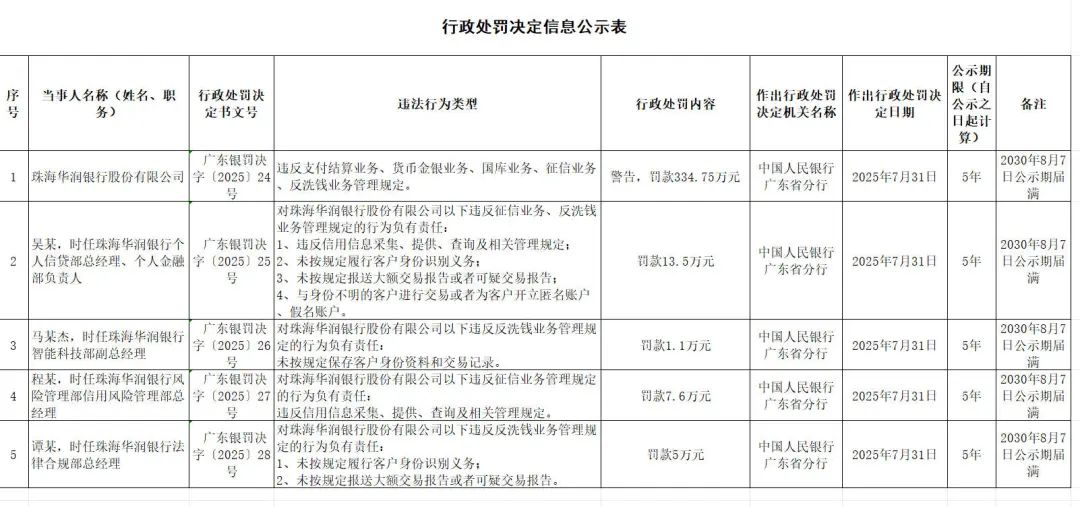
Core Viewpoint - Zhuhai Huaren Bank has faced significant regulatory penalties exceeding 10 million yuan in the past year and a half due to multiple violations of financial regulations, particularly in anti-money laundering practices and other operational areas [1][6][11]. Regulatory Violations - The bank was recently fined 3.3475 million yuan for violating regulations related to payment settlement, monetary and gold business, treasury business, credit reporting, and anti-money laundering [1][2]. - Four senior executives were penalized alongside the bank, with fines ranging from 1.1 million yuan to 135,000 yuan for their respective roles in the violations [1][2]. Financial Penalties History - Over the past 18 months, Zhuhai Huaren Bank has accumulated fines exceeding 10 million yuan, including a record fine of 7 million yuan for rigid repayment of asset management plans [6][8]. - Other significant fines include 1.2 million yuan for serious violations of prudent operation rules in loan business and 1.1 million yuan for improper deposit collection methods [7][10]. Financial Performance - Despite a steady increase in revenue from 6.523 billion yuan in 2022 to 7.132 billion yuan in 2024, the bank's net profit has sharply declined from 2.003 billion yuan to 449 million yuan during the same period [11][12]. - The bank's total assets grew from 317.918 billion yuan in 2022 to 434.04 billion yuan in 2024, but profitability has been adversely affected by narrowing interest margins and increased provisioning [12][13]. Asset Quality Concerns - The bank's asset quality management faces increasing pressure, with a non-performing loan rate of 1.65% as of the end of 2024, primarily concentrated in the wholesale and retail sectors and real estate [14]. - The bank reported a significant increase in credit impairment losses, totaling 4.292 billion yuan in 2024, which has further eroded profit margins [13][14]. Management Changes - The position of the bank's president has been vacant for seven months, following the appointment of Qian Xi as chairman in January 2025 [15][19]. - The bank is currently seeking a new president with stringent qualifications, reflecting the challenges faced in management and operational oversight [19][20].

Campine reacts on alleged resale of its products into Russia.
Globenewswire· 2025-08-15 16:00
Core Viewpoint - Campine NV is addressing allegations regarding the resale of its products to Russia, emphasizing its commitment to compliance with sanctions and export control laws [1][2] Group 1: Company Actions - Campine NV has halted all sales to Russia since the onset of the Russia-Ukraine conflict in March 2022 [1] - The company is taking the allegations seriously and is collaborating with external legal counsel to evaluate the situation [2] - Campine is considering enhancing its compliance measures in response to the allegations [2] Group 2: Legal and Compliance - The company is assessing the appropriateness of further compliance measures and determining the next steps to address the allegations [2] - Contact information for inquiries is provided, indicating transparency in communication regarding the issue [2]

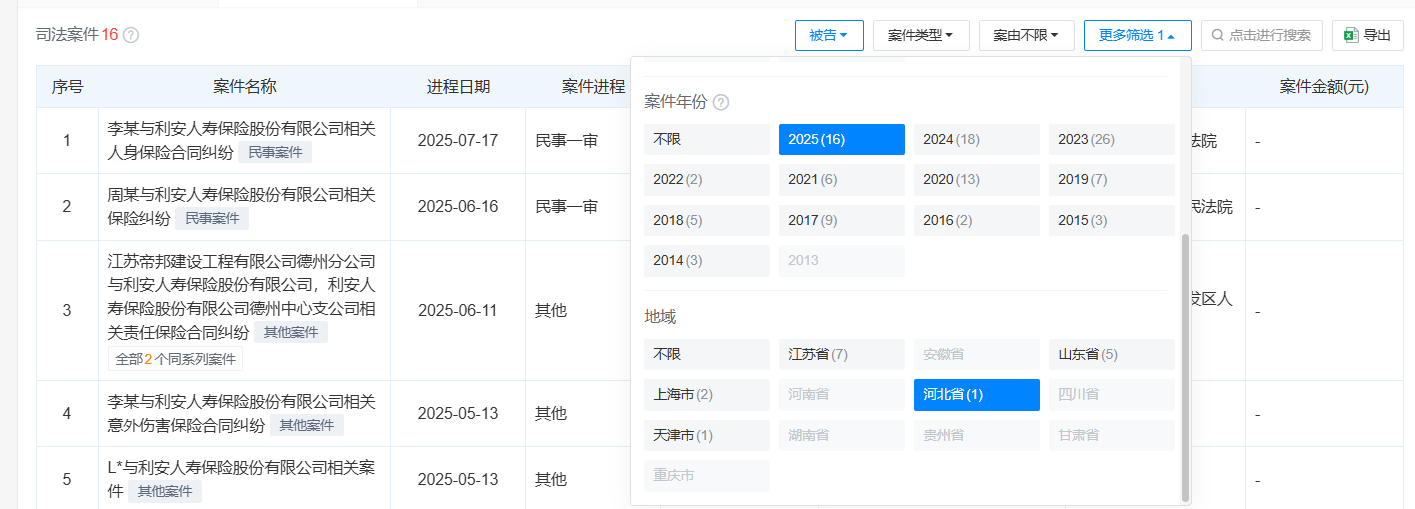
利安人寿罚单不断、盈利困境难破 董事长周俊淑上任同年净亏损27.57亿元
Sou Hu Cai Jing· 2025-08-14 08:31
| 司法案件16 7 | | | | | 被告▼ | 案件类型 → | 案由不限▼ | | --- | --- | --- | --- | --- | --- | --- | --- | | 序号 | 案件名称 | 进程日期 | 案件进程 | 案件年份 ⑦ | | | | | 1 | 李某与利安人寿保险股份有限公司相关 人身保险合同纠纷 民事案件 | 2025-07-17 | 民事一审 | 不限 | 2025 (16) | 2024 (18) | 2023 ( | | 2 | 周某与利安人寿保险股份有限公司相关 | 2025-06-16 | 民事一审 | 2022 (2) | 2021 (6) | 2020 (13) | 2019 ( | | | 保险纠纷 民事案件 | | | 2018 (5) | 2017 (9) | 2016 (2) | 2015 ( | | 3 | 江苏帝邦建设工程有限公司德州分公司 与利安人寿保险股份有限公司,利安人 寿保险股份有限公司德州中心支公司相 | 2025-06-11 | 真他 | 2014 (3) 地域 | 2013 | | | | | 关责任保险合同纠纷 其他案件 全部 ...
“撑不过半年?”社保新规下,奶茶店老板直呼扛不住
3 6 Ke· 2025-08-14 01:16
Core Points - The new social security regulations are causing significant anxiety among beverage shop owners, with some facing the dilemma of either increasing monthly expenses by 20,000 or closing their businesses [1][2] - The regulations require all employers, including small businesses, to pay social security for all employees, which is particularly challenging for the high-turnover beverage industry [2][3] Summary by Sections Impact on Beverage Shops - Many beverage shop owners are calculating that the new regulations will increase their annual costs by over 200,000 yuan, necessitating the sale of an additional 13,000 cups of tea to cover the shortfall [2] - The industry is already facing challenges such as increased competition from top brands and reduced profits due to the online delivery battle, which has further strained financial margins [2][3] Compliance Challenges - The new regulations eliminate the option for employers to negotiate "non-payment agreements" for social security, increasing the penalties for non-compliance [3] - Many shop owners previously only paid social security for management staff, but the new rules require full compliance for all employees, creating additional financial burdens [5][9] Strategies for Adaptation - Some beverage shop owners are considering restructuring their workforce by employing more part-time workers to mitigate the impact of the new regulations [15][16] - There is a trend towards outsourcing non-core positions to reduce direct employment costs while remaining compliant with the new laws [15][16] Industry Response - Larger chain brands are beginning to lower supply costs by 5% to 10% to help franchisees manage the increased financial burden from social security payments [11] - The new regulations are seen as a catalyst for the industry to upgrade and improve operational efficiency, pushing businesses towards more sustainable practices [19] Employee Perspectives - Employees express mixed feelings about the new regulations, appreciating the security of social insurance but fearing potential job losses as employers seek to cut costs [13][19] - There is a growing interest in hiring older workers, which could change the traditional workforce demographics in the beverage industry [16][19] Digital Transformation - Many brands are exploring digital solutions to enhance efficiency, such as smart scheduling systems and automation to reduce labor costs [17]
互联网小贷公司ABS融资活跃 监管规范促行业稳健发展
Jin Rong Shi Bao· 2025-08-12 01:00
Core Viewpoint - The internet micro-lending industry is increasingly utilizing Asset-Backed Notes (ABN) and Asset-Backed Securities (ABS) as primary financing methods, with significant growth observed in ABS issuance in 2025 compared to the previous year [1][2][4]. Group 1: Financing Methods - ABN has become a preferred financing method for several internet micro-lending companies, with 8 out of 14 financing projects in 2025 being ABN [1]. - ABS issuance has shown a notable increase, with 50 ABS products issued in the first half of 2025, a 61% increase from 31 in the same period of 2024 [2]. - The total issuance amount for ABS reached 363.31 billion yuan in the first half of 2025, marking a 105% increase from 177.12 billion yuan in the same period of 2024 [2]. Group 2: Major Players and Projects - Major technology companies like Tencent, Meituan, and JD.com are leading the ABS issuance due to their credit advantages [2]. - ByteDance's Shenzhen Zhongrong Micro Loan Co. and Baidu's Chongqing Du Xiaoman Micro Loan Co. have successfully approved ABS projects with a scale of 90 billion yuan each [2][3]. - JD.com's Chongqing JD Shengji Micro Loan Co. has received approval for three ABS projects totaling 199 billion yuan [3]. Group 3: Regulatory Environment - The National Financial Supervision Administration released the "Interim Measures for the Supervision and Administration of Micro Loan Companies," which aims to regulate the behavior of micro-lending companies and promote healthy development [4][5]. - The interim measures specify that the balance of funds raised through ABS and other standardized forms cannot exceed four times the company's net assets at the end of the previous year [4]. - Industry experts believe that while the measures expand financing space, they also impose necessary regulations to prevent excessive leverage and financial risks [5].
以“经营力”破局“忒休斯之船”:解密数禾科技十年稳健发展的底层逻辑
Zhong Guo Chan Ye Jing Ji Xin Xi Wang· 2025-08-11 05:35
Core Viewpoint - The article discusses how Shuhe Technology has navigated the challenges of the financial technology industry over the past decade by embracing compliance and innovation, likening its journey to the philosophical "Ship of Theseus" paradox, which questions the essence of identity amidst change [1] Compliance and Consumer Protection - Shuhe Technology has actively responded to regulatory demands, embedding compliance into its operational framework as a core element for sustainable development and competitive advantage [2] - The company achieved significant milestones in compliance by obtaining a "micro-loan license" in 2017 and a "financing guarantee license" in 2019, enhancing its legal and operational capabilities [2] - Shuhe Technology has implemented internal compliance processes to protect consumer rights, utilizing digital technology to identify risks such as financial fraud and establishing a comprehensive consumer protection mechanism [2][3] Innovation and ESG Practices - Compliance is viewed as a foundation for innovation at Shuhe Technology, which collaborates with regulatory bodies to enhance consumer protection through initiatives like the "Shu Shield Plan" [3] - The company integrates Environmental, Social, and Governance (ESG) principles into its operations, leveraging advanced technologies to improve efficiency and drive sustainable practices [4] - Shuhe Technology has successfully deployed proprietary models to enhance decision-making speed and accuracy, thereby improving operational efficiency and reducing energy costs [4] Social Responsibility Initiatives - Over the past decade, Shuhe Technology has committed to social responsibility, providing financial services to 27 million users through its "Huanbei APP" and engaging in various philanthropic activities [5] - The company has launched initiatives such as the "Huanbei X Beautiful Echo Rural Study Room" project, which donates educational resources to rural areas, earning recognition for its social impact [5] - Shuhe Technology has conducted ten charitable donation events, benefiting over 1,000 individuals, and aims to continue its commitment to social responsibility in the future [6]
3天遭罚没3300万!上海银行的合规警钟与经营难题
Xin Lang Cai Jing· 2025-08-11 01:35
Core Viewpoint - Shanghai Bank is facing significant challenges due to frequent regulatory penalties and declining operational performance, raising concerns about its management and compliance practices [1][4]. Regulatory Penalties - On August 1, 2023, the People's Bank of China imposed a fine of 29.21 million yuan on Shanghai Bank for multiple violations, followed by an additional fine of 3.8 million yuan on August 4, 2023, from the Zhejiang regulatory bureau [1]. - Over the past three years, Shanghai Bank has accumulated fines exceeding 140 million yuan, indicating ongoing compliance issues [1]. - The bank claims that the violations occurred between 2020 and 2021 and have since been rectified [1]. Operational Performance - Shanghai Bank's revenue peaked in 2021 but has since experienced two consecutive declines, with a 4.79% year-on-year growth in 2024 still 5.77% lower than 2021 levels [1]. - The bank's net interest income has decreased from 38 billion yuan in 2022 to 32.5 billion yuan in 2024, while non-interest income has increased significantly from 8.6 billion yuan to 16.5 billion yuan during the same period [1]. - The bank's net interest margin is low, ranking second to last among 42 listed companies in A-shares, indicating insufficient profitability in its core business [1]. Competitive Position - Shanghai Bank has lost its status as the leading city commercial bank in the Yangtze River Delta, with total assets surpassed by Jiangsu Bank and Ningbo Bank [1][3]. - The bank's asset quality and risk coverage capabilities are inferior to its competitors, with a rising non-performing asset ratio since 2021 [1][3]. - The return on equity has declined from 12.09% in 2020 to 10.01% in 2024, lagging behind Jiangsu and Ningbo banks by 3.58 percentage points [1][3]. Strategic Considerations - The bank needs to reflect on its strategic positioning and execution, especially in light of the regulatory scrutiny it faces [4]. - Despite challenges, Shanghai Bank has potential advantages, including regional market depth and advancements in financial technology and digital applications [2].

涉多项违规,阳光人寿被罚221万,集团合规负责人一同被罚
Nan Fang Du Shi Bao· 2025-08-04 13:08
近日,国家金融监督管理总局宁波监管局对阳光人寿保险股份有限公司(以下简称"阳光人寿")开出 221万元罚单,直指其在资金管理、电话销售、执行条款费率等关键业务领域存在违法违规行为。 与此同时,包括阳光保险集团合规负责人、首席风险官聂锐在内的7名涉事高管受到警告,合计被罚款 70万元。 南都湾财社注意到,2025年以来,阳光人寿罚单不断,累计罚没金额已超500万元。从处罚事由看,"涉 假"问题突出,贯穿"编制虚假资料、虚列银保渠道客户经理薪酬、虚构保险中介套取费用、诱导代理人 违背诚信义务、给予投保人合同外利益、欺骗投保人"等全业务链条。 集团合规负责人一同领罚 8月1日,国家金融监督管理总局宁波监管局行政处罚信息公开表显示,阳光人寿因编制提供虚假报告资 料、资金运用管理不到位、未按照规定使用经批准或备案的条款费率、电销业务存在误导销售和用语不 规范问题等,被罚款221万元。 | 序 号 | 当事人 名称 | 行政处罚决 定书文号 | 主要违法违规行为 | 行政处罚内容 | 作出决定 机关 | | --- | --- | --- | --- | --- | --- | | | 阳光人 | | 编制提供虚假报告资 ...