
资产支持票据(ABN)

Search documents
交易商协会多措并举强化存续期管理 银行间债券市场运行展现韧性与活力
Xin Hua Cai Jing· 2026-02-13 16:56
Core Insights - The interbank market in China has implemented a series of measures in 2025 for bond maturity management, risk prevention, and market services, resulting in positive outcomes [1][2] - There were no unexpected defaults in debt financing tools throughout the year, with the scale of defaults decreasing by 55% year-on-year, indicating a more transparent and orderly market environment [1][2] Group 1: Market Management and Performance - By the end of 2025, the stock of debt financing tools managed by the association exceeded 18 trillion yuan, covering over 3,000 issuers [1] - The association guided market members to disclose periodic reports over 12,000 times throughout the year, achieving a disclosure rate of 99.8% for debt financing tools and 99.4% for asset-backed notes (ABN) [1] - The association conducted special inspections on all 3,115 existing issuers and 1,427 debt items, focusing on technology innovation bonds, green debt financing tools, and platform enterprises [1] Group 2: Risk Monitoring and Prevention - The risk prevention mechanism has become more precise, with monthly inspections, weekly monitoring, and daily supervision implemented to ensure repayment fund verification [2] - The association has opened system accounts for 299 local branches of the People's Bank of China to facilitate information exchange [2] - A notification regarding debt restructuring through replacement business was issued to provide efficient debt disposal pathways for market participants [2] Group 3: Market Services and Support - The association acted as a "lubricant" for dispute resolution, handling 159 disputes and serving over 200 members, with the number of formal mediations reaching a new high [2] - The association supported 176 issuers in completing resale transactions, with the actual resale amount exceeding 52 billion yuan [2] - The association published practical guidance documents, including a compilation of default and disposal cases and rules for issuer management during the maturity period [2]
资产支持票据 2025 年度运营报告与 2026 年度展望:资产支持票据发行单数及规模均同比提升,发行利率处于下行区间,二级市场交易保持较高活跃度; 2026 年,资产支持票据将在拓宽融资渠道、盘活存量资产等方面继续发挥重要作用
Zhong Cheng Xin Guo Ji· 2026-01-30 08:37
1. Report Industry Investment Rating - No information provided regarding the report industry investment rating 2. Core Viewpoints of the Report - In 2025, the issuance volume and scale of Asset - Backed Notes (ABN) increased year - on - year, with personal consumer finance and micro - loans being active. The issuance rate was low and declining, and the secondary market was active. Policy support promoted product innovation. In 2026, ABN will continue to play an important role in serving the real economy [5][59] 3. Summary by Relevant Catalogs 3.1 Issuance - In 2025, 610 ABN products were issued, with a total issuance scale of 571.836 billion yuan, a 9.07% increase from 2024. Among them, 184 Asset - Backed Commercial Paper (ABCP) products were issued, with a scale of 172.173 billion yuan, accounting for 30.11% of the ABN issuance scale. The issuance was mainly private placement [5][6] - By major underlying asset categories, debt - related products led with an issuance scale of 500.701 billion yuan, a 12.88% increase, and a scale share of 87.56%. Other categories had different trends [8] - By detailed underlying asset types, personal consumer finance and micro - loans were active, with 343 products issued and a scale of 307.277 billion yuan, accounting for 53.74% of all ABN products [11] - The top four sponsoring institutions were trust companies, with a combined issuance scale of 182.871 billion yuan, accounting for 31.98% of all ABN products. The market had a high concentration of sponsoring institutions [19] - The single - product highest issuance scale in 2025 was 8.72 billion yuan, and the lowest was 0.25 billion yuan. Products with a single - issuance scale in the (5, 10] billion yuan range had the largest number and scale share [21] - The shortest - term product was 0.17 years, and the longest was 23.41 years. Products with a term in the (1, 2] - year range had the largest issuance number and scale [24] - By rating level, AAAsf - rated notes accounted for 90.34% of the issuance scale [25] 3.2 ABCP Product Issuance - In 2025, 184 ABCP products were issued, with a scale of 172.173 billion yuan, a 5.53% year - on - year decrease, accounting for 30.11% of the ABN issuance scale. The detailed underlying asset types mainly included personal consumer finance, subsidy payments, accounts receivable, etc. [27] 3.3 Product Innovation - In 2025, multiple first - of - its - kind products were successfully issued, such as the first science - and - technology supply - chain bill ABN, the first science - and - technology innovation - type REITs in the inter - bank bond market, etc., providing experience for financing and asset revitalization [29] 3.4 Issuance Rate - In 2025, due to the stable and loose monetary policy, the ABN issuance rate remained low and continued to decline compared to the previous year. The spreads of 1 - year and 3 - year AAAsf - rated ABN products compared to Treasury bonds narrowed [30] 3.5 Secondary Market - As of the end of 2025, the ABN product stock scale was 653.621 billion yuan, a 4.31% year - on - year increase. The secondary - market trading volume was 539.205 billion yuan, a 13.15% year - on - year decrease; the number of transactions was 6,224, an 8.24% year - on - year increase, with an average transaction amount of 0.87 billion yuan and a turnover rate of 84.24%. The active underlying asset types in trading were personal consumer finance, class REITs, accounts receivable, and micro - loans [37] 3.6 Public Offering ABN Products - Accounts Receivable ABN: In 2025, 5 publicly - issued accounts receivable ABN products were issued, with a scale of 6.873 billion yuan, a 56.54% year - on - year decrease. All products had difference - making commitments or liquidity support [42] - Lease Receivables ABN: In 2025, 5 lease receivables ABN products were publicly issued, with a scale of 26.555 billion yuan, a 162.50% year - on - year increase. Some products had low default and early - repayment rates [46] - Supply - Chain ABN: In 2025, 22 publicly - issued supply - chain ABN products were issued, with a scale of 12.771 billion yuan, a 49.56% year - on - year increase. The core debtors/credit enhancers were large real - estate enterprises with high credit quality [50] 3.7 ABN Product Tracking - In 2025, the credit ratings of 3 outstanding public - offering ABN products were upgraded because the credit support for the mezzanine notes increased as the senior notes were redeemed [54] 3.8 Policy - In March 2025, the NAFMII issued the "Action Plan for Further Supporting the High - Quality Development of Private Enterprises in the Inter - bank Bond Market", promoting product innovation and optimizing the financing environment for private enterprises [57] - In May 2025, the NAFMII issued the "Notice on Launching Science and Technology Innovation Bonds and Building the 'Science and Technology Board' in the Bond Market", promoting the construction of the "science and technology board" in the bond market and guiding funds into the science and technology innovation field [58]
银行间资产证券化市场2025年报:规模增长近八成 精准灌溉实体经济关键领域
Xin Hua Cai Jing· 2026-01-21 03:31
Core Insights - The interbank asset securitization market in China is experiencing robust growth in 2025, significantly contributing to national strategies and optimizing financing structures [1][2] Group 1: Market Growth and Performance - In 2025, the issuance scale of Asset-Backed Notes (ABN) in the interbank market reached 571.825 billion yuan, showing substantial growth compared to the previous year [1] - The market has seen a continuous increase in issuance scale, number of issuances, and the number of enterprises served over the past three years, establishing itself as a vital financial tool for asset optimization and financing [1] Group 2: Targeted Financing and Sector Support - Funds are strategically directed towards key areas of national development, with over 22 billion yuan provided for financing technology enterprises in sectors like new materials and the Internet of Things [1] - The green finance channel has become more accessible, with over 70 billion yuan raised for green projects and assets, reflecting strong market response [1] - Continuous capital inflow into rural revitalization has effectively supported agricultural enterprises and projects [1] Group 3: Inclusive Finance and Economic Support - In 2025, the interbank market supported the issuance of securitized products exceeding 35 billion yuan for internet platforms and car rental institutions, benefiting numerous small and micro enterprises and individual consumers [2] - Successful pilot programs for supply chain bill securitization and the expansion of collateral asset ranges for private enterprise asset-backed bonds have provided more flexible financing solutions for small and medium-sized enterprises [2] Group 4: Infrastructure and Service Enhancements - The launch of the ABN underlying asset information disclosure system in 2025 aims to enhance market transparency and risk identification capabilities [2] - The association has improved services for issuers and investors through specialized services, research, and ongoing training [2]
2025年度ABS承销排行榜
Wind万得· 2026-01-10 14:07
Core Insights - The ABS market in 2025 showed a robust issuance trend, with a total of 2,435 new projects and an issuance scale of 23,250 billion yuan, representing a 14% increase compared to the previous year (20,417 billion yuan) [1][6]. Segment Summaries Credit ABS - A total of 238 new projects were issued, with a total amount of 2,915 billion yuan, marking an 8% year-on-year increase. The largest asset class was personal auto loans, with 32 issuances totaling 1,185 billion yuan, followed by non-performing loans with 178 issuances totaling 821 billion yuan [2][9]. Corporate ABS - The corporate ABS segment saw 1,560 issuances, totaling 14,133 billion yuan, which is a 20% increase year-on-year. The largest issuance was in financing lease receivables, with 295 projects totaling 2,891 billion yuan, followed by corporate receivables with 246 projects totaling 2,308 billion yuan [2][12]. Asset-Backed Notes (ABN) - The ABN market had 612 issuances, with a total amount of 5,731 billion yuan, reflecting a 9% year-on-year increase. The main types of issuances were bank/internet consumer loans (191 projects, 1,685 billion yuan) and general small loan receivables (141 projects, 1,295 billion yuan) [2][15]. Market Size and Composition - As of 2025, the cumulative market size reached approximately 35,832 billion yuan, with credit ABS at 4,339 billion yuan, corporate ABS at 22,808 billion yuan, ABN at 6,535 billion yuan, and public REITs at 2,150 billion yuan [4]. Underwriting Performance - In the underwriting rankings for 2025, CITIC Securities led with 527 projects and a total underwriting amount of 2,809 billion yuan, followed by Guotai Junan with 464 projects totaling 2,329.1 billion yuan, and Ping An Securities with 287 projects totaling 1,749.6 billion yuan [17][19]. Detailed Underwriting Rankings - For credit ABS, CITIC Securities topped the list with 109 projects and 538.5 billion yuan, followed by China Merchants Securities with 120 projects and 445.4 billion yuan [23][25]. - In the corporate ABS segment, CITIC Securities also ranked first with 308 projects and 1,853.5 billion yuan, while Ping An Securities followed with 257 projects totaling 1,693.3 billion yuan [28][30]. Asset Class Rankings - The top three asset classes by issuance volume in 2025 were financing lease receivables, bank/internet consumer loans, and corporate receivables [33]. - In the financing lease category, Ping An Securities led with 614 billion yuan, followed closely by Guotai Junan and CITIC Securities [34]. - For bank/internet consumer loans, China Merchants Securities topped the rankings with 502.6 billion yuan, followed by Huatai Securities and CICC [39]. Public REITs - In the public REITs market, the original rights holders' rankings showed Runze Technology Development at the top with 45 billion yuan, followed by Beijing Shou Nong Information Industry and Suning Commercial Group [55][56]. - The plan managers' rankings for public REITs were led by CITIC Securities with 127.9 billion yuan, followed by Southern Capital Management and CICC [58][59].



18家券商斩获银行间债市“金门票”,固收业务竞争白热化
Xin Lang Cai Jing· 2026-01-04 01:47
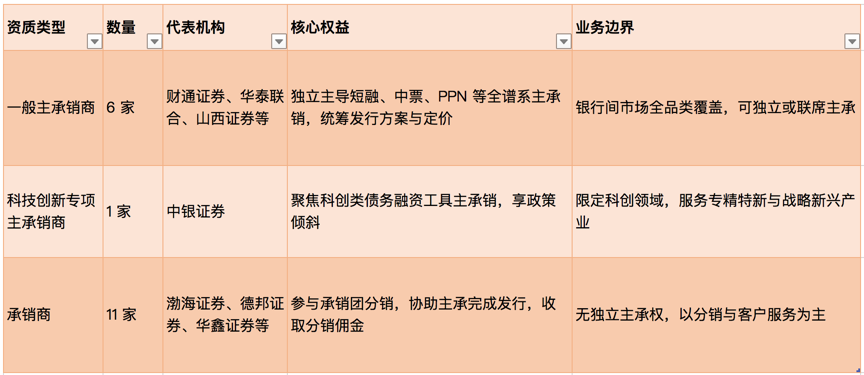
Core Viewpoint - The recent approval of 18 brokerages for non-financial corporate debt financing tool underwriting qualifications marks a significant step in the development of China's bond market, enhancing the service quality for the real economy and increasing direct financing's share [1][5]. Group 1: Qualification Expansion - 18 brokerages have been approved, forming a clear three-tier business structure, reflecting regulatory precision in managing bond underwriting [2][3]. - Six brokerages, including Caitong Securities and Huatai United, have obtained general lead underwriter qualifications, allowing them to independently lead various debt financing products [2][3]. - One brokerage, Zhongyin Securities, has secured a special lead underwriter qualification focused on technology innovation debt financing tools, benefiting from policy support [3][5]. Group 2: Market Dynamics - The entry of these 18 brokerages is expected to disrupt the existing market structure, which has been dominated by large banks and a few leading brokerages, where brokerages previously held less than 30% of the lead underwriting qualifications in the interbank market [5][6]. - The new qualifications enable brokerages to independently participate in the interbank market, previously requiring collaboration with banks, thus allowing them to retain a larger share of underwriting fees [5][6]. Group 3: Business Opportunities - The qualification expansion provides brokerages with broader opportunities in fixed income business, allowing them to build a full-chain service capability from issuance to trading and market-making [7]. - The diverse range of non-financial corporate debt financing tools, including short-term financing bonds and medium-term notes, complements the existing products in the exchange market, enhancing the overall bond service system [7][8]. - The competition in the bond underwriting market is expected to intensify, leading to a more reasonable underwriting fee structure and providing issuers with more options [8]. Group 4: Future Implications - Leading brokerages with strong capital and risk control systems are likely to dominate high-quality projects, while smaller brokerages may need to adopt differentiated strategies to survive [8]. - The approval of qualifications is not a permanent solution; ongoing regulatory oversight will require brokerages to enhance their risk management and pricing capabilities to capitalize on the benefits of their new qualifications [8].


突破2.28万亿:企业ABS主导、ABN崛起、信贷ABS转型——2025资产证券化市场深度扫描
Xin Hua Cai Jing· 2025-12-31 05:21
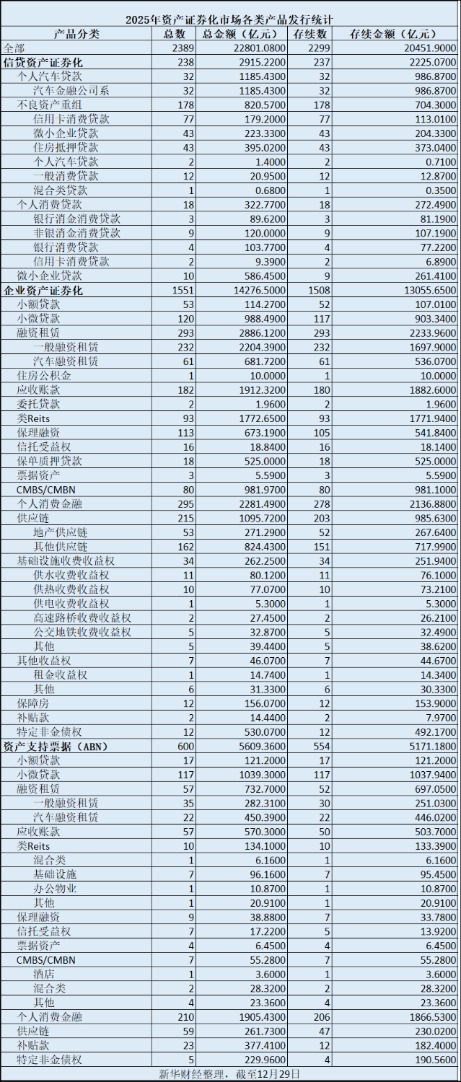
Core Insights - The asset securitization market in 2025 reached a record high with a total issuance of 22,801.08 billion yuan and 2,389 products, marking a significant structural transformation from credit-driven to entity service-oriented [1][3] Group 1: Market Overview - The market structure has evolved, with corporate asset-backed securities (ABS) dominating at 14,276.5 billion yuan, accounting for 62.6% of the total issuance [1][3] - Asset-backed notes (ABN) emerged as the fastest-growing segment, with an issuance of 5,609.36 billion yuan, representing 24.6% of the market [1][3] - Traditional credit ABS saw its market share decrease to 12.8% [1] Group 2: Product Breakdown - Corporate ABS issuance was primarily driven by traditional assets such as financing leases, receivables, and supply chain finance, while consumer finance and microloans reflected the recovery of the economy [3][4] - ABN's growth is attributed to a strong base of institutional investors and the flexible yet standardized product design, with personal consumption loans and micro-enterprise loans as core asset sources [4][8] - Credit ABS issuance totaled 2,915.22 billion yuan, with a notable increase in the restructuring of non-performing assets, which surged by 177.9% in the third quarter [5] Group 3: Market Dynamics - The asset securitization market is characterized by a "quarter-end rush" in issuance, indicating its integration into regular financial and capital management practices [6] - The development of the market is supported by favorable policies, strong demand from the real economy, and improved market liquidity [7][8] - The secondary market for ABS saw increased trading activity, with a quarterly transaction volume of 2,200.17 billion yuan in the fourth quarter, enhancing product liquidity and investment appeal [7] Group 4: Future Outlook - The focus is shifting from mere scale expansion to ecological construction and precise service, with an emphasis on product synergy and innovation [9] - The emergence of data asset ABS signifies a new frontier in the market, with potential growth driven by overcoming common industry challenges [9] - The market is expected to continue evolving, with corporate ABS expanding into intangible assets, ABN gaining recognition for its stable cash flows, and credit ABS focusing on non-performing asset restructuring [9]
协鑫再度融资45.3亿!
Sou Hu Cai Jing· 2025-11-03 10:52
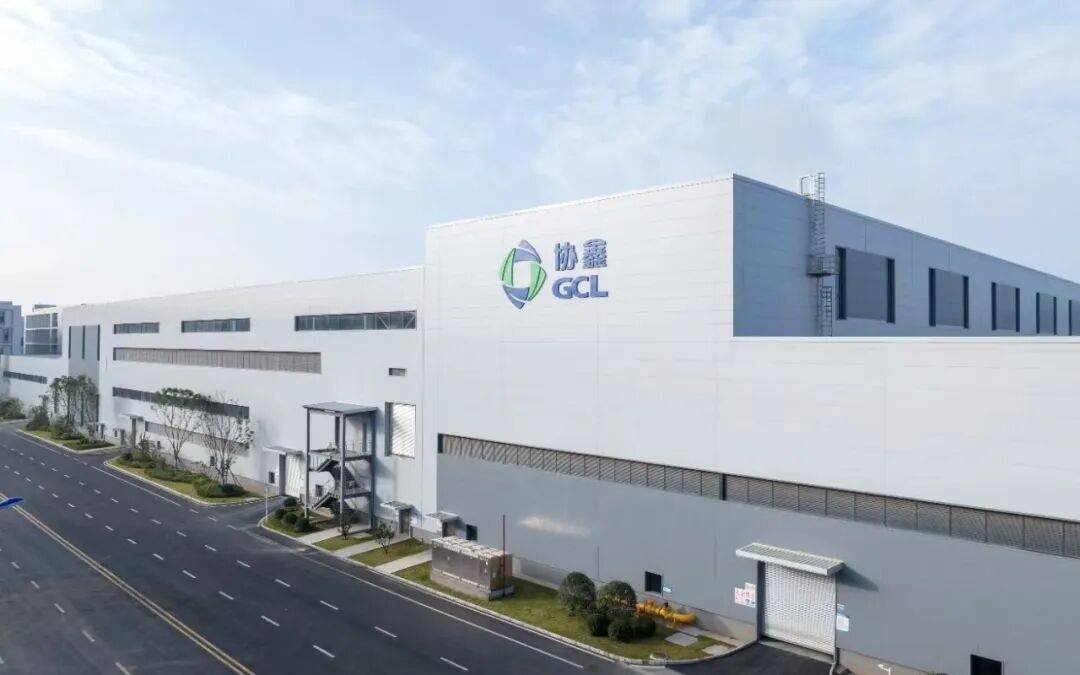
Core Insights - The article highlights the successful issuance of asset-backed notes (ABN) by Taicang Port GCL Power Co., Ltd., a subsidiary of GCL Group, with a registered amount of 4.53 billion yuan, marking a significant achievement in the capital market for private energy enterprises [2][3]. Group 1 - The ABN issuance is the largest scale recorded this year for power supply and heating-related asset-backed notes, setting a benchmark for innovative financing in the private energy sector [3]. - The underlying assets for the ABN are based on the future income from four 330,000 kW units over the next seven years, with a maximum issuance period of seven years and a debt rating of AAA, receiving high recognition from the financial market [3]. - ABN transforms non-standard debt assets into standardized notes, enhancing capital allocation efficiency and reducing financing costs while improving the company's asset-liability ratio [4]. Group 2 - GCL's operation provides a replicable model, creating a closed loop of "activating existing assets—obtaining low-cost funds—investing in green transformation," turning idle power generation assets into liquid funds at a lower financing cost than traditional loans [5]. - This combination of "industrial hard power + capital soft power" is particularly noteworthy for private energy companies to emulate [6]. - The energy industry's development logic of "renewing existing stock and improving incremental quality" establishes a virtuous cycle of "production—operation—financing—reinvestment," where the deployment of photovoltaic components enhances the cleanliness of power generation assets, leading to better market recognition and financing conditions [7]. Group 3 - The internal synergy within the industry chain makes "green transformation" a self-reinforcing positive cycle rather than an isolated investment [8]. - The current policy direction supporting the high-quality development of the private economy sends a strong signal to the market: as long as the assets are of high quality and the transformation direction is clear, private enterprises can also gain full recognition in the capital market, with capital willing to support the green transformation of private energy companies [8].
协鑫集团落地2025年供电供热资产最大规模ABN
Xin Lang Cai Jing· 2025-11-02 08:00
Core Points - GCL-Poly Energy Holdings' subsidiary, Taicang Port GCL Power Co., Ltd., has received a registration notice from the National Association of Financial Market Institutional Investors for asset-backed notes (ABN) totaling 4.53 billion yuan [1] - The asset-backed notes are based on the future heating and electricity revenue generated by four 330,000 kW units over the next seven years [1] - The issuance period for the asset-backed notes will not exceed seven years [1]
蔚来遭指控虚增收入,真相是→
Jin Rong Shi Bao· 2025-10-20 03:31
Core Viewpoint - Singapore's Government Investment Corporation (GIC) has accused NIO of inflating revenue and profits through its partnership with Wuhan Weinan Battery Asset Co., leading to investment losses for GIC, which has drawn market attention [1] Group 1: Stock Market Reaction - On October 16, NIO's Hong Kong stock price initially dropped nearly 13%, closing down 8.99%. The following day, NIO's stock opened over 5% higher and ultimately closed up 2.17% at HKD 50.35 per share, with a total market capitalization of HKD 122.9 billion [1] - NIO's U.S. stock opened down nearly 8% on the same day but quickly rebounded, closing up 0.15% [1] Group 2: Background of the Allegations - The lawsuit initiated by GIC is not related to NIO's recent operational performance but traces back to a short-selling report by Grizzly Research published in June 2022 [2] - The report accused NIO of exaggerating revenue and net profits through Wuhan Weinan, claiming that NIO misrepresented the number of battery asset management business (BaaS) orders [2] Group 3: NIO's Response and Support from Financial Institutions - NIO responded promptly to the allegations in the Grizzly report, stating that the claims lacked factual basis and contained misleading conclusions. An independent internal review was conducted, confirming that all allegations were unfounded [3] - Major financial institutions, including Deutsche Bank, Morgan Stanley, JP Morgan, and Daiwa Capital, released reports supporting NIO, stating that Grizzly's concerns were based on misunderstandings of the BaaS model [3] Group 4: GIC's Litigation History - GIC, managing over USD 100 billion, has a history of initiating lawsuits against publicly listed companies, claiming investment losses. Notable companies previously sued by GIC include Qualcomm, Merck, and BP [3]

小贷公司ABS发行额接近去年全年 小微与消费成融资主力
Zhong Guo Jing Ying Bao· 2025-10-17 19:15
Core Viewpoint - The issuance of asset-backed securities (ABS) for micro-loan companies has been gaining momentum in 2023, with significant regulatory support and a shift towards a more diversified market structure [1][2][7]. Industry Overview - As of October 2023, the total issuance of ABS projects by micro-loan companies reached 761.38 billion yuan, accounting for 40% of the total annual issuance of credit asset securitization products, which is 1,866.1 billion yuan [1]. - The approval process for micro-loan ABS has improved since 2025, indicating a growing recognition of quality assets in the market [2][7]. Market Dynamics - The concentration of ABS issuance among top micro-loan companies is decreasing, with the top three companies accounting for 79.2% of the total issuance in 2024, down from 55.8% in 2025 [3][4]. - The diversification of original rights holders for ABS projects is evident, with new entrants like Zhongrong Micro Loan and Tencent's Financial Payment Loan Company gaining approval for significant ABS issuances [5][6]. Regulatory Environment - The new regulations for micro-loan companies emphasize the importance of small, diversified loans aimed at supporting small and micro enterprises, individual businesses, and consumers [8]. - The regulatory framework allows for increased leverage in financing, enabling compliant institutions to expand their capital space [11][12]. Asset Composition - The underlying assets of micro-loan ABS are primarily directed towards consumption and small business support, with a notable focus on personal operating loans [9][10]. - Companies like QFIN and Meituan are leveraging their platforms to provide financing services, enhancing their market competitiveness through diversified funding sources [10]. Future Outlook - The trend towards a decrease in issuance concentration is seen as a sign of industry maturation, with new players entering the ABS market and focusing on specific scenarios to attract capital [7]. - The favorable policy environment and low-interest rates are expected to further enhance the financing capabilities of micro-loan companies, supporting their growth and market expansion [12].