消费

Search documents
5月份我国经济顶住压力向优向新
Jin Rong Shi Bao· 2025-08-08 07:59
Economic Performance - In May, China's economy demonstrated resilience, with key indicators such as industrial added value and service production index showing stable growth [1][3] - The total value of goods imports and exports increased by 2.7% year-on-year in May, with exports rising by 6.3% [4][1] - From January to May, the industrial added value and service production index grew by 6.3% and 5.9% respectively, indicating overall stability compared to the first quarter [3] Consumer Market - In May, the retail sales of consumer goods increased by 6.4% year-on-year, driven by holiday effects and policies promoting consumption [5][6] - The online retail sales of physical goods grew by 6.3% from January to May, accounting for 24.5% of total retail sales [6][5] - The average urban unemployment rate was 5.2% from January to May, with a slight decrease to 5.0% in May [4] Industrial Sector - The added value of high-tech manufacturing increased by 8.6% in May, while the equipment manufacturing sector saw a growth of 9% [9][8] - The production of industrial robots surged by 32% year-on-year, and the output of new energy vehicles rose by 40.8% [3][9] - Despite external pressures, the manufacturing sector remains a key driver of industrial growth, with significant contributions from high-tech and equipment manufacturing [9][8] Policy Impact - The implementation of financial policies, including interest rate cuts, has provided crucial support for stable economic performance [2] - Consumption policies, such as the "old for new" program, have effectively stimulated consumer spending [6][7] - The government is expected to continue enhancing consumption policies to further boost consumer confidence [7]


上半年民间投资靠什么稳住
Jing Ji Guan Cha Wang· 2025-08-06 02:46
Group 1 - The core viewpoint of the articles indicates that private investment in China has seen a slight decline of 0.6% in the first half of 2025, but when excluding real estate development, private project investment has grown by 5.1% [2][6][9] - The overall fixed asset investment in the country has increased by 2.8%, which is a decrease from the 4.2% growth in the first quarter, attributed to high actual investment growth and macroeconomic adjustments [2][4][6] - The contribution of capital formation to economic growth is reported at 16.8%, with final consumption expenditure contributing 52.0% to GDP growth [4][5] Group 2 - Infrastructure and manufacturing sectors are the primary drivers of fixed asset investment, with broad infrastructure contributing nearly 90% to investment growth, while real estate development investment has decreased significantly [3][9][10] - State-owned and state-controlled investments have increased by 5.0%, while foreign investment has decreased by 15.2% [6][7] - The manufacturing sector's investment accounted for 25.2% of total fixed asset investment, showing a 1.1 percentage point increase compared to the previous year [15][16] Group 3 - The decline in real estate development investment has led to a significant drop in its proportion of total fixed asset investment, from a peak of 30% to 18.8% [9][10] - Equipment purchase investments have surged by 17.3%, contributing 86.0% to overall investment growth, indicating strong support for manufacturing investment [9][10] - The net export growth of 36.1% has contributed 31.2% to economic growth, highlighting the increasing reliance on net exports for economic stability [4][6]

保持政策连续性、稳定性 常态化开展政策预研储备——国家发展改革委解读当前经济形势
Xin Hua She· 2025-08-01 07:57
Economic Performance - In the first half of the year, China's economy showed steady progress, with GDP growing by 5.3% year-on-year, and domestic demand contributing 68.8% to economic growth [2][4] - The total retail sales of consumer goods increased by 5%, with significant growth in household appliances and new energy vehicle sales, which rose by 30.7% and 40.3% respectively [4] National Market Development - The construction of a unified national market has made positive progress, with inter-provincial electricity trading volume increasing by 18.2% year-on-year [3] - The proportion of inter-provincial trade sales to total sales revenue reached 40.4%, up by 0.6 percentage points from the previous year [3] Consumption Expansion - Consumption is identified as the main engine of economic growth, with various policies and activities implemented to boost consumer spending [4] - The government plans to enhance consumer capacity and promote high-quality development through measures aimed at stabilizing employment and increasing residents' income [4] Energy Supply Stability - The national electricity supply remains stable, with adequate demand being met during peak summer temperatures [5][6] - The government will focus on ensuring sufficient energy supply, enhancing peak capacity, and optimizing demand-side management [6] Reform Initiatives - The government aims to deepen reforms to stimulate economic growth, focusing on expanding domestic demand and addressing prominent economic issues [7][8] - Key reform measures include promoting service consumption, improving investment mechanisms, and facilitating market access for new industries [8]
国家发展改革委:第四批690亿元国补将于10月下达
2 1 Shi Ji Jing Ji Bao Dao· 2025-08-01 03:33
Group 1: Economic Measures and Funding - The National Development and Reform Commission (NDRC) will allocate the fourth batch of 69 billion yuan for the old-for-new consumption subsidy program in October, completing the annual target of 300 billion yuan [1] - The NDRC has fully disbursed the 69 billion yuan for the third batch of subsidies this year [1] - The NDRC has announced that the "two重" construction project list of 800 billion yuan has been fully allocated, with 735 billion yuan of central budget investment also nearly disbursed [6][7] Group 2: Artificial Intelligence and Market Development - The NDRC highlighted that there is a strong demand for the application of artificial intelligence, indicating a critical window for its implementation [2] - The NDRC is working on a plan to deepen the construction of a unified national market, with inter-provincial trade sales accounting for 40.4% of total sales revenue from January to April, an increase of 0.6 percentage points year-on-year [4] Group 3: Employment and Economic Stability - The NDRC reported that domestic demand contributed 68.8% to GDP growth in the first half of the year, showcasing strong economic resilience [3] - The NDRC plans to continue implementing measures to stabilize employment and the economy, enhancing policy continuity and flexibility [3] Group 4: Market Regulation and Competition - The NDRC will address disordered competition among enterprises and promote the cleaning up of market access barriers [5][10] - The NDRC aims to unify government behavior regarding investment attraction, clarifying encouraged and prohibited actions [10] Group 5: Consumer Spending and Service Sector - The NDRC will focus on enhancing consumer capacity and promoting service consumption in areas such as culture, tourism, sports, and healthcare [9] - The NDRC plans to implement measures to stimulate consumption, including promoting domestic products and improving consumption infrastructure [9] Group 6: Private Sector Participation - The NDRC will facilitate greater participation of private enterprises in national major projects, particularly in the nuclear power sector [11] - The NDRC is set to establish new policy financial tools to support private investment [11] Group 7: Energy Market Reforms - The NDRC is advancing the construction of a unified national electricity market, with significant progress made in optimizing electricity resource allocation [13][14] - The NDRC has established a basic unified technical rule system for the electricity market, with 25 provinces already conducting spot trading [14]
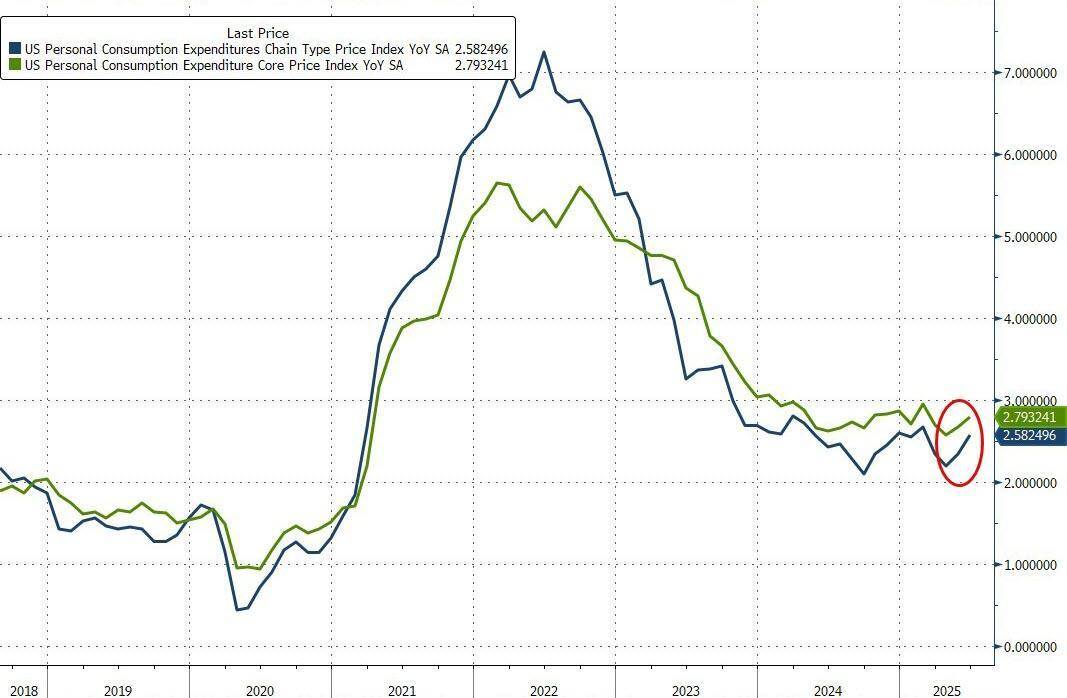
美联储最爱通胀指标意外回升!美国6月核心PCE物价指数同比2.8%,创4个月新高
Sou Hu Cai Jing· 2025-07-31 15:54
Core Insights - The U.S. economy is sending mixed signals amid persistent inflation pressures and weak consumer spending, complicating the Federal Reserve's monetary policy outlook [1][8] - The June PCE price index rose 2.6% year-on-year, above the expected 2.5%, with the previous value revised up to 2.3% [1] - The core PCE price index increased by 2.8% year-on-year in June, surpassing the expected 2.7%, marking the highest level since February [1] Consumer Spending and Labor Market - Despite rising prices, consumer spending shows signs of fatigue, with real consumer spending only growing by 0.1% in June, failing to reverse the previous month's decline [4] - Durable goods spending has declined for three consecutive months, the longest streak since 2021, while service spending remains low, indicating weak discretionary spending [4] - Real disposable income remained flat in June after a decline in May, with weak wage growth limiting consumer spending willingness [4] Federal Reserve's Dilemma - The Federal Reserve faces a dilemma as rising core inflation raises concerns, yet weak consumer and labor market conditions prompt some policymakers to advocate for interest rate cuts [5] - The Fed maintained interest rates for the fifth consecutive time, with two board members unusually voting in favor of a 25 basis point cut, highlighting increasing internal divisions [5] Market Reactions - Following the data release, U.S. stock index futures maintained gains, Treasury yields declined, and the dollar remained stable, reflecting market caution regarding the Fed's policy direction [8] - The June PCE data intensified policy divisions within the Fed, as core inflation remains above target while consumer and income growth show signs of weakness [8]
重要发布会:明日10时
券商中国· 2025-07-31 13:58
Group 1 - The National Development and Reform Commission (NDRC) will hold a press conference on August 1 at 10:00 to interpret the current economic situation and economic work [1][2] - The press conference is expected to provide insights into the economic policies and strategies that will impact various sectors [1][3]

21专访丨上海财经大学校长刘元春:下半年中国经济新逻辑 准财政工具加力稳增长
2 1 Shi Ji Jing Ji Bao Dao· 2025-07-31 00:55
Economic Overview - China's GDP exceeded 66 trillion yuan in the first half of the year, growing by 5.3% year-on-year, laying a solid foundation for the annual target of around 5% [1] - In the second quarter, the economy grew by 5.2% year-on-year, with exports increasing by 7.2%, indicating resilience despite the impact of high tariffs from the U.S. [1][2] - Retail sales of consumer goods showed a rebound, supported by policies encouraging the replacement of old products [1][2] Investment Trends - Investment growth has slowed, particularly in infrastructure and manufacturing, with real estate investment continuing to decline [1][4] - The profit margins of large industrial enterprises have decreased compared to the previous year, indicating a decline in investment returns [4] - There is a need for stronger investment policies to support growth, as private investment has turned negative [4] Export and Trade Dynamics - Exports in the first half of the year increased by 5.9% year-on-year in dollar terms, outperforming expectations despite ongoing trade tensions with the U.S. [3] - The competitiveness of Chinese products has improved, transitioning from a traditional extensive development model to a more innovative and intensive approach [3] Consumer Spending Outlook - Consumer spending is expected to maintain steady growth, supported by various policies including a 1.38 billion yuan fund for replacing old consumer goods [4][7] - Long-term strategies to boost consumption include increasing residents' income and improving social security systems [8] Real Estate Market - The real estate market is experiencing increased sales area and sales volume declines, necessitating stronger measures to stabilize the market [9][10] - Policies to support real estate developers, such as debt restructuring and inventory management, are expected to be implemented [9][10] Policy Recommendations - A more proactive fiscal policy and moderately loose monetary policy are essential to stimulate demand and improve market expectations [5][6] - The government may consider interest rate cuts to alleviate the financial burden on enterprises [6] Market Competition and Regulation - There is a need to address "involution" in competition, which has led to disorderly price competition and reduced investment returns [11] - Regulatory measures should be implemented to ensure fair pricing and restore market self-regulation capabilities [11]
吉林省委统战部部长调整
券商中国· 2025-07-30 23:33
Group 1 - The core viewpoint of the article is the announcement of personnel changes in Jilin Province, specifically the appointment of Qiu Jiang as the new head of the United Front Work Department of the Jilin Provincial Committee [1] - Qiu Jiang was born in August 1972 and has held various significant positions in Yunnan Province, including Deputy Secretary of Chuxiong Prefectural Committee and Vice Governor of Yunnan Province [1][2][3] - Prior to his new role in Jilin, Qiu Jiang served as the Secretary-General of the Yunnan Provincial Committee [4] Group 2 - The previous head of the United Front Work Department in Jilin, Han Fuchun, was born in February 1965 and currently serves as the Deputy Secretary and Vice Chairman of the Jilin Provincial Political Consultative Conference [5]

厦大通报“学生陈某某辱骂国家运动员”
券商中国· 2025-07-30 13:53
Group 1 - The article highlights a situation involving a student from Xiamen University who made inappropriate comments about national athletes on social media, prompting the university to initiate an investigation and take disciplinary action based on the findings [1] - The university expresses gratitude for the attention from the public regarding this matter, indicating a commitment to uphold standards of conduct [1] Group 2 - The article mentions significant positive developments in the A-share market, including a sudden surge and a major rebound in the afternoon trading session [1] - It notes the arrival of a "super week" with important events and announcements from both China and the United States, which are expected to influence market dynamics [1] - Key messages include updates on tariffs between the US and EU, as well as a notable announcement regarding potential interest rate cuts by the Federal Reserve [1]

深圳官宣:18322.26亿元!
券商中国· 2025-07-30 11:54
Economic Overview - Shenzhen's GDP for the first half of 2025 reached 1832.226 billion yuan, with a year-on-year growth of 5.1% [1] - The primary industry added value was 1.033 billion yuan, growing by 2.8%; the secondary industry added value was 650.556 billion yuan, growing by 3.3%; and the tertiary industry added value was 1180.637 billion yuan, growing by 6.1% [1] Industrial Production - The industrial added value for large-scale enterprises increased by 4.3% year-on-year, with a slight acceleration of 0.1 percentage points compared to the first quarter [2] - The manufacturing sector grew by 4.2%, while the electricity, heat, gas, and water production and supply sector saw an increase of 11.8% [2] - High-tech product output experienced rapid growth, with civil drones, industrial robots, and 3D printing equipment increasing by 59.0%, 38.0%, and 35.8% respectively [2] Service Sector - The added value of the service industry was 1180.637 billion yuan, with a year-on-year growth of 6.1%, also accelerating by 0.1 percentage points from the first quarter [3] - Key sectors such as finance, transportation, and information technology services grew by 10.9%, 9.0%, and 8.1% respectively [3] - From January to May, the revenue of large-scale service enterprises increased by 8.4%, with transportation and information services showing significant growth [3] Fixed Asset Investment - Fixed asset investment decreased by 10.9% year-on-year, with real estate development investment down by 15.1% [4] - Infrastructure investment grew by 7.7%, while industrial technological transformation investment surged by 47.1% [4] - Investment in information transmission and technology services increased by 47.7%, and transportation and postal services by 32.5% [4] Market Sales - The total retail sales of consumer goods reached 494.868 billion yuan, with a year-on-year growth of 3.5%, accelerating by 0.4 percentage points from the first quarter [6] - Retail sales of essential goods showed strong growth, with daily necessities and food retail increasing by 10.7% and 9.1% respectively [6] - Online retail continued to grow, with sales through the internet increasing by 19.4% [6] Trade Performance - The total import and export volume was 2167.545 billion yuan, down by 1.1%, but the decline narrowed by 1.7 percentage points compared to the first quarter [7] - Exports amounted to 1308.681 billion yuan, decreasing by 7.0%, while imports increased by 9.5% to 858.864 billion yuan [7] - High-tech product exports grew by 8.0% [7] Financial Sector - By the end of June, the balance of deposits in financial institutions reached 14160.014 billion yuan, growing by 5.7% year-on-year [8] - The balance of loans in financial institutions was 9846.991 billion yuan, with a year-on-year growth of 3.5% [8] Consumer Prices - The consumer price index rose by 0.1% year-on-year, with food and clothing prices increasing by 0.5% and 1.3% respectively [9] - Prices for transportation and communication decreased by 2.4%, while healthcare prices rose by 1.2% [9] - Overall, the economy maintained stable operation, with a focus on high-quality development despite external uncertainties [9]