
公募基金高质量发展

Search documents
信达澳亚基金朱永强:锚定科技主线布局全球,在长期主义中寻找平衡之道
Xin Lang Ji Jin· 2025-07-08 00:29
Core Insights - The core proposition of the article emphasizes the importance of enhancing investor satisfaction as a fundamental aspect of the public fund industry, especially in the context of high-quality development [2][3]. Industry Context - The public fund industry has evolved from a niche sector 20 years ago to a significant player with over 800 million investors, impacting national economic transformation and technological development [3]. - Recent years have seen widespread losses in the industry, particularly in equity funds, leading to poor customer experiences [3]. Business Philosophy - The company prioritizes customer interests above all, asserting that misalignment of this principle jeopardizes long-term sustainability [4]. - A formula for quantifying investor satisfaction is proposed: 20%-30% from active management (Alpha), 50% from macroeconomic and industry trends (Beta), and 20%-30% from investor behavior optimization (Gamma) [4]. Product Strategy - The company avoids chasing market trends and focuses on long-term asset allocation, starting with technology investments and gradually expanding into consumer, healthcare, and value investment sectors [4]. - The sales strategy includes "reverse selling," promoting equity products during market downturns and guiding clients towards fixed-income assets during market highs [5]. Performance and Assessment - The company emphasizes long-term performance metrics for fund managers, focusing on three to five-year results rather than short-term gains [5]. - The company has achieved notable performance, ranking 8th out of 166 in equity fund performance as of June 30, with a two-year average return of 18.95%, the highest among funds over 100 billion [7]. Future Outlook - The company is actively pursuing a license for advisory services and is building a team to empower wealth management institutions rather than directly targeting end clients [7]. - The introduction of a floating fee structure aligns the interests of fund managers and investors, moving away from a sole focus on relative returns [9]. - The company aims to enhance its capabilities in cross-border investments, commodity investments, and talent retention to ensure long-term value creation for investors [10][11].

当基民为亏损买单时,广发基金管理层正忙着瓜分6亿分红
Sou Hu Cai Jing· 2025-07-07 10:04
Core Viewpoint - The performance of GF Fund has come under scrutiny due to poor results, imbalanced incentive mechanisms, and strategic adjustment risks, raising concerns among investors and the market [2][8]. Group 1: Business Strategy and Market Position - GF Fund has recently added seven new primary dealers, including UBS Securities and CICC, signaling a strategic adjustment in its business operations [2]. - The increase in primary dealers can enhance ETF liquidity and reduce bid-ask spreads, with data indicating that a 20% increase in dealers can narrow spreads by 10-15 basis points [2]. - However, the choice to partner primarily with small and medium-sized brokerages raises concerns about their ability to provide liquidity during market volatility [3]. Group 2: Performance and Management Challenges - GF Fund's performance has been disappointing, with 66 actively managed equity products underperforming their benchmarks by over 10% in the past three years, affecting several high-profile fund managers [3][4]. - The relationship between GF Fund and its controlling shareholder, GF Securities, is deeply intertwined, with GF Securities holding 54.53% of GF Fund's shares [4]. - GF Securities reported a significant year-on-year revenue increase of 46.3% in Q1 2025, but a 10.2% decline quarter-on-quarter, indicating volatility that could impact GF Fund's resource support [4]. Group 3: Internal Incentive Mechanisms - GF Fund's internal incentive structure has come under fire, with a significant disparity between management bonuses and fund performance, leading to concerns about misalignment of interests between management and investors [5][6]. - The fund's employee stock ownership platform has distributed 6.48 billion yuan in dividends over five years, while the fund itself has incurred losses of 569 billion yuan during the same period [6]. - Regulatory changes have imposed salary cuts on fund managers whose products underperform, but the implementation of these cuts faces challenges in balancing performance and retention of key personnel [4][7]. Group 4: Regulatory and Market Pressures - GF Fund is facing multiple pressures, including the need to adapt to new regulatory requirements, internal governance issues, and the necessity for salary adjustments and product innovation [8]. - The current situation poses a risk not only to GF Fund but also to the overall health of the public fund industry if trust among investors is not restored [8].
非银行金融行业深度研究:高质量发展增量政策对金融行业影响解析
Tai Ping Yang Zheng Quan· 2025-07-06 15:18
Investment Rating - The report does not explicitly state an investment rating for the non-bank financial industry. Core Insights - The comprehensive financial policy introduced on May 7 aims to address internal demand weakness and external economic fragmentation, while also learning from historical policy timing choices [4][10][12]. - The establishment of a quasi "stabilization fund" mechanism, along with central bank re-lending and insurance capital expansion, is expected to solidify market stability and transition from emergency interventions to a normalized mechanism [5][30]. - New regulations on major asset restructuring open up significant opportunities in the M&A market, introducing flexible payment mechanisms and simplified review processes [6][40][41]. - The public fund industry is encouraged to return to its core focus on investment returns, with new guidelines emphasizing long-term performance and fee structures linked to fund performance [7][67][72]. Summary by Sections 1. Overview: Background and Analysis of the Financial Policy Package - The timing of the financial policy package is influenced by internal factors such as weak domestic demand and risk prevention, as well as external shocks like trade barriers [10][12][13]. - The policy aims to create a coordinated approach among fiscal, monetary, and regulatory measures to avoid the pitfalls of previous economic downturns [13][14]. 2. Significance of the Quasi "Stabilization Fund" - The quasi "stabilization fund" is designed to provide a consistent market stabilization mechanism, moving away from ad-hoc interventions [30][31]. - International examples demonstrate the effectiveness of stabilization funds in mitigating market panic and stabilizing financial systems during crises [31][36]. 3. New Regulations on Major Asset Restructuring: Opening Up M&A Opportunities - The new regulations introduce four key innovations, including a phased payment mechanism and a simplified review process, which enhance transaction flexibility and efficiency [6][40][41]. - The adjustments in regulatory requirements for asset purchases aim to increase tolerance for mergers and acquisitions, particularly benefiting high-potential sectors [47][48]. 4. High-Quality Development Opinions for Public Funds: Returning to Core Principles - The public fund industry is urged to focus on investment returns, with reforms aimed at aligning interests between investors and fund managers [67][72]. - The introduction of a floating fee structure linked to performance is expected to enhance long-term investment strategies and accountability [88][90]. 5. Expanding Equity Investment: Financial Services for New Productive Forces - Continued encouragement for insurance capital to enter the market could lead to an influx of approximately 700 billion in equity investment [8][95]. - The expansion of AIC pilot programs reflects a policy direction aimed at enhancing banking services for technological innovation [8].

公募一哥8月底或易主?上半年华夏基金规模增速14%猛追易方达,规模差距仅剩654亿元
Xin Lang Ji Jin· 2025-07-03 09:01
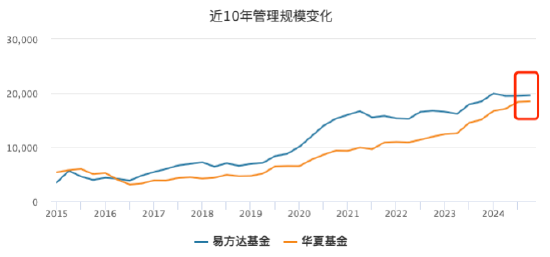
Group 1 - The core viewpoint of the article highlights the significant growth disparity among top public funds, with 华夏基金 leading the pack with a 14.02% growth rate, while 易方达基金 lags behind at 3.04% [2][11][17] - As of June 30, 2025, 华夏基金's non-cash scale reached 19,526.19 billion yuan, closing the gap with 易方达基金 to less than 654 billion yuan [2][5] - 华夏基金's growth is attributed to its strong performance in index funds and ETFs, with its ETF management scale reaching 7,513.36 billion yuan, a year-to-date increase of 931.7 billion yuan [6][9] Group 2 - The top 10 non-cash fund companies show a growth rate disparity exceeding 17 percentage points, with 华夏基金 at the top and 博时基金 at the bottom with a -3.62% growth rate [3][5] - 华夏基金's net inflow averaged 1.3 billion yuan per day, surpassing the combined inflow of 易方达, 招商, and 南方 funds [5][11] - The article notes that the new regulatory environment is pushing the industry towards sustainable development, impacting 易方达's traditional scale advantage [17][18] Group 3 - 易方达基金's sluggish growth may be linked to product performance pressures, with its return rates lagging behind those of 华夏基金 [11][13] - The management strategies of 华夏基金 and 易方达基金 differ significantly, with 华夏 adopting a strategy of expanding its research team while 易方达 focuses on a leaner management approach [14][15] - The upcoming regulatory changes may challenge 易方达's operational model, while 华夏基金's reliance on ETF popularity could expose it to market volatility risks [17][18]
★首批创新浮动管理费率基金上报
Zheng Quan Shi Bao· 2025-07-03 01:56
Core Viewpoint - The first batch of innovative floating fee rate products based on performance benchmarks has been reported, with 26 fund managers participating, indicating a shift towards performance-based fee structures in the industry [1][2]. Group 1: Product Overview - A total of 26 fund managers have submitted products, including 21 leading managers in active equity fund management, 4 small to medium-sized managers, and 1 foreign-owned manager [1]. - The participating fund managers include well-known firms such as E Fund, Fuguo Fund, and GF Fund, among others [1]. - The new floating fee rate model charges management fees based on each investor's holding period and annualized return, with specific fee structures for different holding durations [1]. Group 2: Investor-Centric Design - The product design emphasizes investor interests, allowing fee adjustments based on performance relative to benchmarks, with asymmetric adjustments favoring fee reductions for underperforming funds [2]. - The products aim to encourage long-term investment from investors, focusing on enhancing the long-term investment experience rather than merely increasing fundraising scale [2]. Group 3: Regulatory Framework - The "Action Plan" mandates that leading institutions should issue at least 60% of these new funds compared to their active equity fund issuance within a year [3]. - The implementation of these floating fee rate products will not affect the normal operation of existing products, ensuring a smooth transition [3]. - Fund managers are preparing for the rollout by focusing on product design, legal documentation, and communication with sales channels [3].
基金业首家运营子公司,获批!
Zhong Guo Ji Jin Bao· 2025-06-28 08:16
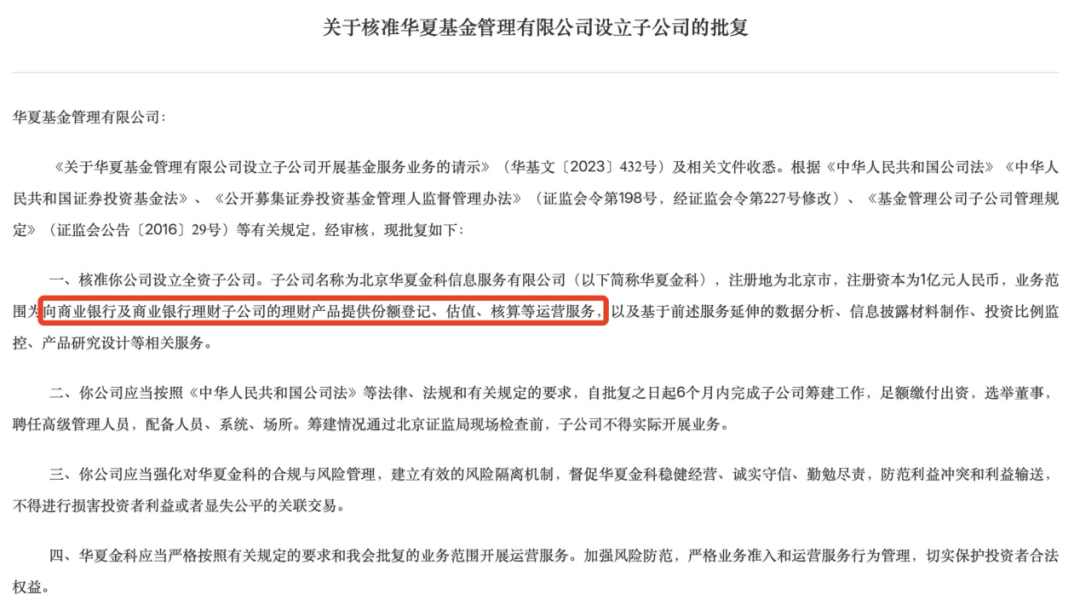
Core Viewpoint - The establishment of the first operational subsidiary in the fund industry by Huaxia Fund marks a significant breakthrough in the sector, allowing for enhanced operational services related to asset management and valuation for banks and their wealth management subsidiaries [1][3]. Group 1: Regulatory Approval and Company Details - The China Securities Regulatory Commission (CSRC) has approved Huaxia Fund to establish a wholly-owned subsidiary named Beijing Huaxia Jinke Information Service Co., Ltd., with a registered capital of 100 million RMB [3][5]. - The subsidiary will provide services such as share registration, valuation, and accounting for wealth management products, along with data analysis and investment monitoring [3][5]. Group 2: Industry Context and Demand - The establishment of this subsidiary comes at a time when the demand for valuation services is increasing due to regulatory changes in bank wealth management, particularly as the mid-year evaluation approaches [2][7]. - Public funds are seen as a benchmark for standardized operations in the asset management industry, and large fund companies are leveraging their experience to enhance performance through specialized service subsidiaries [2][7]. Group 3: Future Developments and Trends - The move aligns with the CSRC's previous initiatives to support the establishment of subsidiaries for public funds to enhance comprehensive wealth management capabilities [3][8]. - Other fund companies, such as Chuangjin Hexin Fund, are also exploring similar operational service subsidiaries, indicating a trend towards specialization and differentiation in the fund management industry [5][8].
基金业首家运营子公司,获批!
中国基金报· 2025-06-28 07:54
Core Viewpoint - The establishment of the first operational subsidiary in the fund industry by Huaxia Fund marks a significant breakthrough in the development of the industry, allowing for enhanced operational services in asset management [1][3][4]. Group 1: Regulatory Approval and Company Details - The China Securities Regulatory Commission (CSRC) has approved Huaxia Fund to establish a wholly-owned subsidiary named Beijing Huaxia Jinke Information Service Co., Ltd., with a registered capital of 100 million RMB [3][4]. - The subsidiary will provide operational services such as share registration, valuation, and accounting for wealth management products to commercial banks and their wealth management subsidiaries [3][4]. Group 2: Industry Context and Demand - The establishment of the subsidiary comes at a time when the valuation of bank wealth management products is undergoing scrutiny, with increased demand for valuation services as the mid-year assessment approaches [1][6]. - Public funds, as benchmarks for net value management and standardized operations, can leverage their experience to enhance performance through the establishment of operational service subsidiaries [1][6]. Group 3: Future Developments and Industry Trends - The CSRC's previous guidelines support the establishment of subsidiaries by fund management companies to enhance comprehensive wealth management capabilities, indicating a trend towards specialization in the industry [3][7]. - Other fund companies, such as Chuangjin Hexin Fund, are also exploring the establishment of operational service subsidiaries, reflecting a broader industry movement towards professional service offerings [4][7].
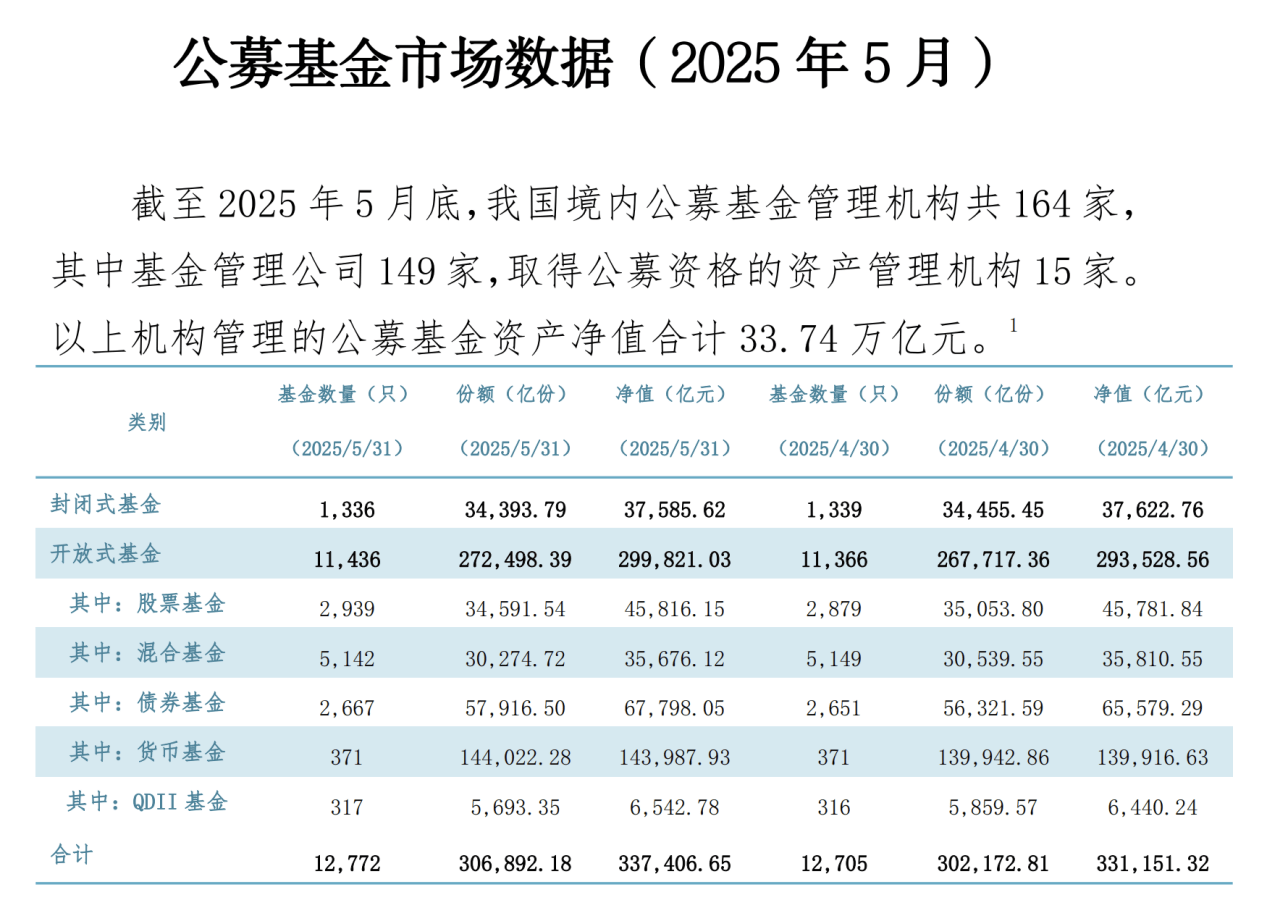
接近34万亿元!公募基金规模再创新高
Sou Hu Cai Jing· 2025-06-27 06:32
Group 1 - The total scale of public funds in China has rebounded to over 33 trillion yuan, reaching historical highs in April and May 2025 after dipping to 31 trillion yuan earlier this year [3] - The growth in the scale of public funds is primarily driven by bond funds and money market funds, which contributed significantly to the overall increase [2] - The People's Bank of China and other regulatory bodies have issued guidelines to support consumption and promote long-term capital market stability, indicating a favorable environment for public funds [3] Group 2 - As of May 31, 2025, the number of closed-end funds is 1,336 with a total share of 34,393.79 million and a net value of 37,585.62 billion yuan [2] - Open-end funds have increased to 11,436 with a total share of 272,498.39 million and a net value of 299,821.03 billion yuan [2] - The number of bond funds has risen to 2,667, with a total share of 57,916.50 million and a net value of 67,798.05 billion yuan, reflecting strong growth in this category [2]
招商基金年内再提第四位副总,险资老将于立勇升任高管
Xin Lang Ji Jin· 2025-06-27 04:25
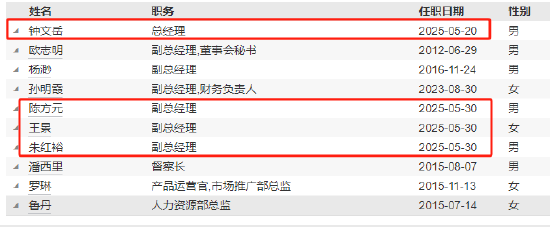
Core Viewpoint - The recent appointment of Yu Liyong as a senior executive at China Merchants Fund marks a significant restructuring of the company's management team, following the recent changes in leadership and the promotion of several key executives [1][5][7]. Management Changes - Yu Liyong is the fourth senior executive promoted this year, following the appointments of Wang Jing, Zhu Hongyu, and Chen Fangyuan on May 30 [1][5]. - The restructuring comes after the departure of former General Manager Xu Yong, who oversaw an increase in the company's management scale from approximately 792.5 billion to 915.2 billion yuan during his tenure [5][7]. - The new General Manager, Zhong Wenyue, has a background of over 30 years in the financial industry and is seen as a stabilizing force for the company [5][7]. Executive Background - Yu Liyong has 21 years of experience in the financial sector, previously working at China Life Asset Management for 18 years before joining China Merchants Fund in March 2022 [1][4]. - His recent promotion is seen as a strategic move to leverage his expertise in asset allocation and pension management, areas where the company has significant operations [4][6]. Strategic Focus - The new management team is expected to focus on three key areas: strengthening research capabilities, diversifying business operations, and enhancing customer experience [7]. - The appointments of the new executives align with these strategic priorities, with a particular emphasis on improving active management capabilities and deepening relationships with institutional clients [7]. Industry Context - The restructuring occurs against the backdrop of a broader industry shift from a focus on scale to a focus on returns, as outlined in the recent "Action Plan for Promoting High-Quality Development of Public Funds" [7].
益民基金再现高管变动 副总经理高喜阳任职7个月离任
Xin Lang Ji Jin· 2025-06-27 03:16
Core Viewpoint - The recent departure of four senior executives from Yimin Fund within a year highlights significant instability in the company's management team, coinciding with a drastic reduction in its asset management scale, which has shrunk by over 61% from the end of 2024 to the first quarter of 2025 [1][9][15]. Group 1: Executive Departures - Yimin Fund announced the resignation of Vice President Gao Xiyang due to personal reasons, marking the fourth senior executive departure in just six months [1][7]. - Gao Xiyang joined Yimin Fund in June 2022 and held the position of Vice President for only six months before his departure [1][4]. - The company has experienced continuous management upheaval since late last year, with the resignation of General Manager Wang Mingde and other key executives [6][7]. Group 2: Asset Management Scale - Yimin Fund's asset management scale plummeted from 2.12 billion yuan at the end of 2024 to 820 million yuan by the first quarter of 2025, a decline exceeding 61% [9]. - As of the first quarter of 2025, Yimin Fund ranked 164th out of 199 public fund companies in terms of scale, placing it at the lower end of the industry [9]. Group 3: Management Challenges - The company is facing severe challenges in business development, exacerbated by a labor dispute related to the enforcement of a salary cap in the financial industry, which has raised concerns about human resource management [11]. - Yimin Fund has struggled to maintain a stable management team, with its asset management scale remaining below 1 billion yuan despite nearly 20 years of operation [12][15]. - The performance of Yimin Fund's products has been inconsistent, with some funds underperforming against their benchmarks [13]. Group 4: Regulatory Environment - In June 2025, the China Securities Regulatory Commission issued a plan to promote high-quality development in public funds, requiring companies to establish a performance evaluation system focused on investment returns, which poses a challenge for Yimin Fund [11][15].
